Reach Compliance for Idler Pulley: Buyer Checklist
For procurement teams, reach compliance for idler pulley sourcing is not a marketing claim. It is a document trail showing that the part and its supplied materials meet REACH (EC) No 1907/2006 obligations for substances of very high concern, restricted substances, and customer disclosure requirements. The real question is whether the supplier can prove compliance at part, batch, and material level before you approve repeat orders. That matters for EU imports, and the same discipline also helps buyers in the UK, US, Canada, Australia, and Brazil manage risk across multi-country supply chains. Driventus is an independent aftermarket manufacturer; brand names are referenced for fitment only. This checklist explains what to verify, which records to request, and how to align compliance checks with drawing control, dimensional inspection, MOQ planning, price breaks, lead-time commitments, and release testing for idler pulley programmes.
Where compliance fails on idler pulleys
Most sourcing mistakes happen after the declaration looks complete. A pulley can be labeled compliant and still miss the mark if the bearing source, coating bath, grease, or polymer insert changes without notice.
Watch for these failure modes:
Blanket declarations that do not identify the exact part number
Material statements that cover the wheel but omit bearing seals, grease, or fasteners
Old candidate-list references that were never refreshed
Supplier substitutions that change chemistry while fitment stays unchanged
Batch records that cannot be linked back to the approved drawing revision
The key point is simple: compliance lives at the revision level. If a supplier swaps from a standard bearing to a custom thin-wall unit, or changes a plating process, the old file may no longer be valid. For buyers, the safest rule is to treat any material, process, plant, or sub-supplier change as a new compliance event until the supplier proves otherwise.
What proof buyers should ask for
Before you release a purchase order, require a file set that ties chemistry, revision, and traceability together. A one-line certificate is not enough.
Document
Why it matters
Minimum buyer check
REACH declaration
Confirms SVHC and restricted substance status
Dated, signed, part-specific
Material list
Shows each material family in the assembly
Matches drawing and BOM
Coating or plating disclosure
Verifies surface treatment chemistry
Names process and finish
Grease or adhesive SDS
Confirms formulation and hazard data
Latest revision only
Change notice process
Flags formulation or source changes
Requires advance notice
CoC / inspection report
Links delivered lot to approved spec
Lot number and revision shown
PPAP or first-article pack
Useful on new programmes or rev changes
Includes dimensional report and sample retention
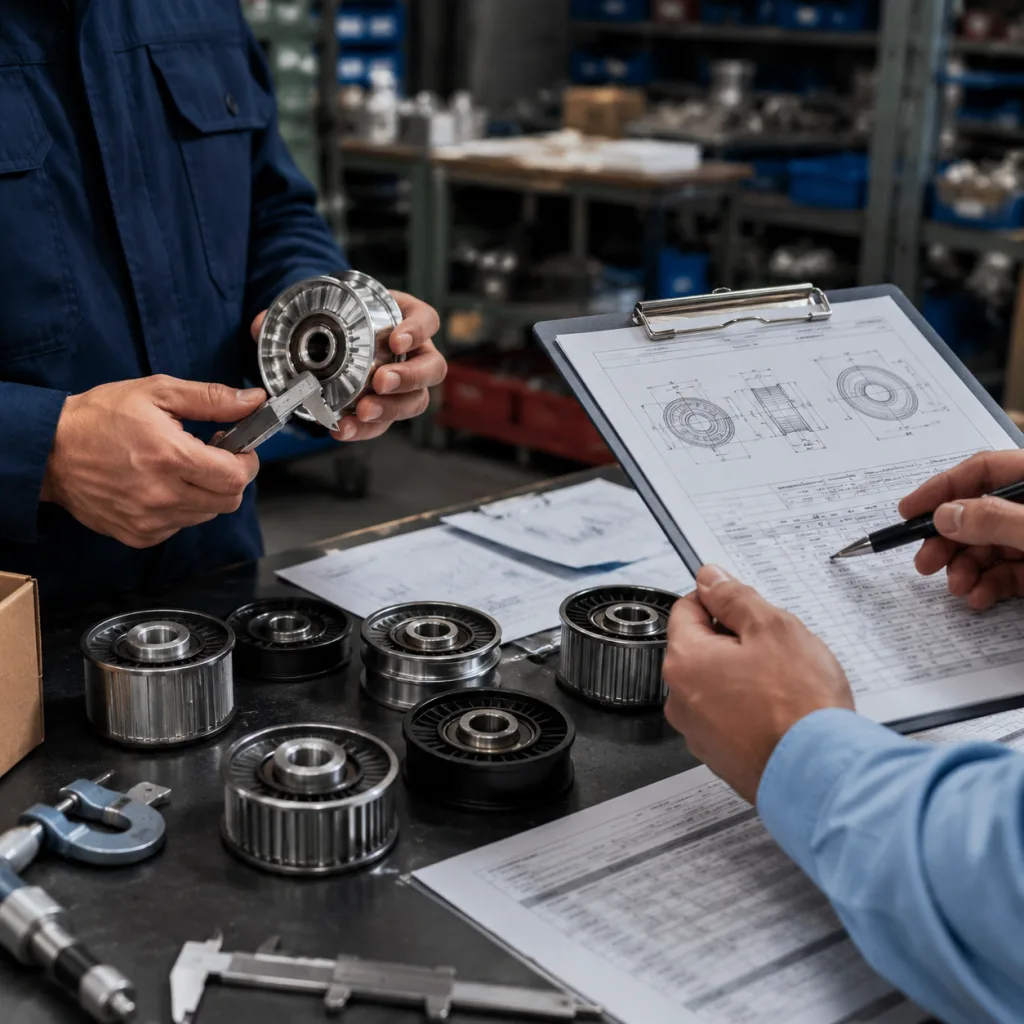
</tr></thead><tbody> </tbody></table>If the supplier cannot separate wheel, bearing, seal, and coating data, ask for a revised package. That is especially important on catalogue cross-reference programmes where the fitment is stable but the internal build may not be. As a buyer rule, do not approve recurring orders until the declaration package matches the approved drawing revision and the same manufacturer, plant, and process route.
Decision tree for qualification
Use a simple sequence when you are deciding whether to approve a new source or revalidate an existing one.
1. Confirm the application, belt path, and load profile. 2. Match envelope dimensions, bore, offset, and face width to the drawing. 3. Request declarations for the wheel, bearing, cage, seals, and coating. 4. Check that the supplier states the exact standard or regulatory basis used. 5. Review whether grease, plating, or polymer parts contain reportable substances. 6. Obtain dimensional inspection results from first article samples. 7. Confirm lot traceability and revision control on every shipment. 8. Lock in a change-notice rule for resin, lubricant, plating, or bearing-source changes. 9. Set MOQ, annual volume, and release-schedule expectations in writing. 10. Require a lead-time commitment by order type: sample, pilot, and mass production.
A practical commercial structure for this part is often a 300 to 500 piece MOQ for standard catalogue builds, with 45 to 60 days for first production after sample sign-off and 25 to 35 days for repeat orders if raw material is already stocked. If the supplier proposes a lower MOQ, confirm whether the unit price includes setup amortization or whether tooling, coating, and packaging are priced separately. For stable programmes, buyers often negotiate tiered pricing such as 500 pcs, 1,000 pcs, and 5,000 pcs breaks, with the largest break priced 8% to 15% below the base tier depending on bearing spec and finish.
Spec checks that expose hidden risk
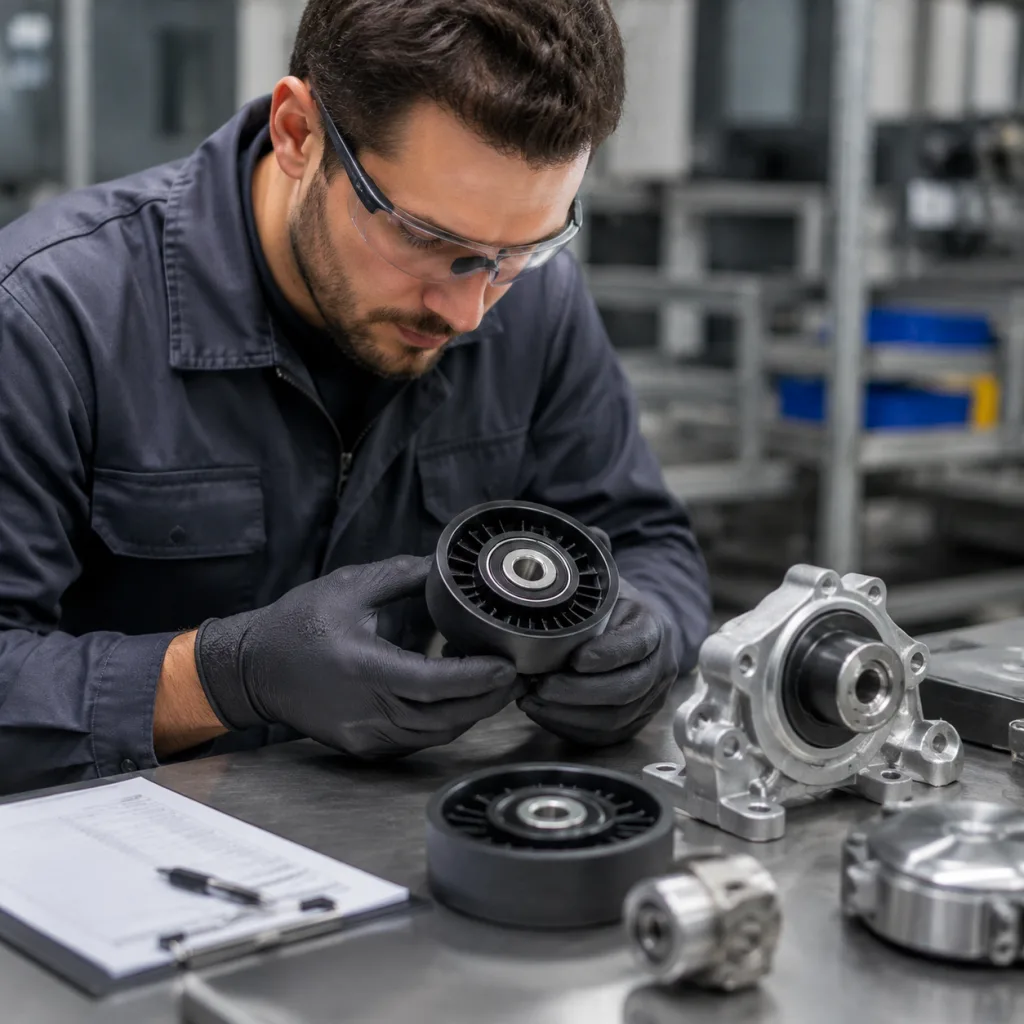
A declaration review is necessary, but it is not enough. Physical inspection often catches the problems paperwork misses.
Key checks:
Radial runout and axial runout against the approved drawing
Bearing noise, drag torque, and seal retention on incoming samples
Surface finish and edge condition on belt-contact areas
Corrosion protection on plated steel or aluminium versions
Label and traceability data on outer cartons and inner packs
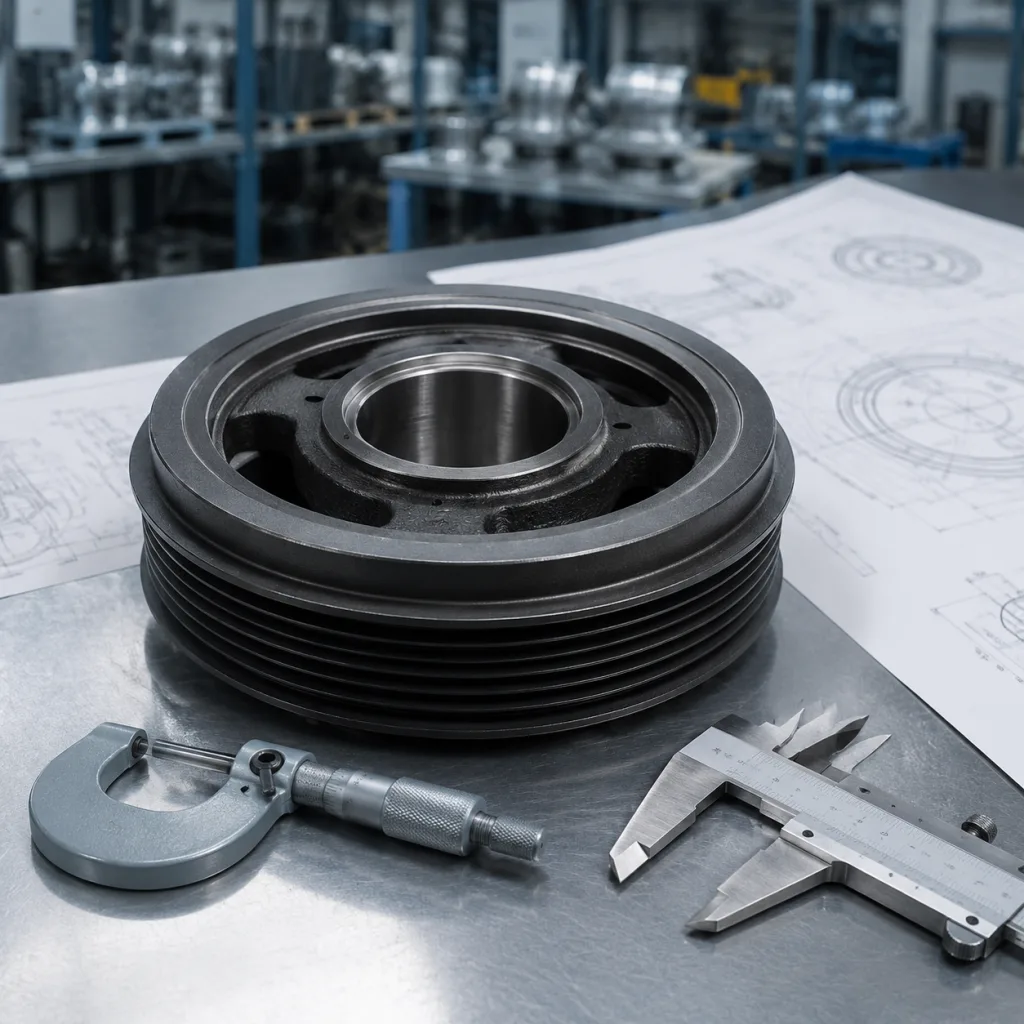
Typical buyer-controlled tolerances for an idler pulley programme should be written on the drawing or inspection sheet, not assumed. As a sourcing baseline, many programmes hold outer diameter to ±0.05 mm to ±0.10 mm, bore diameter to ±0.01 mm to ±0.02 mm depending on bearing class, face width to ±0.10 mm, and axial runout to 0.05 mm max unless the belt system demands tighter control. For bearing checks, ask for drag torque bands, grease fill targets, and seal integrity data on the first article report. For example, a grease fill of 20% to 30% of internal free volume is common for sealed units, but the exact target should match the bearing manufacturer’s specification.
On incoming inspection, ask for AQL terms in the PO or quality agreement, such as AQL 1.0 for critical dimensions and AQL 2.5 for cosmetic attributes, plus a 100% check for thread damage, burrs, and carton traceability. If the pulley includes a coating, specify corrosion targets in hours and method, such as salt-spray or cyclic testing, and state the pass/fail criterion on the purchase specification. Where relevant, align validation with IATF 16949:2016 and ISO 9001:2015 process control, then retain the purchase records, inspection report, and compliance declaration together.
How Driventus supports compliant sourcing
Driventus manufactures engine and powertrain components in Taizhou, Zhejiang, and exports to more than 60 countries. For idler pulley programmes, we support buyers with part-level documentation, revision control, and export-ready packing records.
Use our catalog to review the product family, or visit our quality system page to see how document control is managed under IATF 16949:2016 and ISO 9001:2015. If your programme needs a non-standard bore, offset, coating, or packaging spec, our custom manufacturing process can align the part to your drawing and compliance checklist.
For sourcing decisions, we can also structure the commercial offer by volume band, for example sample lot, pilot run, and annual contract release. In practice, buyers often ask for a 10 to 20 piece sample lot for fitment and document review, a 100 to 300 piece pilot lot for line verification, and a repeat-order price that reflects forecast coverage and shared packaging. Lead time is usually shorter when the drawing, target finish, and packaging spec are approved together at RFQ stage; if the drawing is incomplete, the lead time should be treated as provisional until the first article is signed off.
Driventus is an independent aftermarket manufacturer; brand names are referenced for fitment only. We do not claim OEM approval or endorsement. For controlled sourcing of replacement and catalogue programmes, buyers can also review our engine-component range in our catalog or request a quote once the compliance file is defined.
Frequently asked questions
No. Fitment confirms the pulley matches the vehicle or engine application. REACH compliance confirms the part and its materials meet chemical reporting and restriction obligations.
A part-specific declaration, date, revision, material list, SVHC status, and signed supplier contact details. It should match the exact revision you are buying and identify the plant or process route if those affect coatings, grease, or inserts.
Yes. Compliance and performance are separate checks. Buyers should still verify dimensions, bearing performance, runout, coating quality, traceability, and lot consistency before release.
Ask for separate MOQ, sample, pilot, and production terms. A common starting point is 10 to 20 samples, 100 to 300 pilot pieces, 300 to 500 MOQ for standard catalog builds, 45 to 60 days for first production, and 25 to 35 days for repeat orders if materials are in stock.
If you need a documented, part-specific compliance package for an idler pulley programme, contact Driventus through /contact.html and share your drawing or cross-reference.