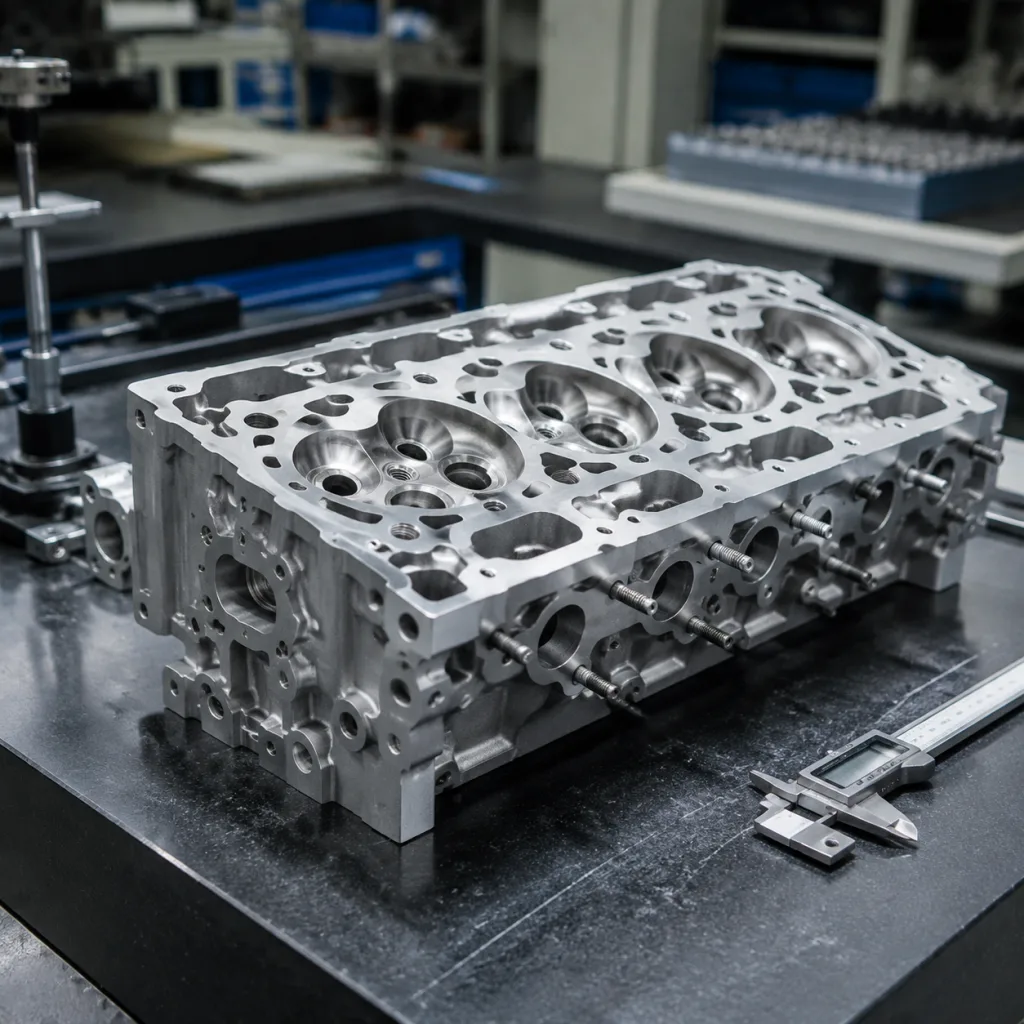
Intake manifold gasket material is a small line item with outsized warranty risk. The wrong compound can relax under clamp load, harden after heat ageing, swell in coolant, or fail to conform to 0.05–0.20 mm flange waviness. The result is familiar: idle complaints, vacuum leaks, coolant loss, comeback repairs, and distributor claims that cost far more than the gasket.
A good material decision starts with the joint, not the catalogue page. Buyers need to know the manifold material, groove design, bolt load, intake temperature, coolant exposure, PCV oil mist, fuel vapour, EGR residue, packaging stress, and expected service life. A dry-air plastic manifold does not need the same construction as a turbocharged mixed-media joint.
This guide is written for B2B sourcing teams comparing OE-equivalent and independent aftermarket intake manifold gaskets. It covers material trade-offs, RFQ fields, dimensional traps, validation logic, supplier checks, and a practical RFQ example. Driventus manufactures intake manifold gaskets and related engine components in Taizhou, Zhejiang, under IATF 16949:2016 and ISO 9001:2015 systems for B2B supply. Driventus is an independent aftermarket manufacturer; brand names are referenced for fitment only.
Decision Framework: Match Material to the Joint, Not the Cheapest Quote
Start with the failure you cannot afford. Is the joint sealing dry intake air, air plus coolant, or air contaminated by EGR condensate and PCV oil mist? Is the manifold plastic, aluminium, or cast metal? Does the groove control compression, or does the gasket depend on bolt load and flange stiffness?
Those answers narrow the intake manifold gasket material quickly. Naturally aspirated air-only joints may operate around 80–120°C. Turbocharged, EGR-adjacent, or compact engine bays can push continuous requirements toward 150–180°C with short peaks near 200°C. Plastic intake manifolds usually have narrow grooves, lower clamp loads, and bead compression targets around 15–30%, depending on profile.
Material family
Best-fit use case
Practical specification range
Buyer risk to check
NBR
Older dry-air or light oil-vapour applications
60–75 Shore A; about -30°C to 100/120°C
Heat ageing and compression set after oil mist exposure
HNBR
Higher-temperature air, oil mist, and EGR residue
65–80 Shore A; about -40°C to 150°C
Compound control, cure state, and cost premium
FKM
High heat and aggressive chemical exposure zones
70–80 Shore A; about -20°C to 200°C
Over-specification on low-risk joints; high unit cost
Silicone rubber
Dry-air plastic manifold grooves
50–70 Shore A; about -50°C to 180/200°C
Oil and fuel resistance in PCV-heavy locations
ACM/AEM
Heat plus oil-vapour exposure
60–75 Shore A; about -30°C to 150/175°C
Coolant compatibility in mixed-media joints
Rubber-coated steel
Thin packages and controlled bead geometry
0.20–0.50 mm carrier plus 15–50 µm coating per side
</tr></thead><tbody> </tbody></table>Use the table as a screening tool, not a final approval. A low-cost NBR gasket can be correct for a low-temperature aftermarket application. The same choice can be expensive if the joint sees hot oil mist and repeated thermal cycling. For buyers comparing parts in our catalog, the stronger question is: which construction controls leakage over time at the required price point? That means comparing temperature range, compression set, chemical compatibility, bead geometry, flange surface compatibility, and clamp-load retention together.
RFQ Spec Deep-Dive: Fields That Stop Quote Drift
Generic RFQs create generic quotes. “Black rubber gasket” is not a specification; it is an invitation for suppliers to quote different compounds, thicknesses, tooling routes, and inspection levels. The RFQ should define the finished gasket, the material family, and the approval route.
Include these fields before asking for final pricing:
Base polymer: NBR, HNBR, FKM, silicone, AEM, fibre composite, or rubber-coated metal; add an ASTM D2000 callout where available.
Hardness: define target and tolerance, such as 70 ± 5 Shore A after 24 h conditioning at 23 ± 2°C.
Thickness: state nominal thickness, tolerance, and measurement pressure; flat gaskets often need ±0.05 mm to ±0.15 mm control depending on construction.
Bead height: define free height, compressed height, measurement section, and maximum variation, such as ±0.05 mm on critical moulded lips.
Compression set: specify temperature, duration, compression percentage, and method; for example ≤30% after 22 h at 125°C and 25% compression for an HNBR screen.
Tensile and elongation: require original and heat-aged retained properties for moulded rubber rings, bonded profiles, and over-moulded carriers.
Fluid exposure: list coolant, oil mist, fuel vapour, ethanol-blended fuel vapour, and EGR condensate where relevant; set limits for volume swell, mass change, hardness shift, and cracking.
Operating temperature: separate continuous and peak limits, such as 150°C continuous and 180°C for 1 h.
Surface compatibility: identify flange material, roughness, flatness, groove depth, and groove width; plastic manifolds often need lower compression force than aluminium flanges.
Traceability: require batch code, cavity number where needed, production date code, barcode, carton label, and inspection-record retention.
Commercial assumptions: give annual volume, MOQ per release, target price level, currency, Incoterms, sample quantity, packaging unit, and requested lead time.
System standards help, but they do not replace the drawing. ISO 9001:2015 covers quality management system requirements. IATF 16949:2016 adds automotive controls for defect prevention, variation reduction, traceability, and change management. REACH (EC) No 1907/2006 matters for EU substance declarations and restricted materials. When there is a dispute, the drawing, control plan, and purchase order should decide the tolerance, test limit, and packaging rule.
Failure Modes Hidden in Bead Height, Flash, and Port Alignment
Many intake manifold gasket failures are not caused by the wrong polymer alone. They come from geometry. A gasket can pass a material test and still leak if the bead is too tall, too short, offset from the port, distorted in storage, or unable to recover after compression.
Inspect the first article against the 2D drawing and the mating part or fixture. Port-edge exposure of only 0.3–0.5 mm can disturb airflow, roll a bead, or open a local leak path.
Feature
Control method
Practical tolerance or limit
Why it matters
Port opening position
Optical inspection or CMM fixture
±0.10–0.25 mm depending on size
Prevents air restriction and edge exposure
Bolt-hole location
Go/no-go gauge or vision system
±0.10–0.20 mm or functional gauge pass
Avoids assembly interference
Overall thickness
Digital thickness gauge under defined pressure
±0.05–0.15 mm
Keeps compression predictable
Moulded bead height
Profile projector or laser scan
±0.05–0.10 mm on critical lips
Controls sealing load and extrusion risk
Flash and burr
Visual standard plus maximum limit
≤0.10–0.20 mm near sealing areas
Protects ports, grooves, and coolant holes
Carrier flatness
Surface plate or dedicated fixture
≤0.20–0.50 mm over length
Supports even clamp load
Coating coverage
Visual, thickness, and adhesion checks
No pinholes on sealing path; 15–50 µm typical
Prevents local leak paths
</tr></thead><tbody> </tbody></table>For elastomeric seals, compression must be high enough to absorb flange waviness but not so high that the bead extrudes, rolls, or takes excessive permanent set. A common design window is 15–25% compression for many moulded beads and 20–35% for some soft profiles. The right value still depends on gasket profile, flange stiffness, fastener spacing, manifold material, groove depth, and torque sequence. If validation uses bolt torque, record the exact torque and order, such as 8–12 N·m in the specified sequence for a small plastic manifold.
Fibre gaskets need recovery and fluid-exposure checks, especially on older cast surfaces. Rubber-coated metal designs depend more on bead height, coating thickness, carrier flatness, and coating adhesion than on bulk compressibility. Ask for a dimensional report on at least 5–10 production-intent pieces, with cavity identification for multi-cavity tools.
Where a buyer supplies OE part-number cross-references, use a generic reference format only when relevant, such as OE 06A… or OE 11251…. Driventus does not claim approval or endorsement by any vehicle manufacturer.
Step-by-Step Validation: Separate Coupon Proof from Finished-Part Proof
Do not approve a new intake manifold gasket material from a coupon test alone. Coupons show compound behaviour. Finished parts show whether the geometry, carrier, coating, tooling, cure process, trimming, and packaging can make a seal under real assembly conditions.
A practical approval route looks like this:
1. Review the drawing, mating flange, media exposure, and temperature target. 2. Select the material family and construction. 3. Confirm prototype or sample fit. 4. Build production-intent tooling. 5. Issue first-article dimensional results. 6. Run material and finished-part validation. 7. Check packaging under storage and transport load. 8. Release production with defined inspection controls.
Useful validation items include:
Hardness check: Shore A or appropriate method by batch; common release tolerance is target ±5 points.
Compression set: heat-aged at the specified temperature, duration, and compression level; screening often uses 22 h or 70 h at 100–150°C.
Heat ageing: track hardness, tensile strength, elongation, dimensions, and visual cracking; buyers often limit hardness shift to ±10 Shore A for screening.
Coolant immersion: measure mass change, volume change, hardness shift, surface condition, and swelling around sealing features after exposure to specified coolant, often 50/50 glycol-water.
Oil or fuel vapour exposure: define the oil grade or fuel blend, especially for PCV and EGR-contaminated systems.
Leak test: use air pressure, vacuum decay, or pressure decay on a representative fixture; example acceptance may be no visible bubbles or decay below a defined limit at 50–200 kPa.
Thermal cycling: cycle under compression, such as -40°C to 150°C for 50–200 cycles, to check recovery and leak risk.
Salt spray or humidity exposure: apply to steel carriers, exposed edges, and coated metal constructions; define edge-corrosion limits.
Packaging ageing: check deformation, bead distortion, and flatness after 7–14 days under the intended carton load.
ASTM D2000 is widely used to classify rubber materials by type and class. ISO 3601 is relevant where the design uses O-ring sections or moulded ring geometry. ISO 37 and ISO 48 are commonly used for rubber tensile and hardness testing. For production control, link every method to a release limit, sample size, and reaction plan.
Driventus applies incoming inspection, compound batch tracking, in-process dimensional checks, and final inspection within its documented quality system. For new programs, PPAP-style documentation can be discussed where customers require control plan, process flow, FMEA, dimensional report, material report, and sample submission.
Supplier Comparison: What to Audit Before Awarding the Program
The approved material is only as reliable as the supplier’s repeatability. Before award, check whether the supplier can hold formulation, geometry, curing, coating, inspection, packaging, and change control across repeat orders. Then connect the commercial review to technical risk. A die-cut fibre gasket is not the same sourcing project as a moulded HNBR multi-port gasket with steel carrier, leak testing, and private-label packaging.
Recommended supplier checks:
Confirm IATF 16949:2016 and ISO 9001:2015 certificate scope, validity, issuing body, and whether the gasket process sits inside the certified scope.
Request material data sheets, compound traceability rules, and REACH (EC) No 1907/2006 declarations where applicable.
Review control plans for hardness, thickness, bead height, visual defects, coating checks, leak testing, and AQL or sampling frequency.
Check whether tooling cavities are identified and traceable to production batches, especially for multi-cavity moulded parts.
Confirm packaging design for flatness retention; ask for stacking height and carton compression limits.
Require written approval before material, process, tooling, or sub-supplier changes.
Verify lab capability for compression set, heat ageing, coolant immersion, dimensional inspection, fixture-based leak testing, and retained sample storage.
Confirm MOQ, price breaks, and lead-time assumptions by construction type, not only by part number.
Aftermarket distributors should add application coverage, cross-reference discipline, barcode labelling, carton strength, mixed-SKU shipment control, and private-label consistency. Existing catalog parts may support lower MOQs per SKU when combined in mixed shipments. Custom moulded parts usually need MOQs that cover compound preparation, mould setup, inspection, and packaging changeover.
As a planning guide, available-tooling samples often take about 2–4 weeks. New moulded tooling may take 4–8 weeks. Special materials, validation, and customer packaging can extend the schedule. For OEM and Tier-1 programs, separate one-time tooling cost, unit price, test cost, packaging cost, and freight terms before comparing suppliers.
Driventus supports intake manifold gasket development through custom manufacturing, including material selection, tooling, sample validation, and bulk production planning. Project discussions can cover MOQ, annual volume bands, private-label packaging, inspection documents, and export documentation for EU, UK, US, Canada, Australia, and Brazil.
Scenario RFQ: A Mixed-Media HNBR Gasket Quote Package
Here is a useful way to make suppliers quote the same scope. Assume the gasket seals intake air and coolant on a compact engine, with oil mist and EGR residue possible. The buyer wants HNBR on steel or an equivalent construction, not a visual substitute.
RFQ field
Example requirement
Part type
Intake manifold gasket for air and coolant sealing
Construction
Moulded HNBR on steel or specified equivalent
Hardness
70 ± 5 Shore A on elastomer sealing bead
Thickness
Drawing nominal with ±0.10 mm tolerance unless otherwise specified
Bead height
CAD-defined; critical bead sections controlled to ±0.05 mm where feasible
Temperature range
-40°C to 150°C continuous; 180°C short peak, or buyer-defined target
Media exposure
Air, 50/50 coolant, oil mist, fuel vapour, and EGR residue as applicable
Fixture pressure-decay or air-under-water method at buyer-defined pressure, e.g. 100 kPa
Quality documents
Certificate of conformity, inspection report, material declaration if required
MOQ and price basis
Quote 1,000 / 3,000 / 10,000 pcs; separate tooling, testing, and packaging costs
Lead time
State sample, tooling, approval, and mass-production lead times separately
Packaging
Flat-pack or protected carton to prevent bending and bead deformation
</tr></thead><tbody> </tbody></table>Add annual volume, shipment destination, Incoterms, label format, sample quantity, and whether samples must come from production tooling. Ask suppliers to identify cost drivers instead of only reducing unit price. Common drivers include polymer family, steel carrier thickness, cavity count, manual deflashing, 100% visual inspection, leak-test cycle time, private-label packaging, and mixed-SKU packing complexity.
For standard and developed engine gasket programs, contact Driventus to request a quote. Fixing the intake manifold gasket material, sealing geometry, validation scope, packaging method, MOQ, and release schedule early makes tooling cost, qualification time, and repeat-order consistency easier to control.
Frequently asked questions
There is no universal default. NBR, HNBR, silicone, FKM, fibre composite, and rubber-coated metal are all used depending on engine temperature, manifold material, media exposure, flange design, and gasket geometry. HNBR is often selected where heat, oil mist, and durability needs exceed basic NBR; silicone is common in dry-air plastic manifold grooves; FKM is usually reserved for higher heat or chemical exposure.
Specify thickness, bead height, port position, bolt-hole position, flash limits, hardness, coating coverage, and carrier flatness where applicable. Practical examples include ±0.05 mm to ±0.15 mm for flat gasket thickness, ±0.05 mm to ±0.10 mm for critical bead height, and ≤0.10 mm to 0.20 mm flash near sealing paths. The drawing and sealing design should set the final requirement.
Yes. Driventus can review drawings, samples, material targets, and annual demand to propose tooling and validation routes. The process can include material selection, prototype sampling, dimensional reports, leak-test planning, packaging definition, MOQ and lead-time review, and batch production under IATF 16949:2016 and ISO 9001:2015 systems.
If you are comparing gasket constructions or preparing an RFQ package, Driventus can review the application, material target, drawing, validation needs, MOQ, price targets, lead time, and volume plan. Send the project details through /contact.html