Valve Guide Symptoms of Failure: B2B Diagnostic Guide
Valve guide wear rarely announces itself with one clean symptom. Blue smoke, oil loss, rough idle or a failed emissions test can point to guides, but the same complaints can come from seals, rings, PCV faults or turbocharger oil leakage. For distributors, repair-chain buyers and engine remanufacturers, the risk is acting too early: ordering replacement stock before the field evidence proves the root cause.
This article treats valve guide symptoms of failure as a sourcing-control problem, not just a workshop diagnosis. It shows which symptoms matter, which checks separate guide wear from lookalike faults, what inspection values should be written into RFQs, and how to prevent repeat warranty claims through material, geometry, finishing and packaging controls. Driventus manufactures engine components, including valve train and cylinder-head related parts, for aftermarket and OEM supply chains. Driventus is an independent aftermarket manufacturer; brand names are referenced for fitment only.
Start With the Complaint: What Each Symptom Can and Cannot Prove
A smoke complaint is useful. It is not proof. Valve guide wear builds slowly, and most reliable cases combine a field symptom with mileage or operating hours, oil grade, oil-consumption rate, exhaust-smoke timing and measured stem-to-guide clearance. That combination gives buyers something they can act on.
Symptom observed in service
What it may mean if guides are involved
Lookalike faults to eliminate first
Buyer action
Blue smoke after 5–10 minutes of idle or after overnight start-up
Oil passes down the valve stem and enters the combustion chamber
Hardened valve stem seals, turbocharger seal leakage, worn piston rings
Request smoke-condition video, cylinder number and seal photos
Oil consumption above fleet baseline, such as 0.5–1.0 L per 1,000 km depending on engine type
Excessive stem-to-guide clearance allows oil migration through the cylinder head
PCV malfunction, bore wear, gasket leakage
Compare against service manual limits and oil-leak inspection results
Uneven idle, low vacuum or intermittent misfire after warm-up
The valve does not centre consistently on the seat
Ask for compression, leak-down and seat contact-width data
Ticking or valve-train noise from one cylinder bank
Rocking valve stem creates impact loading and unstable movement
Lifter wear, cam lobe wear, incorrect lash
Confirm lash setting and inspect stem wear pattern
Failed emissions test with high HC or visible oil smoke
Oil burning and unstable sealing increase hydrocarbon and particulate output
Catalyst ageing, misfire, fuel-control error
Request emissions printout and oil-consumption record
</tr></thead><tbody> </tbody></table>The commercial question comes next. Can the cylinder head be reconditioned, or does the program need standard replacement guides, oversize guides or a finished-bore part? Specify the choice clearly. Unfinished guide bore, semi-finished bore and finished-to-size guide options create different workshop time, scrap risk and unit-cost assumptions. A vague RFQ hides those costs until claims begin.
A Six-Step Diagnostic Route Before You Blame the Guide
Use the same diagnostic sequence across repair partners. It keeps reports comparable and stops normal oil-control faults from being mislabeled as valve guide symptoms of failure.
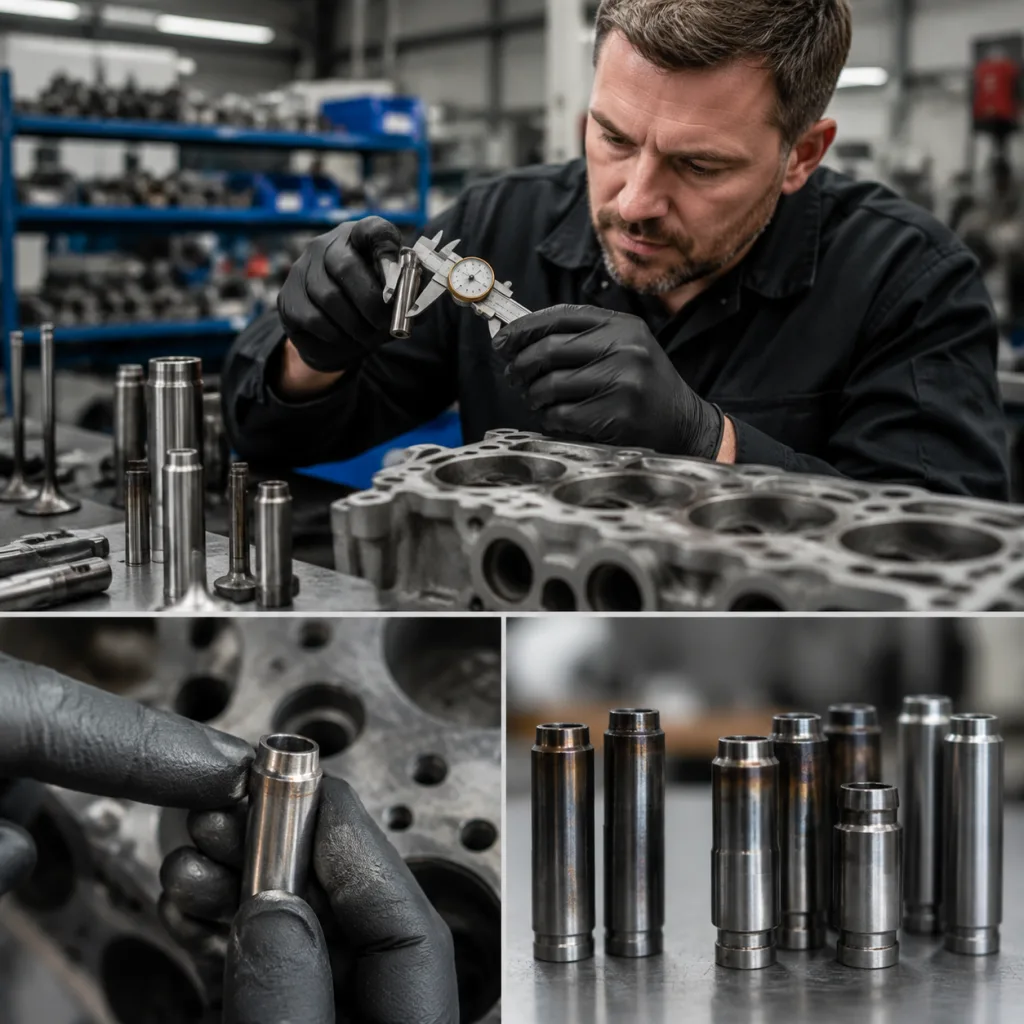
1. Record when the symptom appears. Blue smoke after overnight parking or extended idle often suggests oil draining along the valve stem. Smoke under sustained load, boost or deceleration points more often to ring, bore, turbocharger or crankcase-ventilation issues. Capture mileage, hours, oil grade, oil top-up quantity and hot/cold condition. 2. Check crankcase ventilation. A restricted or malfunctioning PCV circuit can pull oil into the intake and imitate guide wear. Inspect hoses, separators, check valves and intake oil pooling before condemning cylinder-head parts. 3. Run compression and leak-down tests. Worn guides may coexist with poor valve seating, but compression loss alone does not prove guide wear. Many buyers ask for compression variation within 10–15% across cylinders and leak-down percentage by cylinder, then compare the readings with seat-contact evidence. 4. Inspect valve stem seals. Hardened, cracked, swollen or incorrectly fitted seals can produce the same smoke pattern while guide clearance remains acceptable. Confirm seal part number, installed depth, garter spring condition and stem contact marks. 5. Measure stem-to-guide clearance. This is the decision point. Measure valve stem diameter with a micrometer, guide bore with a small-bore gauge or dial bore gauge, and side movement with the valve lifted to the service-manual position. Typical passenger-engine clearances are often around 0.02–0.08 mm for intake and 0.03–0.10 mm for exhaust, but the engine drawing or service limit must control acceptance. 6. Verify guide retention and geometry. A loose, bell-mouthed, cracked or misaligned guide can fail even when one bore reading looks acceptable. Request installed height, OD-to-head interference target and valve-seat concentricity readings after guide replacement.
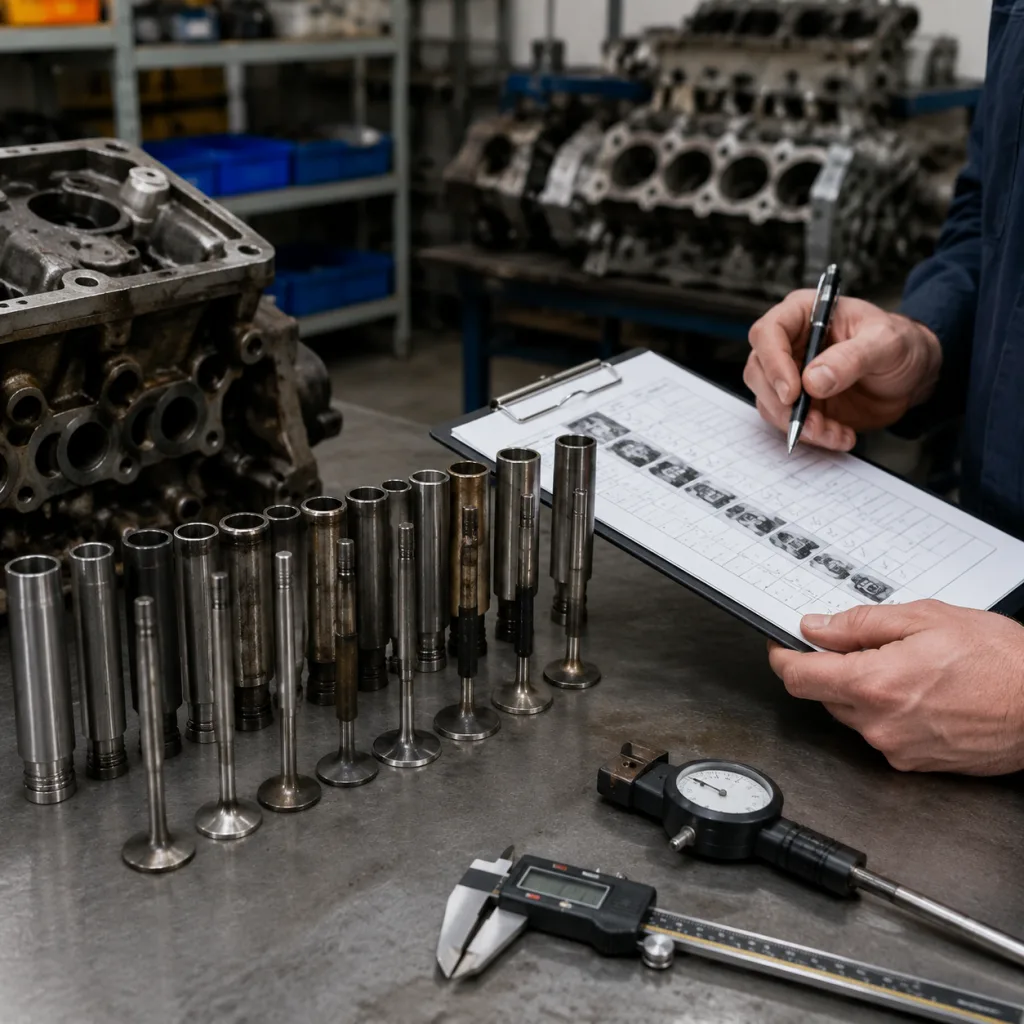
For B2B warranty review, require photographs of carbon deposits, measured clearances, valve stem condition, seal condition, cylinder position and cylinder-head part family. A complete report includes at least three bore readings per guide, top/middle/bottom measurement positions, intake/exhaust identification and instrument resolution. Without those details, the claim is a symptom report, not a root-cause report.
Spec Deep-Dive: The Measurements That Belong in the RFQ
Valve guide acceptance is application-specific. Driventus does not publish one universal clearance value for all engines because guide material, head material, valve stem design, operating temperature and finishing method change the limit. Procurement teams should request drawings, application data or engineering samples for the exact engine family.
Build the RFQ around these inspection points:
Guide material: cast iron, sintered alloy, manganese bronze or application-specific alloy, with grade, hardness range and material certificate where required.
Outer diameter: matched to the cylinder-head bore and required interference fit; many programs define interference in the 0.03–0.08 mm range, while aluminum and cast-iron heads require different limits.
Inner diameter after finishing: controlled for final stem-to-guide oil film, heat transfer and valve stability; state whether the supplier delivers rough bore, semi-finished bore or final honed ID.
Length and installed height: controlled to drawing because 0.2–0.5 mm variation can affect seal location, spring clearance or oil splash exposure on some heads.
Concentricity and cylindricity: guide bore alignment relative to OD and seat machining affects valve sealing; buyers often specify bore-to-OD runout or concentricity limits in the 0.02–0.05 mm range where applicable.
Surface finish: bore finish influences lubrication, oil retention and stem wear; common controlled values may sit around Ra 0.4–1.6 µm depending on material and finishing method.
Chamfer, radius and lead-in geometry: press-in damage, seal fitment and valve-stem assembly depend on both ends, not only overall length.
Heat treatment or impregnation process: relevant for sintered or high-load applications, including oil impregnation, hardness and porosity controls.
Cleanliness and corrosion protection: require clean bore condition, no burrs, no loose chips and packaging that prevents rust during 30–90 days of ocean freight and warehousing.
For first-batch inspection, check 5–10 pieces per lot for OD, length, chamfer and visual defects. Run ID, runout and material verification on a smaller engineering sample or according to the agreed AQL. Higher-risk launches, new tooling or warranty-sensitive applications should use PPAP-style documentation, control plans, gauge R&R evidence and capability data such as Cpk targets of 1.33 or higher for critical dimensions.
Management standards such as IATF 16949:2016 and ISO 9001:2015 support traceability, nonconforming-product control and corrective-action discipline. Material and chemical compliance may also require review against REACH (EC) No 1907/2006 for EU-market programs. Engine emissions regulations such as ECE R-83 can be indirectly affected when oil consumption and valve-sealing faults increase hydrocarbon output, although the regulation is not a valve guide product standard.
Failure Modes Buyers Misread as Supplier Defects
Not every failed guide is a bad guide. Repeat claims can start in the cylinder head, lubrication circuit, installation process or operating environment. Before changing supplier or approving a larger purchase order, separate wear-out, assembly damage, lubrication failure and specification mismatch.
Abrasive or Adhesive Wear
Abrasive wear appears when contaminated oil carries hard particles through the guide bore. Look for vertical scoring, dark abrasive paste, rapid stem wear and similar damage across several cylinders. Adhesive wear or scuffing starts when the stem-to-guide oil film breaks down because of poor lubrication, excessive temperature, insufficient clearance or incompatible material pairing. Evidence can include metal transfer, seizure marks, bluing, heavy local polishing or a valve that sticks when hot.
Incorrect Fit or Reaming
A replacement guide pressed into the head without controlled interference can loosen during service or distort internally. Many guide types also require finishing after installation. If reaming, honing or sizing is skipped or poorly controlled, clearance becomes too tight or too loose. Too tight causes stem seizure, hot sticking or accelerated scuffing. Too loose recreates the original oil-control complaint and can bring back the same valve guide symptoms of failure within a short service interval.
Thermal and Material Mismatch
Exhaust guides run hotter than intake guides and may need different clearance, material or finish assumptions. A guide that holds correctly in a cast-iron head may not retain the same interference in an aluminum head after thermal cycling. Confirm head material, operating temperature, fuel type, valve material, stem coating and whether LPG, CNG, turbocharged or heavy-duty use changes the specification.
Claim review should include the guide, mating valve, seal, head bore condition and installation tool marks. Those parts usually show whether the root cause is component dimension, fitting process or engine operating condition. Packaging belongs in the review too: a low piece price loses value if bores arrive rusty, labels do not trace to a batch, or workshops spend time sorting damaged parts.
Sourcing Decision Matrix for Replacement Programs
When markets report repeat smoke, oil use or valve-train noise, the sourcing response should follow evidence. Driventus can support application review through our catalog, engine-component program planning and custom manufacturing for drawing-based requirements.
Use this matrix before supplier approval:
Sourcing item
What to verify
Why it matters
Practical RFQ detail
Drawing control
OD, ID, length, chamfers, material and finish
Prevents fitment drift across applications
Attach drawing revision, tolerance table and sample approval rules
Process capability
Stable machining and final bore control
Reduces clearance variation
Request Cpk data for OD, ID and length on launch lots
Traceability
Batch, material heat and inspection records
Supports warranty investigation
Require lot code on label and inspection report by batch
Packaging
Corrosion protection and bore damage prevention
Prevents handling-related defects
Specify VCI, oiling, separators or sealed bags for export transit
Quality documentation
IATF 16949:2016 and ISO 9001:2015 systems
Confirms process-control framework
Request current certificates and audit scope
Compliance review
REACH (EC) No 1907/2006 where applicable
Supports EU import requirements
Confirm material declarations and restricted-substance review
Commercial terms
MOQ, price breaks, tooling and lead time
Prevents hidden landed-cost risk
Quote 500, 1,000, 5,000 and 10,000-piece scenarios where relevant
</tr></thead><tbody> </tbody></table>MOQ and price should be judged against application breadth, not only the single-piece quote. A distributor launch may start with 500–1,000 pieces per part number if tooling already exists. Custom drawing-controlled production often needs higher MOQs, dedicated gauges or tooling amortization. For price comparison, split unit price, tooling, inspection documentation, packaging, inland freight, export carton quantity and spare sampling cost. The cheapest quote can become expensive if it creates local rework, mixed packaging, poor labeling or emergency air freight.
Lead time also changes the decision. Existing-tooling samples may move faster than custom parts. New drawings can require engineering review, tool preparation, trial production, inspection reporting and buyer approval before mass production. Buyers commonly approve samples first, then reserve 30–60 days for production depending on quantity and material availability, plus ocean or air transit time. For slow-moving engine families, a 2–3 month stock buffer may be more economical than repeated urgent shipments.
Driventus operates under a documented quality system and supplies engine and powertrain components to distributors, wholesalers, OEM/Tier-1 suppliers and multi-location repair chains in more than 60 countries. The company is based in Taizhou, Zhejiang, China, with manufacturing capability across engine components including pistons, crankshafts, gaskets, water pumps, turbochargers and related parts.
Q&A: When Is Replacement Actually the Right Call?
When does diagnosis justify replacement? Replacement is justified when measured clearance exceeds the engine specification, the guide bore is bell-mouthed, cracked or loose in the cylinder head, or the guide no longer matches the valve stem condition. It may also be selected during cylinder-head remanufacturing when seat machining cannot be held consistently because valve centring is unstable.
What evidence should buyers collect before scaling the order? Ask repair partners for failed guides and mating valves, not just photos. Useful evidence includes oil condition, mileage or operating hours, fuel type, cylinder position, valve stem wear pattern, seal condition, overheating history and whether the head was previously reconditioned. A strong sample pack includes at least 3–5 failed assemblies from different vehicles or engines.
What should the approval flow look like? Confirm symptoms, measure guide and valve, classify cause, install sample replacements, finish the guide bore to specification, recut or verify the valve seat, fit new seals, run the engine, and monitor oil consumption after 500–1,000 km or 20–50 operating hours. If smoke or oil use remains after clearance is corrected, reopen the diagnosis around rings, turbocharger oil control, PCV function or cylinder-head oil drainage.
How should the RFQ be framed? For aftermarket programs, Driventus can review samples, drawings and application lists, then advise whether standard catalog supply or a custom drawing-controlled part is more appropriate. OE part-number cross-references should be treated as fitment references only, not as approval or endorsement by a vehicle manufacturer. Include annual demand estimate, target MOQ, required inspection report, packaging preference, destination market, requested lead time and any warranty-return data related to valve guide symptoms of failure.
Frequently asked questions
The strongest indicators are blue smoke after idle or start-up, unexplained oil consumption, valve-train noise and unstable idle when they are confirmed by excessive measured stem-to-guide clearance. Symptoms alone are not enough because valve stem seals, piston rings, PCV faults and turbochargers can create similar complaints. Buyers should request measured guide bore, valve stem diameter, clearance, cylinder position and oil-consumption rate before treating the guide as the confirmed cause.
Sometimes. The valve stem must be measured for wear, scoring, taper and straightness. If the stem is outside specification or the seating face is damaged, replacing only the guide may not restore oil control or sealing. Workshops should inspect both parts as a matched wear pair and confirm final clearance after the guide is pressed and finished.
Request drawings or specification sheets, material information, tolerance limits, inspection criteria, batch traceability, packaging details and quality certificates such as IATF 16949:2016 and ISO 9001:2015. For EU programs, review material compliance obligations under REACH (EC) No 1907/2006. For custom or high-volume programs, also request sample inspection reports, process capability data, MOQ/price-break quotations and expected lead time for samples and mass production.
If you are reviewing a valve guide program, Driventus can assess drawings, samples, application lists, MOQ targets and inspection requirements before quotation. To discuss standard supply or drawing-controlled production, [request a quote](/contact.html)