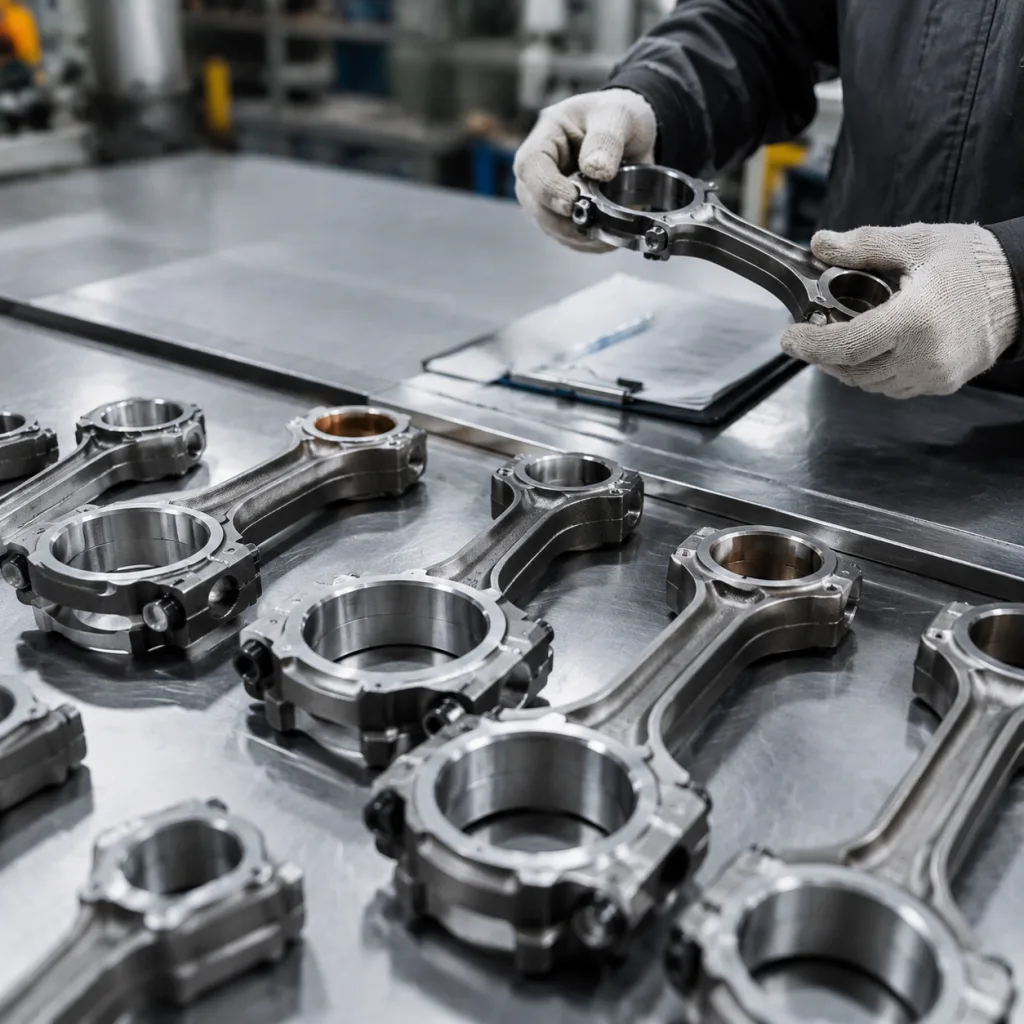
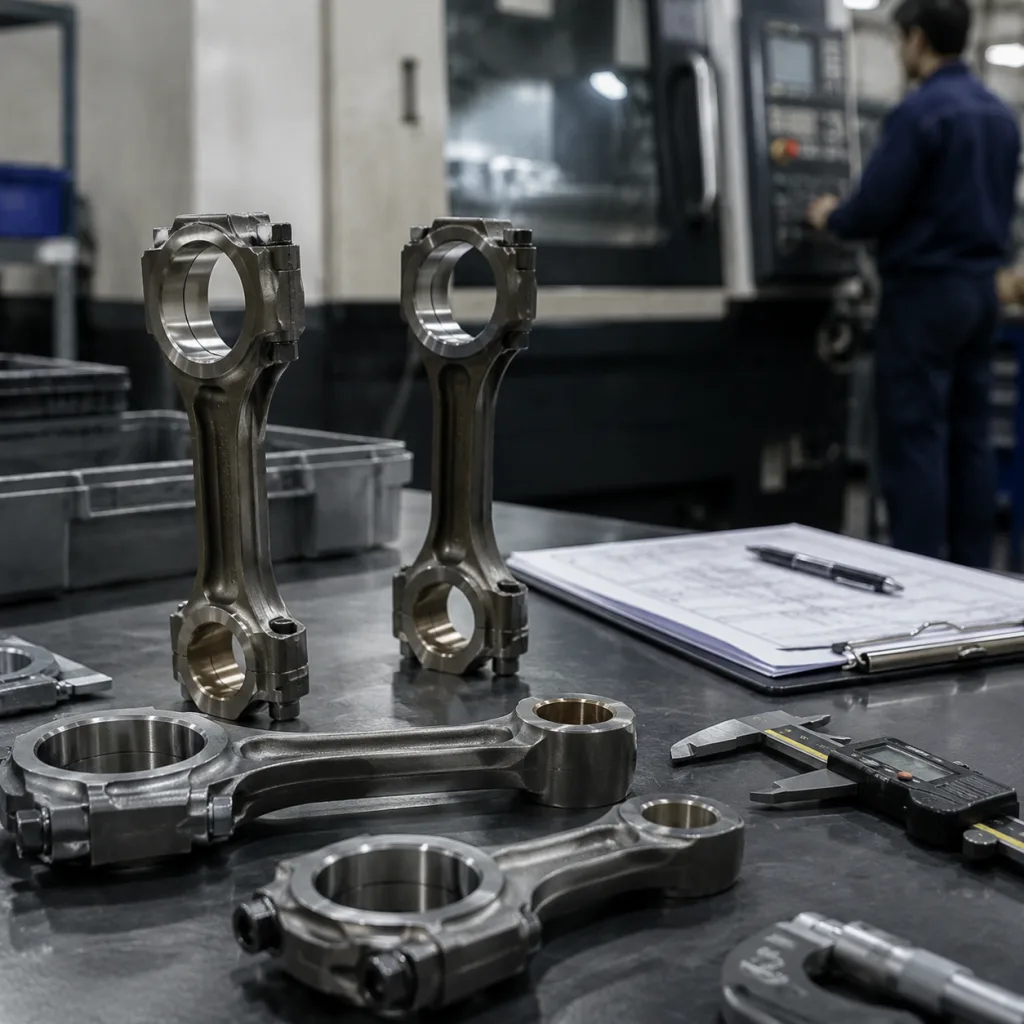
A connecting rod Buick replacement project can look simple on a catalogue screen and become expensive once engines are opened, claims arrive, or fitment variants overlap. The buying decision should start with the engine geometry, not the brand label. A suitable rod must match the target Buick engine family, crank journal, piston pin bore, big-end width, centre-to-centre length, cap design, fastener specification, and weight-balance window. It also needs material traceability, repeatable machining, and inspection records that an incoming quality team can use without interpretation.
Use this as the baseline before releasing volume orders: drawing-controlled dimensions, lot-level material traceability, calibrated inspection data, a defined sample-to-production approval route, and written change control. Driventus manufactures connecting rods and other engine components in Taizhou, Zhejiang for aftermarket distributors, repair-chain programs, and OEM/Tier-1 sourcing projects. Production is managed under IATF 16949:2016 and ISO 9001:2015 systems, with export experience across 60+ countries. Driventus is an independent aftermarket manufacturer; brand names are referenced for fitment only.
Decision Gate: Prove the Rod Geometry Before You Trust the Interchange
The first risk in a connecting rod Buick replacement line is assuming that a catalogue interchange equals production fit. It does not. Two rods can look alike and still differ enough in bore roundness, side clearance, centre distance, or cap alignment to affect bearing crush, piston deck position, oil-film stability, friction, and engine noise.
Start with a controlled fitment file. It should define the engine family, model-year range, fuel type, displacement, aspiration type, and any known variants in crankshaft journal diameter, piston pin diameter, rod width, cap design, or fastener style. If the buyer does not have a released drawing, build the file from evidence: one unworn approved sample, one used field sample for failure-pattern review, bearing shell reference, piston pin reference, bolt marking, and measured crankpin data. When OE part-number cross-references are used, keep them in generic format unless the number is already specified in the sourcing brief, for example OE 06A107065 or OE 11251…. Driventus does not claim approval or endorsement by any vehicle manufacturer.
Treat these dimensions as release gates, not background notes:
Centre-to-centre length: usually controlled within ±0.02 mm to ±0.05 mm unless the customer drawing requires tighter deck-height control.
Big-end bore diameter and roundness: measured after cap assembly and specified bolt torque; many replacement programs target ≤0.008 mm to 0.012 mm roundness on approved production lots.
Small-end bore diameter: checked for piston-pin clearance or bushing press-fit requirements; clearance is commonly specified in the 0.005 mm to 0.020 mm range depending on pin design and lubrication.
Big-end width and side-face parallelism: matched to crankshaft side-clearance requirements; side clearance should be confirmed against the actual crankshaft and bearing stack.
Housing bore surface finish: controlled for bearing seating, with Ra values agreed on the drawing instead of left to supplier default.
Cap alignment and parting-face condition: verified to reduce bore shift after repeated assembly; cap and rod must remain a controlled matched pair.
Weight class: managed for set balance; many rebuild kits require total rod weight within ±2 g to ±5 g per set, with tighter big-end/small-end split control for performance or warranty-sensitive programs.
Material Route Comparison: Standard Replacement vs Higher-Load Rebuild
The best material route is the one that protects the application target. Forged steel, powdered metal, and cast designs can all be valid depending on the original construction, engine load, rebuild channel, and price position. A forged upgrade may suit performance rebuild channels. It can also create problems in a standard replacement program if it changes reciprocating weight, balance strategy, bearing geometry, or service instructions.
Attribute
Standard replacement focus
Higher-load rebuild focus
Primary objective
OE-equivalent geometry and stable cost
Added fatigue margin within fitment limits
Common material route
Steel forging, powdered metal, or equivalent process matched to application
Higher-strength steel forging where required
Typical hardness target
Drawing-controlled, often about 28–36 HRC for common steel routes
Drawing-controlled, often about 32–40 HRC where strength is prioritised
</tr></thead><tbody> </tbody></table>Once the route is chosen, lock the process controls. Typical controls include billet or forging-lot traceability, heat-treatment records, quench/temper curve review where applicable, hardness checks, shot-peening parameters where specified, CNC machining capability studies, cap machining control, and final bore honing. The control plan should state whether the cap is fractured, saw-cut, machined, or dowelled because that decision affects service handling and bore repeatability. If bushings are fitted, specify bushing alloy, interference fit, oil-hole alignment, final bore finish, and 100% visual confirmation after pressing.
Do not treat bolts as accessories. Fastener quality controls cap movement, and cap movement destroys bearing geometry quickly. Procurement documents should define bolt grade or material, thread size and pitch, under-head radius, torque method, lubricant or coating requirements, thread engagement, proof-load requirement, and whether bolts are single-use or reusable according to the repair specification. For sample approval, request torque-preload correlation data rather than only a torque value; the same torque can produce different clamp load if coating, lubricant, or washer face geometry changes.
Driventus can support standard catalogue items as well as custom manufacturing for distributors or Tier-1 buyers that require private drawings, packaging standards, or controlled interchange matrices.
Failure Modes to Catch Before Pilot Release
A replacement rod is not approved because one sample assembles cleanly. It is approved when the supplier proves that later lots will not drift. Drift usually comes from material variation, tool wear, heat-treatment inconsistency, uncontrolled bolt preload, or weak inspection discipline. For connecting rods, the validation plan should combine drawing inspection, material verification, process capability, and functional checks that reflect the intended duty cycle.
Use the approval plan to catch these failures early:
Unknown steel or heat lot: require material certificates by grade, supplier, heat number, chemical composition, and delivery condition.
Hardness scatter: verify chemical composition and hardness on representative lots, with defined test locations and minimum sample quantity.
Bore drift after machining: require 100% or statistically controlled big-end and small-end bore inspection; for new launches, many buyers require 100% critical-bore inspection on the first pilot lot.
Out-of-round housing bore after torque: check roundness, cylindricity, and surface finish after cap bolt torque, using calibrated bore gauges or CMM data tied to equipment ID.
Clamp-load uncertainty: verify torque-and-angle behaviour for cap bolts where applicable, including lubricant condition and reuse policy.
Crack risk in forged rods: use magnetic particle inspection or equivalent crack detection, with defect acceptance criteria agreed before production.
Set imbalance: confirm weight matching within the agreed tolerance, including total mass and big-end/small-end split when required.
Insufficient strength margin: apply fatigue or proof-load testing aligned to the application duty cycle; a common sourcing approach is proof-load screening during development and fatigue testing for higher-risk or higher-load variants.
Hidden assembly conflict: perform trial assembly with bearings, piston pins, crankshaft journals, piston assemblies, and the intended installation torque procedure.
Driventus operates under a documented quality system aligned with IATF 16949:2016 and ISO 9001:2015. For export markets, buyers may also request supplier declarations related to REACH (EC) No 1907/2006 where substances in articles are relevant. Engine internal components are not certified under emissions regulations such as ECE R-83 as standalone replacement items, but dimensional or material changes can indirectly affect engine durability, oil consumption, and emissions performance if the rebuild is not controlled.
Inspection records should be easy for incoming quality teams to audit. Each report should show part number, batch number, cavity or fixture reference where applicable, inspection date, measuring equipment ID, calibration status, nominal dimension, upper and lower tolerance, measured result, sample size, pass/fail judgement, and inspector or approval reference. For PPAP-style launches, buyers can request dimensional layout, material report, process flow, control plan, FMEA-style risk review, capability study on critical dimensions, packaging approval, and signed sample approval.
Step-by-Step Logistics Spec: Protect the Machined Surfaces Until Receiving
Packaging is not separate from quality for replacement connecting rods. A rod can leave the factory within tolerance and arrive unusable if the big-end bore, small-end bushing, machined side face, or fastener threads are damaged in transit. Define corrosion protection, bore protection, unit separation, carton strength, and drop-test expectations before mass production.
Use this supply specification as a practical sequence:
1. Unit packaging: apply anti-rust oil or VCI protection, sealed bag, and bore-protection sleeve where needed; sea-freight programs commonly require 6–12 months corrosion protection under normal warehouse conditions. 2. Set packaging: group matched rods by weight class and identify them clearly; do not mix weight groups in one engine set unless the buyer approves the balance rule. 3. Master carton: use export-grade corrugated cartons with moisture control for sea freight; carton gross weight is usually kept under 15–20 kg for safer manual handling. 4. Palletisation: confirm stable stacking for container loading and warehouse handling, with corner protection, stretch wrap, and pallet labels on at least two sides. 5. Labelling: include distributor part number, application range, batch number, quantity, country of origin, production date or lot code, weight class, and barcode if required. 6. Documentation: prepare commercial invoice, packing list, certificate of origin when requested, inspection report, material traceability summary, and buyer-specific declaration forms.
For EU, UK, US, Canada, Australia, and Brazil buyers, documentation requirements vary by importer, HS classification, customs broker, and sales channel. Connecting rods are often reviewed under engine-parts tariff categories, but the importer of record should confirm the final HS code, duty rate, origin statement, and local labelling rules before shipment. Driventus supports B2B export documentation but does not assign vehicle-manufacturer approval claims to independent aftermarket parts. Brand names should appear only for fitment reference in catalogues, buyer systems, and customer-facing listings.
Multi-location repair chains need kit-level consistency. If rods are supplied with bolts, bushings, bearings, or installation notes, each kit should maintain traceability back to the manufacturing batch to support warranty investigation and field feedback. For mixed-SKU containers, buyers should also define carton numbering, pallet sequence, SKU separation, and ASN or packing-list format to reduce receiving errors.
Supplier Scorecard: Price Only Works After Risk Is Controlled
A connecting rod Buick replacement program should be evaluated on total supply risk, not unit price alone. A low-cost rod with unstable bore geometry can cost more through returns, labour claims, engine failures, stock corrections, and catalogue reputation damage. Score suppliers with technical evidence and commercial terms in the same review.
Evaluation point
What to request
Why it matters
Dimensional capability
Sample inspection report, Cp/Cpk data for critical bores, and production control plan
Confirms repeatable fitment
Material traceability
Mill certificate, heat-treatment record, and batch coding method
Supports warranty investigation
Process validation
PPAP-style documentation where required
Reduces launch risk
Packaging design
Photos, material spec, corrosion-protection method, and drop-test plan
Prevents transit damage
Capacity
Monthly output by part family and bottleneck process
Protects service levels
Lead time
Sample, pilot, mass-production, and repeat-order schedule
Supports stocking plans
Change control
Written notification procedure for material, tooling, process, and subcontractor changes
Prevents unapproved substitutions
</tr></thead><tbody> </tbody></table>A typical aftermarket launch path is sample review, trial order, incoming inspection, controlled field release, then forecast-based replenishment. Plan around 2–4 weeks for drawing or sample review, 4–8 weeks for new sample preparation when tooling or fixture work is needed, 30–45 days for pilot or first production after approval, and 30–60 days for repeat production depending on material availability and order mix. Existing catalogue items can move faster, but buyers should still reserve time for inspection, packaging approval, and catalogue fitment confirmation.
Discuss MOQ and price logic early. Rod cost is sensitive to process route, steel grade, machining time, bolt specification, inspection level, packaging, and annual volume. Existing items may support lower trial quantities such as 50–200 sets. New or modified parts often require higher MOQs because forging, heat treatment, machining fixtures, and inspection setup must be amortised. Price breaks usually become meaningful when orders move from trial quantities to 500, 1,000, or 3,000+ pieces per release, but the exact threshold depends on part weight, process complexity, and whether rods ship individually or as matched engine sets.
OEM and Tier-1 buyers may request a more formal approval package, including control plans, FMEA-style risk review, capability data, and batch-level inspection records. Repair chains often prioritise stable fill rate, kit consistency, fast claim analysis, and clear application separation for counter staff or workshop systems.
A balanced sourcing decision should include landed cost, defect rate, packaging loss, lead-time reliability, documentation quality, communication speed, payment terms, safety-stock policy, and responsiveness during technical review.
Scenario: From Buick Fitment List to Controlled Production
A typical project starts with an importer sending a fitment list and asking for a connecting rod Buick replacement quotation. The useful review begins when that list becomes an engineering brief. Driventus manufactures engine and powertrain components including pistons, crankshafts, gaskets, water pumps, turbochargers, and connecting rods, but feasibility still depends on the target application, sample condition, dimensions, validation level, and commercial route.
The first step is application mapping and dimensional confirmation. The engineering team reviews buyer drawings, samples, interchange requirements, or target specifications before confirming manufacturing feasibility. Support may include catalogue matching, reverse measurement from approved samples, drawing creation, material and process selection, prototype machining, pilot-batch inspection, and production packaging design.
For importers expanding coverage, the main challenge is separating near-identical applications. Bore widths, pin sizes, cap designs, fasteners, or weight classes may differ even when the catalogue description looks close. When the target part is not already in the catalogue, the review should define whether the buyer wants OE-equivalent replacement, reinforced service part, or private-label performance positioning. That choice affects material, validation cost, MOQ, and lead time.
Procurement teams should provide as much of the following as possible: target engine family, application years, sample photos, rod markings, bearing reference, piston pin size, crankpin diameter, centre distance, big-end width, annual volume, first-order quantity, packaging rules, inspection documentation format, and any required private-label or barcode standards. For quote accuracy, state the expected order pattern, for example trial order, quarterly replenishment, annual blanket order, or container consolidation with other engine components. Clear order intent reduces quotation uncertainty and helps prevent approval of a part that fits one engine variant but not another.
For a controlled sourcing review, buyers can request a quote with drawings, samples, or a fitment list.
Frequently asked questions
Verify centre-to-centre length, big-end bore, small-end bore, side width, cap alignment, bolt specification, material, hardness, surface finish, and weight class. Trial assembly with the intended crankshaft, bearing, piston pin, and piston is recommended before production approval. For critical launches, also confirm bore roundness after bolt torque, weight balance by set, and bolt torque-preload correlation.
Yes. Driventus supports custom manufacturing for B2B customers when drawings, samples, or target specifications are provided. Feasibility depends on material, process route, tolerance requirements, validation scope, packaging rules, MOQ, and forecast volume.
No. Driventus is an independent aftermarket manufacturer; brand names are referenced for fitment only. Replacement parts are supplied according to agreed drawings, specifications, inspection plans, and customer requirements.
If you are reviewing a connecting rod Buick replacement project, send the target applications, samples, drawings, inspection requirements, expected order quantity, and target launch date for a technical sourcing review. Start a low-pressure discussion at /contact.html