Valve Cover Gasket Packaging Requirements for Export
A valve cover gasket is easy to underestimate: light weight, low cube, no electronics, no glass. Yet export damage usually starts with small packing errors—one tight bundle flattens a sealing bead, one mixed carton breaks traceability, one weak label forces relabelling at the importer’s warehouse. For buyers, valve cover gasket packaging requirements export should be written into the purchasing specification before production starts, not decided at the packing bench. This article gives sourcing teams a practical way to define unit protection, carton strength, pallet loading, labelling, documentation, and shipment approval without turning the RFQ into a generic checklist. Driventus supplies rubber, cork-rubber, ACM, FKM, NBR, and metal-reinforced valve cover gaskets for aftermarket and OEM service channels, with production controlled under IATF 16949:2016 and ISO 9001:2015. Driventus is an independent aftermarket manufacturer; brand names are referenced for fitment only.
Start With the Failure Mode, Not the Carton
The right export pack depends on how the gasket can fail. A soft molded gasket loose in an oversized carton may twist or rub. A steel-carrier gasket needs edge and profile support. A kit pack with bolt seals can arrive visually clean but commercially unusable if one small component is missing.
Before approving a packing route, tie the packaging specification to the part drawing, purchase order, carton label format, and inspection plan. For mixed export shipments, define how part numbers are separated, counted, photographed, and checked before carton sealing.
For each new reference, record the gasket free-state length, width, bead height, carrier thickness, weight per piece, minimum bend radius, and approved packing orientation. Molded rubber gaskets should not be forced below a bend radius agreed during sample review. Metal-carrier parts should normally be packed flat unless the drawing permits nesting. If a sealing bead still shows a compression mark after 24 hours unpacked, pause mass packing and review the design.
Use these failure modes as the decision framework:
Compression set: sealing beads, corners, or raised profiles are flattened by tight bundles, heavy cartons, or over-stacked pallets.
Distortion: long, U-shaped, or molded-profile gaskets are bent beyond their free-state geometry.
Contamination: dust, oil, cardboard fibres, moisture, loose rubber particles, or mixed elastomer residue reaches the sealing surface.
Traceability loss: barcode, lot number, buyer reference, or carton label cannot be matched to the goods.
Carton failure: export cartons crush, open, or soften because board grade, sealing, humidity resistance, or pallet pattern was under-specified.
Regulatory gap: material declarations, packaging waste obligations, or restricted-substance requirements are missing for the destination market.
For valve cover gaskets in our catalog, Driventus normally confirms packaging during sample approval, so carton design, unit protection, and labels are agreed before the production lot is packed.
Choose the Unit Pack by Channel and Part Geometry
The unit pack is not just a bag. It protects the gasket until a distributor, repair chain, kit assembler, or service counter opens it. It also controls picking accuracy, barcode use, private-label presentation, and small-part completeness.
Use a channel-and-geometry comparison before choosing the pack:
Packaging level
Common format
Best fit
Main risk to control
Bare gasket with separator
PE bag or paper interleaf
Bulk distributor cartons
Abrasion on sealing faces
Individual wholesale pack
Plain or printed bag plus label
Aftermarket distribution
Barcode and fitment label errors
Tray or backing board
Cardboard, molded pulp, or plastic tray
Long rubber gaskets or formed profiles
Bending and bead compression
Kit pack
Gasket plus grommets, seals, washers, or bolt seals
Repair kits and engine sets
Missing small components
Reinforced sleeve
Insert card plus outer bag
Metal-carrier gasket
Edge damage, coating marks, shape change
</tr></thead><tbody> </tbody></table>A usable unit pack specification should state:
Bag material and thickness, usually LDPE or recyclable PE where accepted by the destination market; 40–60 micron is common for individual packs, while 70–100 micron may be needed for sharp carrier edges or kit packs.
Maximum quantity per inner pack or sleeve, such as 1 piece for retail packs, 5–10 pieces for protected wholesale bundles, or a buyer-approved bulk count for flat references.
Whether folding is allowed. For most formed valve cover gaskets, it should be prohibited.
Separator type and placement when pieces are nested, such as 80–120 gsm paper, coated board, or PE sheet between every gasket or every 2–5 pieces depending on surface risk.
Tray, card, or sleeve dimensions for long profiles and metal-reinforced parts, with 5–10 mm clearance around the profile and no pressure on sealing beads.
Desiccant use only where metal inserts, long storage, or high-humidity routes justify it; specify gram count per bag or carton.
Label content, including Driventus item number, buyer item number, quantity, production lot, and country of origin.
Kit packs need a stricter rule: zero missing small parts. Grommets, bolt seals, washers, and related seals should sit in a separate cavity, small bag, or heat-sealed compartment, with weight check or visual count during final inspection.
If the order needs a buyer-specific shape, logo-free pack, private-label artwork, or service-kit configuration, confirm the drawing and packing route through custom manufacturing.
Specify the Export Carton Like a Load-Bearing Part
A carton that looks fine beside the packing line may fail during sea freight stacking, LCL consolidation, cross-docking, courier handling, or humid storage. Treat the carton as a performance item, not a commodity.
The specification should name the board grade, flute type, burst or edge crush performance, gross weight limit, carton dimensions, sealing method, and pallet pattern. Exact values depend on gasket size and quantity, but measurable limits are better than “standard export carton.”
As starting points, buyers often use 5-ply corrugated export cartons for wholesale gasket shipments, double-wall board for heavy mixed cartons or long-distance LCL freight, and a carton gross weight target of 12–18 kg with a hard limit aligned to the importer’s manual-handling policy. If the receiving site uses conveyors, keep carton dimensions inside the facility’s approved range; many warehouses prefer the longest side below 600 mm unless oversized storage is available.
Carton and pallet controls to define:
Keep master carton gross weight within the buyer’s warehouse handling limit, with both target and maximum weight shown on the packing standard.
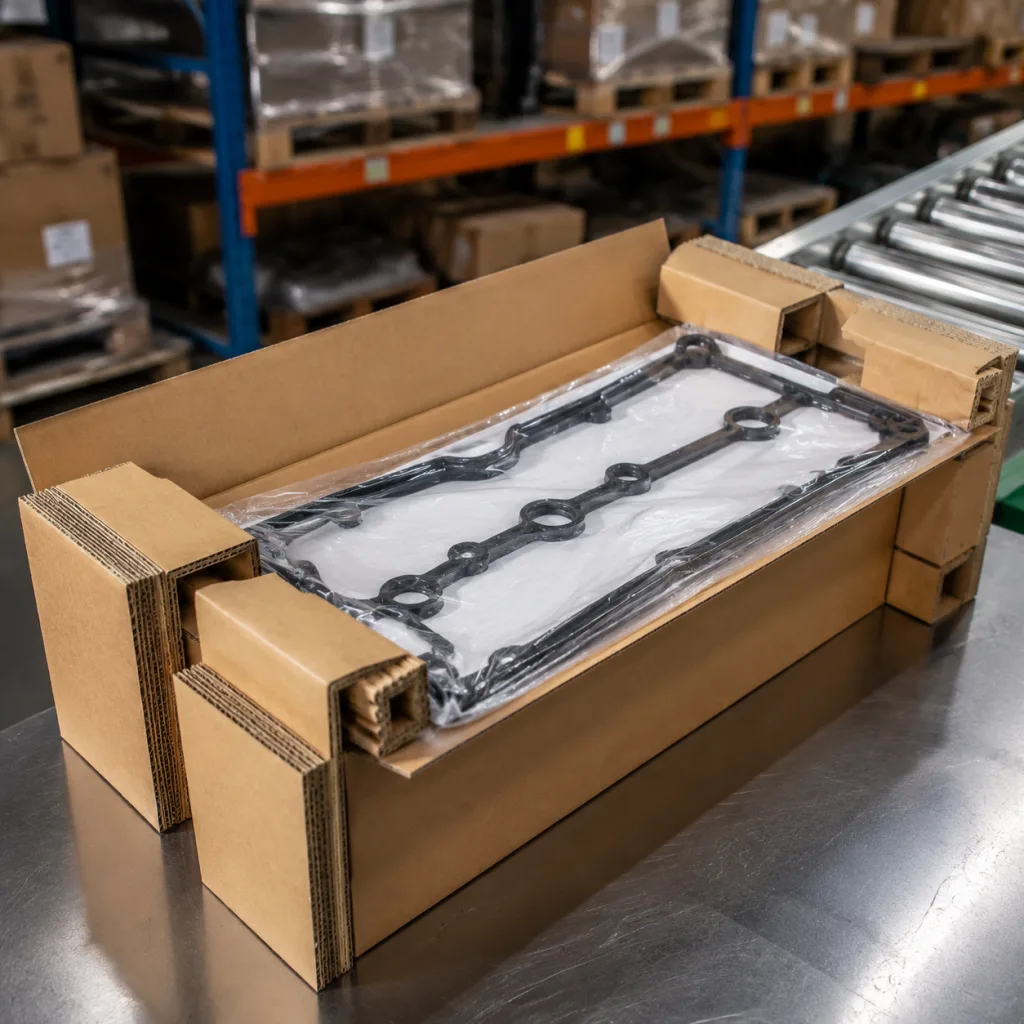
Pack gaskets flat, with no forced bending, twisting, or compression against carton walls.
Use void fill only to stop movement; kraft paper, honeycomb board, PE foam, or air pillows must not create point loading on sealing beads.
Match carton height to pallet stacking so upper layers do not crush lower cartons; define maximum stack height, pallet height, and whether double stacking is allowed.
Seal export cartons with water-resistant tape at least 48–60 mm wide, reinforced tape, staples, or strapping according to the transport lane and buyer policy.
Wrap palletised cartons with stretch film and add corner boards or top protection for LCL, mixed-load, or long-distance truck movements.
Treat and mark solid wood pallets according to ISPM 15 when wood packaging material is used.
Separate heavy automotive parts from gasket cartons when mixed products share a pallet or container.
For pallet loading, common export footprints are 1000 x 1200 mm or 800 x 1200 mm, depending on destination practice. Total pallet height is often held below 1100–1600 mm according to warehouse and container plans. The pallet plan should show cartons per layer, layers per pallet, total cartons, gross pallet weight, and SKU grouping. Mixed-SKU pallets need visible separators or layer sheets plus a pallet-level packing list.
Route matters. For sea freight, check container humidity and decide whether desiccant, liner bags, or stronger carton protection is needed. For air freight, review dimensional weight and carton strength after possible freight-handler repacking. For Brazil, Canada, the UK, EU, Australia, the United States, and other markets, importers should also review local packaging waste, recycling, language, and marking obligations before label artwork is frozen.
Audit Labels as Data, Not Decoration
Many receiving disputes start with a correct gasket and a bad label. If the barcode will not scan, the buyer reference is missing, or carton quantities do not match the packing list, the importer may quarantine the shipment or relabel it at extra cost.
Each packaging level needs a defined data job. Unit packs identify the part and lot. Inner cartons support picking and quantity control. Master cartons and pallets support receiving, customs review, inventory put-away, and claims investigation.
Minimum label fields for export shipments:
Supplier name and address.
Buyer item number and Driventus item number.
Part description, such as valve cover gasket or valve cover gasket kit.
Quantity per bag, inner carton, and master carton.
Production batch or lot number.
Country of origin.
Carton number, for example 1 of 20.
Barcode type and human-readable number, where required.
Gross weight, net weight, and carton dimensions.
Handling marks such as keep dry, do not crush, or this side up where applicable.
Define barcode symbology in the RFQ, not after printing. Common choices include Code 128 for carton labels, EAN-13 or UPC-A for retail unit packs, and buyer-specific GS1 formats where required. Barcodes should be printed at a scannable size, placed on a flat label area, protected from stretch-film distortion, and verified with sample scans from at least two devices before mass printing.
Lock one label format per packaging level and one approved data source. Treat buyer part number, quantity, country of origin, lot number, and barcode readability as zero-defect items. Any mismatch should trigger carton hold, correction, and reinspection. For mixed references, carton numbering should restart by SKU or show a clear sequence, such as SKU A cartons 1–12 and SKU B cartons 1–8.
OE part-number cross-references may be shown only when supplied by the buyer or confirmed for fitment research, using generic formats such as OE 06A107065 where applicable to the sourced family. They must not imply approval, endorsement, supply status, or a commercial relationship with a vehicle manufacturer.
Driventus maintains production and inspection records through its quality system, aligned with IATF 16949:2016 and ISO 9001:2015. Label verification is normally included in final inspection sampling against the purchase order, packing list, and approved artwork.
Run a Packed-Sample Approval Before Release
Do not approve packaging from empty bags, blank cartons, or a pallet diagram alone. Approve the real pack with real gaskets inside. This matters most for a new gasket reference, customer label, carton pattern, pallet plan, or destination with strict receiving rules.
Use this approval sequence:
1. Confirm gasket drawing, material, surface finish, and free-state geometry. 2. Approve the unit pack with the gasket inside. 3. Confirm inner carton and master carton quantities, including weight and dimensions. 4. Check label artwork against the purchase order, barcode data, country-of-origin statement, and import data. 5. Review pallet pattern, total carton count, stacking direction, and container or truck loading plan. 6. Conduct final inspection for quantity, label accuracy, sealing condition, carton integrity, pallet condition, and mixed-reference separation. 7. Retain packing photos, carton labels, pallet photos, and batch records for claims investigation.
Inspection criteria should be measurable. Buyers may use AQL-style sampling for packaging appearance and carton condition, but critical data—part number, quantity, lot number, country of origin, and barcode readability—should be zero-defect. Carton size and gross weight should match the approved packing standard; deviations outside the buyer-agreed tolerance should be held for approval before shipment.
Photo evidence closes many disputes before they start. Capture one unit pack front and back, one open carton showing orientation and separators, one sealed carton with label, one pallet face with carton labels visible, and one container or truck loading view. For high-value or first-lot shipments, buyers may also request a short unpacking video from the approved sample carton.
If transport simulation is required, reference published procedures such as ASTM D4169 or relevant ISTA test procedures in the purchase specification. Driventus does not apply these tests to every order by default; agree them during quotation because they can affect carton design, sample quantity, test cost, and lead time. Allow time for test sample preparation, lab scheduling, corrective repacking, and retesting if the first design fails.
For restricted substances, buyers may request material declarations against REACH (EC) No 1907/2006 or their own restricted-substance list. For gasket production, this is separate from vehicle emissions regulations such as ECE R-83, which apply to vehicle type approval rather than packaging design.
RFQ Questions That Prevent Packaging Assumptions
A strong RFQ forces the supplier to quote the gasket and the packing route together. A weak RFQ says “standard export carton” and leaves too much room for assumptions.
Ask these questions before quotation:
What annual volume, first order quantity, shipment frequency, and order mix should the packaging support?
Which destination country and transport mode apply: sea, air, rail, truck, express, or multimodal?
Is the unit pack bulk, individual bag, kit pack, tray, backing board, sleeve, or buyer artwork?
What are the maximum carton weight and preferred carton dimensions, especially for automated receiving or shelf storage?
Which pallet type, pallet height limit, pallet label format, and ISPM 15 requirement apply?
Which barcode format, label template, language requirement, and human-readable data fields are mandatory?
Which buyer item numbers, fitment references, and OE cross-reference data are supplied by the buyer?
Are material declarations required, including REACH (EC) No 1907/2006 where relevant?
What inspection level applies to packaging, labels, quantity, carton condition, and pallet condition?
Which pre-shipment photos are required: unit pack, open carton, sealed carton, carton label, pallet, and loading view?
Add commercial rules as well as technical rules. For standard Driventus references, state target MOQ by SKU, acceptable carton quantity, and whether mixed-SKU consolidation is allowed. Private-label bags, printed cartons, custom trays, and special barcode labels may require higher MOQ, artwork approval, packaging material procurement, and longer lead time than plain export packing. If launch stock is urgent, separate urgent SKUs from custom-pack SKUs so price and lead time are not averaged into an unrealistic promise.
A practical RFQ table should include target price basis, Incoterms, first order quantity, forecast quantity, requested sample quantity, packaging type, carton quantity, maximum carton weight, pallet limit, required documents, and required ship date. This helps the supplier price tray tooling, printed labels, pallet protection, and inspection work before negotiation closes.
For mixed orders, specify whether references may share one pallet, whether cartons must be grouped by product family, and whether each SKU needs separate carton numbering. This is important for distributors importing valve cover gaskets together with cylinder head gaskets, oil pan gaskets, water pumps, or other engine components. If you are building a broader engine sealing range, our engine components page can help structure the inquiry before you request a quote.
Frequently asked questions
Usually no. Formed rubber and metal-carrier valve cover gaskets should be packed flat or supported in a tray, sleeve, or backing board to avoid bead deformation and geometry change. Any folding permission should be confirmed by drawing review and packed-sample approval.
Common references include IATF 16949:2016 and ISO 9001:2015 for quality management, ISPM 15 for solid wood packaging, REACH (EC) No 1907/2006 for substance declarations, and ASTM D4169 or ISTA procedures where transport testing is specified by the buyer.
Yes. Unit pack, carton quantity, label format, pallet pattern, and inspection photos should be approved during sampling or pre-production. This reduces receiving disputes, relabelling work, mixed-SKU errors, and freight damage claims after the shipment arrives.
If you need export-ready valve cover gasket packaging aligned with your warehouse, labelling, and import process, send your RFQ details and packaging requirements to Driventus. Start here: /contact.html