Turbo Gasket Kit Material: Specs, Options, and Limits
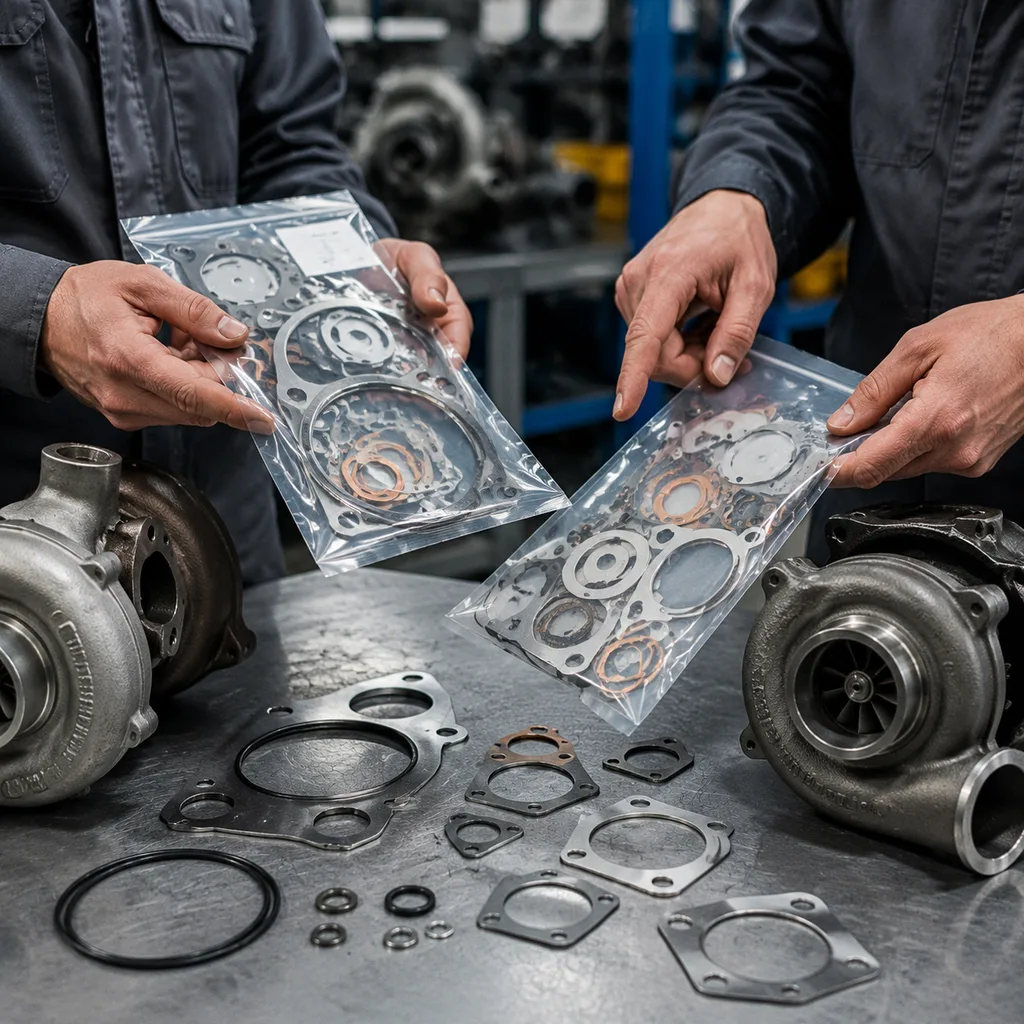
Turbo gasket kit material is not a catalogue afterthought. It determines how a joint handles exhaust heat, flange movement, bolt preload loss, oil mist, coolant vapor, and repeated service cycles. For procurement teams, the right choice depends on where the turbocharger sits, how hot the joint runs, whether the flange is flat enough for steel, and whether the kit is intended for OEM production, service replacement, or export aftermarket supply.
The common material families are graphite composite, multi-layer steel, stainless steel, and high-temperature fibre-based sheet. They do not fail in the same way. Graphite can forgive slight flange distortion but may erode if the edge is exposed to blow-by. MLS holds thickness well but needs controlled clamp load and surface condition. Fibre sheet is economical, yet unsuitable for severe exhaust heat.
Driventus is an independent aftermarket manufacturer; brand names are referenced for fitment only. For repeatable sourcing, define the turbo gasket kit material together with thickness tolerance, surface finish expectation, validation method, lead time, and release checks. The sections below use different buying lenses: decision logic, failure modes, inspection controls, documentation, sourcing economics, and application matching.
Decision framework: shortlist the material before asking for price
Start with the joint, not the gasket. A turbo gasket kit material that works on an oil return joint may be the wrong answer for a turbine outlet. Before comparing quotations, classify each sealing point by temperature, clamp load, flange stiffness, and media exposure. That makes supplier offers easier to judge and prevents a low unit price from hiding a high warranty risk.
Material family
Typical thickness range
Best-fit use
Why buyers choose it
Watch-outs
Graphite composite
1.0-2.5 mm
Exhaust turbine inlet/outlet joints with minor flange irregularity
Conformable, tolerant of thermal cycling, useful recovery where faces are not perfect
Can erode under poor surface finish, blow-by, or excessive gas velocity at the edge
Multi-layer steel (MLS)
0.4-1.2 mm
High-load exhaust and precision flange joints
Stable thickness, repeatable compression behavior, good load retention
Needs good flange flatness, proper bolt preload, and controlled embossing design
Less conformable than graphite; sensitive to flange mismatch
Fibre-reinforced sheet
0.8-2.0 mm
Lower-temperature accessory, oil, or coolant-adjacent joints where validated
Economical, easy to convert, suitable for non-severe locations
Not appropriate for sustained exhaust heat or thermal shock
</tr></thead><tbody> </tbody></table>A practical buying sequence is simple:
1. Identify whether the joint seals exhaust gas, oil, coolant, or mixed exposure. 2. Estimate continuous and peak temperature, not just the nominal engine bay condition. 3. Check flange flatness and bolt pattern stiffness. 4. Choose the material family. 5. Then compare thickness, coating, tolerance, validation data, MOQ, and lead time.
For most exhaust-side turbocharger joints, graphite composite and MLS form the real shortlist. If the flange is slightly aged or service-replacement quality varies, graphite may reduce assembly sensitivity. If the joint is stiff, flat, and tightly torqued, MLS can provide more controlled thickness and repeatability. Price should come after that decision, not before it.
Failure modes: what goes wrong when heat and compression are misread
Turbo gasket kit material rarely fails because someone forgot the word “high temperature” on a drawing. It fails because the test condition did not match the joint. A gasket may survive a static oven exposure and still leak after short heat soak cycles, torque relaxation, and local blow-by. Exhaust-side joints can see sustained temperatures above 650-700°C in local hotspots while the flange expands, cools, and moves.
Common failure modes to screen for:
Crush loss: a graphite gasket with unsuitable density compresses too far and loses effective sealing load.
Low recovery: after thermal cycling, the material does not rebound enough to compensate for bolt load relaxation.
Embossing underperformance: an MLS or stainless design has insufficient embossing height or spring response for the flange condition.
Edge erosion: localized blow-by cuts into graphite or composite material near ports and bolt holes.
Thermal mismatch: the gasket survives peak temperature but not repeated expansion and contraction.
Chemical or contamination damage: oil mist, soot, coolant vapor, coating residue, or road salt changes sealing behavior.
Key data to request from suppliers:
Continuous temperature rating and peak excursion limit, stated separately
Compression set after thermal cycling, ideally after 100-500 cycles depending on the programme
Recovery after clamp load relaxation
Blow-out resistance at flange edges and around bolt holes
Compatibility notes for soot, oil mist, coolant vapor, and salt exposure where relevant
Ask for the test conditions. Clamp load, temperature profile, dwell time, flange finish, torque value, retorque policy, and inspection interval matter. ISO 9001:2015 and IATF 16949:2016 support process discipline, but they do not prove that a specific turbo gasket kit material seals under your joint load. A useful validation report says what passed, how it was tested, and what failure mode was checked.
Inspection deep-dive: tolerances that decide whether the kit actually fits
Material choice does not rescue poor geometry. Thickness, density, hole position, cut quality, formed shape, and surface compatibility all affect first-pass assembly yield. This is especially important when a kit is sold against OE 06A107065 or other OE cross-reference families, where the buyer expects fitment consistency across replenishment lots.
Controls worth putting into the purchase specification:
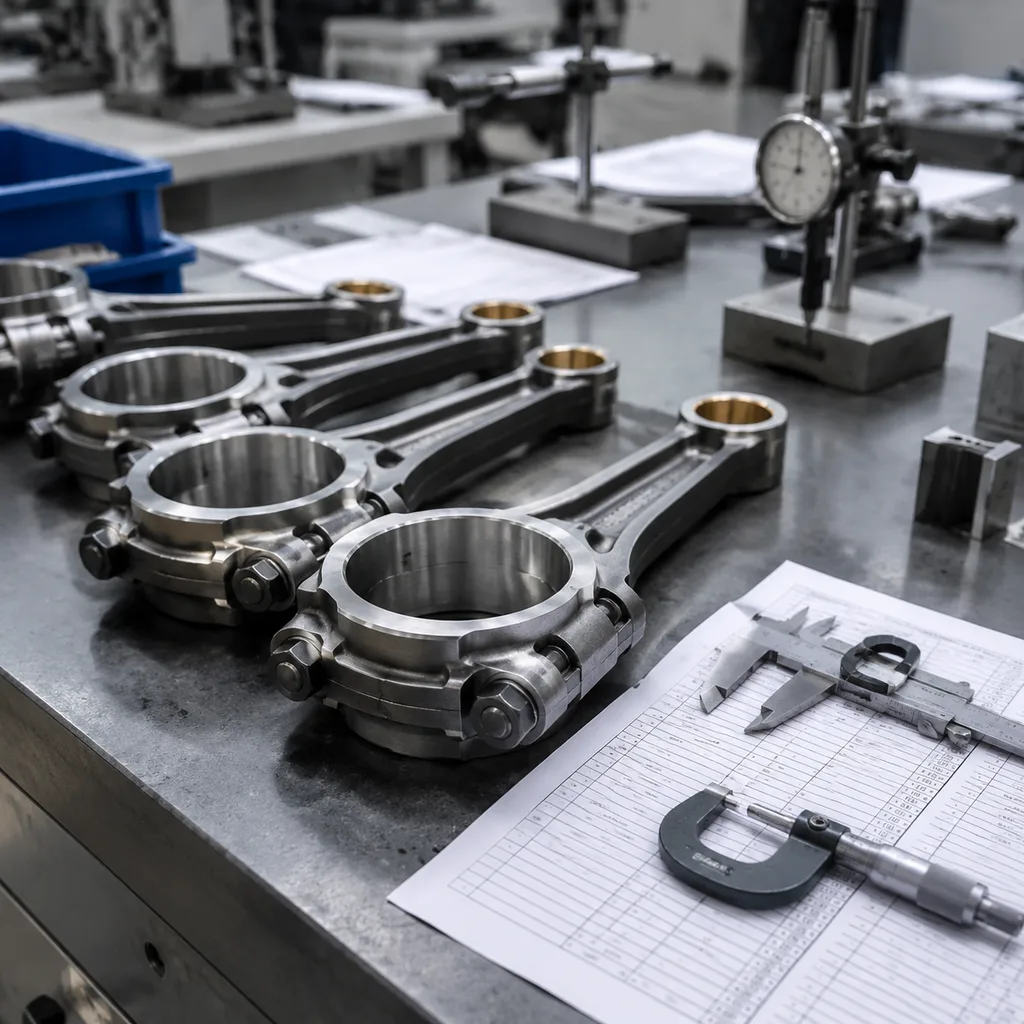
Thickness tolerance: often ±0.10 mm for compressed sealing layers; tighter targets such as ±0.05 mm may be needed where stack height is critical or preload is low.
Profile accuracy: port openings and bolt holes should match the manifold and turbo housing pattern within controlled die tolerance, commonly ±0.15 mm to ±0.25 mm depending on gasket size.
Flatness after forming: a practical target is no more than 0.20 mm warp across the sealing area for small flanges, with stricter controls for high-load MLS joints.
Edge condition: burrs, delamination, fibre pull-out, or damaged coatings can harm adjacent faces and reduce seal quality.
Surface finish compatibility: if the gasket requires a smoother flange, define the roughness expectation; many exhaust joints sit around Ra 1.6-3.2 µm, but the application should confirm the target.
Layer or coating verification: for MLS, stainless, and coated materials, confirm layer stack, embossing orientation, and coating coverage.
Inspect the kit as a system. A premium exhaust gasket does not compensate for a poor washer, miscut oil gasket, or contaminated pack. For production purchases, ask the supplier to define the sampling plan, measurement method, gauge type, and lot release criteria. Accepted samples should represent normal production, not hand-selected demonstration parts.
A strong first article package usually includes measured thickness, port and bolt-hole dimensions, flatness notes, visual edge inspection, and pack-out photos. That is more useful than a broad statement that the turbo gasket kit material is “OE quality.”
Documentation checklist: compliance evidence that prevents export delays
For export programmes, the paperwork is part of the product. A correct gasket with incomplete material evidence can still delay customer approval, distributor intake, or customs-related compliance review. The declaration should cover the whole kit: metal layers, graphite or fibre substrate, coatings, adhesives, anti-stick treatments, washers, labels, and packaging where required.
Driventus recommends asking for this documentation package before volume release:
Material specification with declared composition, grade, and thickness range
Dimensional report or PPAP-style report when required, including sample size and measured values
ISO 9001:2015 or IATF 16949:2016 quality-system evidence
REACH (EC) No 1907/2006 declaration for regulated substances and restricted coating ingredients
Heat-cycle or thermal endurance test summary with temperature, cycle count, torque condition, and failure mode
Packaging specification, especially where contamination control matters for service kits
Change-control statement covering material substitutions, coating changes, die changes, and alternate factories
If the application sits near emissions hardware, review fitment and validation scope against ECE R-83 where relevant to the vehicle programme. ECE R-83 does not define turbo gasket kit material, but emissions-adjacent repairs can affect broader system validation and customer documentation.
Treat vague durability claims carefully. “Heat resistant” is not a test result. “Passed 300 cycles at a defined temperature, torque, flange finish, and leak criterion” is much closer to usable evidence.
Sourcing scenario: comparing two quotes that look cheaper than they are
Consider two supplier offers for the same turbo gasket kit material request. Supplier A quotes a lower unit price, but the material alternates are loosely defined, tooling ownership is unclear, and production lead time excludes packaging approval. Supplier B is slightly higher, but locks the material grade, states sample and production lead times separately, includes dimensional reporting, and requires written approval before substitution. On paper, A wins. In a replenishment programme, B may cost less.
To compare quotes properly, ask for:
Standard material grade and allowable alternates, with written approval before any substitution
MOQ by kit configuration; standard aftermarket runs are often 300-1,000 kits, while custom die-cut patterns may require higher volume
Unit price by tier, such as sample, 500-piece, 1,000-piece, and 5,000-piece brackets
Tooling ownership for custom patterns, including who pays, who stores, who maintains, and who approves changes
Packaging format for distributor, workshop, or OEM use, with carton quantity and inner-pack count defined
Sample lead time and production lead time stated separately; common expectations are 7-14 days for samples and 25-45 days for repeat production depending on tooling and finish
Payment terms, incoterm basis, and inspection responsibility so landed cost is comparable
Whether test samples are included in MOQ or billed separately
Whether the first production lot carries a setup charge that should be amortized into the comparison
For larger programmes, custom manufacturing can lock down material grade, thickness, and pack-out. You can compare related engine and turbo sealing items in our catalog, or review broader engine coverage on the engine components page. The quality system page outlines incoming inspection, process checks, and release approval controls.
A good RFQ does not only ask “how much?” It asks “what exactly changes if the material, die, coating, pack, or factory changes?”
Q-and-A: how Driventus matches material to the application
How does Driventus choose the gasket material? We begin with the service condition: flange type, thermal duty, bolt load, media exposure, and dimensional stack. The material family is selected after those inputs are clear, not treated as a universal kit choice.
Where is graphite composite usually appropriate? Graphite composite is commonly used for high-temperature exhaust sealing where conformity matters. It can absorb minor flange irregularity and thermal movement, provided the surface finish and edge conditions are controlled.
When does MLS make more sense? MLS is a strong choice for stable clamp-load joints with good flange flatness and predictable bolt preload. It offers repeatable thickness control, but it is less forgiving when the joint face is warped or preload is inconsistent.
Why use stainless reinforced designs? Stainless reinforced or embossed designs help where corrosion resistance, shape retention, and repeatable geometry are priorities. They can suit turbo outlet and pipe interfaces, provided flange mismatch is not excessive.
Should fibre-based material be used on exhaust joints? Only where the thermal load is low enough and the application has been validated. Fibre-based sheet can be cost-effective for lower-temperature accessory, oil, or coolant-adjacent joints, but it is not the default answer for severe exhaust exposure.
What can buyers send for review? An existing OE or service sample, drawing, cross-reference, target thickness, flange photos, torque condition, expected temperature, annual volume, and packaging requirement. Driventus can compare the sample, confirm thickness and hole pattern, and support controlled production release.
Driventus is an independent aftermarket manufacturer; brand names are referenced for fitment only. Buyers can request pricing, sample sets, material declarations, or a lot-traceable first article package through request a quote.
Frequently asked questions
There is no single best choice. Graphite composite is common for conformable exhaust sealing, while MLS is better where thickness stability and clamp retention matter. The correct option depends on temperature, flange condition, joint load, and the target compression range for the application.
No. Turbocharger systems may include exhaust, oil, and coolant joints with different thermal and chemical demands. A kit should match each sealing point rather than using one material across every part, and the same material may need different thicknesses or coatings at different locations.
Ask for the material specification, dimensional report, REACH declaration, quality-system evidence such as ISO 9001:2015 or IATF 16949:2016, and the quoted MOQ and lead time. For custom programmes, ask for validation test results, lot size, and pack-out details so price and delivery can be compared on equal terms.
If you need a material review, dimensional check, MOQ/price comparison, or private-label supply discussion, contact Driventus for a controlled quotation and sample plan at /contact.html.