timing belt · 2026-06-12

Timing Belt Replacement: B2B Quality Criteria

Timing belt replacement is a high-volume service category where procurement risk often sits in details that are easy to miss: tooth profile, cord construction, rubber compound, dimensional stability and kit completeness. A belt that is slightly off in pitch, runs hot, tracks poorly or loses teeth can create warranty exposure across a distributor network or multi-location repair chain. For B2B buyers, the purchasing decision should be based on OE-equivalent geometry, controlled production processes and documented validation—not unit price alone. This article sets out practical criteria for specifying replacement timing belts and timing belt kits for aftermarket distribution, OEM service programmes and fleet repair channels. It covers dimensional matching, material selection, validation testing, packaging control and supplier qualification. Driventus is an independent aftermarket manufacturer; brand names are referenced for fitment only.

Replacement intent: match the OE system, not only the belt

A timing belt works inside a synchronised drive system. The replacement part must operate correctly with the crankshaft sprocket, camshaft sprocket, tensioner, idlers and water pump where applicable. For procurement teams, the specification should begin with the complete engine application rather than a visual belt sample.

For aftermarket ranges, buyers normally define coverage by engine family, model year and OE part-number cross-reference where available. If a reference such as OE 06A… or OE 11251… appears in buyer data, it should be treated only as a fitment identifier, not as a claim of vehicle manufacturer approval. Driventus is an independent aftermarket manufacturer; brand names are referenced for fitment only.

Key replacement requirements include:

  • Tooth pitch and profile: trapezoidal, curvilinear or modified curvilinear profiles must match the mating sprockets.
  • Effective length: controlled length helps prevent incorrect tensioner position or phase error.
  • Belt width: the working width must suit pulley face width and flange clearance.
  • Cord tensile stability: low elongation is needed under thermal cycling and high RPM.
  • Backside rubber wear resistance: important where idlers run on the belt back.
  • Kit consistency: tensioner, idler and water pump interfaces must match the same engine application.

Driventus supports belt-only and kit-based sourcing through our catalog, including engine component programmes for distributors that want consolidated part families.

Dimensional and material criteria for OE-equivalent fit

A common sourcing mistake is assuming that two belts with similar length and tooth count are interchangeable. In practice, tooth geometry, pitch accuracy and cord behaviour determine whether the belt tracks correctly and holds valve timing through the service interval.

</tr></thead><tbody> </tbody></table>Materials should be selected for the engine environment rather than copied generically across the range. HNBR is widely used in higher-temperature applications because it provides stronger heat and ageing resistance than conventional chloroprene rubber. Glass fibre cords remain common where dimensional stability is the main requirement, while aramid reinforcement may be specified for selected heavy-duty or high-load applications. The buyer’s technical file should identify compound type, cord construction, tooth fabric and backside finish.

For timing belt replacement programmes, dimensional inspection should cover belt length, width, tooth height, pitch accuracy, edge quality and visible defects. Measurement equipment should be calibrated under an ISO 9001:2015 quality management framework. For automotive production controls, supplier systems should align with IATF 16949:2016, including traceability, control plans and corrective action processes.

Validation testing for replacement belts and kits

A replacement belt programme should be validated before range launch and monitored during production. Testing should not stop at belt tensile strength. A more reliable approach combines material testing, dimensional audits and dynamic running evaluation.

Criterion Procurement check Typical risk if uncontrolled
Tooth countConfirm against application data and sample measurementIncorrect cam timing or no-fit condition
PitchVerify pitch consistency across the full belt circumferenceNoise, heat build-up, accelerated wear
Belt widthMeasure working width and edge finishTracking instability or pulley interference
Tooth profileMatch sprocket form, not only tooth countTooth jump under load or poor meshing
Tensile cordConfirm glass fibre, aramid or specified equivalentStretch, timing drift, premature failure
Rubber compoundCheck heat, oil mist and ozone resistanceCracking, swelling or tooth separation

</tr></thead><tbody> </tbody></table>Procurement teams should ask how validation is linked to production control. A capable supplier will maintain inspection plans for incoming rubber, cord and fabric; in-process belt forming and curing; final tooth and edge inspection; and lot traceability. If a kit includes a water pump, gasket or fasteners, each item should have its own inspection record.

Driventus manufactures engine and powertrain components in Taizhou, Zhejiang, under IATF 16949:2016 and ISO 9001:2015 certified systems. The same quality system approach applies to belt kit components that require dimensional matching, assembly verification and export documentation.

Kit configuration for distributors and repair chains

Many buyers source timing belts as kits because installer risk increases when an old tensioner, idler or water pump remains in service. A kit can reduce warranty disputes by defining the correct component set for each engine application. It also adds sourcing complexity: every component must be verified, not only the belt.

Common timing belt kit configurations include:

  • Belt-only SKU: suitable for markets where workshops prefer separate component selection.
  • Belt + tensioner kit: common for cost-sensitive aftermarket channels.
  • Belt + tensioner + idler kit: appropriate where idler wear is a known failure factor.
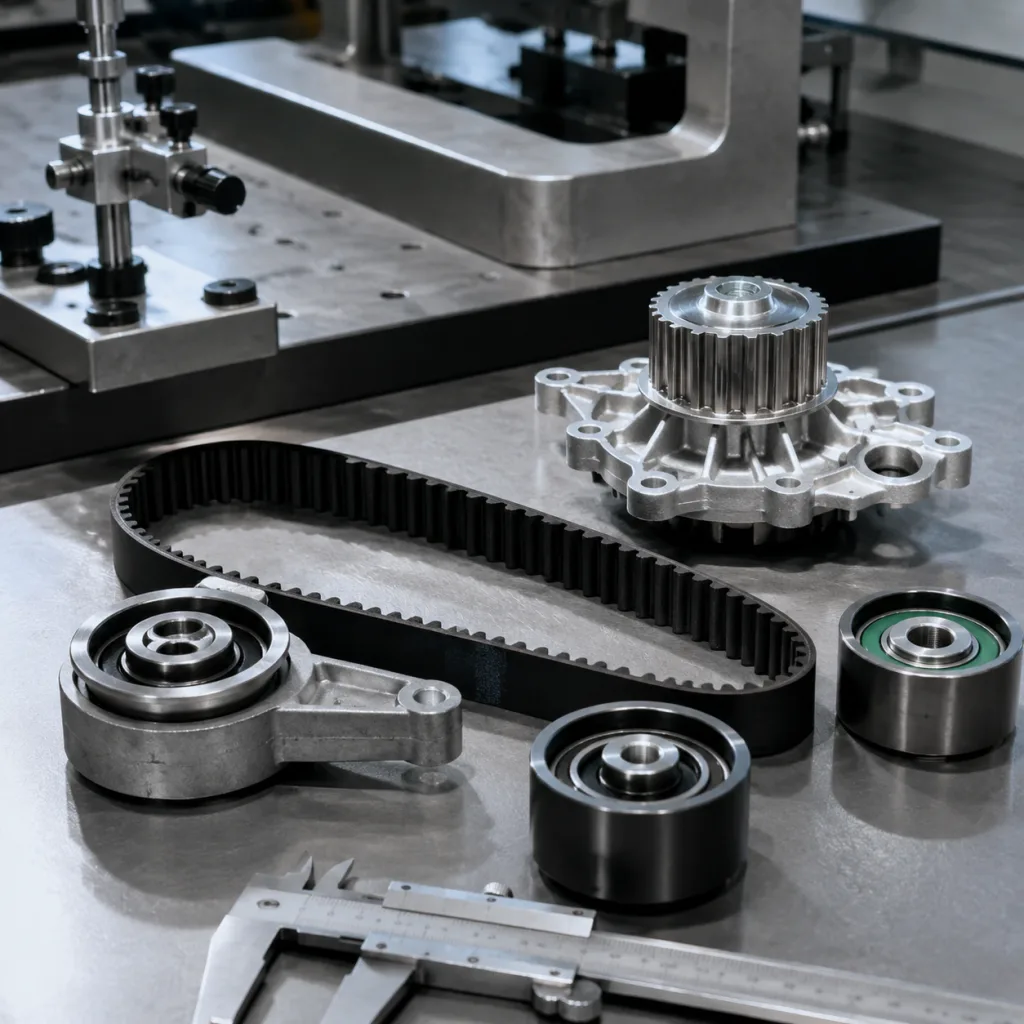
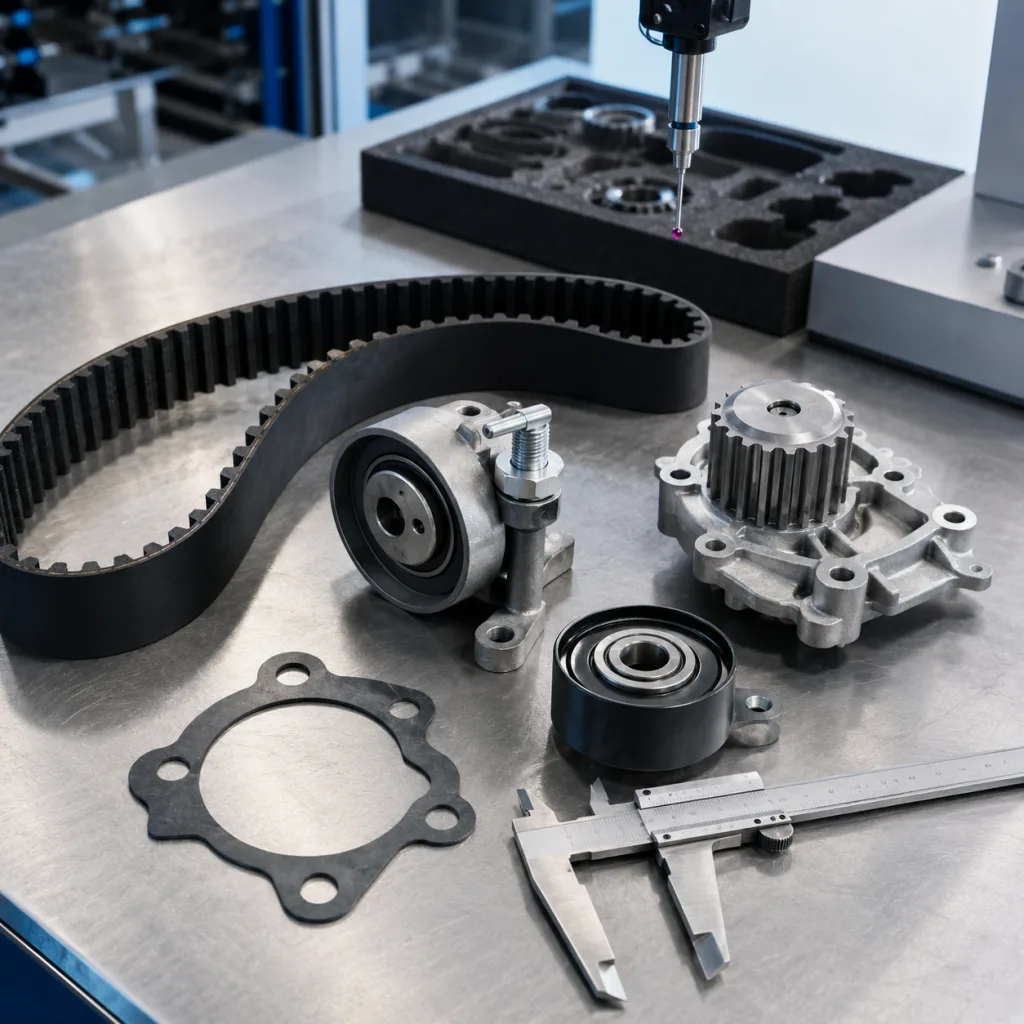
  • Full timing kit with water pump: useful when the pump is belt-driven or replacement access overlaps.
  • Fleet service kit: may include seals, gasket, fasteners and application-specific installation notes.

Packaging should support warehouse handling and workshop use. For distributors, the carton should show application range, internal part number, barcode, batch code and country of origin. For repair chains, clear kit contents reduce bay delays and returns. Export markets may also require material compliance declarations, including REACH (EC) No 1907/2006 where applicable for substances in articles.

A practical procurement control is to freeze the bill of materials by SKU. If a tensioner bearing, pump casting or gasket material changes, the supplier should notify the buyer and provide updated validation where needed.

Supplier qualification and sourcing questions

For a high-volume timing belt replacement line, supplier qualification should combine commercial and technical checks. Unit cost matters, but warranty exposure, claim handling and stock accuracy often have a larger financial impact.

Use the following sourcing checklist during supplier review:

  • Does the supplier operate under IATF 16949:2016 and ISO 9001:2015?
  • Can it provide belt drawings or controlled specifications for tooth profile, pitch and width?
  • Are incoming materials traceable by compound batch, cord batch and production lot?
  • What dynamic running tests are used for new belt families?
  • Can kits be packed under the buyer’s brand, neutral brand or Driventus part number?
  • Are labels, barcodes and carton formats compatible with the buyer’s warehouse system?
  • What is the process for PPAP-style documentation where OEM or Tier-1 customers require it?
  • How are field claims analysed and linked back to production batches?

Driventus supports aftermarket distributors, OEM/Tier-1 buyers and multi-location repair chains with catalogue supply and custom manufacturing. Programmes can include dimensional benchmarking, application mapping, private-label packaging and export documentation for EU, UK, US, Canada, Australia and Brazil channels.

Buyers should also define acceptable service levels: forecast horizon, MOQ by SKU family, mixed-container policy, spare carton availability and lead time after artwork approval. These points reduce friction after the first order and make supplier performance easier to measure.

Procurement specification template

A clear specification reduces sampling cycles and prevents mismatched offers. The template below can be adapted for RFQ files, supplier audits and annual range reviews.

Test area What it verifies Buyer evidence to request
Tensile strength and elongationCord stability under loadBatch test report or periodic validation record
Tooth shear resistanceResistance to tooth separationInternal validation data by belt family
Heat ageingCompound stability at elevated temperatureAgeing test summary and pass criteria
Oil and coolant exposureResistance to incidental contaminationMaterial compatibility data
Dynamic rig runningNoise, tracking and wear under cyclic loadTest duration, load and inspection findings
Kit assembly auditCorrect tensioner, idler and pump pairingPacking list, application table and final inspection record

</tr></thead><tbody> </tbody></table>For long-term demand, buyers often need both broad coverage and SKU discipline. Avoid launching marginal applications with low data confidence. It is better to validate coverage in phases, beginning with high-volume engine families and adding long-tail references after sample confirmation. When timing belt replacement parts are specified this way, distributors gain a range that is easier to sell, easier to stock and easier to defend during warranty review.

Frequently asked questions

Verify tooth count, pitch, tooth profile, belt width, effective length, cord material, rubber compound and application cross-reference. For kits, also confirm that the tensioner, idler, water pump and gasket match the same engine application. Request inspection records and validation data rather than relying only on samples.

IATF 16949:2016 and ISO 9001:2015 are relevant for automotive quality management, traceability and process control. REACH (EC) No 1907/2006 may apply to material compliance for articles sold into the EU. Buyers should request current certificates and declarations where applicable.

Yes. Driventus can support catalogue supply, private-label packaging and application-specific kit development for distributors, repair chains and OEM/Tier-1 programmes. Brand names are referenced for fitment only; Driventus is an independent aftermarket manufacturer.

For application mapping, samples, packaging review or timing belt kit sourcing, contact Driventus to [request a quote](/contact.html).

Request a Quote
Specification field Recommended content
Application dataEngine code, production years, market region and cross-reference format
Belt geometryTooth count, pitch, profile, width and effective length
MaterialsRubber compound, tensile cord, tooth fabric and backside finish
Kit contentBelt, tensioner, idler, water pump, gasket, seals and fasteners as required
Quality documentsIATF 16949:2016 certificate, ISO 9001:2015 certificate, control plan and inspection report
ComplianceREACH (EC) No 1907/2006 declaration where applicable
PackagingBrand format, label layout, barcode, batch code and carton strength
ValidationTensile, tooth shear, ageing and dynamic running evidence
LogisticsMOQ, lead time, incoterms, pallet format and claim process