timing belt · 2026-06-12

Replace Timing Belt: B2B Buying Guide

Timing belt replacement is a scheduled maintenance category where a low-cost part can create a high-cost engine failure. For distributors, repair chains, fleet service networks, and import managers, the buying decision goes far beyond belt price. It includes tooth geometry, tensile cord material, rubber compound, pulley alignment, bearing quality, kit completeness, packaging traceability, and supplier support when vehicle applications change. A belt can look correct and still cause noise, early tooth wear, tracking problems, or camshaft timing deviation if dimensional control is weak. This guide explains what B2B buyers should verify before placing volume orders for timing belts and complete belt kits. It focuses on OE-equivalent aftermarket supply, validation evidence, inspection points, and commercial controls suitable for EU, UK, North American, Australian, and Brazilian procurement teams. Driventus is an independent aftermarket manufacturer; brand names are referenced for fitment only.

Buyer Priorities When Planning Timing Belt Replacement Coverage

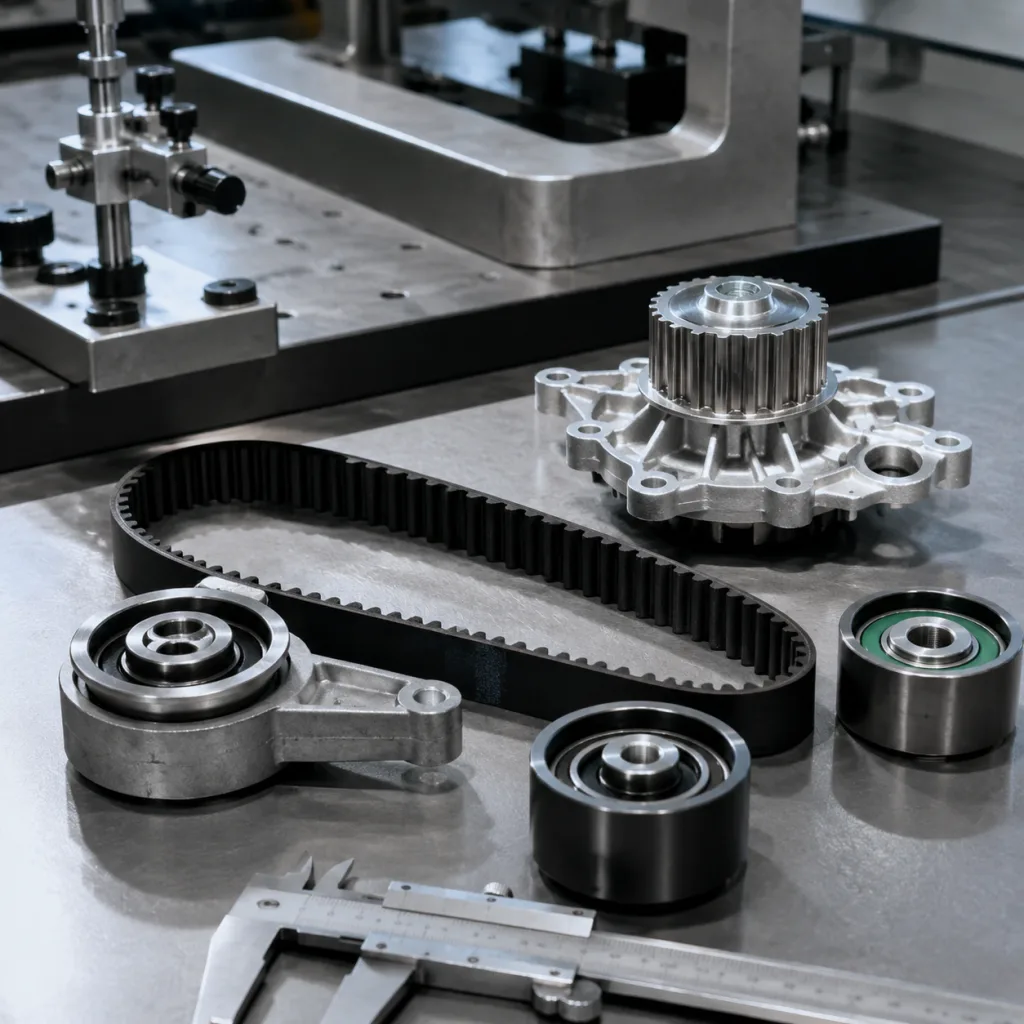
A timing belt synchronises the crankshaft and camshaft, so replacement coverage must be treated as an engine-critical programme rather than a simple rubber belt purchase. Procurement teams usually source the category as a single belt, a belt-and-tensioner set, or a complete kit with idlers, hydraulic damper, water pump, bolts, gaskets, and installation accessories where the engine design requires them. The right buying scope depends on workshop practice, vehicle parc age, and local market expectations.

For aftermarket distributors, broad coverage only creates value when SKU data is tightly controlled. Belt length, pitch, tooth count, width, tooth form, and application notes must match the intended engine code and production range. A catalogue error may not be visible during a quick fit check because the belt can sit on the pulleys but fail under temperature, tension, and load.

Repair chains usually prioritise kit reliability, clear application guidance, and repeatable installation. Missing fasteners, poor pulley bearing grease, unclear tensioner marks, or a water pump gasket mismatch can increase bay time and warranty exposure. OEM and Tier-1 sourcing teams tend to focus more on process capability, PPAP-style documentation, change control, and supplier responsiveness than on catalogue breadth alone.

Useful sourcing checks include:

  • Confirm belt tooth count, pitch, width, and tooth profile against a drawing, approved sample, or verified OE-equivalent reference.
  • Verify tensile cord material, rubber compound, fabric facing, and backing finish for the target service interval.
  • Review pulley bearing supplier, grease temperature rating, seal design, and rotation smoothness.
  • Check whether water pump kits include the correct gasket, O-ring, bolts, and sealant guidance.
  • Require lot traceability on the belt sleeve, kit box, shipping carton, and inspection records.
  • Align private-label packaging, barcode format, application label, and country-of-origin marking before production.

Specification Data to Verify Before Purchase

Dimensional match is the first control point when buyers plan to replace timing belt SKUs or approve a new supplier. Request measured sample data rather than relying only on catalogue descriptions. In multi-application kits, the belt may be correct while an idler washer, spacer, tensioner bracket, or pump gasket differs between engine variants.

</tr></thead><tbody> </tbody></table>Many modern engines use HNBR because it performs well under heat, ageing, and ozone exposure. The correct compound still depends on engine bay temperature, pulley diameter, belt load, contamination risk, and service interval target. Buyers should not approve a belt from appearance or printed markings alone. A capable factory should provide sample inspection records, material declarations where applicable, and endurance or bench-test summaries that connect the belt to the intended tensioner system.

For European programmes, material compliance may require REACH (EC) No 1907/2006 review. Quality management should be assessed against IATF 16949:2016 and ISO 9001:2015. These standards do not certify the timing belt itself, but they help buyers evaluate process control, corrective action, traceability, document management, and supplier discipline during engineering changes.

Single Belt vs Complete Kit: Commercial Trade-Offs

A low unit price on the belt alone can be attractive, especially for older vehicle parc or price-sensitive wholesale channels. In service networks, however, related components often age at the same interval as the belt. Complete kits reduce technician decision-making, simplify ordering, and help standardise repairs when the contents are validated and packed correctly.

Parameter What to verify Procurement risk if uncontrolled
Tooth countExact count by applicationIncorrect cam/crank synchronisation or no fit
Belt widthDrawing value and tolerance bandEdge wear, tracking noise, pulley misalignment
Pitch and tooth formApplication-specific profileTooth jump, meshing noise, accelerated wear
Tensile cordGlass fibre, aramid, or specified equivalentBelt stretch, timing drift, early failure
Rubber compoundHNBR or specified materialHeat, oil mist, and ozone resistance variation
Backing fabricSurface finish and adhesionTooth shear, cracking, or delamination
Tensioner settingPointer marks, spring force, damper functionOver-tension, under-tension, bearing overload
Water pump interfaceImpeller, flange, gasket, bolt patternCoolant leak or installation delay

</tr></thead><tbody> </tbody></table>A complete kit is not automatically better. Bearing noise, coolant leakage, weak pump seals, inaccurate tensioner geometry, or incorrect bolt grade can create the same warranty cost as a defective belt. The supplier should define which components are made in-house, which are sourced from controlled sub-suppliers, and how each part is checked before final packing.

Buyers should also compare inventory economics. Belt-only SKUs are easier to store and reorder, while complete kits can raise average order value and improve workshop confidence. Private-label kits add brand control, but they require clean catalogue data, packaging approvals, carton artwork, barcode rules, and demand forecasting before production.

Driventus supplies engine and powertrain components across multiple product lines, including belts, gaskets, water pumps, and related engine components. Buyers can review our catalog for category coverage and discuss custom manufacturing when drawings, samples, or private-label kit structures are required.

Validation, Traceability, and Audit Evidence

Technical approval should be connected to factory process evidence. A timing belt supplier needs control over rubber mixing, cord preparation, moulding, curing, tooth forming or finishing, printing, sleeve packing, and final inspection. For kits, comparable controls are needed for pulley bearings, tensioner assemblies, water pump casting or machining, seal installation, gasket selection, fastener grade, and packing verification.

Recommended evidence package:

  • IATF 16949:2016 and ISO 9001:2015 certificates within valid manufacturing scope.
  • Control plan covering critical dimensions, material checks, functional tests, and final inspection.
  • Incoming material records for cord, rubber, fabric, bearings, seals, fasteners, and pump components.
  • Sample dimensional report by SKU, including belt width, tooth count, pitch, and tooth profile.
  • Endurance or bench-test summary for the belt, tensioner, and idler combination.
  • Water pump leak test, bearing rotation test, and impeller inspection records where kits include pumps.
  • Lot traceability from raw material batch to finished belt sleeve, kit box, and shipping carton.
  • Corrective action process using 8D or an equivalent root-cause and containment method.

Traceability is most useful when it is practical at warehouse and workshop level. Batch codes should be readable after distribution, linked to production records, and consistent across the belt, kit box, and carton label. This helps buyers separate isolated packing errors from systemic process issues and reduces the need for broad credit notes or blanket recalls.

Driventus operates under a documented quality system and supplies B2B customers in more than 60 countries. For regulated markets, buyers should also confirm packaging waste, chemical declaration, and labelling requirements before shipment. ECE R-83 is relevant to vehicle emissions type approval, not timing belts directly, but engine service parts can affect emissions performance if valve timing is incorrect after installation. That is why dimensional and functional validation matters even when the belt itself is not type-approved.

Installation Factors That Affect Warranty Claims

Even a correctly manufactured belt can fail if installation is poor. Buyers serving repair chains should make technical notes available through kit labels, paper inserts, or digital catalogues. The aim is to reduce avoidable claims, protect workshop productivity, and identify genuine product defects faster.

Common claim drivers include oil contamination from camshaft or crankshaft seals, coolant leakage from the pump area, incorrect tension setting, reused stretch bolts, pulley misalignment, seized idlers, foreign object damage, and rotating the engine in the wrong direction during timing verification. A supplier cannot control every workshop action, but it can support clear application notes, complete kit contents, and component-level traceability.

A practical replacement checklist for service networks:

1. Confirm engine code, production date range, and application note before opening the kit. 2. Inspect camshaft seal, crankshaft seal, valve cover gasket, and water pump area for leakage. 3. Replace tensioner, idlers, and pump when specified by service practice or kit design. 4. Use the correct locking tools and follow the engine timing procedure. 5. Set belt tension according to the tensioner pointer, automatic tensioner procedure, or specified measurement method. 6. Rotate the engine manually and re-check timing marks before start-up. 7. Record mileage, installation date, installer details, and kit batch code for warranty traceability.

For distributors, warranty analysis should separate installation-related damage from material or dimensional issues. Tooth shear can suggest overload, contamination, or mis-timing. Back cracking may point to heat, ageing, or incorrect storage. Edge fraying often indicates tracking or pulley alignment problems. Bearing seizure, pump leakage, and stripped bolts each require different evidence. Photos, mileage, installation records, and batch codes help resolve claims without unnecessary credit notes.

Sourcing Terms, MOQ, and Launch Planning

Timing belt programmes need disciplined launch planning because one kit can combine parts from several processes and suppliers. Lead time depends on belt tooling status, mould availability, pulley and bearing supply, water pump casting or machining, packaging artwork, inspection requirements, and destination compliance checks. Treat the first order as a controlled launch rather than a routine stock purchase.

A typical sourcing sequence is:

  • Share target SKU list, annual volume, destination market, vehicle parc priorities, and required packaging format.
  • Provide OE part-number cross-references only when available and use them as fitment references, not brand claims.
  • Approve samples against a drawing, vehicle application, confirmed reference sample, or buyer-approved benchmark.
  • Confirm MOQ by SKU, by kit family, and by packaging type to limit slow-moving inventory.
  • Lock carton dimensions, barcode rules, pallet quantity, shipping marks, and country-of-origin labelling.
  • Agree inspection level, AQL approach, retention sample policy, and documentation package before mass production.

For high-volume distributors, a phased range launch is often the most efficient route: fast-moving belts first, then complete kits, then long-tail applications. This lowers cash tied in slow inventory while allowing catalogue coverage to expand in a controlled way. Repair chains may prefer the opposite sequence for selected engines, launching complete kits first where bay-time reduction and warranty control matter more than shelf count.

Commercial terms should also cover sample cost, tooling responsibility, artwork ownership, change notification, claim handling, and replenishment lead time. These details are easy to overlook during price negotiation, but they determine how smoothly the programme runs after the first shipment.

Driventus can support standard aftermarket supply, private-label packing, and drawing-based production for qualified B2B buyers. Share the target application list, volume forecast, and destination compliance requirements to request a quote. Driventus is an independent aftermarket manufacturer; brand names are referenced for fitment only.

Frequently asked questions

Verify belt dimensions, tooth profile, tensile cord, rubber compound, pulley bearing specification, water pump interface, kit contents, application notes, and lot traceability. Also review IATF 16949:2016 and ISO 9001:2015 certificates, sample inspection records, material declarations, and endurance test summaries before approving volume orders.

A complete kit can reduce workshop risk because tensioners, idlers, and water pumps often age with the belt. It is only the better option when every component is validated, correctly packed, and matched to the application. For price-sensitive wholesale or older parc coverage, belt-only SKUs may still be appropriate.

Yes. Driventus supports B2B private-label packing, barcode requirements, carton marking, and application-based kit structures for qualified buyers. MOQ, lead time, documentation, and launch sequence depend on SKU range, tooling status, kit complexity, and destination market requirements.

For timing belt sourcing, kit development, or private-label packing, send your SKU list, annual volume, and destination market requirements. Contact Driventus at /contact.html

Request a Quote
Buying format Typical contents Best fit Main trade-off
Belt onlyTiming beltPrice-sensitive wholesale and older parcHigher risk if worn pulleys or pump remain in service
Belt setBelt, tensioner, idlerCommon repair chain useRequires separate pump sourcing if needed
Complete kitBelt, tensioner, idlers, water pump, gaskets, bolts where specifiedHigher-value service jobsMore complex validation, packaging, and inventory control
Private-label kitBuyer branding, barcode, application labelDistributor programmesNeeds artwork approval, MOQ planning, and launch discipline