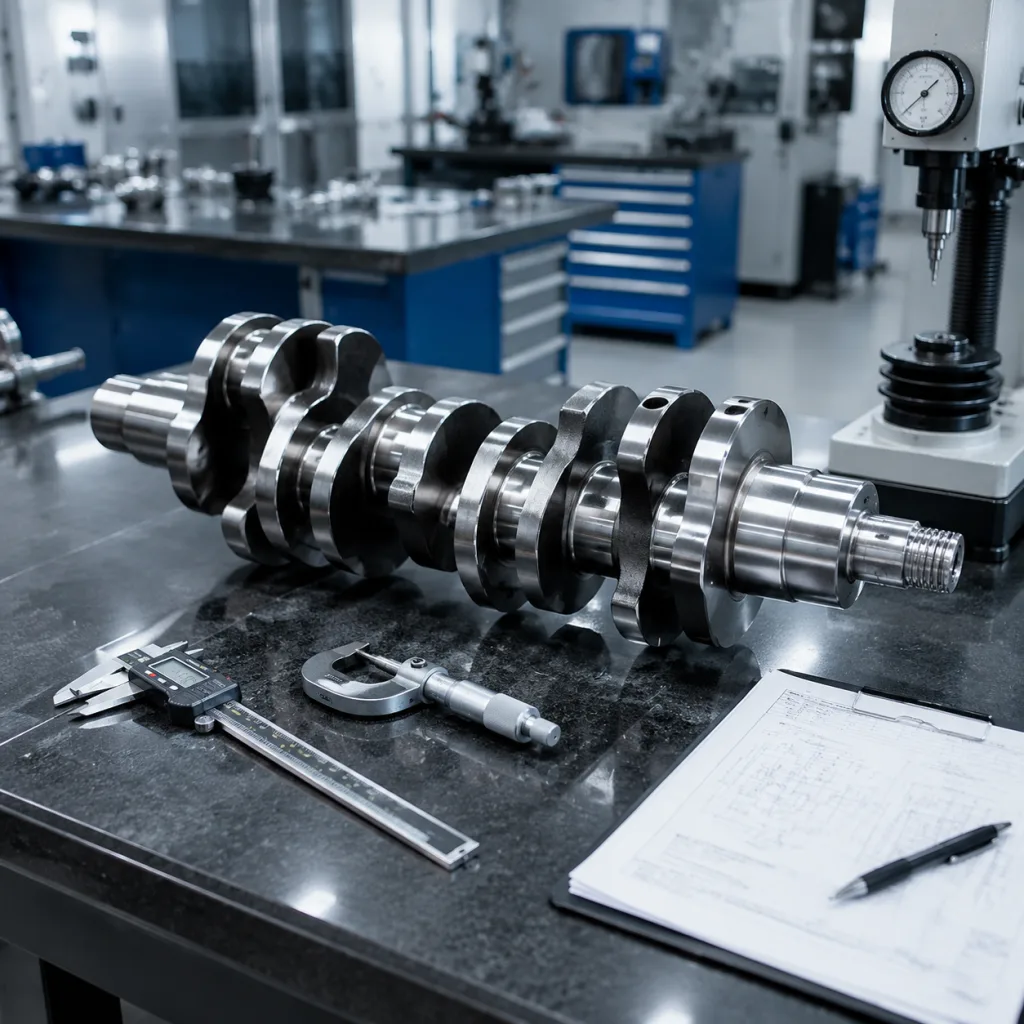
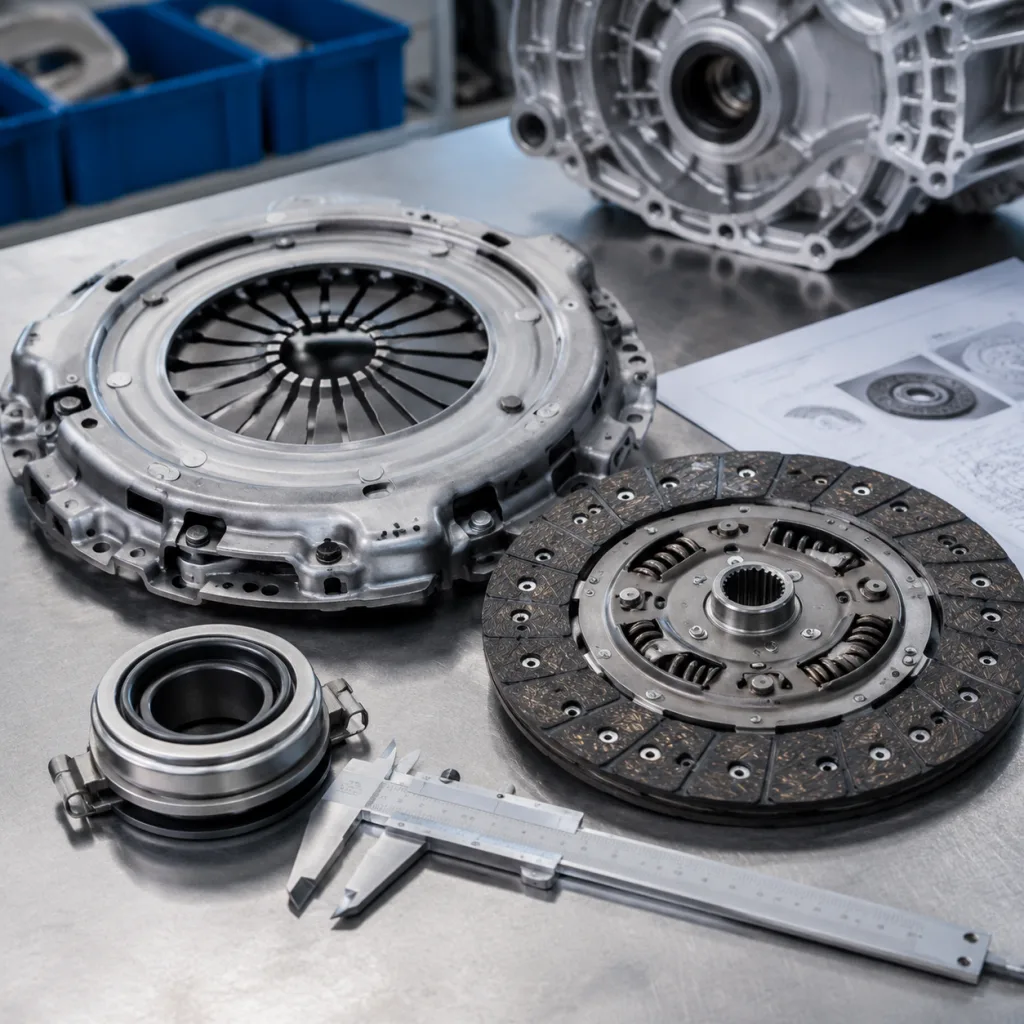
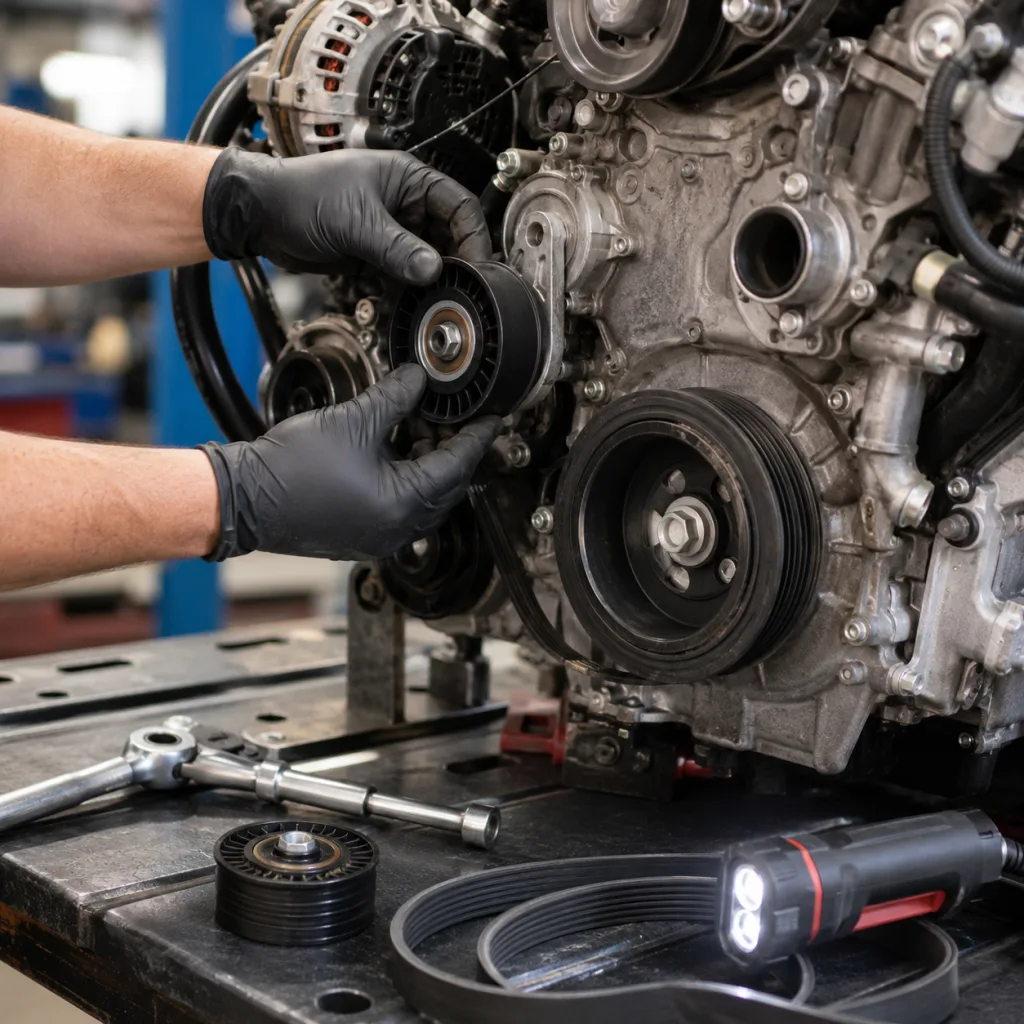
Timing belt kit material selection has a direct impact on service life, noise, warranty exposure, and fitment consistency in aftermarket programs. For distributors, repair chains, and Tier-1 sourcing teams, the specification must cover the whole kit, not only the belt compound. A complete kit commonly includes the synchronous belt, tensioner, idler pulley, mounting hardware, and, for many applications, a water pump or seal set. Each part brings different material and process risks: belt tooth shear, cord adhesion loss, bearing grease degradation, pulley runout, casting porosity, gasket compression set, and bolt-coating corrosion. Driventus manufactures and sources timing system components under an IATF 16949:2016 and ISO 9001:2015 controlled quality system in Taizhou, Zhejiang, with export supply to more than 60 countries. This article outlines practical material specifications, tolerance controls, and inspection points for buyers comparing kit suppliers. Driventus is an independent aftermarket manufacturer; brand names are referenced for fitment only.
Core material specification for kit components
A timing kit works as a matched system. A material change in one component can affect belt tracking, bearing load, installation torque, or long-term noise. Procurement drawings and supplier control plans should state the material grade, hardness range, coating, functional tolerance, and inspection method for every included part.
</tr></thead><tbody> </tbody></table>For aftermarket programmes, a belt described as OE-equivalent is not enough. The kit bill of materials should define all child parts, packaging position, and whether fasteners are single-use stretch bolts or reusable items. This prevents installation variation across repair chains and reduces disputes when multiple applications are supplied under one kit family.
Belt compound, cord, and tooth fabric requirements
The belt is the highest-risk item because it maintains crankshaft-to-camshaft timing through repeated thermal and load cycles. Modern engines often require high-temperature hydrogenated nitrile butadiene rubber (HNBR), especially in compact engine bays with limited airflow. Chloroprene rubber (CR) may still be suitable for older applications, but buyers should confirm the intended temperature window, replacement interval, and OE design requirements before approval.
A practical timing belt kit material file should include:
Rubber base: HNBR or CR, with batch traceability.
Tensile member: glass-fibre cord with controlled twist direction and tension.
Tooth jacket: nylon fabric with wear-resistant treatment.
Hardness: specified Shore A range, verified after curing.
Tooth pitch and profile: measured against the application drawing.
Width tolerance: controlled to prevent pulley edge contact.
Marking durability: part number, direction marks, and installation marks where required.
Validation can include tensile testing, tooth shear testing, heat ageing, low-temperature flexibility, oil exposure, ozone resistance, and cord adhesion checks. The exact plan should match the engine family and service interval rather than rely on a generic pass/fail certificate.
Where kits are sold in the EU or UK, buyers should also check material compliance declarations for REACH (EC) No 1907/2006. For Brazil, Canada, Australia, and the US, importers often request equivalent restricted-substance documentation even when REACH is not directly mandated.
Driventus can align belt specifications with application-level requirements listed in our catalog, including kits supplied with or without water pumps.
Pulley, bearing, and tensioner material controls
Tensioners and idlers turn a correct belt into a stable timing system. Their specifications should cover geometry, bearing quality, spring behaviour, and contamination control. A visually acceptable pulley can still cause belt wander if runout, flange form, or bearing press-fit is outside the drawing requirement.
Typical dimensional controls
Pulley radial runout: commonly controlled within a tight drawing-defined range, often below 0.10 mm for critical applications.
Bearing bore and shaft fit: controlled to the supplier drawing to avoid creep or excessive preload.
Pulley surface roughness: specified to prevent fabric abrasion.
Flange height and radius: controlled to reduce belt edge damage.
Tensioner mounting face flatness: checked to prevent misalignment after torque.
Sealed bearings should be specified by internal clearance, seal type, grease specification, and operating temperature. A low-cost bearing with unsuitable grease can pass initial rotation checks but fail after heat exposure. Spring steel and damping material inside an automatic tensioner need torque-curve verification, not only dimensional inspection.
For supplier audits, ask for production control plans, gauge repeatability and reproducibility records, and process capability data for bearing press-fit, pulley machining, and spring setting. These controls should be integrated into the supplier’s IATF 16949:2016 and ISO 9001:2015 procedures. Driventus documents these checks through its quality system.
Water pump and gasket materials in extended kits
Many timing belt kits include a water pump because labour overlap is high. In these extended kits, the pump can become the main return risk even when the belt is correct. Material and process requirements should be agreed before purchase order release, not after the first quality issue.
Aluminium pump housings require casting porosity control, machined sealing faces, and pressure leak testing. Shaft material, bearing load rating, and seal-pair selection must match coolant exposure and engine temperature. Ceramic-carbon mechanical seals are common, but the exact design should be validated through coolant compatibility and endurance testing.
Impellers may be polymer or metal. Polymer impellers reduce rotating mass and corrosion risk, while metal impellers can provide higher mechanical rigidity in some applications. Neither option is a universal upgrade. The correct choice depends on OE design intent, clearance, coolant flow, cavitation risk, and thermal conditions.
Gaskets and O-rings should be checked for elastomer type, thickness, compression set, and coolant compatibility. EPDM is common for coolant exposure; NBR and FKM may be used in other sealing environments depending on the application. If the kit references fitment families such as OE 06A… or OE 11251…, the supplier should confirm dimensional cross-reference without claiming vehicle manufacturer approval. Driventus is an independent aftermarket manufacturer; brand names are referenced for fitment only.
Tolerance and testing checklist for sourcing teams
A specification-based RFQ should request measurable evidence, not only photos and sample pricing. The following checklist helps import managers compare quotations for a timing belt kit material package and identify gaps before tooling, sampling, or packaging approval.
RFQ item
Evidence to request
Acceptance focus
Belt compound
Material declaration, batch record, heat-ageing result
Correct rubber type and stable hardness
Tooth geometry
First article inspection report
Pitch, tooth height, width, profile
Tensile cord
Supplier specification and tensile test
Elongation control and cord integrity
Pulley machining
Dimensional report and runout record
Alignment and belt tracking
Bearing
Grease type, clearance class, noise test
Heat resistance and low noise
Tensioner
Torque curve report
Correct operating range
Water pump
Leak test, shaft runout, seal validation
No seepage, stable rotation
Fasteners
Coating and thread inspection
Clamp load and corrosion resistance
Packaging
Drop test or packing validation
No bearing shock or belt deformation
</tr></thead><tbody> </tbody></table>Standards named in supplier files should be relevant to the part category. IATF 16949:2016 and ISO 9001:2015 relate to quality management. REACH (EC) No 1907/2006 relates to chemical substances. ECE R-83 is relevant to vehicle emissions type approval and is not a direct timing belt kit material standard. SAE J2527 is a brake dynamometer test procedure and should not be used to justify timing kit performance. Accurate use of standards is a useful signal that the supplier understands the product and is not recycling generic documentation.
For applications requiring a non-standard bill of materials, private packaging, or controlled cross-reference coverage, Driventus supports custom manufacturing for distributors and Tier-1 supply programmes.
Commercial specification points before approval
Material approval should be tied to commercial and change-control terms. A sample that passes testing is useful only if mass production follows the same approved bill of materials. Buyers should freeze the compound, bearing source, gasket material, coating type, grease specification, water pump configuration where applicable, and packaging method in the purchase specification.
Recommended approval steps:
1. Confirm application list and OE-style cross-reference format, such as OE 06A… where applicable. 2. Review drawings, material specifications, and restricted-substance declarations. 3. Test samples for dimensional fit, rotation, leakage, and belt tracking. 4. Approve the golden sample and packaging layout. 5. Define change-notification rules for rubber compound, bearing supplier, grease, casting source, coating, or gasket material. 6. Set incoming inspection criteria for each shipment.
This approach reduces disputes after launch. It also gives wholesalers and repair chains clear evidence when investigating installation complaints or field returns. Driventus supplies timing system parts as part of its broader engine components range and can provide documentation for distributor onboarding, tender files, and sample approval. To confirm application coverage and documentation requirements, buyers can request a quote.
Frequently asked questions
HNBR rubber is common for modern high-temperature applications. Some older applications may use CR rubber. The correct selection depends on engine design, temperature exposure, tooth profile, and service interval, so buyers should specify by application rather than by general material preference.
It depends on the engine layout and service practice. If water pump replacement overlaps with timing belt labour, an extended kit can reduce repeat work. The pump must be validated for leakage, shaft runout, impeller clearance, seal performance, and gasket compatibility.
Request a bill of materials, material declarations, first article inspection reports, belt and tensioner test data, water pump leak-test records where applicable, packaging validation, and quality certificates such as IATF 16949:2016 and ISO 9001:2015.
If you are building a timing kit sourcing file, Driventus can review target applications, materials, and documentation requirements before quotation. Contact our team at /contact.html