Spark Plug Coil Replacement for Aftermarket Sourcing
Spark plug coil replacement is a high-volume aftermarket category, yet procurement risk is often underestimated. A coil-on-plug unit has to match the OE envelope, connector geometry, boot hardness, secondary resistance range, insulation performance and thermal durability. A small deviation can lead to misfire codes, radio-frequency interference, premature boot cracking or warranty returns from repair networks.
For distributors, Tier-1 buyers and multi-location repair chains, the sourcing target is broader than interchange coverage. Buyers need repeatable OE-equivalent fit, verified electrical performance, traceable production and export-ready packaging that protects parts through sea freight, warehousing and branch-level picking. Driventus manufactures engine and powertrain components in Taizhou, Zhejiang, under IATF 16949:2016 and ISO 9001:2015 quality management systems. This guide outlines a practical procurement framework for ignition coil replacement programmes, with emphasis on dimensional control, validation testing and supplier qualification.
Replacement Fit Criteria Buyers Should Specify
A coil-on-plug assembly is not a generic electrical part. It interfaces with the cylinder head, spark plug terminal, engine harness and engine cover, so replacement fit should be defined by measurable criteria rather than vehicle application lists alone.
For sourcing teams, the purchase specification should include:
- Overall length from connector datum to plug-terminal contact point
- Boot outer diameter and rib profile for sealing in the plug well
- Connector keying, latch retention force and terminal plating
- Primary and secondary winding resistance target ranges at 20 °C
- Coil housing material, glass-fibre content where applicable and heat-ageing requirement
- Silicone boot hardness, normally controlled by Shore A range
- Dielectric strength requirement between high-voltage and low-voltage paths
- Marking format for batch traceability, date code and internal part reference
Buyers should also define the cross-reference basis. OE part-number references may appear in application data, but they should be used only where the buyer has confirmed the vehicle platform, engine code and model-year logic. Driventus is an independent aftermarket manufacturer; brand names are referenced for fitment only.
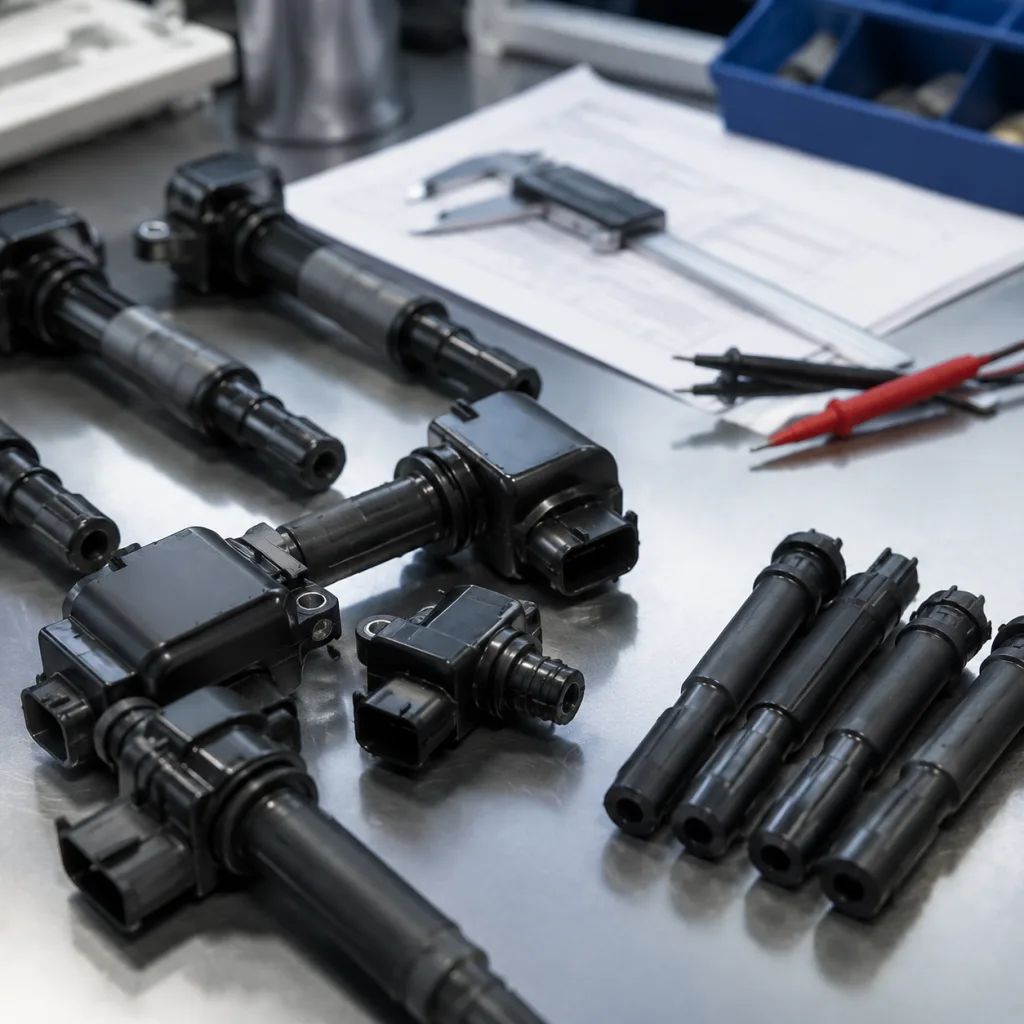
A robust spark plug coil replacement programme usually starts with OE sample measurement, 3D fixture checking and comparison against the buyer’s current fast-moving SKUs. For broader coverage planning, sourcing teams can review our catalog and confirm which coil families need local-market packaging, private labelling or application-list formatting.
OE-Equivalent Construction and Material Checks
The commercial issue with ignition coils is rarely first-fit installation. The larger risk is field durability after repeated heat cycles, oil vapour exposure and engine vibration. Procurement specifications should therefore separate visible fitment characteristics from hidden material, winding and potting controls.
| Component area | Procurement check | Why it matters for replacement programmes |
|---|---|---|
| Housing | PA66, PBT or specified engineering polymer with heat-ageing data | Helps prevent cracking near mounting ears and connector bodies |
| Boot | Silicone compound with controlled Shore A hardness | Maintains plug-well sealing and reduces carbon tracking risk |
| Terminal | Correct spring contact force and corrosion-resistant plating | Supports stable high-voltage transfer to the spark plug |
| Winding | Controlled copper wire diameter and turns ratio | Keeps output voltage and resistance consistent across lots |
| Epoxy potting | Void control and thermal cycling resistance | Reduces internal arcing and moisture ingress |
| Connector | OE-matched keyway and latch geometry | Prevents harness-fit complaints and intermittent contact |
| Test item | Typical verification method | Purchasing relevance |
|---|---|---|
| Dimensional inspection | CMM, caliper gauge and connector fixture | Confirms installation compatibility before shipment |
| Resistance check | Primary and secondary resistance at controlled temperature | Screens winding consistency and process drift |
| High-voltage output | Spark-gap or load-simulated bench test | Verifies ignition energy margin |
| Dielectric withstand | High-voltage insulation test | Reduces risk of internal or external arcing |
| Thermal cycling | Alternating hot and cold exposure | Evaluates housing, potting and boot durability |
| Vibration | Fixture-mounted vibration test | Screens solder, terminal and potting weakness |
| Salt spray or humidity | Corrosion and moisture exposure | Supports export markets with varied climates |