Suspension Arm Replacement Cost: What Buyers Should Expect
Suspension arm replacement cost is rarely just a part-price question. For B2B buyers, the real issue is what the arm costs once it is fitted, aligned, warranted, and monitored in service.
That is why simple quote comparisons often mislead. A lower-priced arm can become the expensive option if it adds 0.5 labour hours, arrives without one-time-use hardware, causes an alignment comeback, or fails early in high-corrosion service. A more expensive arm can still lower total spend if fitment is cleaner and service life is longer.
For distributors, workshop groups, and fleet procurement teams, the most useful lens is a six-part cost model: piece price, installation time, alignment requirement, hardware policy, expected service life, and warranty exposure. In practice, a USD 12-20 saving on the part can disappear immediately if labour rises, repeat work appears, or claims handling starts consuming margin.
This article breaks suspension arm replacement cost into decision points buyers can actually use: what belongs in the job cost, where cheap programmes fail, how pricing shifts by vehicle segment, what technical specs justify a higher quote, and what to ask suppliers before placing volume orders. Driventus is an independent aftermarket manufacturer; brand names are referenced for fitment only.
Build the cost correctly: what belongs in a suspension arm replacement job
The fastest way to misread suspension arm replacement cost is to look only at the arm itself. Trade buyers should treat the job as four core cost blocks: the arm assembly, labour, alignment, and ancillary hardware.
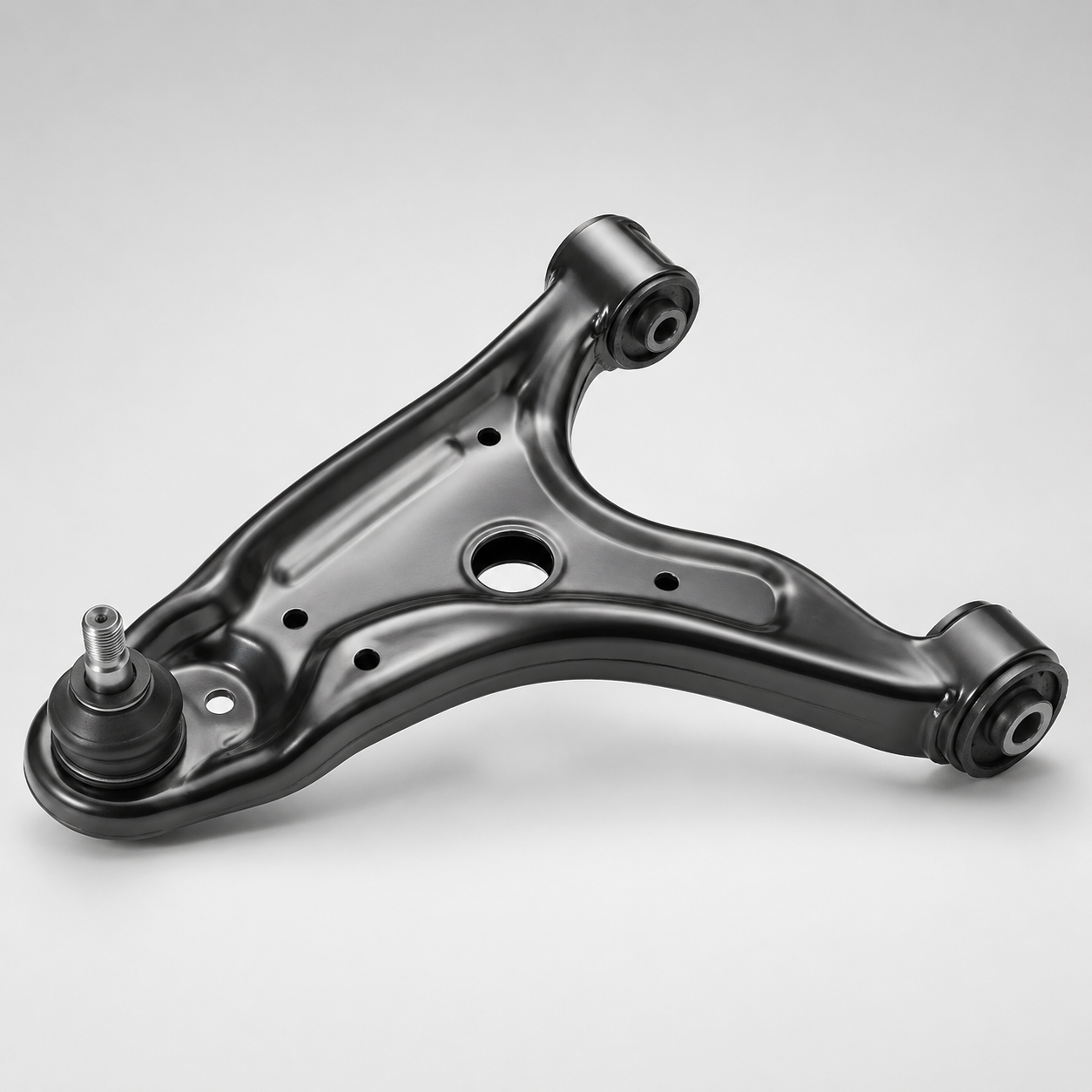
A suspension arm may be supplied as:
Bare arm only
Arm with bonded rubber bushing(s)
Arm with pre-installed ball joint
Complete kit with fasteners and nuts
That configuration changes the invoice. So does the workshop process. On many passenger vehicles, replacing one front lower arm also means loosening subframe-adjacent fixings, setting bonded bushes at ride height before final torque, and checking wheel alignment afterwards. If the ball joint is integrated, replacing the full assembly often cuts labour compared with pressing components in and out.
Access also matters more than catalogues suggest. Left and right sides do not always consume identical time. Corrosion, exhaust routing, underbody shields, and subframe clearance can all shift the real labour requirement.
Typical installed cost structure
Cost element
Typical share of total
Notes
Suspension arm assembly
35-60%
Higher for forged aluminium, multi-piece, or hydro-bushed designs
Labour
25-45%
Depends on access, corrosion, seized bolts, and axle layout
Wheel alignment
10-20%
Commonly required after front arm replacement
Ancillary hardware
5-10%
Stretch bolts, nuts, links, clips, and one-time-use fixings
</tr></thead><tbody> </tbody></table>Labour variation often exceeds part-price variation. That is the key buying lesson. A low-cost arm that installs poorly, shifts bushing preload, or creates early noise complaints can push the actual service cost well above the apparent saving.
Typical workshop time and added-cost logic
For budgeting, split the quoted part from the real job time. Typical benchmark labour times for one arm are:
Job type
Typical labour time per side
Cost implication
Simple front lower arm, compact car
0.8-1.2 hr
Lowest installed cost band
Mid-size front arm with tighter access
1.2-1.8 hr
Common aftermarket benchmark
SUV/crossover front arm
1.5-2.2 hr
More frequent alignment and hardware replacement
Rear multi-link arm
0.9-1.6 hr
Varies by eccentric adjuster and access
Corroded/seized hardware case
+0.5 to +1.5 hr extra
Often exceeds part-price difference
</tr></thead><tbody> </tbody></table>At a workshop labour rate of USD 60-120 per hour, an extra 0.5 hour adds USD 30-60 before alignment. If alignment is another USD 40-120, and one-time-use hardware adds USD 8-35, the “cheap” arm can lose on total installed cost very quickly.
For RFQs, buyers should state whether the requested price includes:
Pre-installed bushings
Pre-installed ball joint
New self-locking nuts
Stretch bolts or camber bolts where required
Side-specific hardware packs
Fitting notes for final torque at ride height
Where service networks estimate by flat rate, these details are not minor. They directly affect margin accuracy.
Where the money moves: price bands by vehicle segment and order model
Installed pricing changes by market, but the pattern is consistent. Small passenger cars with stamped-steel arms usually sit at the bottom of the range. SUVs, LCVs, and premium platforms using aluminium arms or hydraulic bushes sit higher because both the part and the labour are more demanding.
Vehicle segment
Typical part price per arm
Typical installed cost per arm
Common reasons for higher cost
Small hatchback / compact sedan
USD 35-90
USD 140-280
Simple stamped steel design
Mid-size passenger car
USD 55-140
USD 180-380
Larger bushes, tighter fitment tolerances
SUV / crossover
USD 80-180
USD 240-480
Heavier construction, higher labour time
Premium passenger vehicle
USD 120-260
USD 320-650
Aluminium forgings, hydraulic bushes
Light commercial vehicle
USD 90-220
USD 260-520
Load-rated joints, corrosion, more difficult access
</tr></thead><tbody> </tbody></table>These are trade-oriented reference ranges, not retail quotations. Regional labour rates, tax treatment, and workshop policy can move them sharply. In high-labour markets, time becomes the dominant variable. In lower-labour markets, the part specification can account for more of the total bill.
Front-axle jobs often cost more because alignment is frequently required, though some rear multi-link layouts are just as labour-intensive. Seized inner-bush bolts are a common turning point: once hardware must be cut out, the labour delta can exceed the price gap between supplier quotes.
For network buyers, a better metric is often cost per 10,000 km of service life rather than simple unit cost. The reason is straightforward: better rubber control, more consistent articulation torque, and stronger corrosion resistance can reduce repeat jobs and NVH returns.
B2B supply-price logic by order size
Order size also changes the economics. Typical aftermarket ex-works logic for common passenger-car references can look like this:
Order type
Indicative MOQ per item
Typical ex-works price logic
Typical lead time
Trial order / sample validation
2-10 pcs
Highest unit cost; sample tooling and packing not optimised
2-4 weeks if stock/sample-ready
Small repeat order
50-100 pcs
Standard catalogue price
30-45 days
Distribution order
200-500 pcs
Better unit pricing due to material and setup efficiency
35-50 days
Container-mix programme
800-2,000+ pcs across SKUs
Best blended price if volume is stable and forecasts are shared
45-60 days
Private-label launch
300-1,000 pcs per active SKU typical
Added cost for artwork, carton change, label management, approval cycle
45-75 days
</tr></thead><tbody> </tbody></table>As a broad rule, common stamped-steel passenger-car arms may show 8-18% lower unit pricing when moving from a 50-piece buy to a 300-piece buy. More complex aluminium or hydraulic-bushed references often show a smaller percentage reduction because raw material cost dominates.
A simple service-life comparison shows why buyers should not stop at acquisition price:
A USD 48 arm lasting 30,000 km equals USD 16 per 10,000 km before labour.
A USD 62 arm lasting 60,000 km equals about USD 10.3 per 10,000 km before labour.
Add labour and alignment, and the better part can be much cheaper overall.
Why two similar-looking arms can have very different costs
This is where many purchasing mistakes begin. Two arms can fit the same vehicle and still be very different products.
A serious price comparison needs a technical review of the assembly, not just the application listing. Cost differences usually come from material route, bushing design, ball joint content, corrosion protection, dimensional control, and validation depth.
Main cost drivers
Material route: stamped steel is usually cheaper than forged steel or cast/forged aluminium.
Bushing type: solid rubber bushes generally cost less than hydraulic or voided designs.
Ball joint inclusion: integrated joints increase component cost but may reduce workshop time.
Surface protection: e-coating, zinc-flake systems, and salt-spray performance affect durability in wet or salted-road markets.
Dimensional control: bore position, pin angle, and joint centreline must match OE geometry to protect alignment and steering feel.
Validation testing: fatigue, pull-out force, articulation torque, and rubber-bond durability testing add cost but reduce field failure risk.
From a procurement perspective, the high-risk differences often hide in details such as:
Rubber hardness consistency between batches
Weld penetration or forging integrity
Ball pin surface finish
Dust boot sealing performance
Corrosion resistance after stone-chip exposure
Accuracy of bushing sleeve position relative to the arm body
Those details affect real service outcomes. If geometry drifts or rubber properties are unstable, the result can be tyre wear, steering pull, early NVH complaints, or repeat alignment work.
Suppliers operating under IATF 16949:2016 and ISO 9001:2015 generally bring stronger process discipline for traceability, material control, and corrective action. For EU and UK supply chains, material declarations should also be checked against REACH (EC) No 1907/2006 where applicable.
You can review our broader quality system and our catalog for suspension part coverage and validation scope.
Technical details that usually separate low-cost from reliable supply
Feature
Lower-cost risk
Better-controlled target range or method
Bushing rubber hardness
Wide batch variation causing harshness or premature cracking
Typically controlled within ±5 Shore A, and tighter on key platforms
Bushing sleeve position
Geometry drift and difficult installation
Critical centre distance and sleeve location checked to drawing tolerance, often ±0.2 to ±0.5 mm depending on feature
Ball-joint articulation torque
Too loose creates play; too high creates steering stiffness
Verified against design window, often by lot and start/end of run
Ball pin taper and thread
Fitment mismatch and unsafe fastening
100% gauge checking on critical taper/thread features for many programmes
Coating thickness
Early rust and cosmetic claims
E-coat or zinc-flake measured by batch, often around 20-35 μm depending on system
Corrosion resistance
Boot-edge rust and arm-body attack
Salt-spray or cyclic test target commonly 240-720 hours, depending on market/spec
</tr></thead><tbody> </tbody></table>Material route has a large effect on price. A simple stamped-steel arm may use 3.0-5.0 mm plate with welded reinforcement. A forged aluminium arm adds expensive raw material, trimming, machining, and tighter inspection. Hydraulic bushes add another layer of cost because they require more complex bonding and process stability than solid rubber bushes.
Ball-joint quality is another major divider. Better suppliers control:
Ball stud hardness and surface roughness
Socket material and liner consistency
Grease fill volume
Dust boot lip retention
Axial and radial play limits
Stud pull-out force
In short: if a supplier validates pull-out force, articulation torque, boot sealing, fatigue life, and post-corrosion performance, the piece price will usually be higher. That extra cost often buys lower field risk.
Failure modes that make a low quoted cost expensive later
A cheap arm usually does not fail on paper. It fails in the field, in the workshop, or in the claims file.
For buyers, the main question is not whether the arm fits on day one. It is which failure modes are most likely to turn a low quotation into a costly programme.
Common cost-escalation points include:
Dimensional drift leading to forced assembly or poor alignment outcomes
Bushing preload errors caused by poor fit or missing ride-height torque instructions
Early boot damage from weak packaging or freight compression
Corrosion complaints on arms with marginal coating coverage in salted-road markets
Ball-joint play or stiffness caused by poor articulation-torque control
Missing one-time-use hardware that delays installation or forces local emergency sourcing
The commercial effect is bigger than the defect itself. One bad arm can trigger technician downtime, rebooking, alignment credits, freight claims, and goodwill concessions. In workshop chains, even a small pattern of these issues can erase the savings from a cheaper sourcing programme.
This is why buyer reviews should not stop at unit price. They should ask where the part tends to fail and what the cost of each failure looks like.
Typical failure mode to cost translation
Failure mode
Likely operational effect
Cost consequence
Sleeve position out of tolerance
Difficult installation or geometry shift
Labour overrun, alignment comeback
Rubber compound inconsistency
Harshness, cracking, early NVH return
Warranty claim, repeat replacement
Ball-joint torque outside window
Steering stiffness or premature looseness
Safety concern, claim escalation
Weak coating / edge coverage
Early rust complaints
Higher return rate in wet or salted-road regions
Missing hardware
Job delay or reuse dispute
Lost bay time, margin leakage
Packaging damage to boot or finish
Defect on arrival or short service life
Receiving claim, replacement freight
</tr></thead><tbody> </tbody></table>Buyers who track warranty properly often find that the expensive problems are not catastrophic failures. They are the small, repeatable issues that consume labour and administration.
How to test OE-equivalence before you commit to volume
The right pre-purchase question is not “will it interchange?” It is “will it preserve geometry, install cleanly, and last through the target service interval?”
A proper OE-equivalent review should cover:
Critical dimensions: mounting width, bushing bore, taper size, arm length, and ball-joint centre position
Material specification: steel grade or aluminium grade, plus heat-treatment route if relevant
Rubber formulation control: hardness, rebound, bond integrity, and ageing resistance
Joint performance: breakaway torque, rotational torque range, and sealing performance
Coating performance: corrosion resistance under cyclic exposure
Fitment verification: trial installation against the target vehicle platform
Where an OE cross-reference is used in a listing, such as OE 11251…, buyers should confirm that it is used for fitment identification only, not as a claim of vehicle-maker endorsement.
A reliable supplier should be able to provide:
Dimensional inspection records
Material certificates where required
Salt-spray or cyclic corrosion test data
Fatigue or durability test summaries
Traceability by lot or batch
Fitment confirmation for the intended platform or engine derivative
Configuration also needs checking. A listing may show a complete assembly while the shipped part excludes hardware or uses a different ball-joint arrangement. That kind of mismatch creates delays and hidden labour cost.
For private-label programmes or application-specific variants, custom manufacturing can be relevant where buyers need modified bushing compounds, coating upgrades, or market-specific packaging.
OE-equivalence checks buyers can put directly into RFQs
Check area
Practical buyer requirement
Arm geometry
Key centre distances and pivot positions to be held to drawing tolerance; request CMM or fixture report
Mounting interfaces
Bore/slot dimensions and sleeve width to match OE so no forced assembly is needed
Ball-joint stud
Taper angle, thread pitch, and installed height to match OE fitment
Rubber properties
Hardness, bond strength, and ageing results declared by batch or approval sample
Joint torque
Breakaway and running torque values supplied against internal spec window
Surface finish
Coating type, nominal thickness, and test standard identified
Durability
Fatigue rig summary with cycles completed and failure mode noted
</tr></thead><tbody> </tbody></table>For many high-volume aftermarket programmes, buyers ask suppliers to confirm dimensional tolerances on features such as:
Overall arm length: often within ±0.5 to ±1.0 mm depending on design
Bushing sleeve width: often within ±0.1 to ±0.3 mm
Ball-joint centre position: commonly within ±0.3 to ±0.5 mm on critical applications
Stud thread accuracy: checked with GO/NO-GO gauges
Service-life verification should also include:
Rubber ageing after heat exposure, for example 70-100°C lab ageing by internal or referenced standard
Bond integrity after cyclic load
Salt-spray or cyclic corrosion testing after stone-chip damage
Fitment trial on actual knuckle/subframe interfaces
Torque retention after installation and articulation cycling
If a supplier cannot provide measurable evidence beyond a basic fitment claim, the buyer is carrying the validation risk.
A practical cost-control playbook for distributors and repair networks
Reducing suspension arm replacement cost does not mean buying the lowest-priced arm. It means lowering total installed cost without creating claim exposure.
The most effective buyers work backwards from workshop friction. They look for the points that consume bay time, trigger rework, or complicate replenishment.
Practical procurement checklist
Control point
Why it matters
Buying action
Consolidated application coverage
Reduces SKU complexity
Prioritise platforms with stable volume and shared geometry
Hardware inclusion
Cuts installation delays
Specify whether bolts, nuts, and washers are included
Ball joint pre-installation
Reduces labour and press work
Compare complete assembly vs component-level replacement
Corrosion protection level
Limits early cosmetic and structural complaints
Request coating test data for salted-road markets
Batch traceability
Supports warranty containment
Require lot coding on part and packaging
Packaging protection
Prevents boot damage and coating scratches
Audit individual tray or separator design
</tr></thead><tbody> </tbody></table>For chain workshops, the most useful internal metrics often are:
Warranty returns by vehicle platform
Labour overrun caused by fitment mismatch
Alignment complaints after installation
Noise, vibration, and harshness returns within 90 days
Side-specific failure trends on left or right applications
Repeat replacement intervals by mileage band
Those numbers usually reveal the same pattern: a slightly higher acquisition price can lower total cost through fewer reworks, lower claim administration, and better technician productivity.
Another practical step is to standardise fitment notes across service locations. If technicians already know whether bolts are one-time-use, whether suspension must be loaded before final torque, or whether alignment is mandatory, estimate accuracy improves and comeback risk drops.
Driventus supports B2B supply programmes for suspension and steering categories alongside engine and powertrain components. Buyers comparing range depth can review our catalog before they request a quote.
Actionable ways to reduce real replacement cost
Strategy
Typical impact on total cost
Operational note
Buy complete arm assemblies for high-turn references
Cuts labour by roughly 0.2-0.8 hr versus component-level rework on some platforms
Best where bay time is expensive
Bundle alignment into suspension jobs
Reduces missed-charge and comeback risk
Useful for front-axle programmes
Standardise one-time-use hardware policy
Prevents repeat disassembly and safety disputes
Add hardware SKU or kit by default
Focus on top 20% of applications by sales volume
Better MOQ efficiency and stock turns
Reduces dead inventory
Use claim-rate targets in supplier scorecards
Controls hidden warranty cost
Typical target often below 0.5% for mature references
Forecast seasonal demand
Helps secure production slots and avoid airfreight
Important before winter chassis season
</tr></thead><tbody> </tbody></table>A proper landed-cost model should include more than ex-works price. Buyers should calculate:
Unit price
Inbound freight per piece
Duty/tax where applicable
Packaging cost for private label
Expected claim reserve percentage
Average labour-credit exposure per failed unit
Inventory carrying cost over the lead-time window
For example, a part bought at USD 52 with USD 4 freight and 0.8% claims may be less profitable than a part bought at USD 58 with USD 4 freight and 0.2% claims if the average warranty event costs USD 90-180 including administration and labour contribution.
Lead-time risk matters too. If standard replenishment is 45 days, but stockouts force emergency local purchasing at much higher prices, the annual cost of poor planning can wipe out normal sourcing savings. For stable references, many importers target 6-10 weeks of forward stock plus confirmed production visibility.
Supplier Q&A: the questions that expose real cost before you place the order
Before onboarding a suspension arm supplier, buyers should force a more useful conversation than “what is your best price?” The right questions expose hidden cost, process weakness, and claim risk before volume is committed.
Recommended points include:
What validation tests are completed on each platform?
Are bushings and ball joints produced in-house or outsourced?
What are the dimensional inspection frequencies for critical characteristics?
Is coating thickness controlled by specification and batch record?
Are there market-specific compliance documents for REACH or related requirements?
What is the standard warranty claim handling process?
What packaging method protects joint boots during sea freight?
What is the normal lead time for repeat orders and for private-label launches?
It is also sensible to ask for recent examples of corrective action handling. The speed and quality of problem resolution often matter as much as the original defect rate. For high-volume passenger-car applications, return rates above 0.5-1.0% can materially affect account profitability once freight, administration, labour credits, and customer goodwill are included.
Commercial questions should also cover MOQ, label formats, barcode standards, pallet configuration, and mixed-application container loading. These points influence landed cost and replenishment flexibility more than many buyers expect.
Driventus manufactures aftermarket components under controlled processes aligned with IATF 16949:2016 and ISO 9001:2015. We focus on dimensional match, repeatability, and documentation expected by distributors, importers, and service groups. Driventus is an independent aftermarket manufacturer; brand names are referenced for fitment only.
Volume-order questions that should appear on a buyer checklist
Question area
What to confirm
MOQ
Standard MOQ per SKU, mixed-SKU MOQ, and MOQ for private-label cartons
Pricing
Breakpoints at 50, 100, 300, and 500 pcs where relevant
Lead time
Sample lead time, first order lead time, repeat order lead time, and high-season lead time
Tooling/approval
Whether any fixture, artwork, or package approval fees apply
Inspection
AQL level, critical-dimension frequency, and final audit method
Traceability
Lot code format on part, inner box, and master carton
Warranty
Claim window, evidence required, and debit-note/credit-note handling time
Packaging
Pieces per box, inner protection, pallet height, and container loading plan
</tr></thead><tbody> </tbody></table>Typical commercial ranges in this category are often:
MOQ for catalogue supply: about 50-100 pcs per SKU for common items
MOQ for private label: often 200-500 pcs per SKU, depending on carton print method
Sample lead time: around 7-21 days if an existing item is available
Repeat-order lead time: commonly 30-45 days for standard references
New private-label packaging lead time: often 45-75 days including artwork approval
Buyers should also ask how production control works in practice, not just on paper. Useful questions include:
Are welded arms checked on fixtures every shift or every lot?
Are ball-joint torque values recorded by batch?
Is rubber hardness tested on incoming compound, finished bushes, or both?
Is coating adhesion verified after curing?
What is the containment process if one critical dimension goes out of tolerance?
Can the supplier segregate stock by production lot within 24 hours of a field claim?
For sea-freight programmes, packaging detail matters more than many buyers expect. Ask for:
Individual bagging or tray separation
Dust boot protection cap where needed
Carton drop-test status
Pallet wrap and corner-board method
Maximum stack height in warehouse and container
The most useful supplier is rarely the one with the absolute lowest opening quote. It is usually the one that can explain why the part costs what it costs, what controls are in place, what lead-time and MOQ terms apply, and how claims are contained if something goes wrong in the field.
Frequently asked questions
For many front-axle applications, yes. Even when the mounting points appear fixed, arm geometry and bushing position can influence toe or camber enough to justify an alignment check after installation. Some rear applications also require alignment depending on suspension design. In B2B costing, many buyers budget alignment as a standard front-arm line item because a USD 40-120 charge is common.
The biggest reasons are material route, bushing type, ball joint inclusion, coating system, dimensional control, and validation depth. Two parts may fit the same application but still differ in durability, corrosion resistance, or installation accuracy. Small differences in sleeve position, joint centreline, rubber hardness variation, or coating thickness can all raise total suspension arm replacement cost later.
It depends on the design and wear pattern. If the ball joint is integrated, or the bushings are also worn, replacing the complete assembly usually reduces labour time and lowers repeat-visit risk. Where the joint is separately serviceable and the arm body remains sound, component-level repair may still make sense. For fleet and workshop networks, complete assemblies are often preferred on high-volume applications because they can save roughly 0.2-0.8 labour hours and make pricing more predictable.
If you are comparing suspension arm programmes for distribution, fleet service, or private label supply, we can support technical review and quotation. Please [request a quote](/contact.html).