Cost for Control Arm Replacement: B2B Sourcing Guide
For importers, repair chains, fleet operators, and aftermarket distributors, the cost for control arm replacement is more than a retail labour-and-parts question. It includes the arm assembly, installation time, alignment, warranty exposure, inventory carrying cost, returns handling, and the risk of repeat work. A low purchase price can become expensive when bushings compress early, ball joint torque varies by batch, or mounting brackets fall outside fixture tolerance. This guide separates visible invoice items from the sourcing variables that shape landed cost, service margin, and customer satisfaction. It is written for buyers comparing private-label, OE-equivalent, and custom programmes across passenger car and light commercial applications. Driventus supplies chassis and powertrain components from Taizhou, Zhejiang, under IATF 16949:2016 and ISO 9001:2015 quality management systems. Driventus is an independent aftermarket manufacturer; brand names are referenced for fitment only.
What Replacement Cost Includes
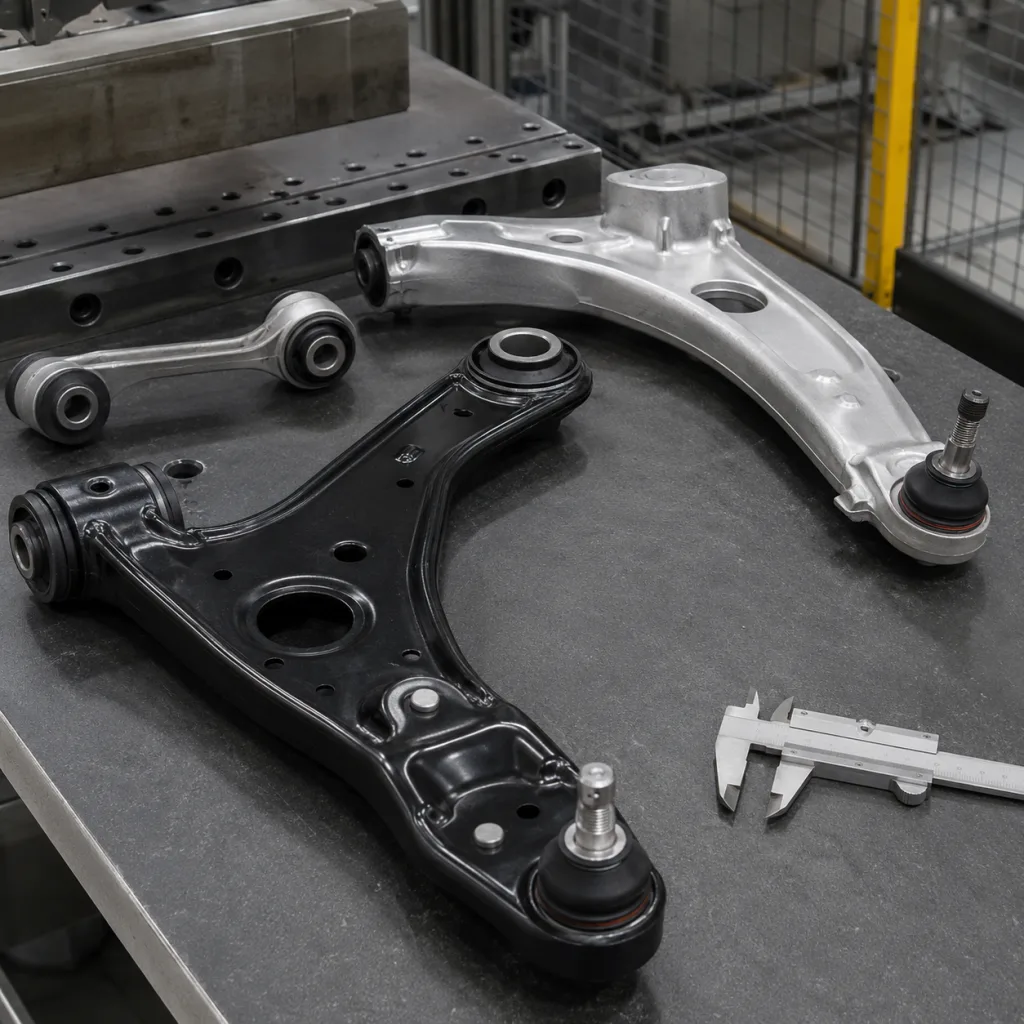
For a workshop, fleet network, or repair chain, control arm replacement is usually priced as a combined parts-and-labour operation. The supplied part may be a bare pressed steel or aluminium arm, or it may include pre-installed bushings, an integrated or bolted ball joint, retaining hardware, and installation accessories. Labour time changes with suspension layout, corrosion level, fastener access, subframe clearance, and whether the ball joint is riveted, bolted, pressed, or built into the arm.
Procurement teams should define replacement cost as a system number rather than a purchase price alone. The cost for control arm replacement usually includes these elements:
Cost element
Typical driver
Procurement impact
Control arm unit price
Material, forging or stamping complexity, bushing type, ball joint inclusion
Direct effect on gross margin
Labour time
Access, seized fasteners, subframe clearance, joint construction
Influences service pricing and bay capacity
Wheel alignment
Often required after arm replacement
Adds technician time and customer charge
Hardware replacement
Stretch bolts, nuts, clips, cotter pins, washers
Should be included, specified, or clearly excluded
Adds freight, administration, and customer-service cost
</tr></thead><tbody> </tbody></table>For high-volume repair chains and distributors, a stable 0.8% claim rate can be worth more than a small reduction in ex-factory price. A 3% claim rate may erase the saving through credits, labour reimbursement, lost bay time, and customer dissatisfaction. Before approving bulk orders, buyers should request application-level drawings, sample inspection reports, batch traceability rules, and packaging standards.
Part Price Versus Installed Cost
The cost for control arm replacement differs by region and sales channel. Labour rates in the US, UK, EU, Canada, Australia, Brazil, and other markets vary widely, but the commercial logic is consistent: the part must fit without rework, hold suspension geometry under load, and avoid noise, vibration, and harshness complaints.
For distributors, the quoted part price should be reviewed beside landed cost. Sea freight, duty, inland transport, packaging density, pallet utilisation, and stocking policy all influence the final shelf cost. A heavier cast aluminium arm may carry a higher freight component than a pressed steel arm. A complete arm with bushings and ball joint may cost more per unit but reduce installation time compared with a bare arm that requires pressing operations.
</tr></thead><tbody> </tbody></table>A complete sourcing file should include the bill of material, coating specification, rubber hardness range, ball joint torque limits, critical-to-quality dimensions, salt spray target, packaging drop-test criteria, and supplied hardware list. Driventus can review these requirements through custom manufacturing when standard catalogue coverage is not enough.
Technical Factors That Move the Price
Control arms look simple from the outside, but several design and process choices affect cost, durability, and workshop experience. A procurement specification should state these variables clearly so quotations can be compared on the same basis.
Arm material: stamped steel, forged steel, cast aluminium, or welded fabricated assemblies.
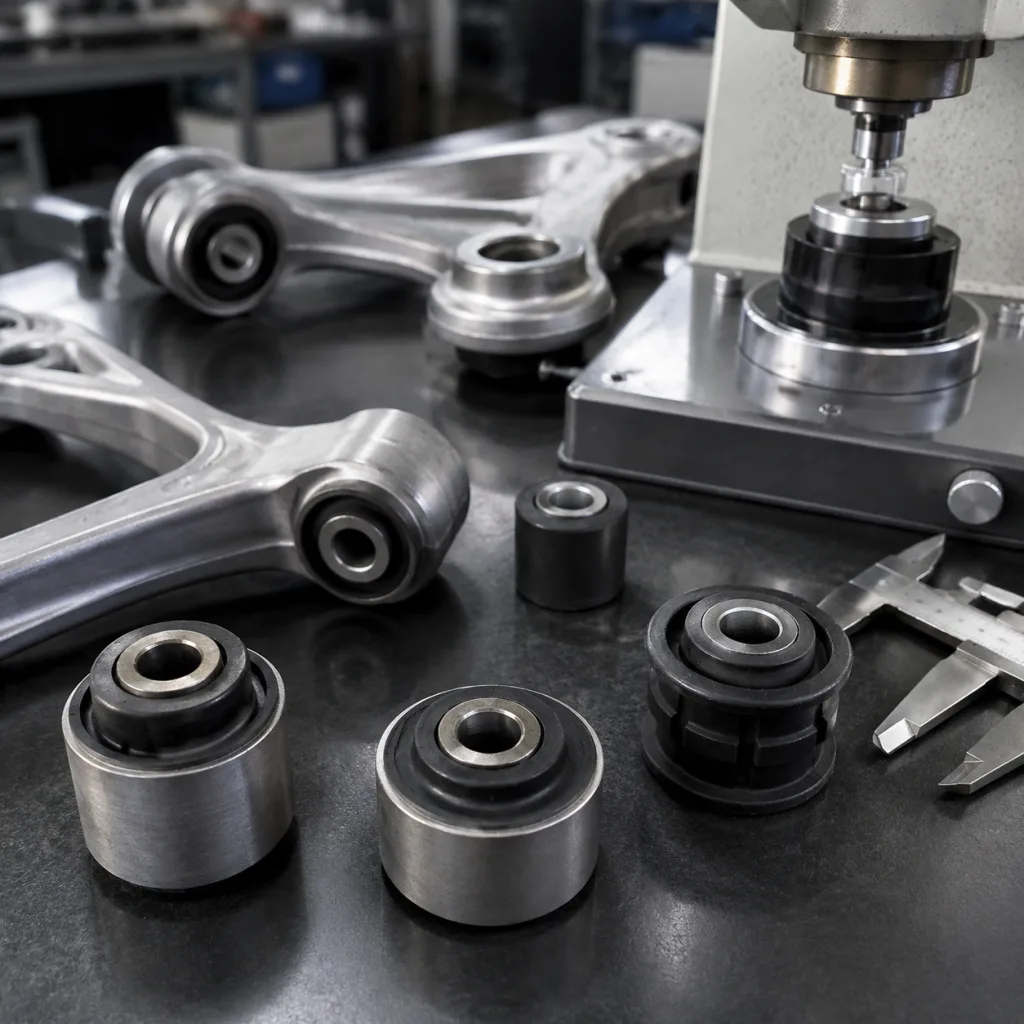
Bushing compound: natural rubber, synthetic rubber blends, or hydraulic bushings where the OE design requires them.
Ball joint design: replaceable, riveted, bolted, pressed, or integrated into the arm assembly.
The largest hidden cost often comes from geometry variation. If the distance between the bushing centre and ball pin centre is outside tolerance, the vehicle may not align correctly. If the ball pin taper is wrong, clamping force, steering feel, and service removal behaviour become unpredictable. If rubber hardness varies too much, the vehicle may pull under braking, transmit vibration, or generate early noise complaints.
Driventus inspection plans combine incoming material checks, in-process fixture inspection, and final batch sampling under an IATF 16949:2016 and ISO 9001:2015 framework. Buyers can review related controls on our quality system page.
How Buyers Should Compare Quotes
A low quote is useful only when the technical scope is identical. When evaluating suppliers, confirm whether each quotation covers the same part structure, coating, hardware, packaging, traceability, and validation level. Many apparent price gaps come from omitted accessories, lighter packaging, lower corrosion targets, or simplified testing.
Quote comparison checklist
Confirm application coverage by vehicle platform, model year range, steering position, drive type, axle side, and chassis variant.
Compare supplied content: bare arm, arm with bushings, arm with ball joint, complete kit, or hardware-included service pack.
Require drawing-based critical dimensions rather than relying only on sample photos or catalogue cross-references.
Ask for rubber hardness data, ball joint rotational torque, pull-out force, stud taper control, and dust boot material.
Confirm corrosion protection test method and target duration; avoid vague claims such as “anti-rust coating” without evidence.
Check carton strength, pallet pattern, barcode format, label language, and private-label artwork requirements.
OE part-number cross-references must be handled carefully. If a buyer uses a generic reference such as OE 11251… for fitment matching, the supplier should still validate dimensions against drawings, samples, and application data. No aftermarket supplier should claim vehicle manufacturer approval unless formal authorisation exists. Driventus is an independent aftermarket manufacturer; brand names are referenced for fitment only.
For standard programme review, buyers can start with our catalog and then request sample validation for selected applications.
Validation, Compliance, and Warranty Control
Control arm validation should match the commercial risk of the programme. A low-volume regional line may require dimensional confirmation, material certificates, and selected durability evidence. A national repair-chain programme needs tighter controls because one fitment or noise issue can spread quickly across branches, applications, and warranty claims.
Relevant published frameworks include IATF 16949:2016 for automotive quality management and ISO 9001:2015 for general quality management. Material and chemical compliance may involve REACH (EC) No 1907/2006 for EU market obligations. Buyers selling into multiple regions should organise documentation by market, product family, part number, and batch.
Recommended validation records include:
Record
Purpose
Buyer value
Initial sample inspection report
Confirms key dimensions before bulk order
Reduces fitment and alignment risk
Material certificate
Verifies steel, aluminium, rubber, and fastener grade
Supports claim investigation and supplier control
Bushing hardness report
Confirms rubber consistency
Controls NVH variation and ride feel
Ball joint torque test
Measures movement resistance and consistency
Reduces steering complaints and premature looseness
Coating test report
Confirms corrosion protection target
Supports regional durability requirements
Packaging test record
Verifies carton and pallet integrity
Reduces freight damage and missing-part claims
</tr></thead><tbody> </tbody></table>The supplier should also maintain traceability by batch code, production date, and inspection record. This enables containment if a field issue appears. For procurement teams, traceability is not paperwork overhead; it is the mechanism that limits warranty exposure and protects profitable programmes.
Practical Budgeting for Distributors and Fleets
The cost for control arm replacement should be budgeted by channel. A distributor focuses on landed unit cost, catalogue coverage, margin, stock rotation, and return rate. A repair chain focuses on bay time, comeback rate, technician confidence, and alignment workflow. A fleet operator focuses on uptime, predictable maintenance intervals, and fewer repeat visits.
A practical B2B model should include these inputs:
Ex-factory unit price by MOQ tier and annual volume commitment.
Freight, duty, and inland transport per unit after carton and pallet optimisation.
Expected claim rate by application, warranty period, and operating environment.
Alignment time, labour exposure, and potential comeback cost after replacement.
Inventory turns for left/right, upper/lower, front/rear, and platform-specific variants.
Slow-moving SKU reserve for less common vehicles or ageing platforms.
Packaging, barcode, labelling, and private-label setup cost.
A lower-priced arm that creates additional alignment time, repeated noise complaints, or higher return freight may have a higher true cost than a more consistent OE-equivalent assembly. At the same time, over-specifying a premium arm for low-value older applications can reduce competitiveness. The right purchasing decision depends on market position, application mix, price tier, service promise, and acceptable warranty exposure.
Driventus supports distributors, OEM/Tier-1 suppliers, and multi-location repair chains with standard and customised control arm programmes. Buyers can share target applications, annual volume, packaging requirements, and validation needs through request a quote.
Frequently asked questions
Labour and alignment often exceed the part cost in retail service. For B2B buyers, the main drivers are landed unit cost, supplied content, warranty rate, and fitment consistency. A complete arm with bushings and a ball joint may cost more upfront but can reduce workshop time, missing-part issues, and returns.
The choice should follow the original vehicle design and target market. Steel arms are usually cost-effective and durable. Aluminium arms can reduce weight but may cost more and require stricter casting, forging, and dimensional controls. Buyers should compare geometry, material grade, coating, and validation evidence rather than material alone.
Yes. Driventus can support private-label packaging, application consolidation, and custom manufacturing where MOQ and tooling conditions are agreed. Buyers should provide target applications, forecast volume, preferred carton format, barcode requirements, label rules, and any market-specific compliance documents.
If you are benchmarking replacement cost, warranty exposure, or a private-label control arm programme, send the application list and annual volume for review. Contact Driventus at /contact.html