camshaft · 2026-06-16

Camshaft Ford OEM Supplier: B2B Sourcing Guide

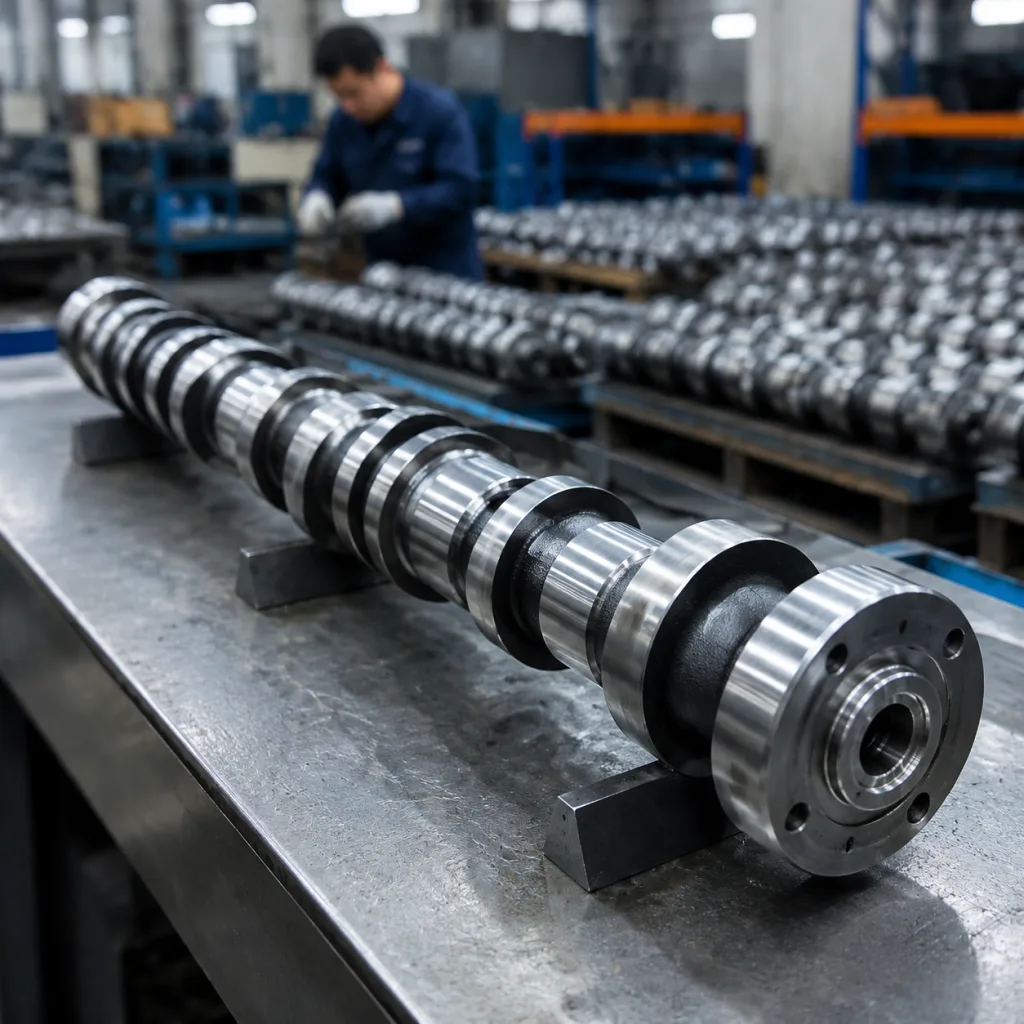
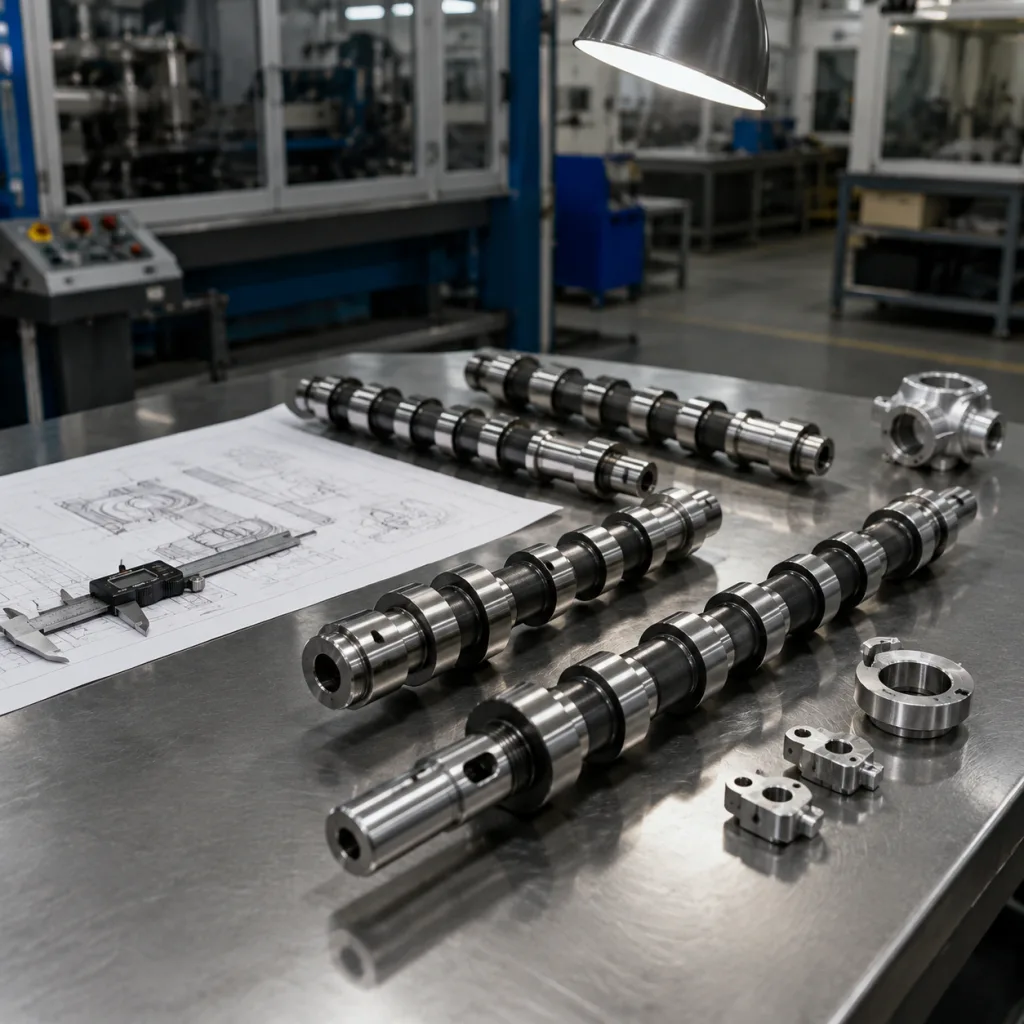
Procurement teams sourcing Ford-fitment camshafts need more than a dimensional drawing and a unit price. A credible camshaft Ford OEM supplier has to control the full chain: casting or forging inputs, heat treatment, lobe grinding, surface finish, cleaning, packaging, and batch traceability. Commercial terms matter just as much as technical control, especially for distributor, OEM service, and repair-chain programmes that depend on stable MOQ, realistic lead times, documented inspection, and audit support. This guide explains how to evaluate a camshaft Ford OEM supplier for independent aftermarket and contract manufacturing programmes. It covers manufacturing routes, material and process checks, quality documentation, commercial expectations, and the questions to ask before issuing a purchase order. Driventus is an independent aftermarket manufacturer; brand names are referenced for fitment only.

Camshaft sourcing decisions: what matters first

A camshaft is timing-critical. Small deviations in lobe profile, journal diameter, runout, or hardness can affect valve lift, oil-film stability, noise, emissions performance, and service life. Before talking price, buyers should sort the requirement into one of three sourcing paths:

  • Aftermarket distribution: broad SKU coverage, private-label packaging, stable replenishment, and fitment cross-reference support.
  • OEM service or Tier-1 supply: PPAP-style documentation where required, tighter change control, and agreed control plans.
  • Repair-chain supply: predictable availability, low warranty exposure, and clear installation guidance for technicians.

That first split matters because it changes everything else: documentation depth, packaging, lead time, and how much process control the supplier must prove. Driventus supports camshaft sourcing within wider engine component programmes. Buyers can review our catalog for related engine and powertrain parts, including pistons, gaskets, crankshafts, water pumps, and turbochargers. For dedicated engine lines, the engine components page at /products/engine-components.html can also help align camshaft demand with adjacent SKU planning.

When requesting a quote, provide engine family, intake/exhaust position, valve count, VVT/phaser requirement, target market, annual forecast, and the acceptable tolerance stack if your team already has one. If you can accept an existing tooling base, say so. If you need a fresh build, say that too. That single detail often changes launch timing more than the geometry does.

Inside the part: route, tolerances, and control points

Camshafts may be produced from chilled cast iron, ductile iron, steel billets, or assembled constructions depending on engine family, load, lubrication condition, and cost target. The route should fit the application, not the other way around.

Typical control points include:

</tr></thead><tbody> </tbody></table>For the sourcing file, buyers should not stop at a nominal diameter. Ask for the values that actually control function:

  • Journal diameter tolerance should be stated on the drawing, typically to a controlled band such as ±0.005 mm to ±0.015 mm depending on journal function and bearing strategy.
  • Lobe lift, base-circle diameter, and lobe separation must be locked to the application; request profile data rather than relying on a nominal diameter alone.
  • Total indicated runout should be defined at final inspection, commonly in the 0.02 mm to 0.05 mm range for precision-sourced automotive camshafts, unless the OEM drawing requires tighter control.
  • Surface roughness should be specified for both journals and lobes, often with journal Ra and lobe Ra limits stated separately; many buyers request journal Ra around 0.2 to 0.4 µm and lobe Ra around 0.4 to 0.8 µm, subject to engine design.
  • Hardness and microstructure limits should be documented after heat treatment, including target hardness range, quench depth where relevant, and rejection criteria for decarburization, porosity, or cracks.
  • End-play, thrust-face finish, oil-hole geometry, sensor trigger geometry, and phaser interface dimensions should be listed when the part is used in variable valve timing systems.
  • Anti-rust oil, VCI packaging, or equivalent export protection should be specified for sea freight, with salt-spray or storage-duration expectations agreed in advance.

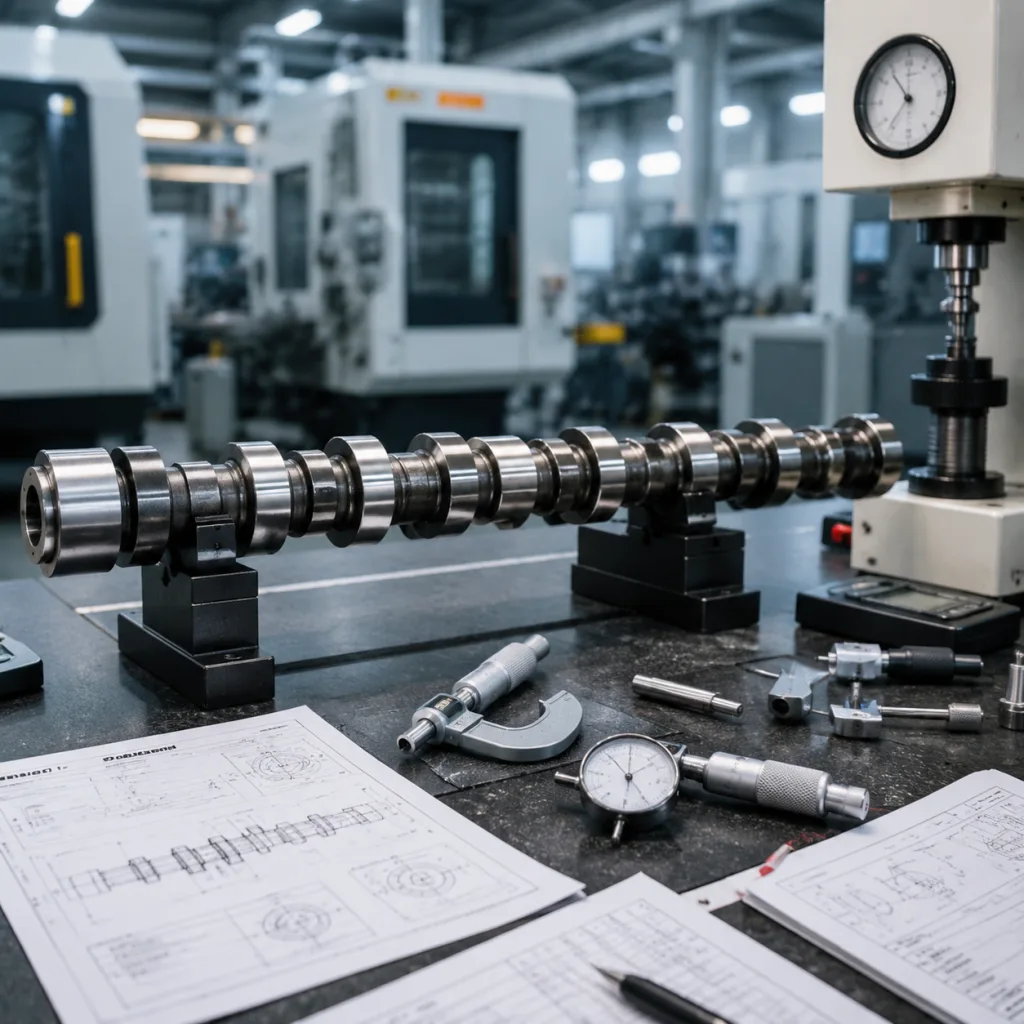
If the program is new, ask for a first-article dimensional report, material certificate, hardness map, and profile scan on the first lot before approving mass production. For ongoing supply, the control plan should state which dimensions are checked 100%, which are sampled, and what happens if drift is detected. Driventus does not claim approval or endorsement by any vehicle manufacturer; the target is OE-equivalent fitment and performance for independent aftermarket or contract supply programmes, verified through drawings, samples, and agreed inspection plans.

Quality proof without the fluff

A credible camshaft Ford OEM supplier should show both system certification and part-level records. Certification alone is not enough, but it does show that document control, corrective action, calibration, supplier management, and traceability are managed as a system.

Driventus operates under IATF 16949:2016 and ISO 9001:2015. Buyers can review our quality system when preparing supplier qualification packs or remote audit checklists.

For camshaft sourcing, audit files commonly include:

  • Business licence and export documentation.
  • IATF 16949:2016 and ISO 9001:2015 certificates.
  • Process flow diagram and control plan.
  • FMEA or equivalent risk review where required by the buyer.
  • Incoming material inspection records.
  • Heat-treatment batch records.
  • Final dimensional report with calibrated gauge references.
  • Nonconformance and corrective-action procedure.
  • Packaging drop, corrosion, or transport protection evidence where specified.

Where parts enter the EU, UK, or other regulated markets, buyers may also request material declarations aligned with REACH (EC) No 1907/2006 and applicable customer restricted-substance lists. Camshafts are not certified as standalone emissions devices, but engine performance can affect regulated outcomes. For vehicle-level programmes, buyers should manage compliance against the relevant vehicle or engine requirements, such as ECE R-83 where applicable to emissions type approval.

Two audit questions matter more than a certificate number. Can the supplier trace one finished camshaft back to its material heat, heat-treatment batch, grinding line, and packing date within one working day? And when drift is found, does the corrective-action process include containment, root cause, effectiveness verification, and retroactive screening? That is the difference between paperwork and control.

Quality proof without the fluff

Lead times, MOQs, and the economics behind the quote

Commercial feasibility depends on SKU maturity, tooling status, blank availability, packaging requirements, and inspection depth. A mature aftermarket camshaft with existing tooling normally carries different lead-time and MOQ expectations from a new custom programme.

Typical sourcing parameters for discussion:

Process stage Buyer concern Evidence to request
Raw materialChemistry and cleanlinessMill certificate or incoming material report
Casting or forgingPorosity, inclusions, grain structureMetallographic records and defect limits
Heat treatmentLobe and journal wear resistanceHardness map and case-depth data where applicable
Rough and finish machiningDatum control and concentricityIn-process inspection sheet
Lobe grindingLift curve, flank profile, nose radiusProfile measurement report
StraighteningRunout and journal alignmentFinal runout record
Washing and preservationCleanliness and corrosion protectionCleaning process record and packaging standard

</tr></thead><tbody> </tbody></table>These are planning ranges, not commitments. Alloy availability, heat-treatment capacity, holiday schedules, and sea-freight routes can move the date. Pricing shifts for the same reasons. Active tooling and steady volume usually support lower unit cost; low-volume or new-profile camshafts need a higher first-price because setup, test, and scrap risk are still being carried.

If a quote looks unusually low, ask what it assumes. Reused tooling? Reduced inspection? Simpler packaging? Those shortcuts often reappear later as delay or nonconformance.

For import managers, the real question is not just the first MOQ. It is whether the supplier can keep replenishment stable for the fast movers without forcing excess stock on the slow movers. A common structure is pilot order first, then forecast-based replenishment once first-article approval is complete. Buyers should ask for price breaks at 500, 1,000, and 3,000-unit tiers, plus the surcharge for custom labels, corrosion-protection upgrades, and third-party inspection if required. Driventus can also discuss mixed-container planning across camshafts and other engine components to support distributor inventory turns.

Fitment checks: avoid the lookalike trap

Ford-fitment camshaft programmes require careful cross-reference management. A part that looks similar by length or journal count may still differ in lobe profile, sensor trigger design, oil-feed detail, or phaser interface.

Useful enquiry data includes:

  • OE-style reference format if already used in the buyer system, such as OE 06A… only where relevant to the existing catalogue data.
  • Engine family and displacement.
  • Intake or exhaust camshaft position.
  • Variable valve timing interface requirement.
  • Sensor wheel, slot, or trigger pattern details.
  • Target annual volume and shipment destination.
  • Required markings, carton label fields, barcode format, and pallet standard.

Do not approve a part by visual comparison alone. A sourcing engineer should confirm journal layout, thrust location, oil holes, drive feature, cam sensor reference, and measured lobe profile. In practical terms, that means verifying at least the journal center distance, overall length, flange or sprocket end geometry, thrust face width, and lift profile against a known-good sample or drawing.

If the buying team has access to a returned-failure sample, request metallurgical comparison, wear-pattern photos, and a dimensional delta report before placing a replenishment order. Those three items often expose the root cause faster than a plain part-number match.

Fitment checks: avoid the lookalike trap

Buyer checklist: the questions that expose weak suppliers

Use a structured checklist before nominating a supplier. It reduces ambiguity between purchasing, engineering, quality, and logistics teams.

Camshaft sourcing checklist

  • Confirm whether the requirement is catalogue aftermarket supply or custom manufacturing.
  • Request certification to IATF 16949:2016 and ISO 9001:2015.
  • Check material, hardness, runout, lobe profile, and surface-finish controls.
  • Review traceability from raw material batch to finished carton.
  • Ask for packaging suitable for ocean freight and warehouse handling.
  • Define AQL, inspection frequency, and retained-sample rules.
  • Confirm private-label, neutral, or buyer-branded packaging requirements.
  • Agree lead time, MOQ, payment terms, and forecast update frequency.
  • Require written change notification for material, process, tooling, or sub-supplier changes.
  • Verify export documentation, HS code handling, and destination-market material declarations.
  • Ask for a first-article report with actual values, not only pass/fail marks.
  • Confirm whether incoming inspection can be waived only after a stability period.
  • Ask how the supplier handles line stoppage, late shipment, and shortage allocation.

A supplier that can answer these points clearly will usually reduce onboarding time. A supplier that cannot separate technical requirements from sales claims may create risk later in the programme. For Ford-fitment parts, the buyer should retain final responsibility for application validation in the destination market and service channel. If the programme is important enough to carry warranty exposure, it is important enough to require written acceptance criteria, not just sample approval by email.

Frequently asked questions

Yes. Driventus can support Ford-fitment camshaft sourcing for independent aftermarket distributors, repair-chain supply, and contract manufacturing projects. Application data, samples, drawings, annual volume, and packaging requirements are needed before quotation.

Typical qualification files include IATF 16949:2016 and ISO 9001:2015 certificates, process flow, control plan, inspection reports, material records, heat-treatment data, and packaging specifications. Exact documentation depends on the part and buyer requirements. Buyers can also request first-article dimensional reports, hardness maps, profile scans, and traceability records tied to the finished lot.

Yes. Driventus can discuss neutral packaging, buyer-label cartons, barcode fields, pallet standards, and mixed-container planning across camshafts and related engine components, subject to MOQ and confirmed production schedule. Pricing usually changes with label complexity, carton testing, pallet pattern, and whether shipments are consolidated by SKU or built as dedicated lots.

If you are evaluating a camshaft Ford OEM supplier for distributor, repair-chain, or contract manufacturing supply, share your application list, target volume, and documentation needs. Contact Driventus to [request a quote](/contact.html).

Request a Quote
Requirement Existing catalogue item Custom or new development item
Sample lead-time2–4 weeks when blanks are available6–10 weeks after drawing confirmation
Mass production lead-time45–75 days depending on order mix75–120 days after sample approval
MOQOften 100–300 pcs per SKU for active catalogue items, sometimes lower for replenishment lotsOften 300–1,000 pcs per SKU or tied to tooling amortization and setup time
ToolingExisting if validatedQuoted separately if required
PackagingNeutral or buyer labelBuyer-specific artwork and carton tests
DocumentationStandard inspection reportControl plan, PPAP-style pack if required