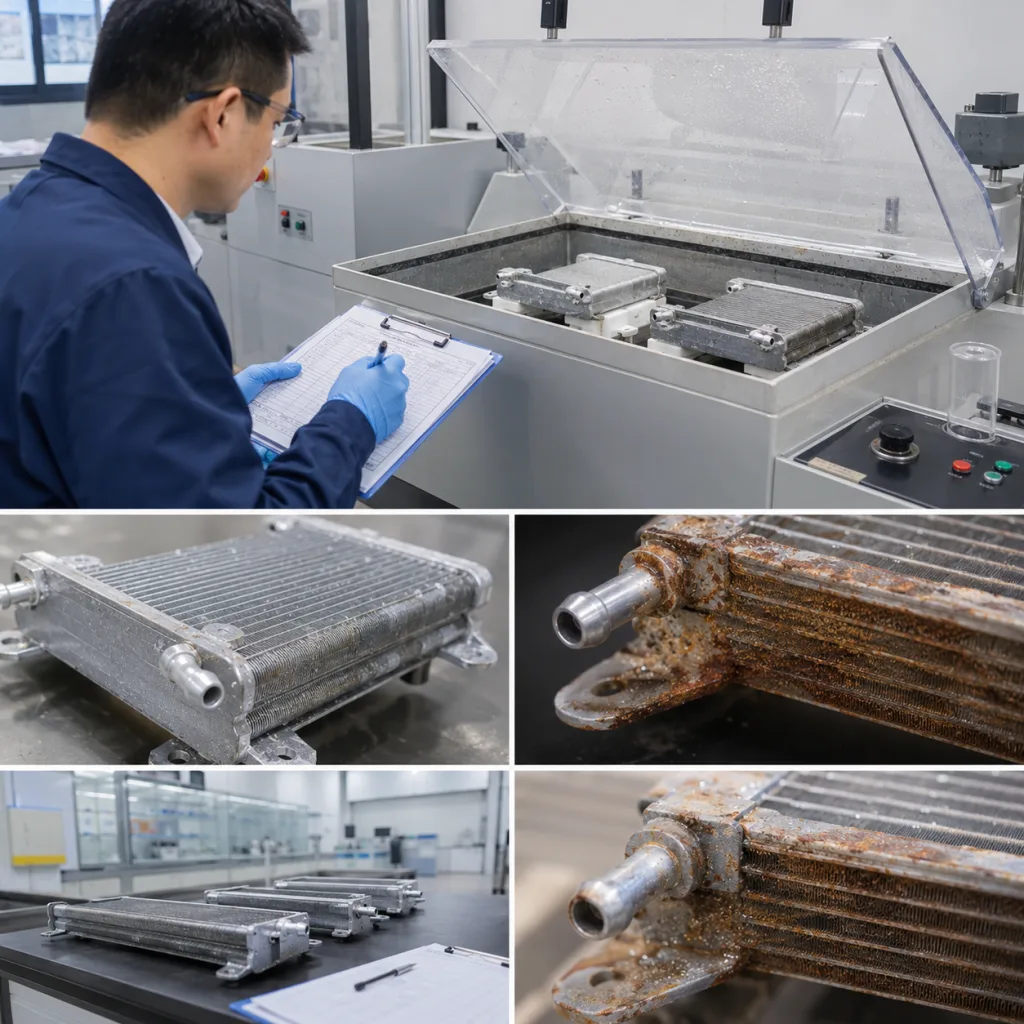
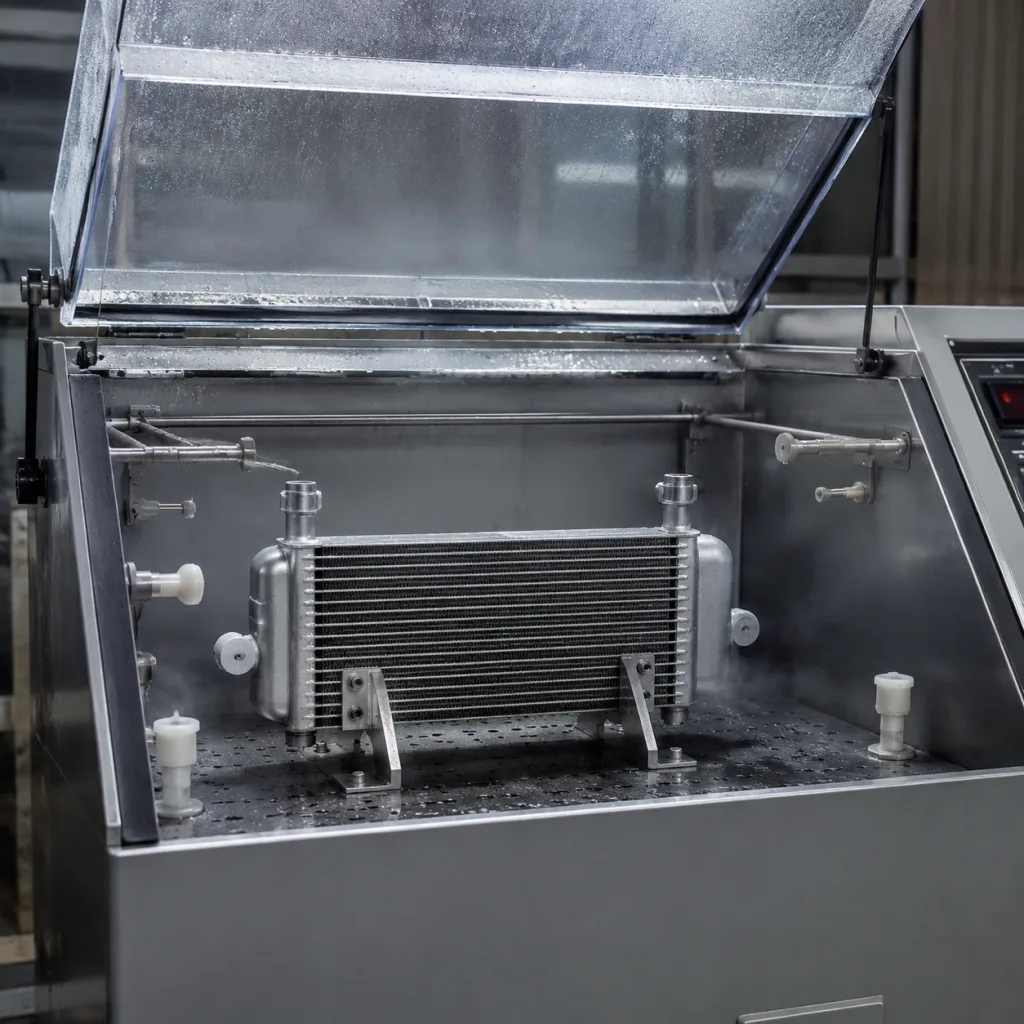
If you source oil coolers, the oil cooler salt spray test standard is useful only when it answers a specific buying question: will this part survive the corrosion exposure your program actually expects? The test can compare coating, brazing, and end-tank protection under controlled chloride conditions, but it does not replace leak testing or field validation. That is why the purchase spec should name the method, duration, sample count, coating window, and post-test inspection before quotes are compared. Driventus is an independent aftermarket manufacturer; brand names are referenced for fitment only. We supply oil coolers to distributors, OEM/Tier-1 customers, and repair networks from Taizhou, Zhejiang, with IATF 16949:2016 and ISO 9001:2015 controls. This guide focuses on how to choose the right standard, spot weak reports, and avoid apples-to-oranges comparisons.
Start with the buying question, not the cabinet
The phrase "oil cooler salt spray test standard" is often used as shorthand, but procurement should turn it into a clear requirement. Ask first: are you trying to screen coating quality, compare suppliers, or qualify a production part for export? The answer determines the method, exposure hours, and acceptance criteria.
Buyer need
What to specify
Why it matters
Supplier comparison
Same standard, same sample state, same hours
Keeps quotes comparable
Production approval
Standard plus function check
Verifies the part still works
Export compliance
Standard plus chemistry documentation
Supports market entry paperwork
Field-life screening
Standard plus corrosion limit and leak test
Reduces warranty risk
</tr></thead><tbody> </tbody></table>For most oil coolers, the test should be tied to the actual build state: bare, coated, brazed, assembled, or packaged with protective oil. If the part state is not fixed, the result is hard to trust. A supplier can look strong on paper and still fail once the real production finish is tested.
If you are mapping the requirement to a broader sourcing program, align the corrosion spec with the rest of the product line in our catalog and confirm the supplier’s documented quality system.
ASTM B117 or ISO 9227: which one fits your spec?
The two names buyers see most often are ASTM B117 and ISO 9227. They are related, but they are not identical in how purchasing teams should use them.
`ASTM B117` is the common neutral salt spray reference in North American sourcing.
`ISO 9227` is widely used for neutral, acetic acid, and copper-accelerated salt spray methods.
Both are valid only when the exposure conditions and evaluation rules are written into the PO or drawing.
Neither standard alone proves service life in the vehicle.
In practical sourcing terms, use the standard your customer or market already recognizes, then lock down the rest of the test package. That means solution concentration, cabinet temperature, part orientation, sample count, exposure time, and failure definition. If the supplier says "salt spray passed" without those details, the report is too vague to support approval.
For oil coolers, the better question is often not which standard is best, but whether the same standard was used on the same part configuration. A coated end tank, a brazed core, and a finished assembly do not behave the same way in the chamber.
What a useful test report must show
A report is only procurement-ready if it lets you trace the sample, the method, and the outcome in one pass.
Minimum fields to check
Part number, revision, and batch or lot number
Alloy, coating type, and pretreatment process
Coating thickness target and tolerance
Exact standard name, not just "salt spray"
Exposure hours, sample count, and chamber setup
Solution concentration and cabinet temperature
Failure criteria, including red rust, white rust, blistering, or leakage
Post-test function check, such as pressure retention or leak-free status
Do not rely on photos alone. A stained surface is not always a failure if the spec allows cosmetic corrosion. The reverse is also true: a clean-looking exterior may still hide leakage, poor brazing, or edge-seal damage. For an oil cooler, function matters more than a pretty panel.
A strong supplier report should also connect the test to batch traceability and the production control plan. That is the practical value of IATF 16949:2016 and ISO 9001:2015 controls: the result is not just a sample-story, it is evidence the process can be repeated.
Failure modes buyers should screen for
Salt spray exposes different weak points, and each one points to a different manufacturing problem. If you know the likely failure mode, you can ask better questions during sourcing.
`White rust` often points to surface finish or coating weakness.
`Red rust` usually signals deeper corrosion risk or coating breakdown.
`Blistering` may indicate poor pretreatment or trapped contamination.
`Leakage` suggests brazing, seam, or joint integrity problems.
`Dimensional drift` can appear after exposure if the part was not stabilized properly.
This is why a pass/fail line alone is too thin for procurement. A bracket can corrode cosmetically and still be acceptable, while a tiny leak at a header joint is a hard reject. The acceptance rule should separate cosmetic zones from functional zones.
For buyer teams, the safest approach is to require three checks after exposure: visual inspection, leak test, and dimensional confirmation where needed. That gives you a functional decision, not just a cabinet result.
A practical acceptance framework
Acceptance criteria work best when they are written by function, not by general appearance. For oil coolers, most sourcing specs end up using a mix of cosmetic and performance rules.
Criterion
Cosmetic check
Functional check
Buyer priority
Surface staining
Yes
Sometimes
Low alone
Red rust on sealing area
No
Yes
High
Leak-free after exposure
No
Yes
Required
Mounting fit and flatness
No
Yes
Required
Coating thickness window
Yes
Sometimes
High
Batch traceability
Yes
Yes
Required
</tr></thead><tbody> </tbody></table>A clear specification might allow light cosmetic corrosion on non-critical brackets but require zero leakage, no cracking, and no red rust on sealing surfaces. If the part is for export, also check whether the coating chemistry and associated documentation fit REACH (EC) No 1907/2006 and the destination market’s paperwork needs.
Commercially, it helps to freeze MOQ, sample quantity, and lead-time expectations alongside the test rule. Otherwise, the supplier may approve a lab sample and still miss your replenishment model.
Common mistakes that distort the result
The biggest sourcing error is treating the standard name as enough. It is not. The part state, cleaning method, and acceptance rule change the meaning of the result.
Watch for these traps:
No exact standard named in the report
No note on coating thickness before testing
No pressure test after corrosion exposure
No sample preparation or cleaning record
No link to the production lot
No commercial follow-through on MOQ or lead time
Another trap is comparing test hours as if they were the whole story. 240 hours is not automatically better than 96 hours if the samples were prepared differently. Geometry, orientation, and finish all matter. For repair networks and distributors, the real goal is repeatability across lots, not a one-time headline number.
If you need private-label or export support, use request a quote to specify the standard, exposure hours, acceptance limit, and expected order quantity so the technical claim and commercial offer match.
Frequently asked questions
No. It is one input only. Buyers should also require leak testing, dimensional checks, coating verification, batch traceability, and a post-test functional check. Salt spray compares corrosion resistance; it does not prove full service life.
ASTM B117 and ISO 9227 are the most commonly referenced methods. The right choice depends on customer specification, export market, exposure duration, and how the part will be evaluated after exposure.
Yes. For oil coolers, function matters as much as appearance. A valid report should show that the unit remained leak-free and structurally sound after the corrosion exposure and inspection, ideally with the test pressure, hold time, and acceptance limit documented.
If you need an oil cooler test specification, batch documentation, MOQ guidance, or private-label supply support, send your drawing and target standard through /contact.html.