oil cooler · 2026-06-05

Oil Cooler Material Grade Comparison for B2B Sourcing

A useful oil cooler material grade comparison starts with the failures buyers are trying to prevent. Base metal, temper, clad layer, coating, and joining method all influence heat rejection, corrosion behaviour, braze or weld integrity, pressure capability, weight, machinability, and service life. A material that looks fine in a static bench test can still fail early once it sees chloride-rich road spray, coolant contamination, aggressive degreasers, repeated cold-start pressure spikes, vibration at unsupported brackets, or poor galvanic isolation at ports and fasteners.

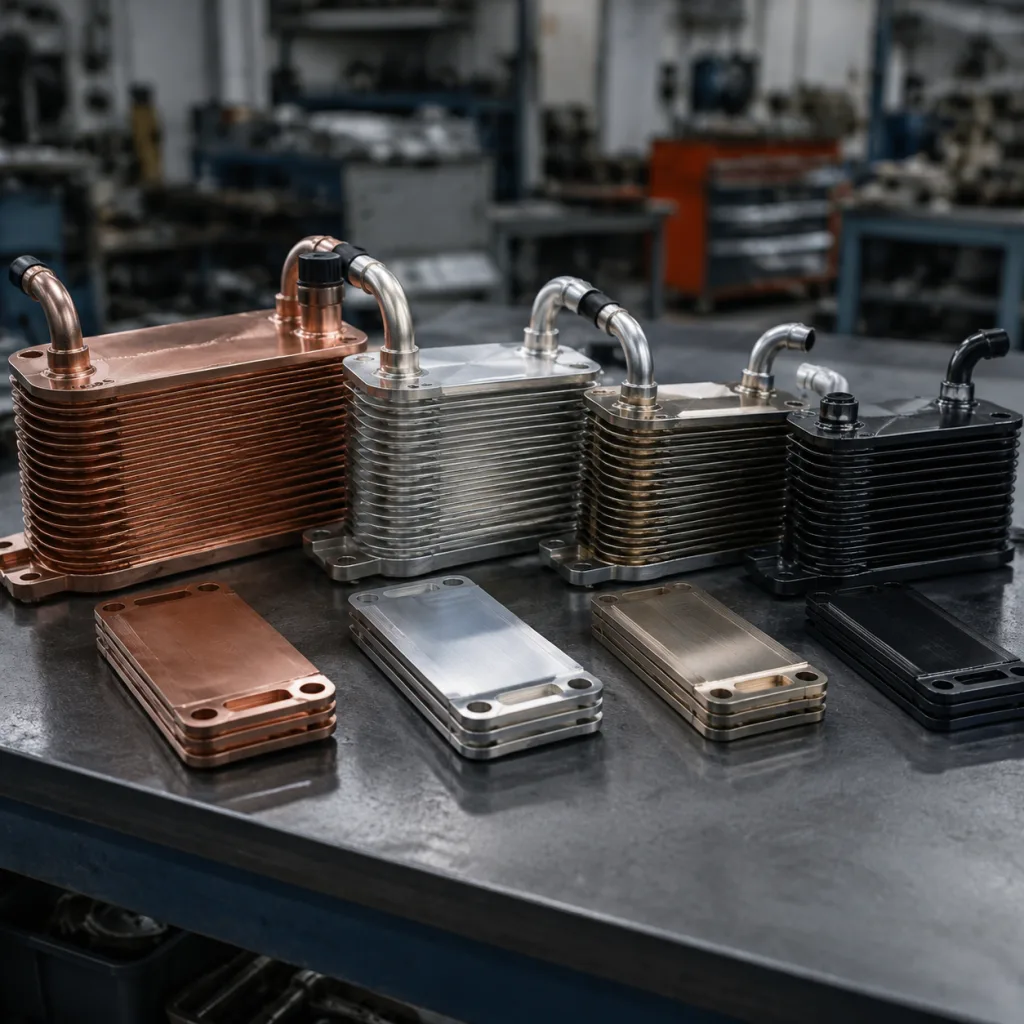
For procurement teams, the decision is rarely aluminium versus steel in the abstract. The real sourcing question is whether a specific alloy family, wall thickness, braze-clad specification, coating system, and joining process fit the application, region, validation plan, and warranty target. This guide compares brazed aluminium, stainless steel, copper-brass, cast aluminium, coated carbon steel, and mixed-material constructions used in plate-and-fin, tube-and-fin, and stacked-plate oil coolers for passenger vehicles, light commercial vehicles, and industrial systems. Driventus is an independent aftermarket manufacturer; brand names are referenced for fitment only. The aim is to make oil cooler material grade comparison practical for B2B buyers by tying material choice to operating environment, test evidence, manufacturability, and total landed cost.

What material grade changes in an oil cooler

In an oil cooler, material grade changes far more than a single conductivity value on a datasheet. Core tubes and fins are usually chosen for heat transfer, formability, and brazeability, while headers, tanks, adapters, bosses, and brackets may be chosen for yield strength, machinability, seal retention, thread durability, or corrosion resistance. A supplier can accurately call a cooler *aluminium* even when the ports are steel, the adapter block is cast, and the bracket coating is doing much of the corrosion work. That is why buyers need to compare the full assembly BOM, not one alloy callout.

Material grade affects five performance areas at once:

  • Heat rejection: Aluminium alloys used in cooler cores typically offer thermal conductivity in the rough range of 120 to 200 W/m-K depending on alloy and temper, while austenitic stainless steels such as 304 or 316 are typically around 14 to 16 W/m-K. Copper is much higher again, often around 380 to 400 W/m-K, but base metal is only part of the picture. Assembly design, airside fin efficiency, oil flow, and fouling also shape real-world performance.
  • Pressure capability: Stronger grades or thicker sections improve burst and fatigue margin. In practice, B2B buyers should review design pressure, burst ratio, and impulse life together. A cooler for passenger vehicle engine oil service may need only modest continuous pressure capability, while transmission, hydraulic, or cold-start conditions can impose much higher transient loads.
  • Corrosion mode: Aluminium typically faces pitting and crevice corrosion, especially where chloride deposits stay wet. Stainless is generally more resistant to atmospheric chloride attack, with 316/316L usually outperforming 304/304L because of its molybdenum content. Copper-brass can see dezincification, erosion-corrosion, or solder-joint ageing. Mixed metals can create galvanic cells if electrical isolation and coating continuity are weak.
  • Joining reliability: Controlled atmosphere brazing (CAB), vacuum brazing, TIG welding, laser welding, soldering, and mechanical crimping all respond differently to alloy choice, oxide control, and wall thickness. For brazed aluminium, braze-clad chemistry and furnace stability are often just as important as the parent alloy.
  • Production yield: Some grades form cleanly and join consistently at volume; others increase scrap, rework, tooling wear, distortion, or leak-test fallout. Yield loss at the furnace or weld cell can wipe out an apparent material saving.

Common sourcing questions are straightforward, but they need precise answers before RFQ release:

  • Will the cooler see engine oil only, ATF only, hydraulic oil, or oil-to-coolant exchange with OAT, HOAT, or another long-life coolant chemistry?
  • Is the vehicle used in coastal, winter-road-salt, mining, agricultural, marine-adjacent, or high-humidity regions?
  • Is the design brazed, welded, crimped, soldered, or mechanically assembled with seals that must survive long exposure to 120 to 150 deg C oil?
  • Does the application prioritise low mass and compact packaging, or repairability, thicker walls, and higher abuse tolerance?

The commercial point is simple: a cheaper base material can become the expensive choice if it needs thicker walls, extra coating steps, larger frontal area, more brackets, or a broader validation programme to reach the same field life. Any oil cooler material grade comparison should therefore cover corrosion resistance, joinability, yield strength, coating strategy, and manufacturing consistency, not just raw thermal conductivity.

Side-by-side comparison of common grades

The table below captures the trade-offs most buyers review during an oil cooler material grade comparison. These are representative material families used in the market, not a substitute for the exact drawing, mill certificate, or component-level BOM.

</tr></thead><tbody> </tbody></table>In current passenger vehicle and light commercial programmes, brazed aluminium usually offers the strongest overall balance because it combines good heat transfer, low mass, and scalable manufacturing. Stainless steel becomes more attractive when external corrosion risk, media aggressiveness, cleaning chemistry, or pressure severity matter more than weight and cost. Copper-brass still has a place in some legacy and repair-oriented markets, but it is less aligned with today's packaging and mass targets.

The sourcing lesson is straightforward: broad labels are not enough. Ask for the exact alloy family and temper by component, the braze-clad specification where relevant, the coating or passivation method, and the joining route used on the production part. A quote that says only *aluminium* or *stainless* leaves too much technical and commercial risk unresolved.

How to match grade to the operating environment

A sound material choice starts with the duty cycle and exposure map, not a catalogue image. For oil-to-air coolers, fin pitch, face area, airside pressure drop, airflow quality, and stone-impact protection influence performance as much as alloy selection. For oil-to-coolant designs, compatibility with coolant additives, elastomer seals, and adjacent housing metals becomes just as important as the core material itself.

Use these checks before RFQ release:

1. Confirm the fluid circuit: engine oil, ATF, hydraulic oil, or an oil-to-coolant exchanger with specific coolant chemistry. 2. Define continuous temperature, peak temperature, cold-start pressure spikes, and pressure pulsation range. 3. Identify exposure to road salt, marine air, fertilisers, mud, pressure washing, alkaline cleaners, and stone impact. 4. Check the full stack-up for dissimilar metals at fittings, brackets, fasteners, sensors, and mating housings. 5. Verify packaging limits for thickness, frontal area, mounting stiffness, and allowable mass. 6. Confirm whether the customer values lowest weight, longest corrosion life, easiest field repair, or lowest initial piece price.

For standard on-road passenger and light commercial applications, brazed aluminium is usually the first material family to assess because it supports compact packaging and competitive weight. In winter-road-salt or coastal markets, aluminium can still be the right answer if the supplier has a validated coating system, controlled braze quality, and evidence that fittings and brackets are galvanically managed. In those programmes, details such as edge protection, fin collar quality, and bracket drainage can materially change field life.

Bare or poorly protected steel may look economical at quotation stage but become expensive later if stone chipping exposes the substrate. Once corrosion starts at chip points, local wall loss can accelerate quickly in splash zones and under retained deposits.

For heavy-duty, industrial, or chemical-adjacent environments, stainless steel may justify the premium. Its lower conductivity penalty can often be offset by larger surface area, altered fin geometry, or a different flow path when the bigger commercial risk is corrosion-driven leakage or very long service intervals. Where platforms are older, service-focused, or repaired in the field rather than replaced as sealed modules, copper-brass may remain commercially viable because repairability and solder rework can matter more than mass.

Mixed-material assemblies need extra scrutiny. An aluminium core with steel fittings, stainless sensors, or cast housings can perform well, but only when the isolation strategy is deliberate. Ask how the supplier controls galvanic couples, seal compression set, and coating continuity at interfaces. For buyers serving multiple regions, the safest approach is to specify performance targets and field conditions first, then let the supplier recommend the material stack that meets them with test evidence.

Validation tests buyers should request

An oil cooler material grade comparison is incomplete without representative test evidence. Buyers should ask for reports that connect the selected grade to the real use case, not just a generic material certificate or brochure claim. The critical question is whether the exact material stack, wall thickness, joining process, and surface treatment have survived conditions close to the field profile.

Common validation items include:

  • Material traceability: Mill certificates or equivalent declarations showing the actual alloy or grade by component, plus clad thickness or coating information where applicable.
  • Leak and proof pressure testing: Room-temperature and elevated-temperature leak checks that reflect both production screening and validation conditions. Production leak testing is commonly done with air decay, helium, or under-water methods depending on line capability.
  • Burst pressure testing: Confirmation that the assembly maintains an adequate safety margin above maximum operating pressure. Many buyers use a minimum internal safety factor target, but the required ratio should be specified by application rather than assumed.
  • Pressure impulse or fatigue testing: Cyclic pressure loading to evaluate crack initiation at tubes, headers, weld toes, braze fillets, or threaded adapters. This is especially important where cold-start viscosity and pump behaviour create transient spikes.
  • Thermal cycle and thermal shock testing: Repeated transitions between hot oil and lower ambient or coolant temperatures to expose joint fatigue, differential expansion, and seal movement.
  • Corrosion testing: Salt spray is a basic screen, but cyclic corrosion usually gives a better picture for underbody automotive use because it includes wet-dry cycling and deposit effects.
  • Vibration and mechanical durability: Testing the cooler with the real bracket configuration, hose mass, and mounting stiffness, not just an isolated core.
  • Metallographic or section analysis: Cross-sections of brazed joints, braze fillet continuity, weld penetration checks, and wall-thickness verification after forming or joining.
  • Fluid compatibility and cleanliness: Confirmation that oil, coolant, and seal materials remain stable, and that internal cleanliness meets programme limits for particulate and residue.

Useful references depend on the programme, but buyers often see IATF 16949:2016 and ISO 9001:2015 for system control, PPAP and APQP documentation for launch discipline, ISO 9227 or ASTM B117 for salt spray, ASTM G85 or OEM cyclic corrosion methods for more realistic chloride exposure, and ISO 16750-3 or ISO 16750-4 for vibration and environmental loading where relevant. Chemical compliance requests commonly include REACH, IMDS, and ELV declarations.

The main sourcing discipline is to match the report to the quoted part. A corrosion result from one coating system does not automatically validate another. A burst result from a thicker wall does not validate a cost-down version. If the supplier changes alloy, temper, braze clad, header thickness, or fitting material, ask what must be revalidated before SOP.

Cost, supply chain, and manufacturability trade-offs

For procurement teams, the best grade is usually the one that balances unit cost with process stability, supply continuity, and field durability. Aluminium often leads because it supports efficient high-volume brazing, relatively low transport weight, and compact designs that help packaging. Stainless steel can raise raw material and fabrication cost, but it may reduce lifetime cost when corrosion or pressure severity drives warranty exposure. Copper-based designs can deliver excellent heat transfer, yet they often carry a heavier BOM, higher freight mass, and tighter packaging penalties.

When comparing offers, separate the main cost drivers instead of looking only at piece price:

  • Raw material exposure: Aluminium, copper, and stainless all move differently with commodity pricing and alloy surcharges. Stainless pricing can also vary materially with nickel and molybdenum content.
  • Conversion cost: Forming, machining, brazing, welding, passivation, and leak testing vary significantly by material family.
  • Tooling and launch cost: A new fin profile, header roll form, casting die, or weld fixture can change project economics.
  • Yield and scrap: Sensitive brazing windows, difficult forming behaviour, porosity in castings, or weld distortion can erase an apparent material saving.
  • Coatings and secondary treatments: Passivation, e-coat, paint, plating, or anti-corrosion coatings can be mandatory in harsh markets.
  • Freight and packaging: Weight, pack density, corrosion protection in transit, and export packaging all affect landed cost.
  • Warranty and service cost: A more expensive grade can still be cheaper overall if it reduces field failures in salt-heavy fleets or long-drain service intervals.

Supply chain resilience matters as much as price. Ask whether the supplier has more than one approved source for clad aluminium coil, stainless tube, cast housings, brazing sheet, or specialised fittings. Check mill lead times, MOQ assumptions, and whether the proposed material family is common enough to scale without disrupting SOP. A quote built around a niche grade with long replenishment cycles can become a planning risk even if the nominal price looks attractive.

Manufacturability should be reviewed at the same time as material selection. Aluminium rewards good process control in cleaning, flux application, furnace atmosphere, braze-gap design, and post-braze handling. Stainless can require slower fabrication, more robust tooling, lower heat tint, and tighter weld discipline to maintain leak integrity. Steel may look low-cost per kilogram but can force a larger heat exchanger because of lower conductivity, reducing or eliminating the expected saving. That is why total cost of ownership should be assessed at assembly level, not metal price alone. For additional context, review our quality system and our catalog before comparing quotations.

How Driventus supports custom oil cooler sourcing

For new programmes, the most efficient sourcing path is to define the environment, performance target, and packaging envelope first. Once those inputs are clear, the supplier can recommend the material stack, joining route, test plan, and inspection method in a way that makes quotations comparable across vendors. That reduces redesign loops and avoids RFQs that specify only a nominal material without the assembly details that actually determine field life.

We support custom manufacturing for applications that need:

  • Alternate alloy grades or coating systems for higher corrosion resistance
  • Thickness changes to improve burst, fatigue, or mounting robustness
  • Revised port geometry, thread forms, or mounting points
  • Dimensional control for OE-equivalent fitment
  • Integrated housings, adapters, or mixed-material assemblies
  • Market-specific packaging, labelling, and traceability requirements

A typical project starts with application data such as vehicle family, OE reference for fitment, oil type, operating temperature range, peak pressure, installation space, mounting method, and annual volume. From there, the material recommendation can be tied to the commercial reality of the programme: whether the priority is lowest mass, highest salt-corrosion margin, fastest tooling launch, or lowest total landed cost.

Driventus operates as an independent aftermarket manufacturer with production aligned to IATF 16949:2016 and ISO 9001:2015 workflows. For buyers working across distributors, repair networks, and OEM-facing supply chains, that means the material specification, inspection checkpoints, PPAP-related documentation where required, and traceability package can be aligned to the purchase order instead of left as a late-stage clarification. If you need a practical oil cooler material grade comparison for a specific platform, request a quote and include the target vehicle family, operating region, media type, pressure and temperature targets, packaging constraints, and expected annual volume.

Frequently asked questions

No. Brazed aluminium is the default choice for many modern passenger and light commercial applications because it balances heat transfer, low weight, and scalable cost, but it is not automatically the best fit for every duty cycle. Stainless steel can be a better choice in aggressive corrosion or chemical environments, and copper-brass can still suit legacy or repair-focused heavy-duty platforms.

Ask for the exact alloy or grade by component, temper, wall thickness, braze-clad or coating specification, joining process, pressure rating, corrosion test results, thermal cycling data, and the application environment used for validation. Those details determine whether the quoted material will actually survive field conditions.

Yes. Define the critical dimensions, port positions or thread forms, mounting points, pressure and temperature limits, and validation criteria required for the application. Brand names should be referenced for fitment only, not as proof of OEM approval or endorsement.

If you need a grade recommendation, comparison sample, or production quote, send the OE reference, media type, temperature and pressure targets, operating region, and annual volume through our contact page: /contact.html

Request a Quote
Material family Typical grade examples Typical thermal conductivity Corrosion resistance Relative weight Common joining route Typical best-fit use case Main watch-outs
Brazed aluminiumAA3003/AA4343 clad core stock, AA3005, AA6061/AA6063 adapters or headersApprox. 120-200 W/m-K depending on alloyModerate to good with validated coating and coolant controlLowCAB, vacuum brazing, welding on fittingsHigh-volume automotive oil coolers with tight packagingNeeds strong corrosion validation in salt-heavy markets; clad thickness, flux control, and coating matter
Cast and wrought aluminium modulesA356 or similar cast housings paired with brazed cores or machined 6xxx fittingsModerate to high at the core; housing performance depends on wall section and geometryModerateLow to mediumMachining, sealing, bolting, weldingIntegrated filter housings, transmission modules, compact assembliesCasting porosity, sealing flatness, and galvanic interfaces need control
Stainless steel304/304L, 316/316LApprox. 14-16 W/m-KGood to very good, especially in aggressive environments; 316/316L usually better in chloride exposureHighTIG, laser, or furnace welding/brazingHarsh corrosion exposure, industrial duty, high-pressure serviceLarger heat-transfer area may be needed to match aluminium performance; fabrication cost is higher
Copper-brassCopper tube with brass tank or fin constructions; often legacy radiator-style buildsCopper approx. 380-400 W/m-KModerateHighSoldering or brazingRepair-focused, legacy, or some heavy-duty platforms where serviceability mattersMass is high, packaging is less efficient, and solder-joint durability must be reviewed
Coated carbon steel tube assembliesLow-carbon steel with plated or coated surfaces and steel fittingsApprox. 45-60 W/m-K for carbon steelDependent on coating quality, edge coverage, and stone-chip resistanceMedium to highWelding, brazing, mechanical assemblyCost-sensitive robust line-and-cooler assembliesLower conductivity can force a larger design; once coating is damaged, corrosion risk rises quickly
Mixed-material assembliesAluminium core with polymer tanks, steel adapters, or stainless fittingsDepends on the coreMedium if isolation and seals are well managedLow to mediumCrimping, sealing, brazing, weldingCost-optimised module designs and service partsDissimilar-metal corrosion, seal ageing, and tolerance stack-up become critical