Oil Cooler Dimensions for B2B Sourcing Specs
Oil cooler dimensions are not a catalogue footnote. They decide whether the cooler clears the engine bay, seals at the block, accepts the hose or housing, survives vibration, and delivers the intended oil-side and coolant-side performance. A sourcing drawing that lists only length and width leaves too much hidden risk: port geometry, gasket land, boss height, stack height, face flatness, cleanliness, packaging protection, and validation evidence all need to be controlled.
The problem shows up in small numbers. On passenger-vehicle stacked-plate units, a 1.0 mm port offset, 0.10 mm sealing-face distortion, or 0.3 mm gasket-groove depth error can create hose stress, low seal compression, or repeat installation leakage. Across multiple engine families, minor differences in stack height, port offset, gasket land, or mounting boss height can turn into delayed assembly, warranty returns, or mixed inventory that looks correct but does not fit.
Driventus manufactures engine and powertrain components in Taizhou, Zhejiang, for aftermarket distributors, OEM and Tier-1 programmes, and multi-location repair chains. Production is managed under IATF 16949:2016 and ISO 9001:2015, with dimensional inspection, leak testing, and batch traceability built into the control plan. Driventus is an independent aftermarket manufacturer; brand names are referenced for fitment only.
Decision Framework: Which Oil Cooler Dimensions Must Be Locked First?
Start with the features that can stop installation or cause leakage. External size matters, but it is rarely the only critical item. A compact plate-type cooler may clear the engine envelope and still fail if the port depth, gasket groove, boss height, or sealing face position does not match the reference assembly.
Use functional datums instead of loose edge measurements. In most programmes, the block-mating face becomes datum A, the primary mounting holes or dowels become datum B, and a port centreline or secondary boss becomes datum C. That gives the factory a repeatable basis for CMM programming, machining fixtures, and go/no-go gauges.
Prioritise dimensions in this order when the RFQ is incomplete:
| Dimension field | Practical RFQ target | Why it matters | Common control method |
|---|---|---|---|
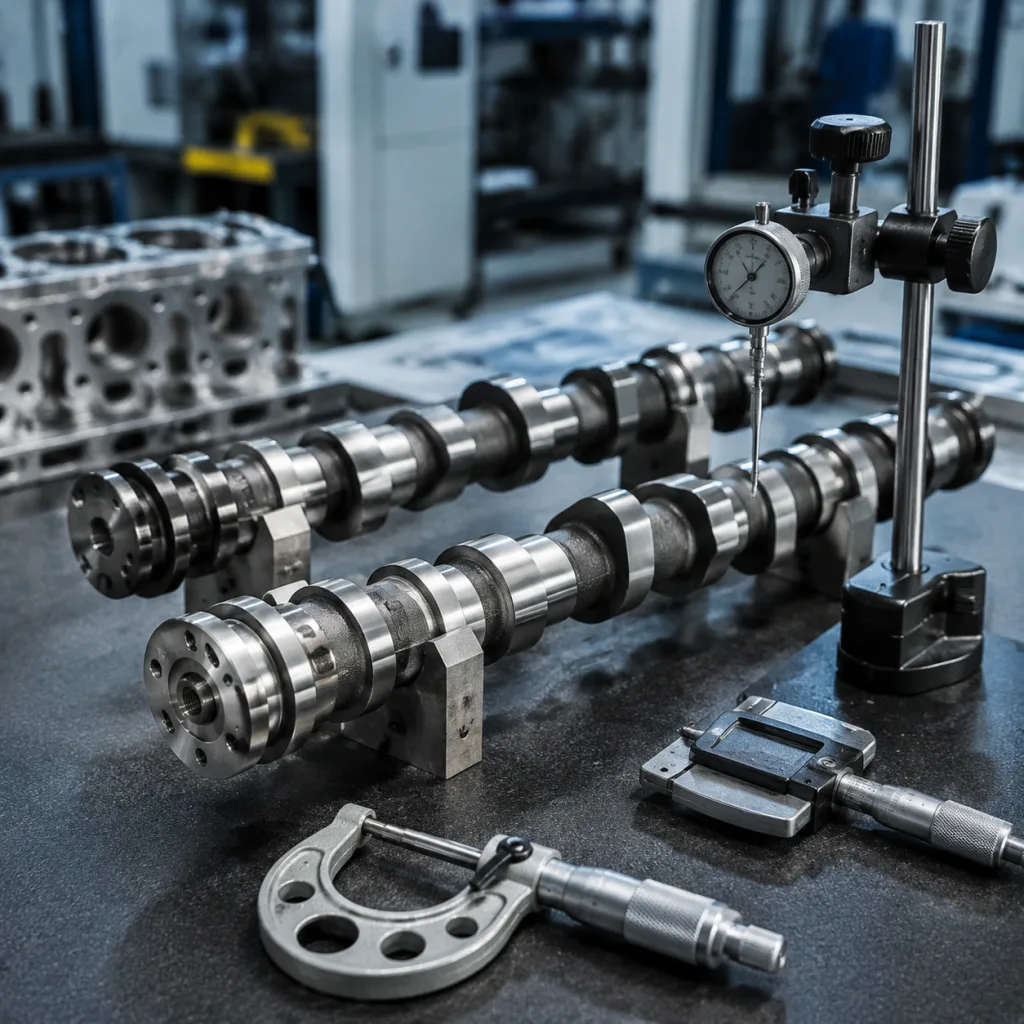
| Sealing face flatness | 0.03–0.10 mm across the gasket land | Static sealing reliability | Surface plate, dial indicator |
| Gasket groove width and depth | Width ±0.05–0.15 mm; depth ±0.03–0.10 mm | Seal compression and leakage risk | Profile measurement |
| Port diameter and depth | Diameter ±0.05–0.15 mm; depth ±0.10–0.30 mm | Oil flow and connector engagement | Pin gauge, bore gauge, depth gauge |
| Port centre distance | ±0.10–0.30 mm for rigid interfaces | Housing or hose alignment | CMM or optical measurement |
| Mounting hole diameter and pitch | Hole ±0.10–0.20 mm; pitch ±0.15–0.30 mm | Bracket or block fitment | Thread gauge, CMM |
| Core thickness or stack height | ±0.3–0.8 mm after brazing | Heat transfer area and mounting load | Height gauge, CMM |
| Overall length, width, height | ±0.5–1.0 mm unless tighter fit is required | Engine bay clearance and packaging | Vernier, CMM, go/no-go fixture |
| Thread specification, if used | 6H/6g or customer-defined class | Correct fastening and serviceability | Thread plug gauge |
| Parameter | Typical range for RFQ review | Procurement note | |
|---|---|---|---|
| Assembly length | 80–220 mm | Confirm whether fittings, brackets, or caps are included | |
| Assembly width | 60–160 mm | Check nearby alternator, filter, hose, or bracket clearance | |
| Stack height | 30–95 mm | More plates can increase heat transfer and pressure drop | |
| Plate count | 5–18 plates for many light-duty applications | Do not compare price without circuit and plate count | |
| Oil port diameter | 8–25 mm | Match flow demand and connector type | |
| Coolant port diameter | 10–32 mm | Verify hose bead, flange, or O-ring interface | |
| Sealing face flatness | Commonly controlled within 0.03–0.15 mm | Final value should follow application risk | |
| Surface roughness on seal land | Ra 1.6–3.2 µm typical for machined faces | Too rough can cut seals; too smooth may affect gasket grip | |
| Burst pressure target | Often 1.5–3.0× maximum working pressure | Define oil-side and coolant-side limits separately | |
| Leak test medium | Air under water or dry air decay | Specify pressure, time, and acceptance limit |
| Feature | Suggested control | Practical frequency | Typical risk if uncontrolled |
|---|---|---|---|
| Port centre distance | CMM or dedicated fixture | First piece, last piece, and hourly or per batch | Hose stress, assembly interference |
| Sealing face flatness | Surface plate and indicator | First piece after machining and final audit | Oil or coolant leakage |
| Gasket groove profile | Optical or contact profile check | Setup approval plus periodic checks | Under-compression or seal extrusion |
| Thread quality | Thread plug gauge | 100% on safety-sensitive or critical threaded ports | Cross-threading or torque loss |
| Internal cleanliness | Flushing and particle check | Per batch or per agreed cleanliness plan | Engine lubrication contamination |
| Leak integrity | 100% leak test | Every part | Field leakage and warranty claims |
| Packaging orientation | Final audit | Per carton and pallet audit | Transit damage to ports and faces |