How to Verify Cylinder Liner Quality Before Purchase
Cylinder liner quality is not confirmed by appearance alone. A liner can look clean, yet still fail on bore geometry, hardness, surface finish, or fit after installation. For procurement teams, the practical question is how to verify cylinder liner quality before release, not after a return or field failure. The answer is a controlled check of drawings, metallurgy, dimensions, traceability, and test evidence against the application requirement. For wet and dry liners, the acceptance criteria are different, but the inspection logic is the same: confirm the part matches the OE envelope, the material is consistent, and the supplier can prove process control. Driventus is an independent aftermarket manufacturer; brand names are referenced for fitment only. If you source across multiple platforms, the same method also helps compare suppliers in our catalog and separate marketing claims from measurable quality.
Start With the Application Data
Before you inspect a sample, lock down the application data. A cylinder liner must match the engine family, bore size, deck height, flange geometry, interference fit, and cooling design. If the application uses OE 06A107065 or another OE cross-reference, treat it as a fitment reference, not a guarantee of equivalence.
Check these points first:
Engine code and displacement
Wet or dry liner type
Finished bore diameter and honing allowance
Flange thickness, overall length, and protrusion
Wall thickness and press-fit allowance
Piston-to-liner clearance target
If the drawing is missing, ask for it before sampling. For buyers comparing multiple plants, ask whether the supplier can support custom manufacturing for special lengths, coatings, or machining states. A supplier that cannot state the required tolerances in writing is not ready for production release.
Check Material and Process Evidence
Material consistency is the base requirement. Most liners are made from cast iron or alloyed cast iron, but the real question is whether the chemistry and microstructure stay within the specified process window. Request mill certificates, heat numbers, and internal batch traceability. Then verify that the supplier uses a documented inspection route aligned to our quality system.
A practical document set should include:
Document
What it proves
Chemical composition report
Alloy range and batch identity
Heat treatment record
Hardness and metallurgical stability
Dimensional inspection report
Conformance to drawing tolerances
Traceability sheet
Lot control from casting to packing
Non-conformance procedure
How defects are contained and corrected
</tr></thead><tbody> </tbody></table>For export markets, also confirm REACH (EC) No 1907/2006 compliance where applicable. If the liner is part of a broader engine program, review the related items in our catalog and engine components to keep acceptance criteria consistent across the order.
Measure the Critical Dimensions
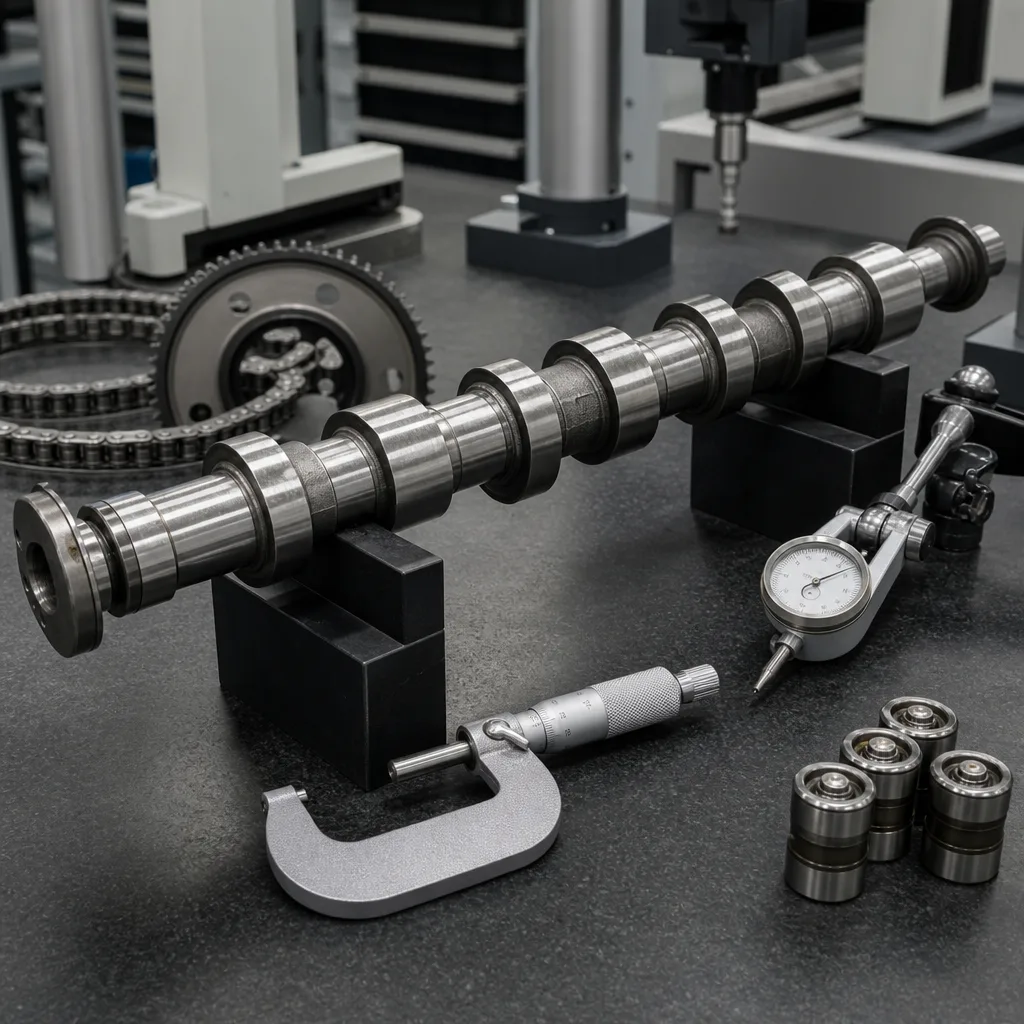
Dimensional inspection is where many sourcing mistakes are found. Use calibrated bore gauges, micrometers, profilometers, and height gauges, and do not rely on one-point checks. A liner can pass diameter but fail on roundness, taper, or flange squareness.
Inspect at minimum:
1. Inner diameter at multiple axial positions 2. Roundness and cylindricity 3. Wall thickness at defined points 4. Overall length and flange height 5. Bore surface roughness after finishing 6. Seat and deck contact surfaces
For comparison samples, measure at least three pieces from each lot and keep the results against the same datum scheme. If the part is for high-load diesel service, ask whether the supplier validates dimensional retention after thermal cycling. In many programs, the useful decision is not whether the sample is nominal, but whether the spread is small enough to preserve piston ring sealing over the service interval.
Verify Surface Finish and Wear Resistance
The bore surface controls ring seating, oil control, and wear rate. Surface finish should be specified in roughness terms, not described with subjective words like smooth or polished. Ask for the target Ra or Rz value and the method used to achieve it, such as honing with controlled cross-hatch.
If the liner is sold for severe-duty use, request evidence of wear testing. For some applications, suppliers reference SAE J2527 for corrosion or durability-related test methodology, but the test must still match the part function. If the engine family requires emissions-related durability validation, the request may also reference ECE R-83 in the wider system context, although the liner itself is only one component.
Look for:
Uniform cross-hatch angle
No torn metal, chatter marks, or glazing
No porosity break-out on the bore
Stable finish across the full stroke length
A surface that looks acceptable in photos can still fail once rings start running under load.
Confirm Certification, Traceability, and Packing
Quality control does not end at the part itself. A good supplier can tie each liner back to a batch, a process route, and a release record. Ask for confirmation of IATF 16949:2016 and ISO 9001:2015 certification, but verify scope and validity rather than assuming coverage.
Before release, confirm:
Lot number on cartons and inner packs
Batch traceability on the inspection report
Corrosion prevention for storage and transit
Protective caps or wrapping for the bore and flange
Container packing that prevents edge damage and impact marks
For international procurement, packing quality matters because liners are precision machined, not commodity castings. A part that meets spec at dispatch can still fail receiving inspection if it arrives with rust staining, chips, or impact marks. When the order is custom or low-volume, request a quote early so the supplier can confirm lead time, gauge control, and packaging detail before production starts.
Use a Simple Acceptance Checklist
A short checklist is usually enough to separate acceptable supply from avoidable risk. Keep it consistent across vendors so the comparison stays objective.
Acceptance checklist:
Correct engine application and OE cross-reference
Material certificate matches the purchase specification
Dimensions fall within drawing tolerance
Bore finish matches the required Ra or Rz
Heat treatment and hardness records are available
Traceability is complete at carton and batch level
Packaging prevents corrosion and transit damage
If one item is missing, hold the lot until the supplier closes the gap. If several items are weak, the cost of rework usually exceeds the value of the shipment. For recurring programs, standardise the checklist across all cylinder liner suppliers so incoming inspection is predictable and audit-ready.
Frequently asked questions
Start with the application data: engine code, liner type, bore size, length, flange geometry, and fitment tolerance. If that does not match, later inspection is not useful.
No. Visual checks can catch rust, chips, or poor honing, but they do not prove roundness, hardness, surface finish, or traceability. Use measured and documented inspection.
Ask for material certificates, dimensional reports, hardness or heat treatment records, traceability data, and evidence of an ISO 9001:2015 or IATF 16949:2016 quality process where applicable.
If you need a verified supply route for a new program or replacement order, contact Driventus to review specifications, inspection records, and packaging requirements at [request a quote](/contact.html).