A camshaft for Ford Focus OE equivalent replacement program needs more than visual similarity. Buyers must verify base-circle geometry, lobe lift, journal diameters, material grade, surface hardness, timing feature position, and packaging controls before approving a supplier. For distributors, importers, and repair-chain buyers, the commercial risk is clear: an incorrect cam profile can create misfire complaints, valve-train noise, emissions faults, or early warranty returns. Driventus manufactures engine and powertrain components in Taizhou, Zhejiang, including camshafts for aftermarket replacement applications. Production is managed under IATF 16949:2016 and ISO 9001:2015 controls, with export supply to more than 60 countries. Driventus is an independent aftermarket manufacturer; brand names are referenced for fitment only. This article explains what procurement teams should check when sourcing Focus replacement camshafts and how to evaluate OE-equivalent claims using measurable criteria.
What OE-equivalent means for Focus camshafts
For replacement sourcing, “OE-equivalent” should mean functional and dimensional interchangeability with the original application, not approval by the vehicle manufacturer. It normally covers the physical dimensions, timing relationship, cam-lobe profile, oil-feed features, sensor trigger location, heat treatment, and durability requirements needed for correct engine operation.
For a camshaft for Ford Focus OE equivalent program, procurement teams should request evidence in three areas:
Functional match: valve lift curve, opening and closing event relationship, phasing feature position where applicable, and compatibility with hydraulic or mechanical valve-train components.
Production repeatability: controlled machining, heat treatment, surface finishing, cleaning, rust prevention, and batch traceability.
OE part-number cross-references may be used for identification in the format OE 06A… or OE 11251… when applicable to a buyer’s data file. These references should support fitment checking, not imply vehicle-maker endorsement. Driventus is an independent aftermarket manufacturer; brand names are referenced for fitment only.
Replacement buyers can review broader engine coverage in our catalog and related product groups under engine components.
Critical dimensions and materials to confirm
Camshafts are tolerance-sensitive components. A small error in lobe height or journal geometry can change valve lift, oil-film behaviour, and valve-train contact stress. Buyers should avoid approving a replacement camshaft based only on application lists or catalogue images.
A typical incoming technical review should include the following specification checks:
Parameter
Why it matters
Typical verification method
Journal outside diameter
Controls oil clearance and rotation stability
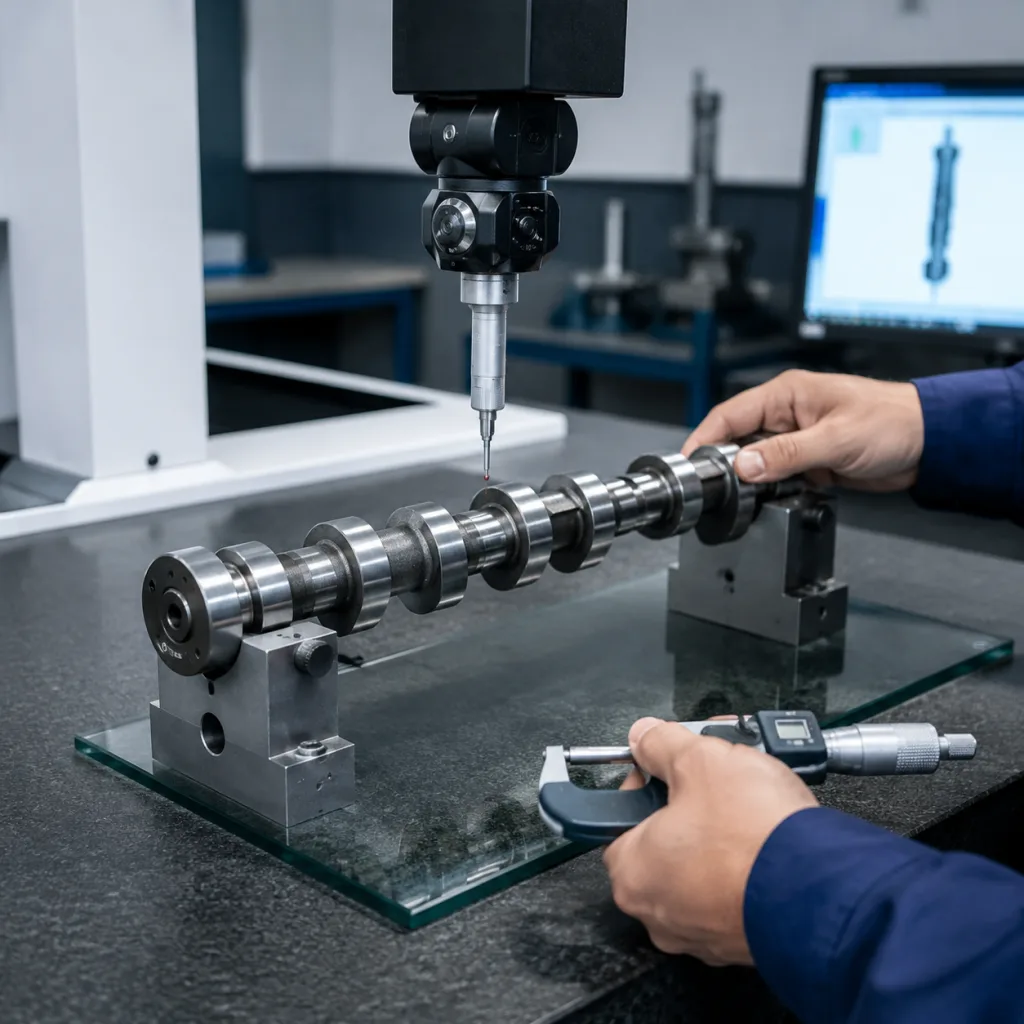
Micrometer, roundness gauge
Lobe height and base circle
Determines valve lift and lash relationship
Profile measuring instrument
Overall length and thrust width
Affects axial location and timing alignment
CMM or calibrated height gauge
Keyway, slot, or drive feature position
Controls cam timing relationship
CMM and fixture inspection
Sensor trigger or phaser feature
Supports ECU signal and variable timing function
Gauge fixture and functional check
Surface hardness
Reduces lobe and follower wear
Rockwell or Vickers hardness test
Surface roughness
Supports oil-film retention and reduces scuffing
Roughness tester
Straightness/runout
Limits vibration and bearing load
V-block and dial indicator or CMM
</tr></thead><tbody> </tbody></table>Material selection depends on the engine design and manufacturing route. Common solutions include chilled cast iron, ductile iron, forged steel, or assembled camshaft construction. The selected process should be matched to contact stress, follower type, oiling arrangement, and required hardness depth.
For B2B supply, the most useful documentation is not a generic “fits Focus” statement. It is a controlled drawing, inspection plan, and sample report showing that the supplier understands the exact camshaft family being quoted.
Validation testing for replacement approval
A replacement camshaft should pass both dimensional validation and process validation before being released for a distributor or repair-chain program. The objective is to reduce installation complaints and warranty exposure across multiple engine codes and model years.
Recommended validation controls include:
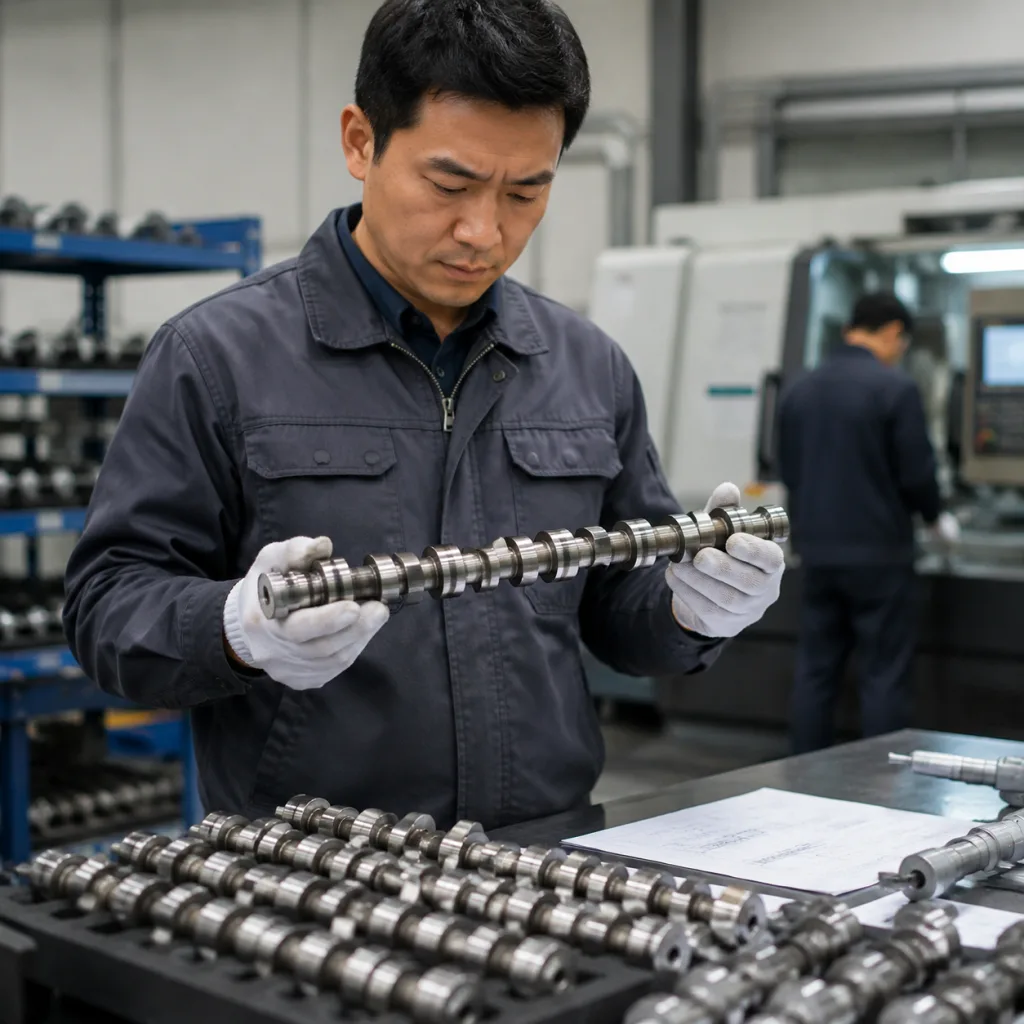
First article inspection: full measurement against the agreed drawing or master sample.
Cam profile comparison: lift curve and angular position checked against the approved reference.
Hardness and case-depth verification: performed after heat treatment and finishing.
Metallurgical inspection: microstructure review, graphite form where applicable, and defect screening.
Runout inspection: confirmation of shaft straightness after machining and heat treatment.
Cleanliness control: removal of abrasive residue, chips, and rust-prevention contaminants.
Fitment trial: assembly check with representative bearings, followers, sprocket or phaser interface, and sensor components.
Packaging drop and corrosion review: confirmation that export packaging protects machined surfaces during sea or air freight.
Quality planning should be aligned with IATF 16949:2016 and ISO 9001:2015. Where materials or coatings are supplied into the EU, buyers may also ask for declarations related to REACH (EC) No 1907/2006. These frameworks do not replace part-specific testing, but they support repeatable production and document control.
Driventus manages replacement camshaft programs through its documented quality system, including incoming material checks, in-process control, final inspection, and traceability by production batch.
Common sourcing risks and how to reduce them
Most camshaft sourcing issues are caused by incomplete cross-reference data or insufficient validation before launch. The Focus platform covers multiple engine families, fuel systems, emissions levels, and production years. A camshaft that matches one engine variant may not suit another, even if the model name is the same.
Procurement teams should control the following risks:
1. Incorrect engine-code mapping Match by engine code, displacement, valve train, timing system, and production year. Do not rely only on vehicle model name.
2. Unverified OE cross-reference Require the supplier to state the reference source and confirm the physical sample or drawing used. Use generic references such as OE 06A… only where the buyer’s data already contains that family.
3. Cam profile deviation Lobe height alone is not enough. Lift curve, ramp rate, and angular position must be controlled.
4. Poor surface finish or hardness variation These failures may not appear at installation but can create lobe wear, follower noise, and metal debris after service.
5. Weak packaging for export Camshafts require protection against corrosion, bending, and impact to machined journals and lobes. Packaging should suit container shipment, mixed pallets, and distributor warehouse handling.
6. No batch traceability If a market complaint occurs, importers need batch, material, heat-treatment, and inspection records to isolate the issue quickly.
A camshaft for Ford Focus OE equivalent sourcing file should therefore include cross-reference data, drawings or master-sample reports, validation records, and packaging specifications before purchase order release.
Buyer checklist before placing volume orders
Before approving a supplier for serial supply, buyers should use a structured checklist. This is especially important for import programs serving the EU, UK, US, Canada, Australia, and Brazil, where distributors need consistent catalogue accuracy and low return rates.
Procurement checklist:
Confirm exact vehicle applications, engine codes, fuel type, and model years.
Provide or approve OE cross-reference data in a controlled format.
Request a drawing, master-sample report, or detailed dimensional inspection report.
Review material grade, casting or forging route, and heat-treatment process.
Check cam profile inspection method, not only static dimensions.
Ask for sample parts from production tooling, not hand-finished prototypes.
Require packaging images, corrosion protection details, and carton/pallet specifications.
Confirm MOQ, lead time, annual capacity, and spare-parts continuity.
Agree on claim-handling procedure, defect evidence required, and corrective-action timing.
For private-label or application-specific projects, Driventus can support custom manufacturing using buyer drawings, samples, or validated reference parts. Typical B2B discussions include tooling status, sample schedule, PPAP-style documentation when requested, labelling rules, and export carton configuration.
The strongest supplier approval process compares measurable product evidence with commercial requirements. Price should be reviewed after application accuracy, process control, and inspection capability are confirmed.
Documentation Driventus can provide for B2B programs
B2B buyers need documents that support internal approval, customs preparation, catalogue loading, and aftersales traceability. For Focus replacement camshaft projects, Driventus can prepare a documentation package based on the buyer’s market and order scope.
Typical available documents include:
Quotation with application scope and agreed cross-references.
Dimensional inspection report for approved samples.
Material and heat-treatment confirmation.
Hardness and surface-finish test records where specified.
Batch traceability label and packing list format.
Export packaging specification with carton and pallet data.
Certificate copies for IATF 16949:2016 and ISO 9001:2015 management systems.
REACH-related material declaration where required by the buyer and applicable to the shipment.
For replacement distribution, the goal is stable repeat supply. That means consistent machining, controlled profile measurement, reliable export packaging, and clear communication when an application changes. Driventus does not claim approval or endorsement by any vehicle manufacturer. Driventus is an independent aftermarket manufacturer; brand names are referenced for fitment only.
Buyers comparing suppliers for a camshaft for Ford Focus OE equivalent program should request sample inspection data and application confirmation before committing to full container or annual blanket orders.
Frequently asked questions
Confirm engine code, model year, valve-train design, and OE cross-reference data first. Then review dimensional inspection, cam profile measurement, material, hardness, surface finish, runout, and packaging controls. A physical sample or approved drawing should be used before volume orders.
No. OE-equivalent means the part is designed to match the original part’s fit and function for replacement use. It does not mean approval, endorsement, or supply by the vehicle manufacturer. Driventus is an independent aftermarket manufacturer; brand names are referenced for fitment only.
Yes. Driventus can discuss private-label packaging, agreed cross-reference data, sample validation, and custom manufacturing for qualified B2B buyers. Requirements such as MOQ, lead time, inspection reports, and export packaging should be confirmed during quotation.
If you are sourcing Focus replacement camshafts for distribution, repair-chain, or import programs, share your application list and target volumes with Driventus. You can [request a quote](/contact.html)