How to Choose an Oil Sump Supplier for B2B Programs
Knowing how to choose a oil sump supplier is not a catalog exercise. It is a risk decision that affects engine sealing, oil capacity, corrosion exposure, freight damage and warranty cost. A low unit price means little if the flange arrives distorted, the drain thread strips, or the supplier cannot trace a bad batch. B2B buyers should test the offer against four questions: does the sump match OE geometry, can the factory hold the sealing face and critical ports within measurable limits, will the part survive transport, and can every batch be documented? This guide gives procurement teams a sharper way to compare steel, aluminium and composite oil sump suppliers for aftermarket replacement ranges, private-label programs and custom development projects. Driventus is an independent aftermarket manufacturer; brand names are referenced for fitment only.
Start With the Buying Decision, Not the Part Number
Most oil sump sourcing problems begin before the RFQ is sent. The buyer lists a model name or cross-reference, but leaves out the engine code, material, sensor-port layout, drain-plug thread, gasket interface or oil-capacity requirement. The supplier quotes anyway. The sample looks close. Then the pilot order exposes the gap.
Frame the program first. Define the vehicle parc, engine families, annual demand, sales channel and stocking model. Separate fast-moving aftermarket references from slow long-tail SKUs. Decide whether each part needs to be an OE-equivalent replacement, a private-label item, a service-continuity part or a redesigned sump for a custom application. If you are building a range plan, compare demand against available fitments in our catalog.
Minimum RFQ data should include:
Vehicle application, engine displacement, engine code and production years
Material requirement: stamped steel, cast aluminium, die-cast aluminium or composite
Drawing, OE sample or verified reference part, including oil capacity where known
Drain-plug thread size, washer type, torque target and whether plug or gasket is included
Required coating system, salt-spray target or corrosion-resistance requirement
Annual volume, first-order quantity, MOQ target and reorder cadence by SKU class
Packaging standard, carton drop requirement, pallet loading limit and destination port
Required documents: PPAP file, inspection report, material certificate and IMDS data where applicable
Use different commercial logic for different SKU classes. A launch order may combine 20 to 80 SKUs, but not every SKU deserves the same MOQ target. High-volume steel references may support 100 to 300 pieces per production run. Aluminium references often sit closer to 50 to 150 pieces. Slow movers may need mixed-carton planning, annual blanket orders or shared production windows where tooling already exists. For OEM or Tier-1 projects, confirm tool ownership, engineering-change control, sample approval timing, service-part commitments and volume-break pricing before quotation.
Match the Factory to the Sump Material
A supplier that makes good stamped steel parts is not automatically qualified for die-cast aluminium or composite assemblies. Each material fails in a different way. The right question is not “Can you make this part?” but “Which process controls prove you can repeat it?”
Sump type
Typical process
Key controls
Procurement risk to check
Stamped steel
Progressive die stamping, welding, coating
0.8-1.5 mm sheet thickness, flange flatness, weld integrity, 15-25 μm e-coat or 60-90 μm powder coating
Rust at seams, drain-boss leakage, flange distortion
Joint strength, sealing validation, assembly sequence, adhesive or weld cure control
Inconsistent assembly and leak paths
</tr></thead><tbody> </tbody></table>Ask how tooling is designed, built and maintained. In-house tooling can shorten feedback loops and improve flange control, but only if the supplier keeps tool-maintenance records, performs first-off inspection and accepts clear responsibility for tool correction. For new programs, custom manufacturing should include CAD review, prototype sampling, dimensional reports and an approval route with defined correction rounds.
Push every tolerance discussion toward numbers. Useful RFQ targets may include sealing-surface flatness within 0.30 to 0.50 mm over the full flange unless the drawing states otherwise, bolt-hole position within ±0.20 to ±0.30 mm, gasket-groove width within ±0.10 mm, machined sensor-port position within ±0.20 mm, and threaded drain holes checked with go/no-go gauges. Drain-plug torque should be agreed by thread size and material, such as 25 to 35 N·m for many M14 steel applications or a lower controlled value for aluminium threads where the OE specification requires it. “Same as original” is not a specification unless a verified drawing, sample or technical data sheet is attached.
Look for the Failure Modes Quality Systems Should Catch
Certificates matter, but they do not seal an engine. A credible oil sump supplier needs a documented automotive quality framework and part-level controls that catch the defects buyers actually see: leakage, distorted flanges, bad threads, porosity, weak coating, incorrect ports and untraceable batches.
Driventus operates under IATF 16949:2016 and ISO 9001:2015. Buyers can review our quality system during supplier pre-qualification. For export markets, also confirm how the supplier manages material declarations and restricted substances, including REACH (EC) No 1907/2006 where relevant to EU supply.
Request controls that map directly to failure risk:
Incoming inspection for sheet steel, aluminium ingots, resin and bought-in inserts, with lot numbers recorded
Material certificates linked to heat, lot or batch identification and retained for the agreed period
First-article inspection for new tooling, tool repair and engineering changes, including at least 5 measured parts where practical
In-process checks for flange flatness, bolt-hole position and machined surfaces at start-up and defined production intervals
100% leak testing for cast or welded high-risk sumps, or a documented sampling plan for lower-risk stamped parts
Leak-test method, pressure and hold time, such as air-decay or water-immersion testing at an agreed pressure for 10 to 30 seconds
Coating-thickness and adhesion checks for painted or e-coated steel parts, plus salt-spray testing where required
Thread-gauge verification for drain-plug and sensor ports, including go/no-go gauges for every production batch
Final inspection records linked to batch number, production date, operator and work order
For higher-risk parts, ask for a control plan, process flow chart and PFMEA. OEM and Tier-1 projects may require PPAP documentation aligned with the AIAG Production Part Approval Process, including dimensional results, material records, capability data and appearance approval where applicable. Aftermarket programs may not need a full PPAP package for every SKU, but they still need traceable inspection records, retained samples, a defined AQL level for final inspection and an 8D corrective-action process for repeat defects.
Run the Supplier Through a Five-Gate Evaluation
A polished sample can hide weak production discipline. A low FOB price can hide unstable packaging, poor traceability or subcontracted coating. Use the same five gates for each bidder and score technical, commercial and compliance items separately. A practical weighting is 40% technical capability, 25% quality system, 20% commercial fit and 15% logistics and support, adjusted for your risk profile.
Gate 1: Supplier Screen
Confirm product scope, export history, certifications, main markets, manufacturing processes and language support for technical documents. A supplier exporting to the EU, UK, US, Canada, Australia and Brazil should understand HS codes, durable export packaging, documentation timing and destination-specific import requirements. Ask for active SKU count, monthly sump capacity, normal defect rate, top three material processes and whether coating, machining or packaging is subcontracted.
Gate 2: Sample and Drawing Review
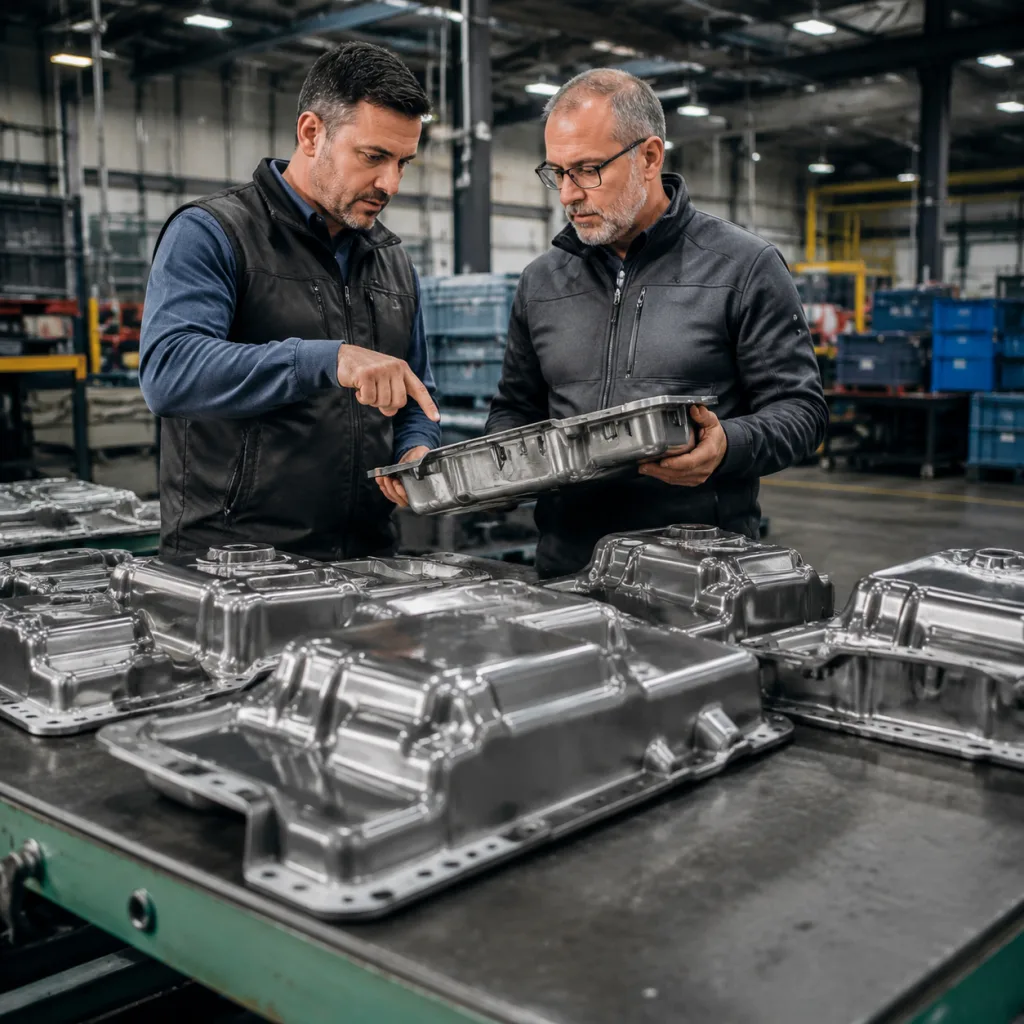
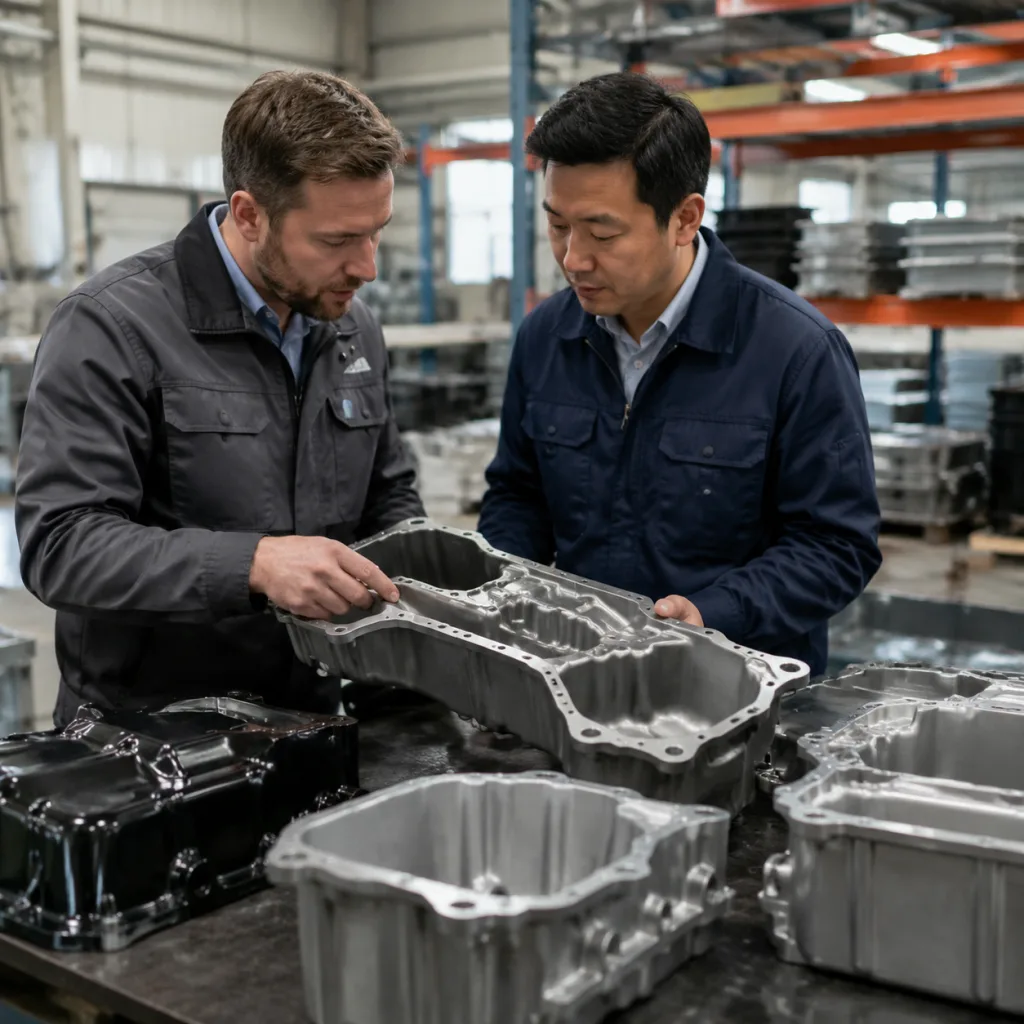
Request production samples, not hand-finished display parts. Check gasket-surface quality, flange flatness, thread cleanliness, sensor-port position, drain-plug fit and coating coverage inside and outside the sump. For a new SKU, inspect at least 3 to 5 samples from production tooling. For a pilot order, pull random pieces from different cartons and pallets rather than one convenient carton. If OE part-number cross-references are used in your internal system, list them generically, such as OE 06A… or OE 11251…, only where they support fitment verification.
Gate 3: Testing and Traceability Audit
Ask how the supplier detects leakage, porosity, poor welds, thread defects and coating failures. Check whether inspection equipment is calibrated. Then test record retrieval: can the supplier find inspection data by production batch, work order or date code within 24 to 48 hours? For multi-location repair chains, that speed can contain a field issue without blocking an entire range.
Gate 4: Commercial Terms Review
Compare MOQ, lead time, payment terms, packaging, spare gasket inclusion, drain-plug inclusion, private-label options and change-notice rules. A low MOQ helps range expansion only if materials, packaging and subcontracted processes remain stable. Ask for price breaks at realistic quantities, such as 50, 100, 300 and 500 pieces per SKU. Separate one-time tooling cost from part price, packaging cost and accessory cost.
Gate 5: Pilot Order Approval
Run a pilot shipment before committing to annual supply. Inspect arrival condition, carton strength, label accuracy, barcode readability, pallet stability and random parts from different cartons. A useful pilot order is often 5% to 10% of expected annual demand for fast movers, or the minimum economical production batch for slow movers. Feed non-conformities into corrective action before scaling volume, then freeze the approved sample, packaging layout and inspection standard for repeat orders.
Compare Bids With a Landed-Cost Lens
Unit price is only one line in the sourcing decision. Oil sump bids should also be compared for defect exposure, freight damage, claims handling, inventory pressure and working capital. A cheaper sump that arrives with bent flanges, weak coating or inconsistent threads can cost more than a higher-priced part from a supplier with stable process control.
Use this comparison table during quotation review:
Evaluation item
What to verify
Why it matters
Unit price
Same material, coating, accessories and packaging assumptions
Prevents false price comparison
MOQ
Per SKU, per material group and per shipment
Affects inventory risk for slow-moving references
Lead time
Tooling, sample, mass production and repeat-order timing
Supports launch planning and replenishment
Testing
Leak test, dimensional inspection, coating checks and AQL level
Reduces field returns and warranty cost
Packaging
Carton strength, flange protection, palletisation and pallet height
Prevents transit deformation
Documentation
Certificates, inspection reports, traceability and compliance declarations
Supports importer compliance and customer audits
Change control
Notice period for process, material, coating source or tooling changes
Protects fitment consistency across batches
</tr></thead><tbody> </tbody></table>For established references, many buyers target repeat-order lead times of 30 to 60 days depending on SKU mix, coating queue, order consolidation and shipping schedule. New tooling programs need longer planning. Design review, prototype sampling, tool correction and approval can add 8 to 16 weeks before mass production, especially for die-cast aluminium or complex composite parts. Put target dates, split shipments and critical SKUs in the RFQ instead of assuming all references can ship together.
Build a landed-cost model that includes unit price, tooling amortisation, accessories, packaging, inland freight, ocean or air freight, duty, inspection, expected claim rate and inventory carrying cost. A part that is USD 0.80 cheaper but creates a 3% claim rate, rework and emergency replenishment can lose its advantage quickly. Ask suppliers to quote EXW, FOB and, where useful, CIF separately so your team can compare freight control and consolidation options consistently.
Treat Packaging and Claims as Engineering Controls
Oil sumps are easy to damage in transit. The sealing flange is wide, exposed and often thin enough to distort under stacking pressure or point impact. Packaging should therefore be written into the purchase specification, not negotiated after the price is fixed.
Set rules by material and geometry. For steel sumps, specify anti-rust protection, part separation and carton strength. For aluminium sumps, protect mounting ears, drain bosses and machined surfaces. For composite sumps, control stacking pressure and avoid deformation during container loading. If the part includes a gasket, drain plug, sensor blanking plate or hardware kit, define whether each item is pre-installed, packed separately or excluded.
Make the packing standard measurable. Common requirements include individual polybag or VCI protection for steel parts, edge or flange guards where the sealing face is exposed, 5-ply export cartons for heavy aluminium parts, carton gross weight below 18 to 22 kg where manual handling is expected, and pallets wrapped and strapped with no overhang. For range shipments, require SKU labels, barcode format, country-of-origin marking, carton quantity, batch code and pallet list before dispatch. A carton drop test from 60 to 80 cm, or an equivalent internal standard, is useful for parts with thin flanges or protruding bosses.
Claims handling should be evidence-based and fast. Require photos, batch code, installation mileage, failure description, torque information where relevant and inspection results before issuing replacements or credits. Common claim categories include flange leakage, drain-plug thread failure, cracked casting, coating corrosion and incorrect sensor-port configuration. Agree response times in advance: acknowledge claims within 2 working days, provide initial technical feedback within 5 working days and issue an 8D report for serious or repeated defects within 10 working days after receiving evidence or returned parts.
Driventus supports B2B customers with fitment review, sample development, batch inspection and export documentation. We do not claim approval or endorsement by any vehicle manufacturer. Driventus is an independent aftermarket manufacturer; brand names are referenced for fitment only.
Frequently asked questions
Request a business licence, IATF 16949:2016 or ISO 9001:2015 certificate, material certificates, dimensional inspection reports, leak-test records, coating reports where applicable, packaging specification and batch traceability records. For higher-risk parts, also request a control plan, process flow chart, PFMEA and retained-sample policy. For OEM or Tier-1 projects, request PPAP documentation when required by the purchasing specification.
Neither is universally better. Stamped steel is often cost-effective and suitable for many aftermarket applications, but coating thickness, weld quality and flange control are critical. Aluminium can improve rigidity and heat dissipation, but porosity, thread strength and machining accuracy must be controlled. Select based on OE design, fitment, duty cycle, target market and the supplier’s proven process capability.
For a new supplier, inspect at least 3 to 5 samples from actual production tooling where practical, then verify random parts from a pilot order across different cartons or pallets. The sample size depends on risk, SKU value and order quantity, but checks should include flange flatness, bolt pattern, drain-plug thread, sensor ports, coating, oil-capacity features and leak performance.
If you are comparing oil sump suppliers for an aftermarket or OEM program, Driventus can review your SKU list, drawings, target tolerances, MOQ logic and packaging requirements. Send your RFQ or sample plan to [request a quote](/contact.html).