EGR valve · 2026-06-18

EGR Valve Volvo Wholesale Sourcing Guide

For importers, distributors, and category buyers, egr valve volvo wholesale sourcing is a risk-control exercise, not a race to the lowest unit price. A small sensor drift, weak actuator, porous casting, or unreadable carton label can turn a cheap valve into warranty cost, warehouse delay, and lost customer trust. The buying decision should balance fitment accuracy, thermal durability, actuator response, documentation, MOQ logic, and repeat delivery performance. This guide gives procurement teams a sharper way to assess Volvo-fitment EGR valve supply from an independent Chinese manufacturer: what to send in an RFQ, which specifications to verify, how to audit production controls, where cost really moves, and how to inspect first shipments. Driventus manufactures engine and powertrain components in Taizhou, Zhejiang, and exports to more than 60 countries. The company operates under IATF 16949:2016 and ISO 9001:2015 systems for process control, traceability, and corrective action. Driventus is an independent aftermarket manufacturer; brand names are referenced for fitment only.

Decision Framework: Build the RFQ Around Fitment Risk

Start with the failure you most want to avoid: wrong fitment, unstable feedback signal, slow-moving inventory, or a shipment your warehouse cannot receive cleanly. Then build the RFQ around that risk. Volvo-fitment EGR valves can vary by engine family, emission configuration, actuator type, connector layout, cooling interface, mounting geometry, and calibration range. A model name alone is not enough.

Send a fitment matrix, not a vague inquiry. It helps the supplier confirm interchange, flag references that need sampling, separate active SKUs from development items, and quote the same quality scope across all lines.

Include application year range, engine code where available, fuel type, emission level, OE-style cross-reference format already used in your ERP, and target market. Add connector pin count, plug orientation photos, gasket shape, mounting-hole center distance, coolant-port layout where applicable, and known diagnostic trouble codes linked to the part family. If your catalog uses a generic OE-style reference for internal mapping, share it only as a fitment cross-reference. An aftermarket part should not be described as approved by the vehicle manufacturer unless that approval is documented by the manufacturer.

Minimum RFQ data should include:

  • Target annual volume and first order quantity by SKU, such as 500, 1,000, or 3,000 pcs/year
  • Required packaging: neutral, distributor brand, or bulk pack with inner box quantity
  • Label data: SKU, barcode type, country of origin, batch code, date code, and carton gross weight
  • Market compliance needs: EU, UK, US, Canada, Australia, or Brazil
  • Test requirements: functional curve, closed leakage, insulation resistance, thermal cycling, and vibration check
  • Warranty handling: claim evidence, return sampling rate, response time, and credit/replacement rules

Buyers can review our catalog to identify related engine components, reduce fragmented ordering, and build a consolidated sourcing plan.

Spec Deep-Dive: What Must Be Measured, Not Assumed

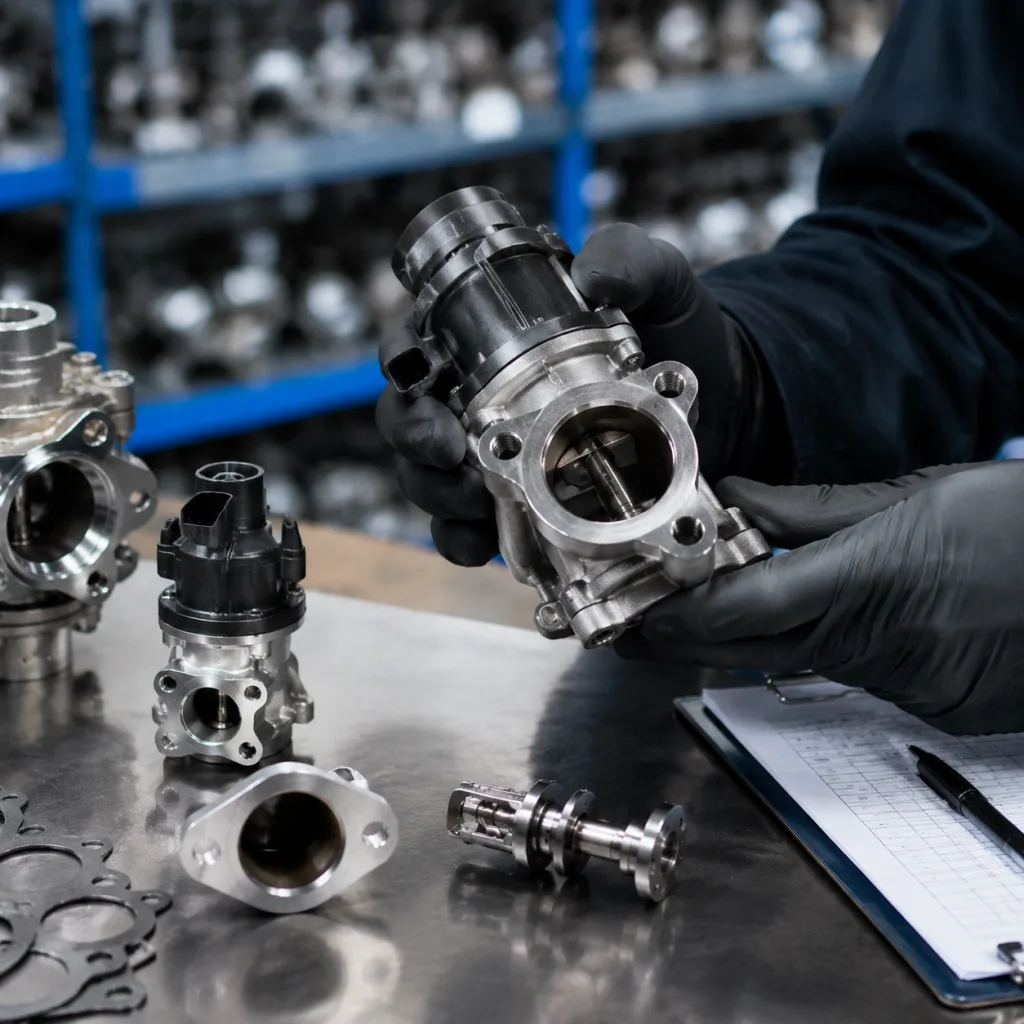
An EGR valve is not just a machined housing with a moving pintle. The assembly includes casting, shaft, bearing, seal, actuator, sensor, connector, gasket interface, mounting face, and calibration. For electronically controlled valves, a mechanically smooth part can still fail if the feedback signal drifts. A stable signal will not save a valve that leaks at closed position.

Use the specification review to separate supplier claims from measured evidence.

</tr></thead><tbody> </tbody></table>For emission-related parts, importers should understand the target vehicle’s regulatory environment before committing to a purchase program. ECE R-83 is relevant to light-duty vehicle emissions type approval in applicable markets, while aftermarket component supply normally requires fitment and performance responsibility rather than vehicle-level approval. Material declarations may also be requested for REACH (EC) No 1907/2006 when EU distribution is planned.

Failure Modes to Audit Before the First Order

A certificate tells you the system exists. The audit tells you whether the system catches bad valves before they reach your warehouse. Focus on the defects that create field claims: casting porosity, actuator supplier variation, machining fixture wear, calibration drift, mixed parts, weak segregation of rejected material, and test limits copied across unrelated SKUs.

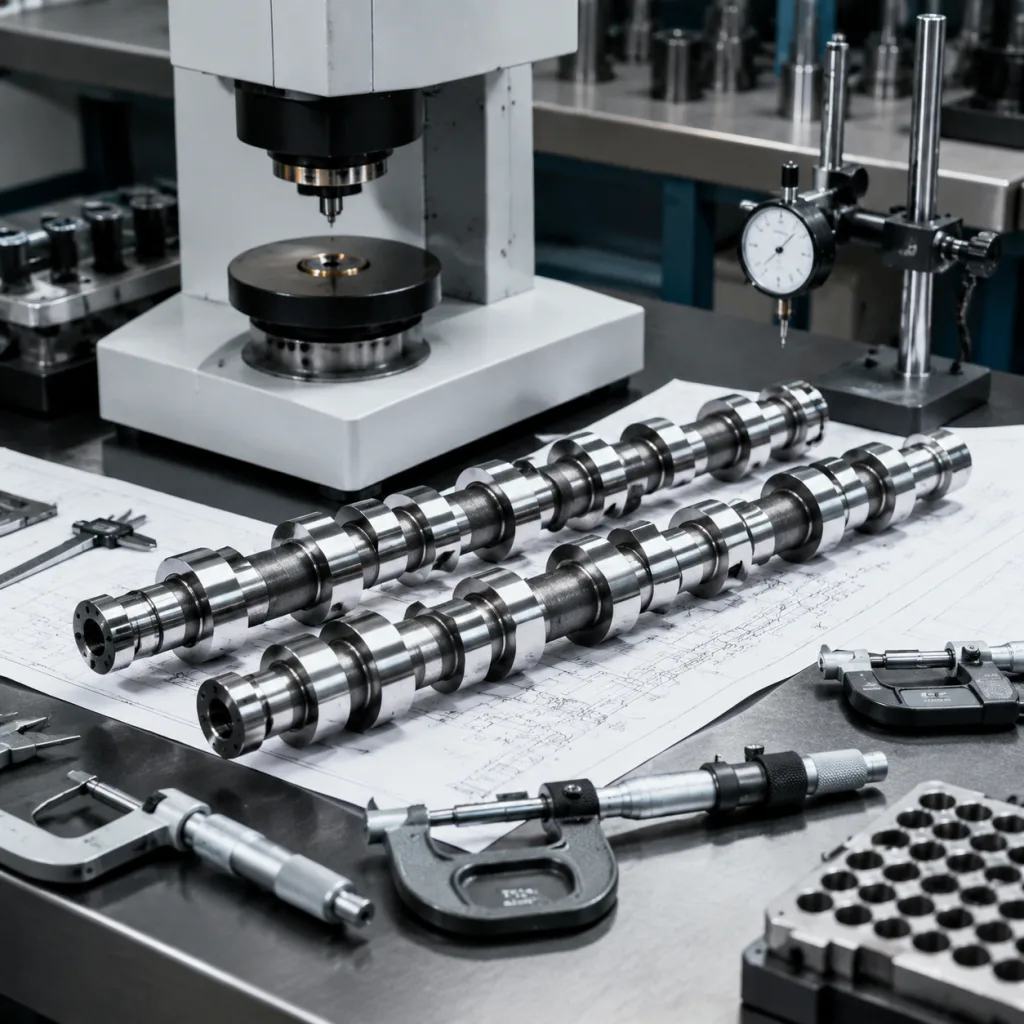
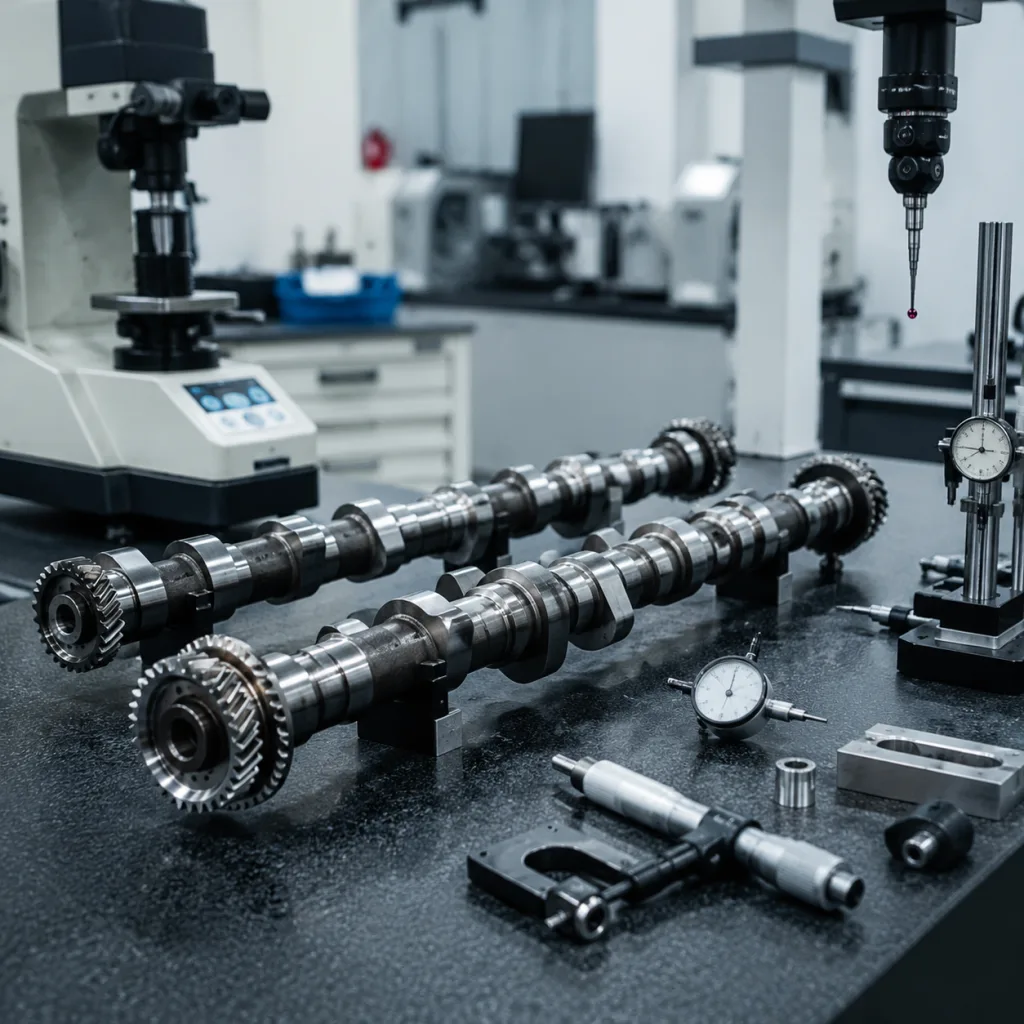
Driventus operates a quality system aligned with IATF 16949:2016 and ISO 9001:2015. For procurement teams, the useful evidence is practical: process flow chart, control plan, inspection standard, packaging specification, PPAP-style submission where required, batch test records, and corrective action reports for recurring defects. For a first order, ask for a dimensional report on 3–5 sample units, material certificate, final functional test report, packaging drop-test confirmation where required, and a traceability example linking raw material lot to finished carton.

Audit questions for EGR valve programs

  • Are critical dimensions listed separately from general tolerances, with gauges calibrated and identified?
  • Is every finished valve function-tested before packing, and are failed curves stored by serial or batch number?
  • Are electrical test limits defined by part number rather than shared across all SKUs?
  • Are rejected valves physically isolated, labelled, locked, and recorded by defect code?
  • Are actuator sub-suppliers approved and re-evaluated at least annually or after quality incidents?
  • Is traceability maintained from raw material lot, casting batch and actuator lot to finished carton?

For OEM and Tier-1 projects, buyers may also request custom manufacturing, including drawing review, tooling feasibility, PPAP documentation, sample validation, and project-specific control plans.

Failure Modes to Audit Before the First Order

Comparison: MOQ, Lead Time and Price by SKU Type

Wholesale EGR valve purchasing rarely fails because one SKU was expensive. It fails because the program is fragmented: too many slow references, too many packaging versions, and unclear expectations on samples versus mass production. One distributor may need 20 fast-moving references with repeat demand. Another may need 80 long-tail references with low monthly turns. Treat them differently.

Specification area Buyer requirement to confirm Typical verification method
Housing materialHeat-resistant aluminium alloy or stainless section as designed; confirm grade and heat treatment where usedMaterial certificate, incoming inspection
Valve movementSmooth travel without sticking across full stroke; no abnormal noise on returnFunctional bench test and 100% end-of-line actuation
LeakageControlled closed-position leakage, commonly agreed as a maximum flow or pressure-decay value by SKUAir pressure decay or flow test at agreed pressure
Actuator responseStable opening command and feedback signal; feedback drift controlled within agreed voltage windowElectrical functional test with recorded curve
Connector fitCorrect pin count, keyway, terminal plating, locking feature and insertion feelGauge and mating connector check
Mounting interfaceFlatness, hole position and port alignment within drawing tolerance, commonly ±0.05–0.10 mm for critical facesCMM or fixture inspection
Gasket surfaceNo porosity, dents, machining burrs or raised edges over sealing landVisual and dimensional inspection
TraceabilityBatch-level material, machining, actuator and final test record retained by lotLot code and inspection report

</tr></thead><tbody> </tbody></table>Indicative lead time for repeat wholesale orders is often 30–60 days after deposit and packaging confirmation, depending on order size, production queue, and actuator availability. New development programs can require 15–30 days for samples, 30–45 days for validation and tooling adjustment, and buyer approval before mass production. Separate sample lead time from production lead time in the purchase contract.

Price usually moves with actuator specification, casting complexity, machining time, test cycle duration, order volume, and packaging requirements. It improves when buyers consolidate SKUs into family orders, repeat the same packaging artwork, accept scheduled partial shipments, and confirm annual call-off volume. A quotation far below the market range may signal reduced testing, weak material control, limited traceability, or lower-grade electrical components.

Step-by-Step: Inspect the First Shipment Like a Claim File

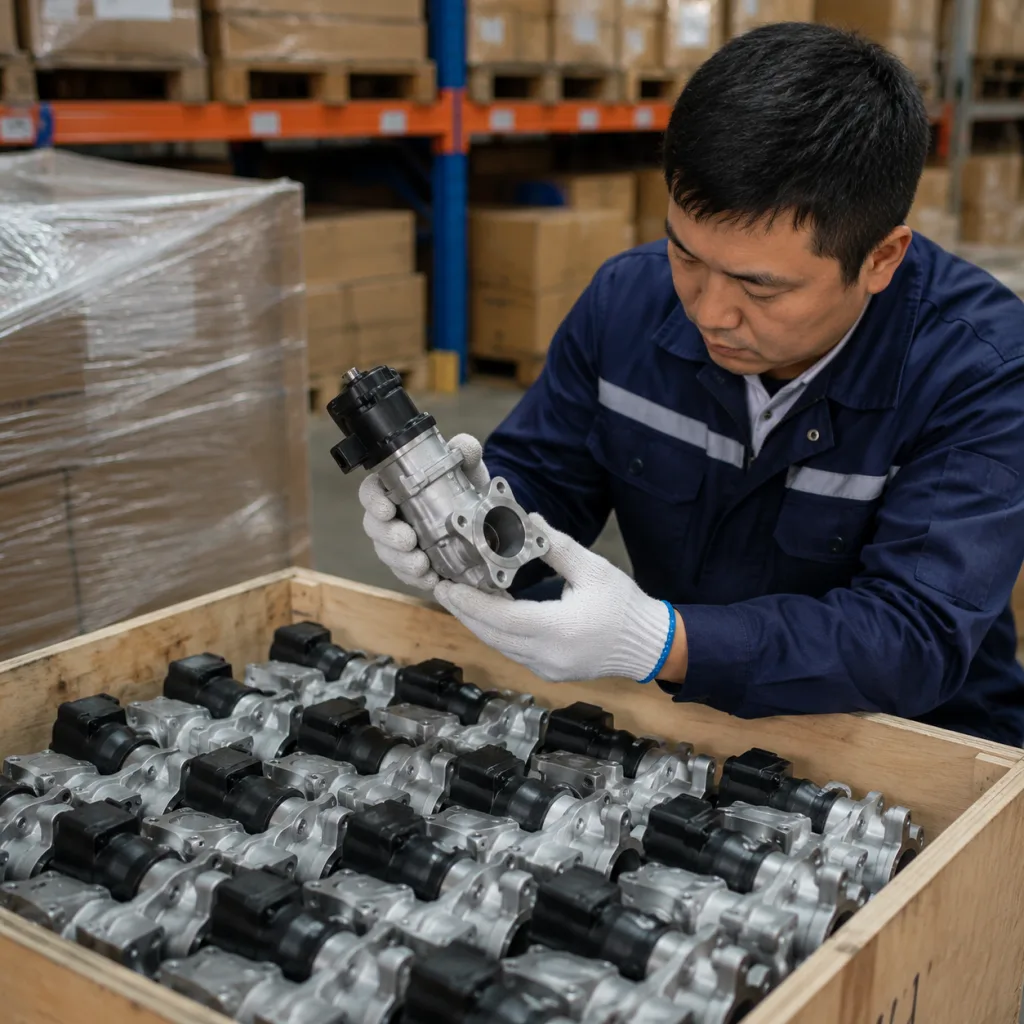
Treat first-arrival inspection as the file you would need if a warranty dispute appears three months later. The goal is not to repeat the factory’s full process. It is to confirm identity, catch visible and dimensional issues, verify basic function, and preserve evidence by batch number.

Recommended checks for first shipment:

  • Match carton label, SKU, quantity, batch code and date code against packing list and purchase order
  • Inspect casting surface, gasket face, connector lock, terminal condition and mounting holes on sampled units
  • Measure key mounting dimensions with fixture or caliper method, recording hole center distance, port diameter and face flatness
  • Run sample electrical tests for actuator response, sensor feedback and insulation resistance at room temperature
  • Check valve movement for sticking, abnormal noise, unstable return or delayed response across the operating stroke
  • Verify supplied gaskets, bolts, blanking caps and accessories against the agreed bill of materials
  • Retain 2–3 reference units and inspection records by batch number for future warranty comparison

For high-volume accounts, consider an AQL sampling plan under ISO 2859-1. General Inspection Level II is a common practical base for visual and packaging checks. Tighten sampling for critical functional characteristics during the first 1–3 shipments, after process changes, after corrective actions, or when a new SKU enters the range.

If an installed valve is linked to an emission fault code, do not jump straight to blame. Request diagnostic data, photos, installation conditions, production batch number, mileage after installation, and returned samples. A clean claim file shortens root-cause analysis and protects both sides from guesswork.

Step-by-Step: Inspect the First Shipment Like a Claim File

Scenario: Turning a Trial Order Into a Distributor Program

A stable EGR valve Volvo wholesale program starts before production release. Imagine the first order has 12 SKUs, two packaging formats, and three destination markets. Without clear terms, the order can stall at artwork approval, customs documentation, inspection timing, or warranty handling. With clear terms, it becomes a repeatable distributor program.

Define Incoterms, payment schedule, packaging ownership, approved artwork, inspection rights, warranty process, claim response timeline, and the document set required for customs clearance. For EU and UK distributors, confirm HS code review, commercial invoice details, packing list format, country-of-origin marking, and REACH (EC) No 1907/2006 substance declaration needs. For the US and Canada, confirm labelling, product liability documentation, and customer-specific warehouse requirements. For Brazil, importers should check local customs and tax documentation requirements before shipment booking.

Milestones should be visible: sample approval, packaging approval, production release, final inspection, balance payment trigger, and shipment booking. Repeat orders can move to monthly or quarterly call-offs once quality and demand are stable. Warranty terms should state the claim window, evidence required, return quantity, analysis lead time, and whether approved claims are handled by credit note, replacement parts, or next-order deduction.

Driventus can support wholesale buyers with consolidated engine component supply, neutral or customer-brand packaging, batch traceability, and application development for selected references. The company does not claim approval or endorsement by any vehicle manufacturer. Driventus is an independent aftermarket manufacturer; brand names are referenced for fitment only. To start a sourcing discussion, send your application list, target quantities, packaging requirement, and test documentation needs through request a quote.

Frequently asked questions

Provide application list, engine codes where available, target market, estimated annual volume, first order quantity, packaging type, label requirements, connector details, gasket/accessory needs, and any OE-style cross-references already used in your system. Confirm test and documentation requirements before pricing so quotations reflect the same quality scope.

Yes, private label packaging can be discussed for distributor programs. MOQ may depend on carton type, label format, SKU count, order frequency, and whether packaging materials are shared across multiple references. Artwork approval, label data, barcode format and packaging samples should be completed before mass production.

No. Driventus is an independent aftermarket manufacturer; brand names are referenced for fitment only. Product validation focuses on dimensional match, functional testing, material control, traceable manufacturing records, and agreed customer requirements.

If you are comparing Volvo-fitment EGR valve suppliers, share your SKU list, volumes, target market, connector details, packaging plan and documentation requirements. Our team can review feasibility, MOQ and lead time through /contact.html

Request a Quote
SKU situation MOQ and lead-time logic Cost pressure
Existing active SKULower MOQ, often 100–300 pcs/SKU or mixed against a family MOQ when production is runningBest pricing when grouped with similar references
Dormant SKU with tooling availableCommonly 300–500 pcs/SKU, with time for sample validationSetup time, validation, and smaller batch size
New casting or connector variantOften 800–1,500 pcs/SKU, plus tooling cost and engineering lead timeTooling, engineering, trial runs, and approval cycles
Private label packagingPackaging MOQ may exceed component MOQ, especially below 500–1,000 boxes per artworkArtwork, carton print, barcode control, and inventory of packing materials
Mixed-container orderBetter freight efficiency but requires tighter carton planning and SKU allocationPallet height, carton cube, and warehouse receiving complexity