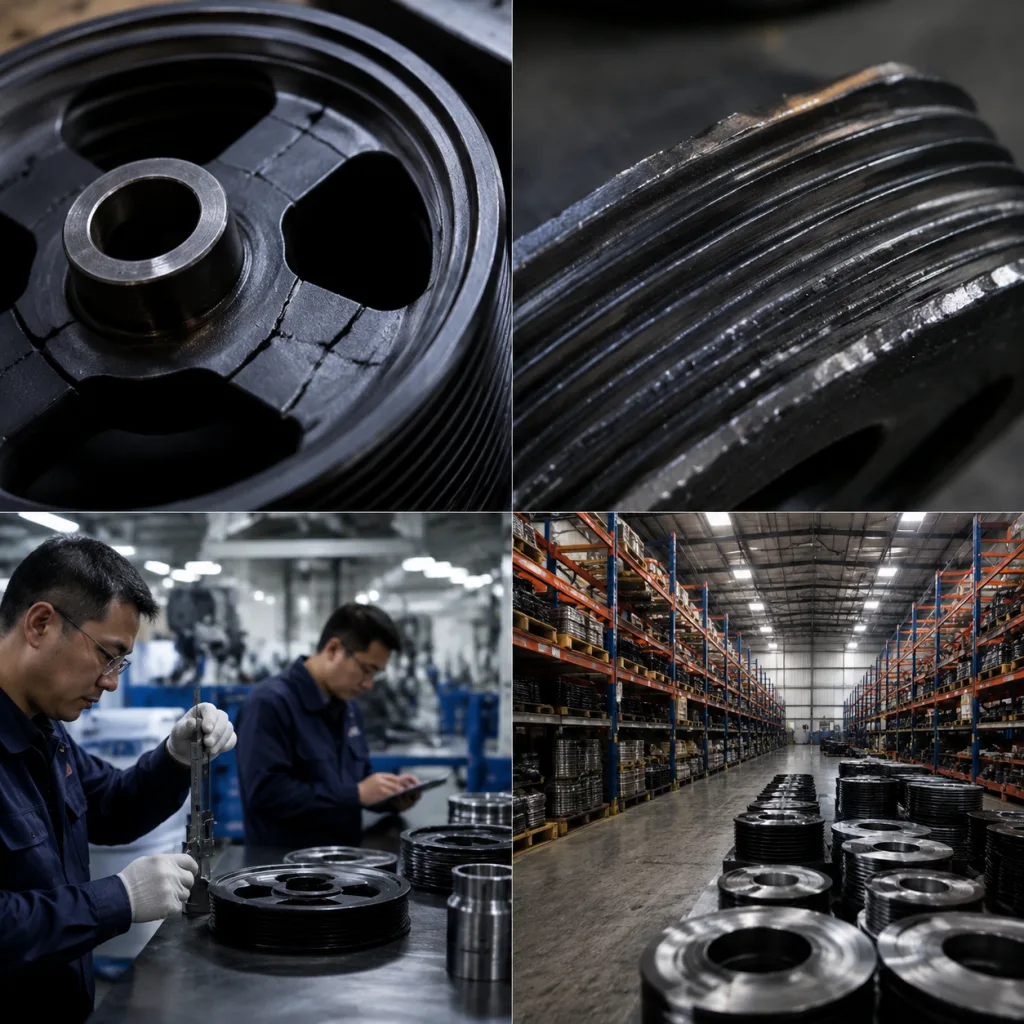
A crankshaft pulley supplier is not interchangeable with any general engine-parts vendor. This component carries belt load at the front of the engine, and many versions also use a bonded rubber damper to control torsional vibration. Small errors can become expensive: groove misalignment creates belt noise, weak bonding leads to separation, poor runout accelerates accessory-drive wear, and incorrect trigger features can affect sensor signals.
The useful question is not simply “who has the best price?” It is “which supplier can prove the part will fit, rotate, damp, resist corrosion, ship consistently, and be traceable when a claim appears?” That requires a sourcing method built around drawings, process control, inspection data, validation tests, MOQ logic, lead time, and corrective-action discipline.
This guide explains how to choose a crankshaft pulley supplier without relying on catalogue photos or generic factory claims. It is written for distributors, repair chains, OEM projects, Tier-1 buyers, and private-label sourcing teams that need repeatable supply rather than one successful sample. Driventus is an independent aftermarket manufacturer; brand names are referenced for fitment identification only.
Decision Gate 1: Lock the Programme Before You Ask for Prices
Do not start supplier screening with only a vehicle model, engine code, or OE cross-reference. Crankshaft pulleys vary by belt profile, offset, hub bore, damper construction, trigger pattern, mounting face, and accessory load. Two parts can look nearly identical on a screen and still fail on the engine.
Build the RFQ as a control document. It should define the application range, annual demand, service market, packaging rules, labelling format, Incoterms, approval method, and acceptance standards. If OE references are available, use them as fitment identifiers only, such as OE 06A… or OE 11251…, and require confirmation by drawing, dimensions, 3D scan, validated sample, or signed master sample. Do not accept brand claims as technical evidence.
Include these items in the RFQ pack:
Outer diameter, hub bore, bolt circle, total width, offset, and groove count, with tolerances such as bore ±0.02 mm, offset ±0.30 mm, and groove pitch ±0.10 mm where applicable
Belt interface, such as 4PK, 5PK, 6PK, V-belt, or timing profile, including groove angle, rib pitch, and belt centreline datum
Damper type: solid, bonded rubber, viscous, or dual-mass, with the required rubber hardness range, often 60–75 Shore A depending on the application
Special features, including keyway width, timing marks, sensor trigger teeth, bolt seating face, chamfers, thread engagement, and mating-face roughness
Target annual volume, first order quantity, forecast variation, replenishment pattern, and safety-stock expectation by part number
Required samples, PPAP-style documents, control plan, capability report, and inspection report format with numbered drawing characteristics
Export destination and compliance needs, including REACH (EC) No 1907/2006 where relevant, corrosion target, and packaging drop-test requirement
Then force every supplier to quote against the same assumptions: sample quantity, sample lead time, tooling cost, MOQ, price breaks at 100/300/500/1,000 pieces, mass-production lead time, packaging inclusion, and quote validity. This makes quotations comparable and exposes vague suppliers early. For range planning, buyers can review related engine parts in our catalog before finalising the RFQ scope.
Manufacturing Reality Check: Who Controls the Critical Processes?
A trading company can often find a pulley. It may not control machining, broaching, rubber bonding, balancing, coating, inspection timing, or corrective actions. For a rotating engine component, that gap matters.
Map the process before approving the supplier. Crankshaft pulley production may include casting, forging, stamping, CNC turning, drilling, broaching, rubber vulcanisation or bonding, surface treatment, balancing, marking, and final inspection. Ask which steps are in-house, which are subcontracted, and how subcontractors are approved. The answer should be specific, not “we have partner factories.”
For damper pulleys, go deeper. Elastomer formulation, primer application, surface preparation, cure time, press temperature, rubber storage, and batch shelf life all influence durability. A supplier that cannot explain these controls is asking you to accept risk without evidence.
Bore tolerance to drawing, face runout commonly ≤0.05–0.10 mm, critical dimensions with Cpk ≥1.33 after pilot
Rubber bonding
Compound control, shot blasting or degreasing, primer, vulcanisation parameters, adhesion checks
Shore A hardness within agreed range, cure record per batch, bond failure mode recorded after pull or shear test
Balancing
Dynamic balance equipment and defined acceptance criteria
Balance grade such as ISO 21940 G6.3 or tighter when specified, residual unbalance recorded by lot
Surface protection
Phosphate, e-coat, zinc, paint, or other specified finish
Coating thickness target, no exposed metal on functional surfaces unless specified, 96–240 h neutral salt spray by requirement
Traceability
Lot codes linking material, process, operator, inspection data, and shipment
Finished part traceable to material heat, rubber batch, machining date, cure batch, inspection record, and carton label
</tr></thead><tbody> </tbody></table>Ask for photographs or videos of actual fixtures, gauges, bonding equipment, balancing machines, and inspection stations. Generic machine photos prove little. A credible manufacturer can describe how it controls chucking deformation, groove tool wear, keyway burrs, bolt-hole deburring, rubber ring placement, and balance correction.
Also settle tooling control early. Who owns the tooling? Who approves revisions? How are obsolete drawings blocked? Can prototype, pilot, and mass-production records be separated? Driventus supports custom manufacturing for crankshaft pulleys and adjacent engine components, subject to technical review and tooling feasibility.
Failure Modes to Eliminate Before Approval
Certificates are useful, but crankshaft pulley failures usually come from uncontrolled details. The supplier’s quality system must prevent specific defects: eccentric rotation, wrong offset, loose rubber bond, incorrect groove geometry, coating breakdown, mixed references, and poor traceability.
Start with baseline certification. Request current IATF 16949:2016 and ISO 9001:2015 certificates, then verify the scope, issuing body, site address, expiry date, and manufacturing location. A certificate for a sales office is not enough.
Next, ask for working evidence. A serious supplier should provide an example process flow, control plan, inspection work instruction, incoming material record, calibration list, gauge R&R result where required, nonconformance procedure, and a completed 8D report. For serial programmes, look for APQP-style planning, FMEA, measurement system analysis, production approval records, and formal change-control notices.
Key controls should cover:
Steel, cast iron, aluminium, and elastomer verification against approved specifications, with material certificate, heat number, hardness result, and rubber batch COA
Bore diameter, keyway, bolt hole, groove pitch, offset, and face flatness inspection using calibrated gauges, with 100% checks for special characteristics where risk requires it
Radial and axial runout checks after machining and, where applicable, after assembly, using limits defined on the drawing rather than operator judgement
Rubber hardness, adhesion, cure condition, compression set, ageing resistance, and shelf-life monitoring for damper pulleys
Balance verification for rotating assemblies above agreed size, speed, or mass thresholds, with balance correction limits and rework approval rules
Coating thickness, salt-spray target, edge coverage, thread masking, and appearance checks where corrosion protection is specified
Packaging checks to prevent impact damage, corrosion, mixed-part shipments, wrong labels, barcode errors, and carton collapse during export shipping
Use numbers. Require calibration intervals of 6–12 months for measuring equipment, first-piece inspection at every setup, patrol inspection every 1–2 hours or by defined batch quantity, and final AQL criteria agreed before production. For claims, set containment within 24–48 hours, root-cause response within 5 working days, and verified permanent corrective action within 10–20 working days depending on severity.
Traceability is not paperwork decoration. The supplier should be able to connect a finished pulley to material batch, elastomer lot, machining date, inspection result, operator, and shipment within one working day. Driventus operates under IATF 16949:2016 and ISO 9001:2015. Buyers can review our quality system as part of supplier prequalification.
Spec Deep-Dive: Prove Fit, Rotation, Damping, and Corrosion Resistance
A crankshaft pulley can pass a visual check and still fail. Appearance does not confirm belt alignment, crankshaft fit, sensor clearance, balance, rubber damping performance, or corrosion protection. Approval needs dimensional, material, and functional validation tied to the intended engine application.
Start with a full dimensional report against the drawing, specification, or approved master sample. Critical-to-fit features usually include centre bore, bolt circle, bolt-hole diameter, offset from crankshaft face to belt centreline, rib profile, pulley width, keyway position, and trigger feature position if a sensor reads the pulley. Practical limits often include bore and bolt-hole tolerances in the ±0.02–0.05 mm range, offset within ±0.30 mm unless the drawing is tighter, radial runout within 0.05–0.10 mm, and groove geometry verified by profile gauge or CMM.
Then match validation to construction.
Solid pulleys need geometry, material hardness, coating, runout, balance, and mounting-face checks.
Bonded damper pulleys need all of the above plus elastomer compound control, Shore A hardness, bond integrity, heat ageing, ozone or oil exposure review where relevant, and torsional performance checks when programme risk justifies them.
Sensor-related pulleys need trigger feature position, tooth profile, clearance, and signal stability reviewed against the application.
For trial lots, request rubber hardness at 3–5 points, ageing comparison after 70–120 hours at elevated temperature, destructive section or adhesion checks where appropriate, and dynamic balance data to an agreed ISO 21940 grade. If the part is used in emissions-related engine applications, replacement part consistency may also support compliance expectations under frameworks such as ECE R-83, without implying vehicle manufacturer approval.
A clean approval sequence looks like this:
1. Confirm part number, drawing revision, material specification, application list, and approval basis. 2. Measure all critical dimensions on at least three samples from the same trial lot using a numbered characteristic report. 3. Check runout, balance, coating condition, rubber hardness, and bond quality where applicable. 4. Install on a reference engine, crankshaft nose, or fixture to confirm belt alignment, bolt seating, keyway fit, and sensor clearance. 5. Run durability, thermal cycling, salt-spray, or vibration tests based on project risk and expected warranty exposure. 6. Review packaging for corrosion protection, part separation, VCI or oil-paper use, and label accuracy. 7. Record deviations, concessions, approvals, and release conditions before moving to a pilot order.
Define the release authority before samples arrive. Who signs approval? Which deviations are temporary? How long can concession stock ship? What triggers revalidation after a material, tooling, mould, coating, drawing, or subcontractor change? If the supplier cannot provide measurement data and acceptance criteria, the sample is not approved; it is only attractive metal.
Commercial Comparison: Low Price Versus Total Supply Risk
The lowest unit price can become the highest total cost. Sorting campaigns, unstable lead times, field returns, wrong labels, premium freight, and unresolved claims can erase a small purchasing saving quickly. Commercial evaluation belongs beside technical risk, not after it.
Compare MOQ by part number and by production batch. For slow-moving aftermarket references, 50–100 pieces may be workable if tooling exists. New machining, bonding, or coating batches may require 300–1,000 pieces. For OEM, fleet, or chain repair programmes, repeatable lead time and capacity reservation may be more valuable than a lower quote.
Ask each supplier to show the quote logic, not just a single number:
Unit price at 100, 300, 500, and 1,000 pieces
Sample lead time, typically 20–45 days for existing tooling or 45–90 days for new tooling
Mass-production lead time, often 30–60 days after deposit and sample approval
Tooling charge, tooling ownership, spare tooling availability, and revision cost
Use a weighted scorecard to stop price from dominating the decision:
Evaluation factor
Suggested weighting
Procurement question
Technical fit and validation
30%
Does the part meet drawing, fitment, and test requirements?
Quality system and traceability
25%
Can the supplier contain defects and correct root causes quickly?
Manufacturing control
20%
Are key processes controlled in-house or tightly managed through approved subcontractors?
Commercial terms
15%
Are MOQ, price, tooling, payment terms, and revision costs sustainable?
Logistics and documentation
10%
Can the supplier support export packaging, labels, shipment schedules, and compliance records?
</tr></thead><tbody> </tbody></table>Distributors should also test cross-reference discipline. A reliable supplier separates visually similar pulleys when offsets, grooves, dampers, or trigger features differ. A risky supplier merges references to simplify inventory.
Set claim rules before release: required evidence, containment timing, credit policy, replacement stock, freight responsibility, debit-note process, and corrective-action format. The strongest commercial offer has transparent assumptions, realistic MOQ, stable lead time, and a defined cost owner when nonconforming stock appears.
Scenario Workflow: From Shortlist to Repeat Orders
Imagine a buyer has shortlisted three suppliers. All quote similar parts. One has the lowest price, one has strong documents, and one has proven damper-process control. The right next move is not a full-volume order. It is a staged release that turns claims into evidence.
Start with document review. Check production flow, inspection equipment, calibration records, operator training, nonconforming material control, warehouse conditions, preservation methods, and export packing. If the supplier manufactures several engine product categories, confirm that crankshaft pulley controls are specific rather than copied from a generic inspection sheet.
For damper pulleys, audit the rubber process closely: storage temperature, shelf-life labels, surface preparation, primer control, cure records, bond testing, expired-compound quarantine, and destructive test records. These details often separate a durable damper from an early warranty problem.
Then scale in steps:
1. Approve 10–30 samples for engineering review. 2. Place a 50–200 piece pilot order to confirm process repeatability, packaging, labels, corrosion protection, and shipment accuracy. 3. Release 30%, then 60%, then 100% planned volume after two or three acceptable shipments. 4. Track early returns by symptom: belt noise, wobble, rubber separation, incorrect offset, wrong bolt pattern, sensor issue, or cosmetic corrosion. 5. Review supplier KPIs monthly or quarterly: on-time delivery, lot acceptance rate, claim ppm, response time, premium freight incidents, and repeated defect count.
Use these questions in the final review:
Can the factory provide actual measured values for every production batch rather than pass/fail ticks only?
Are corrective actions documented with root cause, containment, verification, recurrence prevention, owner, and due date?
Is there a named escalation path for urgent stock issues or repeated field complaints?
Are export documents, HS code references, packing lists, carton marks, pallet data, and country-of-origin details accurate?
Can the supplier support catalogue items and engineered variants without mixing revisions, labels, or packaging versions?
Does warranty feedback feed back into FMEA, control plans, and inspection frequency?
This is the practical answer to how to choose a crankshaft pulley supplier: approve the source that proves fitment accuracy, process control, traceability, documentation discipline, and responsive support over repeated shipments. A good sample is only the start. A controlled supplier repeats it.
Frequently asked questions
Request IATF 16949:2016 and ISO 9001:2015 certificates, process flow, control plan, dimensional report, material or coating specification, balance data where applicable, packaging specification, and traceability records. For custom parts, also request drawing revision control, tooling records, sample approval documents, gauge R&R where required, and an 8D corrective action example.
For an initial evaluation, inspect at least three samples from the same trial lot and compare all critical dimensions with the drawing or master sample. Higher-risk damper pulleys may require 10 or more samples, durability checks, heat ageing, vibration review, balance data, and bond integrity testing before release.
No. Unit price should be evaluated with defect risk, lead time stability, MOQ, tooling condition, documentation quality, logistics performance, and warranty handling. Compare price breaks, sample lead time, mass-production lead time, claim responsibility, and total landed cost. A slightly higher price from a controlled manufacturer can reduce total cost when fewer claims, delays, and sorting actions are considered.
If you are qualifying a crankshaft pulley source, Driventus can review drawings, samples, MOQ targets, validation needs, price-break logic, lead-time expectations, and export requirements for your programme. To discuss specifications or [request a quote](/contact.html), contact our team at /contact.html