A sourcing decision for a camshaft for Kia Optima aftermarket replacement should start with risk, not price. The part may fit the cylinder head and still fail the programme: one incorrect intake/exhaust listing, a shifted trigger feature, weak lobe hardness, or poor export protection can turn a low unit cost into returns, labour claims, and quarantined stock. Buyers managing mixed model years, engine codes, and regional specifications need a controlled fitment file, measurable geometry, traceable materials, and packaging that protects machined surfaces through international logistics. Driventus manufactures engine components in Taizhou, Zhejiang, under IATF 16949:2016 and ISO 9001:2015 quality management systems, with inspection records available for B2B sourcing reviews. This guide gives procurement teams a practical way to evaluate Kia Optima replacement camshafts by fitment risk, critical dimensions, material verification, surface treatment, validation, MOQ logic, lead-time planning, documentation, and warranty control. Driventus is an independent aftermarket manufacturer; vehicle brand names are used only to identify fitment.
Fitment Decision Framework: Stop the Wrong SKU Before It Ships
Kia Optima camshaft applications can vary by engine family, displacement, market, production year, valve-train layout, and intake or exhaust position. That makes “Kia Optima camshaft” too broad for purchasing control. A reliable replacement programme starts with engine code, timing system type, sensor trigger geometry, cam position, and OE-style part-number cross-reference where the buyer has already verified the reference.
Use a structured fitment file instead of email notes or catalogue free text. Minimum fields should include vehicle model, market, production month/year range, engine code, displacement, fuel type, intake/exhaust position, OE-style reference, supersession note, sample status, and open-risk flag. Keep 2.0L, 2.4L, turbocharged, and hybrid-related listings separate until the physical geometry is confirmed. A visually similar camshaft can still create high returns if the phase angle, thrust location, or sensor feature is different.
A simple release rule works well: no SKU enters the live catalogue until the sample, drawing, and fitment file agree. If any one of those three items is missing, treat the part as under development rather than ready for sale.
Driventus can review drawings, physical samples, and OE-style references such as OE 06A… or OE 11251… formats when supplied by the buyer. These references are used for identification only and do not imply approval or endorsement by any vehicle manufacturer. For a first RFQ, buyers should send at least one approved sample, clear photos of the sprocket/phaser end and sensor feature, and a demand forecast split by SKU.
Check fitment at these points before commercial release:
Intake or exhaust camshaft identification, including bank or side where applicable
Overall length and journal sequence, measured from the thrust datum rather than only end-to-end
Lobe count, lobe angular position, and firing-order relationship
Journal diameter, oil-hole position, and oil-groove width
Cam phaser, sprocket, dowel, keyway, or sensor-wheel interface
Thrust-face width and axial location, including spacer or retainer contact face
Surface finish on lobes and journals before anti-rust oil is applied
Packaging separation for left/right or intake/exhaust variants, with barcode-level SKU control
Geometry Deep-Dive: The Dimensions That Decide Timing Accuracy
A camshaft for Kia Optima aftermarket replacement must keep valve timing inside the window expected by the engine management system. Small errors matter. A shifted lobe centreline, incorrect base circle, journal misalignment, or rotated trigger feature can cause rough idle, diagnostic trouble codes, reduced power, poor fuel economy, or accelerated valvetrain wear.
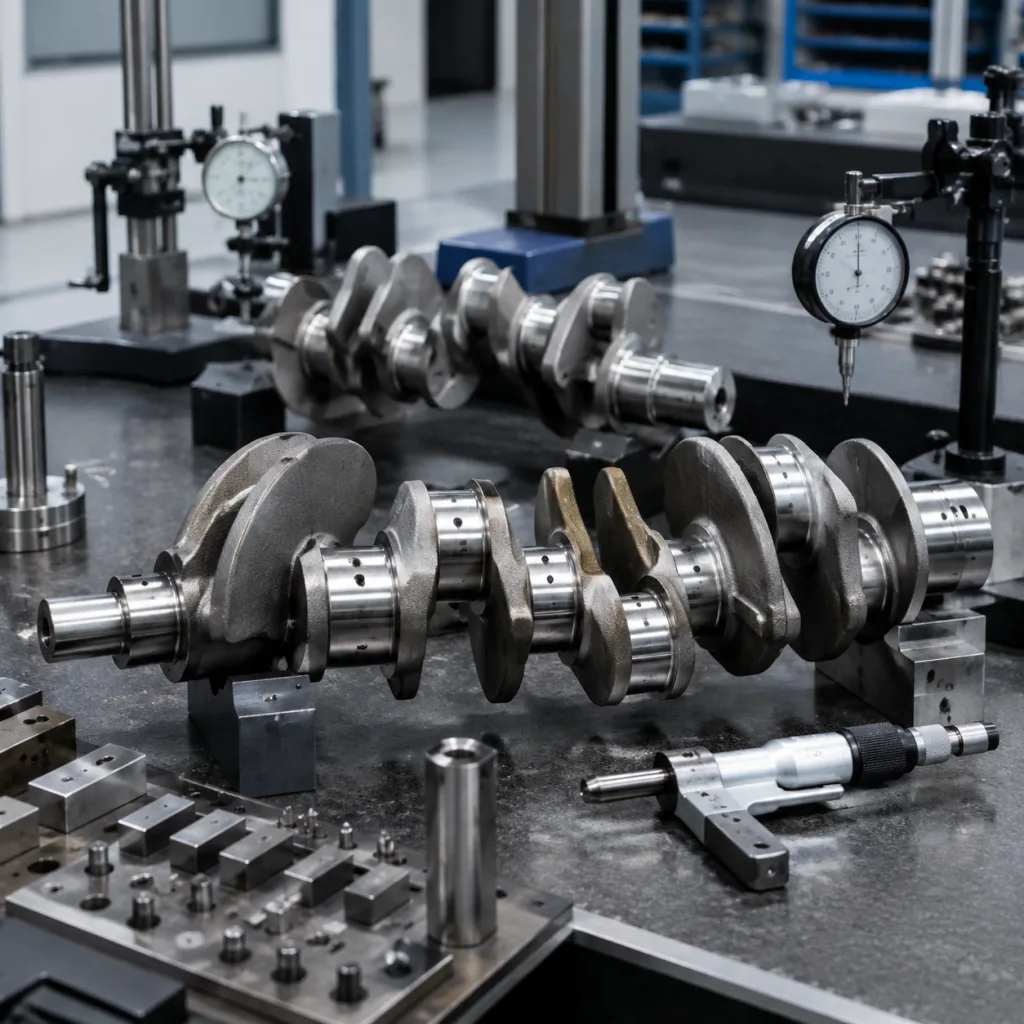
Before inspection, agree the datum scheme. Use the thrust face or front journal as the axial datum, the main journal axis as the rotational datum, and the dowel, keyway, or sensor feature as the angular reference where applicable. Without that agreement, two suppliers can measure the same camshaft and report different phase-angle results.
The table below shows common control points used during RFQ and sample approval. Final tolerances should follow the approved drawing, master sample, or buyer-specified inspection standard.
Control item
Typical control target for RFQ discussion
Typical inspection method
Overall length
Drawing value, commonly controlled within ±0.10–0.20 mm
Vernier caliper or CMM
Journal diameter
Buyer oil-clearance target, often ±0.010–0.020 mm on machined journals
Outside micrometer, air gauge, roundness tester
Lobe lift
Matched to master profile, often within ±0.03–0.05 mm
Cam profile measuring machine
Base circle
Consistent follower preload, commonly ±0.02–0.04 mm
Profile measurement
Lobe phase angle
Timing accuracy, commonly within ±0.5°–1.0° crank equivalent where specified
CMM or angular fixture
Journal runout
Noise and oil-film stability, commonly ≤0.03–0.05 mm TIR
V-block and dial indicator
Surface roughness
Lobe/journal wear-in, commonly Ra 0.2–0.8 μm depending on surface
Roughness tester
Trigger feature position
Cam sensor signal accuracy, measured against angular datum
CMM or dedicated gauge
</tr></thead><tbody> </tbody></table>For B2B programmes, Driventus can support PPAP-style sample review when a customer requires it, even if a full OEM production part approval process is not requested. A practical approval route is 3–5 sample pieces per SKU, full dimensional layout on the first article, critical-dimension checks on all submitted samples, and a signed master sample retained by both parties. Control plans, inspection records, material reports, and gauge methods can be aligned with buyer audit requirements before order release.
Material and Surface Failure Modes Buyers Should Screen Out
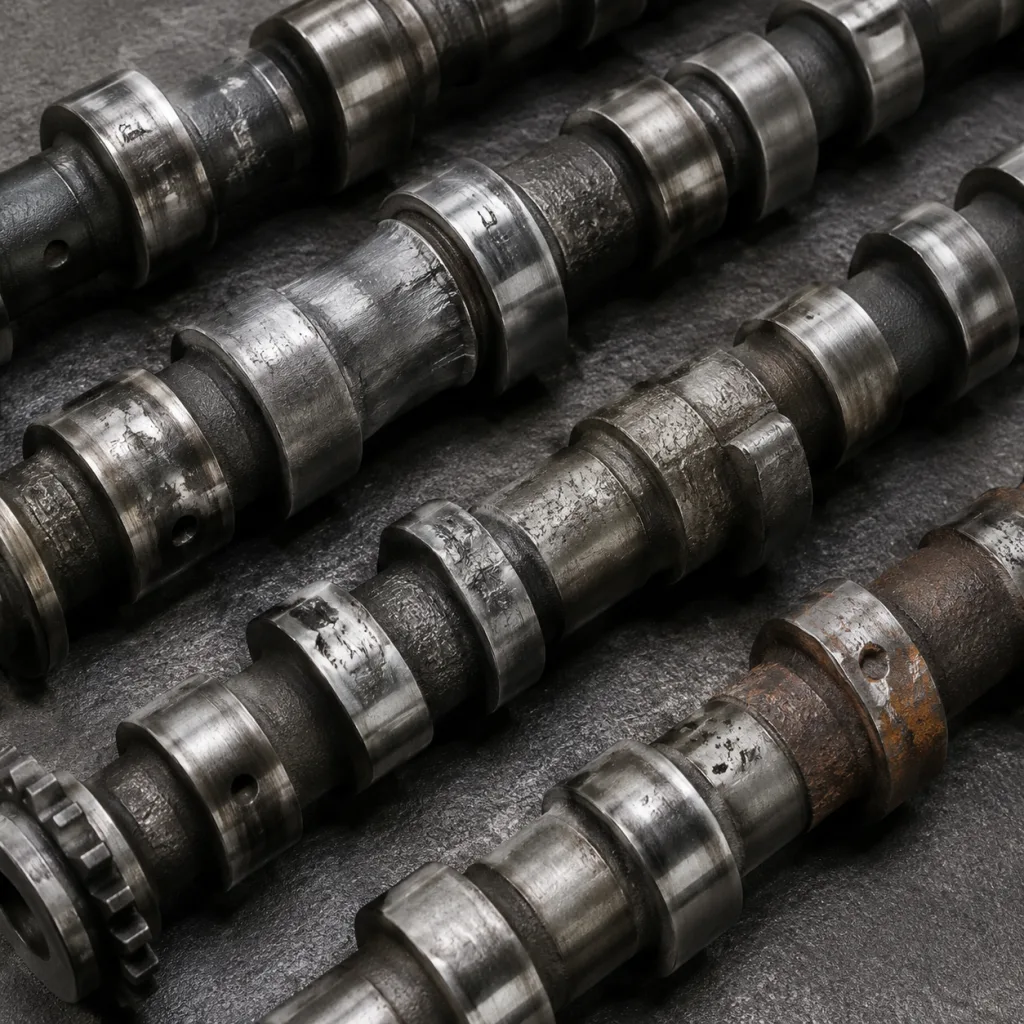
Most camshaft failures are not dramatic on day one. They appear later as pitting, scuffing, abnormal noise, lobe wear, follower damage, or customer complaints after installation. The usual causes are weak material control, unstable heat treatment, grinding burn, poor straightness correction, or inadequate corrosion protection.
Common camshaft manufacturing routes include chilled cast iron, ductile iron, forged steel, and assembled camshaft designs. The suitable route depends on the OE construction, valvetrain load, lubrication conditions, and cost target. Buyers should not accept a lower-grade material substitution without validation and approval. For example, a chilled cast iron design should not be replaced with ordinary grey iron simply to reduce cost unless wear testing, hardness mapping, and customer sign-off support the change.
Screen each batch for the controls that affect service life:
Controlled chemical composition with heat-lot traceability and retained material records
Lobe hardness verification, commonly specified in HRC or HV depending on material and process
Journal hardness verification, separated from lobe hardness where surfaces are treated differently
Case depth or hardened-layer confirmation where induction hardening, nitriding, or chilled layers apply
Crack inspection after heat treatment, straightening, and final grinding when specified
Straightness correction before final grinding, with final runout checked after correction
Grinding-burn risk control through wheel dressing, coolant control, and process monitoring
Rust prevention suitable for export shipping time, normally 30–90 days depending on route and climate
Ask for hardness readings by location, not only a single average value. A useful report shows several lobe readings and journal readings per sample, plus the test scale and load. For surface treatment, the question is not “is it hard?” but “is the correct area hard enough, deep enough, and consistent enough across the batch?”
Driventus production is managed under a documented quality system aligned with IATF 16949:2016 and ISO 9001:2015. For regulated markets, buyers may also request material declarations linked to REACH (EC) No 1907/2006 where applicable to the supplied product and packaging.
Validation Sequence: From Sample Bench to Repeat Orders
Replacement camshafts should be validated against service-related risks, not only compared by appearance. For Kia Optima applications, procurement teams should focus on timing accuracy, wear resistance, lubrication compatibility, sensor signal reliability, and protection during long-distance logistics.
A practical validation package may include:
Dimensional report against approved drawing or master sample, with critical dimensions marked separately
Material certificate and hardness test report by heat lot or batch
Cam profile measurement report for lift, base circle, opening ramp, and phase
Runout and straightness inspection data before packing
Surface roughness report for lobes and journals, normally reported in Ra with test direction noted
Magnetic particle, dye penetrant, or equivalent crack inspection where specified
Trial assembly feedback from customer-nominated samples, ideally including cold start, idle, and road-test comments
Salt-spray or packaging corrosion check when required for sea freight or humid destinations
Sequence matters. First approve the fitment references. Then inspect 3–5 pre-production samples. Next, run installation confirmation on the buyer side. After that, freeze the drawing or master sample and start a pilot order before releasing a full container or annual blanket order.
Different buyers should weight the evidence differently. For distributors, the main exposure is catalogue mismatch and batch inconsistency. For repair chains, it is comeback labour cost after installation. For Tier-1, programme-supplier, or private-label projects, incomplete technical documentation can become the issue during customer audits.
For repeat production, buyers can request 100% visual checks, 100% runout checks on critical SKUs, and sampling inspection for hardness, profile, and roughness based on agreed AQL or control-plan frequency. Driventus can support replacement programmes with sample matching, reverse engineering from customer-supplied samples, and custom manufacturing when the customer provides drawings, performance criteria, or target specifications.
Commercial Sourcing Scenario: Distributor Order vs Repair-Chain Programme
A distributor and a repair chain may buy the same camshaft, but they should not evaluate the project in the same way. The distributor usually needs broad coverage, barcode accuracy, carton durability, and predictable replenishment. The repair chain needs lower installation risk, clear warranty evidence rules, and stable kit contents across branches.
Start by separating technical approval from commercial approval. Comparing price before confirming fitment, inspection standards, and validation data can create slow-moving stock, wrong applications, warranty disputes, and avoidable labour claims.
Use this checklist before placing a production order:
Confirm engine code, model-year range, and market coverage
Identify intake, exhaust, left-bank, or right-bank position where relevant
Use OE-style reference numbers only as fitment references, not endorsement claims
Approve one master sample or drawing revision before production
Define inspection points, AQL level, and report format; common starting points are AQL 1.0 for major defects and AQL 2.5 for minor defects, subject to buyer policy
Confirm packaging label format, barcode requirement, country of origin marking, and destination-country rules
Specify anti-rust oil, VCI bag, end protection, divider material, carton strength, and pallet height limit
Review MOQ, lead time, replenishment plan, and spare-stock strategy before agreeing annual pricing
MOQ is usually driven by casting or forging batch size, machining setup time, heat-treatment lot size, packaging print quantity, and inspection workload. For a developed SKU with existing tooling and neutral packaging, a trial order may be feasible at a lower quantity than a new private-label SKU. For a new camshaft requiring sample reverse engineering, tooling or fixture work, and printed packaging, expect MOQ and unit price to reflect setup cost unless the cost is amortised across an annual forecast.
Lead time should be split by stage: 7–15 days for sample review if material is available, 25–45 days for first production after approval depending on tooling and heat-treatment capacity, and 20–40+ days for sea freight depending on destination. Urgent replenishment can sometimes move by air, but long camshafts are weight- and length-sensitive; freight cost may exceed the part-price saving from a low quotation.
For multi-location repair chains, kit accuracy can be as important as the camshaft itself. If bolts, seals, timing components, or gaskets are sourced separately, installation risk rises because responsibility is split across different suppliers. Driventus also manufactures related engine components such as gaskets, pistons, crankshafts, water pumps, and turbocharger parts, helping buyers consolidate technical review across a wider engine repair range.
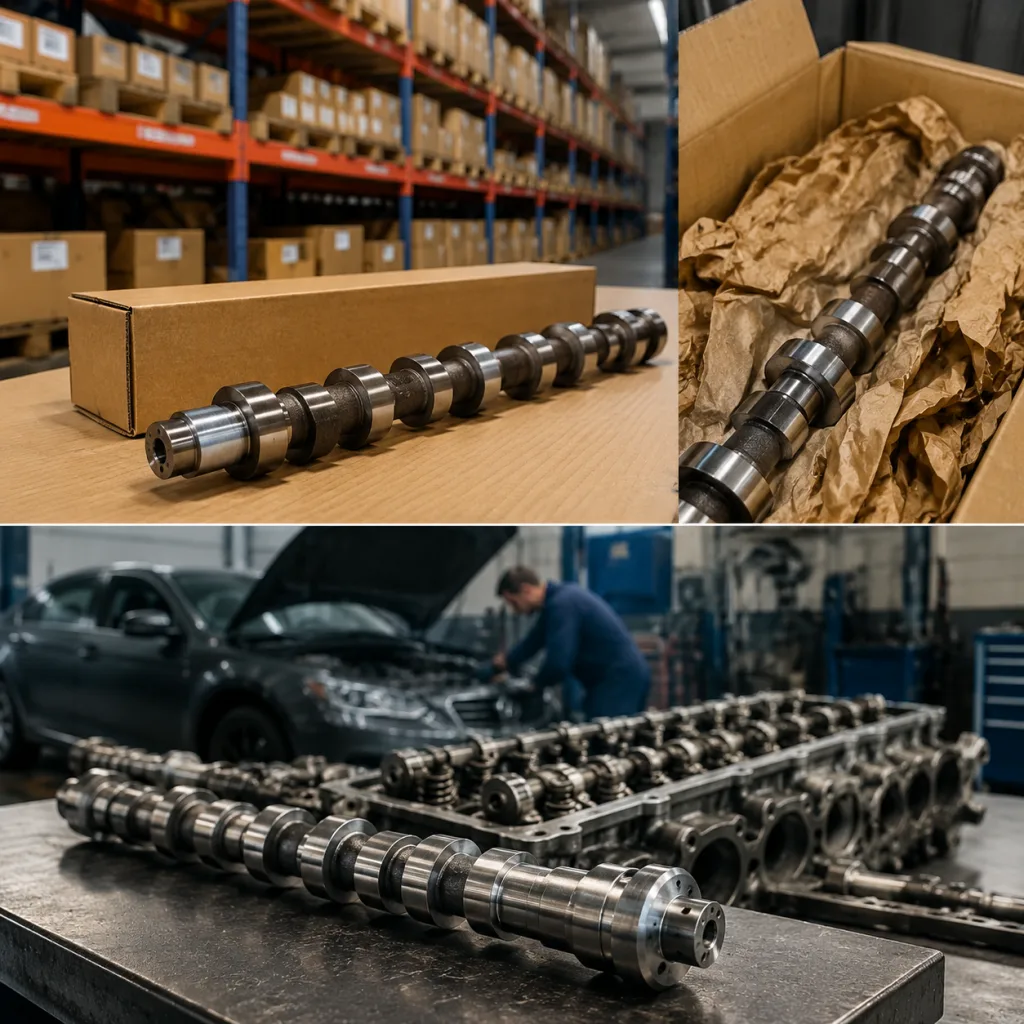
Packaging deserves its own approval. Camshafts are long, machined parts with exposed journals, lobes, and trigger features. A minor dent or corrosion mark can make the part unusable even when the outer carton appears acceptable. Practical checks include a drop test on the packed unit, end-cap compression review, corrosion check after simulated storage, and verification that the camshaft cannot rotate or contact the carton wall during vibration.
Documentation Q&A for Import, Audit, and Warranty Teams
What documents should be agreed before order release? Typical B2B documentation includes commercial invoice, packing list, certificate of origin where required, inspection report, material declaration, product label files, and batch traceability details. For quality audits, buyers may also request process flow, control plan, gauge list, calibration status, and corrective action procedure.
How should traceability be structured? A strong file set links carton label, batch number, production date, inspection record, material heat lot, and shipment invoice. That link lets a buyer investigate one claim without quarantining unrelated stock.
Which standards can be cited? Cite published standards accurately. IATF 16949:2016 and ISO 9001:2015 relate to quality management systems, not automatic product approval. REACH (EC) No 1907/2006 relates to chemical substance obligations in the EU. Vehicle emissions rules such as ECE R-83 may affect complete vehicle compliance, but a replacement camshaft supplier should not claim vehicle-level certification unless relevant evidence exists for the specific claim.
How should quotations be compared? Request the same Incoterms, packaging level, inspection scope, label requirement, and document package from each supplier. A neutral bulk-pack EXW quotation with basic inspection is not comparable with a private-label FOB quotation that includes VCI packing, barcode labels, full dimensional reports, and retained sample control.
What is the strongest buyer position before first shipment? Use a controlled fitment file, an approved sample, an inspection agreement, and a clear warranty evidence process before the first container shipment. Driventus is an independent aftermarket manufacturer; brand names are referenced for fitment only.
Frequently asked questions
Confirm engine code, model year, market, intake or exhaust position, timing system details, and OE-style cross-reference supplied by the customer. A physical sample or drawing should be approved before mass production, with critical dimensions such as journal diameter, lobe lift, phase angle, and trigger feature position checked against the agreed datum scheme.
Yes. Driventus supports B2B private-label supply with agreed packaging, labels, inspection reports, and export documentation. MOQ and price depend on existing tooling, packaging type, annual forecast, inspection scope, and whether new sample development is required.
Typical documents include dimensional reports, material certificates, hardness results, surface-finish checks, and batch inspection records. Additional documents such as control plans, process flow, gauge lists, calibration status, and traceability records can be agreed for audit or customer approval needs.
For camshaft sourcing, sample review, or distributor programme planning, share your engine code list, target annual volume, required packaging, destination market, and documentation package. You can [request a quote](/contact.html) or contact Driventus through /contact.html.