How to Choose a Turbo Actuator Supplier
When evaluating how to choose a turbo actuator supplier, unit price is only one part of the sourcing decision. Procurement and quality teams also need evidence of controlled fitment, traceable production records, repeatable end-of-line testing, stable lead times, and formal engineering change control. That scrutiny is especially important for electronic VGT actuators, vacuum capsules, pneumatic units, and wastegate applications. A few degrees of lever angle, a small preload error, a different connector keyway, or a shifted feedback curve can lead to underboost or overboost faults, DTCs, installation rework, and warranty returns. A credible supplier should identify the exact application, share production-representative test evidence, document revision levels, and support repeat orders without changing the part specification without notice. Driventus is an independent aftermarket manufacturer; brand names are referenced for fitment only. The right supplier reduces receiving inspection work and field risk instead of passing them to your warehouse and customer service teams.
Start with fitment and application control
Start with the vehicle and turbo system, not the catalogue photo. A capable supplier should be able to identify the turbocharger family, actuator type, connector style, mounting pattern, lever geometry, stroke range, and calibration method from the engine code, turbo model, OE reference, emissions level, and production year. Ask the supplier to confirm whether the actuator is electronic, pneumatic, vacuum-controlled, wastegate, or VGT/VNT, because each design has different critical-to-quality characteristics. Two parts can look nearly identical on the bench and still have the wrong lever index, sensor output curve, connector keyway, rod length, or closed-stop position.
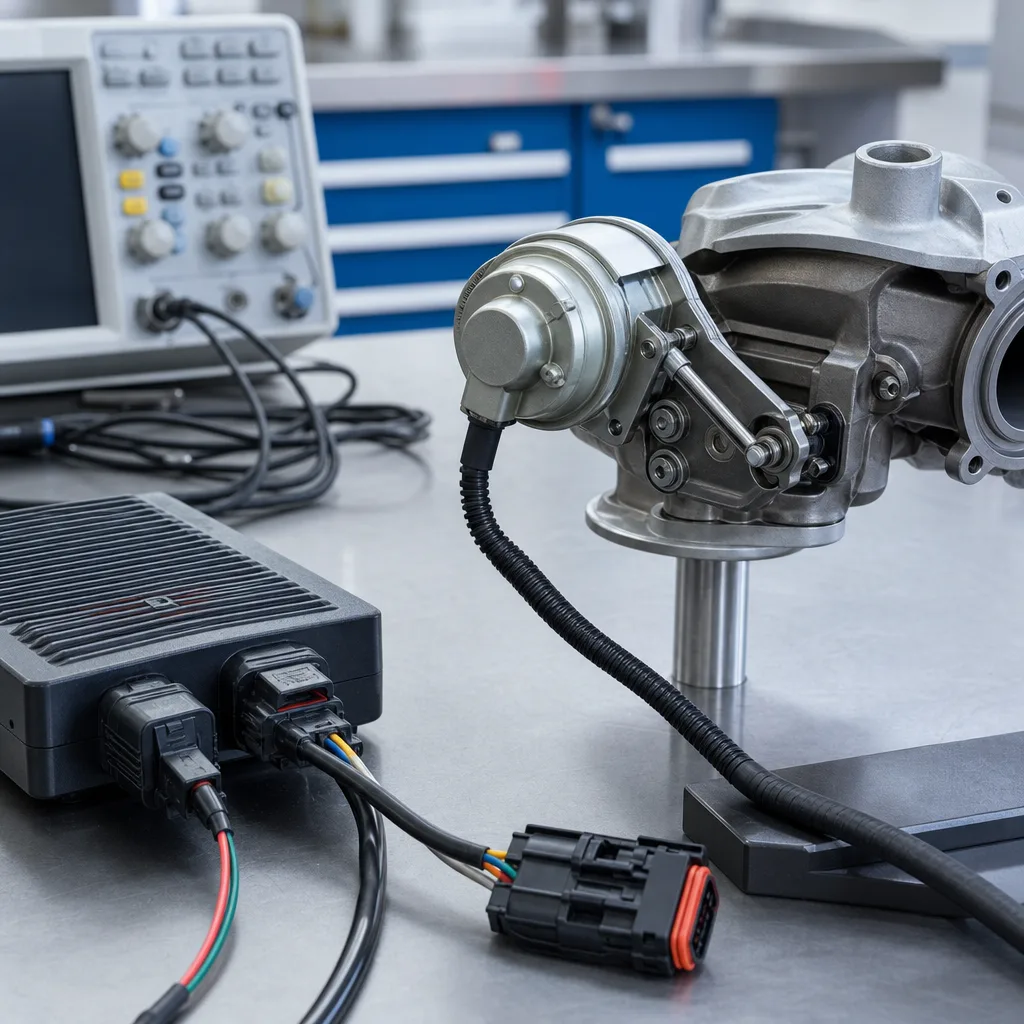
Request a controlled application file before comparing prices. It should include a dimensional drawing, mounting-hole pitch, bracket datum, lever orientation, pinout, operating voltage, ECU control signal, connector housing reference, and any required initialization or calibration procedure after installation. For electronic VGT actuators, confirm the commanded sweep range, end-stop positions, feedback signal curve, fail-safe position, gear train design, and whether software or EEPROM data is locked to a specific turbocharger reference. For wastegate units, confirm crack pressure or preload setting, rod length tolerance, clevis position, diaphragm response if applicable, and whether the actuator is set against a reference turbocharger or a calibrated stand-alone fixture.
Application control also means revision control. Ask how the supplier separates superseded OE numbers, regional emissions variants, engine-output differences, left-hand and right-hand drive packaging changes, and model-year breaks. If the same sales code covers several actuator versions, require written confirmation of the exact variant, drawing revision, connector, bracket, and calibration file being shipped. The supplier should also explain how new cross-references are approved, how fitment errors are contained, and how customers are notified when a drawing, connector, bracket, firmware, sensor, spring, diaphragm, or calibration file changes.
If the supplier cannot tie the part to a controlled application list, your team will spend more time on returns, rework, and customer explanations. Cross-check the proposal against our catalog and, when the programme extends beyond actuators, engine components to see whether the supplier manages related fitment data with the same discipline.
Verify certifications and traceability
Audit the paperwork before approving the factory. Certifications do not guarantee every actuator will conform, but they show whether the supplier has the production discipline needed for recurring orders. Minimum documents should include:
- IATF 16949:2016 certificate for automotive production control, where applicable to the manufacturing site
- ISO 9001:2015 certificate for the quality management system
- Material declarations and restricted-substance control under REACH (EC) No 1907/2006
- Batch traceability from incoming component lot to finished actuator
- Final inspection records with numeric acceptance limits
- Gauge calibration records for fixtures used to set stroke, preload, leak rate, and sensor output
- Nonconformance, containment, 8D or equivalent corrective action procedures for rejected lots and warranty returns
Check that certificates are current, issued by a recognized certification body, and matched to the legal entity and production site that will make the parts. If a trading company is quoting on behalf of a factory, ask which organization owns design control, incoming inspection, process control, end-of-line testing, and customer complaint handling. The paperwork should connect to the exact product family you are buying, not sit in a generic supplier file.
Traceability should work at part, carton, and batch level. Ask for a sample part label, carton label, batch traveller, inspection sheet, and end-of-line test record from a recent production run. A strong supplier can trace motor, gear, housing, PCB, position sensor, spring, diaphragm, connector, fastener, and seal lots where applicable. For electronic actuators, confirm whether serial numbers or batch codes link to electrical data such as supply voltage, current draw, feedback voltage, commanded position, response time, and sweep result. For vacuum or pneumatic units, confirm how rod setting, leak testing, spring force, and crack-pressure or response-threshold checks are recorded.
A supplier with a real quality system can explain gauge R&R or fixture validation where relevant, calibration intervals, operator training, nonconformance handling, containment timing, root-cause analysis, and corrective action closure. If the answer is vague, the process is not robust enough for a recurring purchase order, especially when the same actuator family will be ordered across multiple SKUs, packaging formats, and customer channels.
Ask for validation data, not claims
Do not accept phrases such as tested in-house or validated for durability without the report behind them. Ask for the test method, sample size, pass/fail limits, equipment used, test date, environmental conditions, and outcome. The report should identify the part number, drawing revision, production batch, software or calibration revision where applicable, and whether the samples came from prototype tooling, pilot production, or normal mass production. Without those details, the data may not represent the parts you will receive.
| Evidence requested | What good looks like | Why it matters |
|---|---|---|
| Functional cycle test | Current draw, response time, travel sweep, stop position, and position feedback recorded across the operating range | Confirms the actuator moves consistently under electrical or pressure load |
| Thermal cycling | Defined hot and cold soak points, cycle count, dwell time, and stable re-test results | Exposes drift in sensor, motor, gear, seal, spring, or diaphragm behaviour |
| Vibration or shock screening | Fixture details, axis, acceleration level, duration, and no loss of calibration or connector retention | Reduces field failures after transport, installation, and engine-bay vibration |
| End-of-line test | 100% inspection with serial or batch traceability and numeric pass/fail limits | Improves outgoing quality control and complaint investigation |
| Leak or vacuum test | Measured leakage rate, response threshold, and hold time where applicable | Confirms pneumatic and vacuum actuator performance |
| Electrical and connector check | Pinout, insulation, continuity, terminal retention, and connector latch engagement verified | Reduces installation faults and ECU communication issues |
| Material compliance | REACH declarations and part-level material traceability | Lowers regulatory, customs, and import risk |
| Category | Weight | What to verify |
|---|---|---|
| Fitment accuracy | 30% | Correct application mapping, drawings, pinout, stroke range, preload or feedback curve, calibration data, and revision control |
| Quality evidence | 25% | IATF 16949:2016 where applicable, ISO 9001:2015, traceability, inspection records, gauge control, and corrective action process |
| Validation data | 20% | Test reports, sample size, pass/fail limits, durability evidence, and production-representative samples |
| Supply continuity | 15% | MOQ, lead time, buffer stock, packaging discipline, export readiness, and change-notice control |
| Commercial fit | 10% | Terms, communication speed, warranty handling, claim response time, and after-sales support |