Head Gasket Leak Oil Pan Gasket: Diagnosis and Replacement
A head gasket leak and an oil pan gasket leak can create overlapping symptoms: oil loss, underbody residue, smoke, and a burnt-oil smell. The overlap is why these faults get misdiagnosed and why the wrong gasket is often ordered first. For procurement teams and workshop buyers, the real job is to confirm the sealing interface before stock is committed. A head gasket fault can move oil, coolant, or combustion gases across internal passages; an oil pan gasket leak usually leaves a direct external oil trace at the sump joint. Driventus is an independent aftermarket manufacturer; brand names are referenced for fitment only. We manufacture engine and powertrain components to controlled specifications under IATF 16949:2016 and ISO 9001:2015, with materials and processes selected for repeatable sealing performance across service intervals.
Decision First: Which Leak Is More Likely?
Start with the simplest question: where is the highest wet point?
Low, at the sump rail: the oil pan gasket is the first suspect.
High, at the head-to-block seam: the head gasket moves up the list.
Mixed oil and coolant: treat the head gasket as the priority until proven otherwise.
Oil only, no coolant change: inspect the pan, valve cover, oil cooler lines, and crankcase ventilation.
The reason this matters is practical, not academic. A top-end repair can mean a head removal, machining checks, and a larger gasket kit. A lower-end reseal may only need pan removal, flange correction, and a controlled torque sequence. If the wrong path is chosen early, the job multiplies.
One useful rule: fluids travel downward, so the drip point is rarely the fault point. Clean first, then judge.
Failure Modes: How Each Leak Shows Up
A head gasket leak and an oil pan gasket leak can look similar in a parking lot. Under the hood, they behave differently.
Observation
More likely source
Why it matters
Oil trail starting at the engine base
Oil pan gasket
Leak is external and usually visible at the rail
Milky oil or oil in coolant
Head gasket
Fluid crossover points to internal sealing loss
White smoke after warm-up
Head gasket
Coolant may be entering the cylinders
Burnt-oil smell after shutdown
Either
Oil can reach hot exhaust surfaces from above or below
Recurrent low oil with no puddle
Either
Could be a slow pan seep, internal leak, or undertray accumulation
</tr></thead><tbody> </tbody></table>A pan leak often worsens with heat soak, over-torque, or flange distortion. A head gasket failure more often brings pressure imbalance, coolant loss, misfire, or bubbling in the expansion tank. Engines with weak crankcase ventilation can confuse the picture because excess pressure can push oil past a gasket that is otherwise still serviceable.
That is why symptom-only diagnosis fails so often. The pattern matters more than the single drip.
Step-By-Step Inspection Before You Order Parts
Use the same sequence every time.
1. Degrease the engine exterior and undertray. 2. Run the engine to operating temperature. 3. Mark the highest wet point, not the lowest drip point. 4. Check the head seam, valve cover, timing cover, and sump flange. 5. Verify oil level, coolant condition, and crankcase pressure. 6. If the source is unclear, add UV dye and repeat after a short road test.
For workshop triage, a cold-start idle check, a 15-20 minute road test, and a second inspection after heat soak usually catch leaks that only appear once the oil thins out. Remove the undertray before diagnosis if the vehicle has one. Trapped oil in the shield can make a small leak look severe.
A second rule applies to repeat failures: do not replace the gasket until the mating surfaces are checked. A dirty rail, a warped sump edge, or a missing fastener will turn a good part into a comeback.
Spec Deep-Dive: What the Oil Pan Gasket Must Match
The part may look simple. The specification is not.
Typical checks
Material: molded rubber, FKM, NBR, or composite depending on the engine family
Heat resistance: suitable for continuous sump temperatures in service
Compression set: low enough to maintain seal after thermal cycling
Bolt-hole alignment: no stretch, skew, or mislocation
Seal continuity: no voids, flash, or cut edges
For fitment-sensitive programs, we validate against dimensional drawings and process controls aligned with IATF 16949:2016. That reduces variation across batches and helps procurement avoid mixed-quality replenishment.
If you are writing an RFQ, specify the operating window, not just the part number. For example, ask for continuous exposure from -40°C to 150°C, oil splash resistance to API SP / ACEA-class engine oils, and no visible seepage after 100 thermal cycles. If the engine is used for towing or extended idle, request the higher-temperature compound and a torque-control installation note.
Installation spec matters too. Many returns come from uneven clamp load, dirty surfaces, or cross-threaded bolts rather than gasket material failure. A 2- to 3-stage tightening sequence to OE torque usually reduces rail distortion and gives the seal a fair chance to work.
Scenario Match: When the Oil Pan Gasket Is the Right Call
Use the oil pan gasket path when the evidence stays low and clean.
The leak starts at the sump flange and does not climb above it.
Oil residue reappears after hot idle or a highway cycle.
Coolant stays clean and there is no milky oil.
The flange shows distortion, impact marks, or over-torque history.
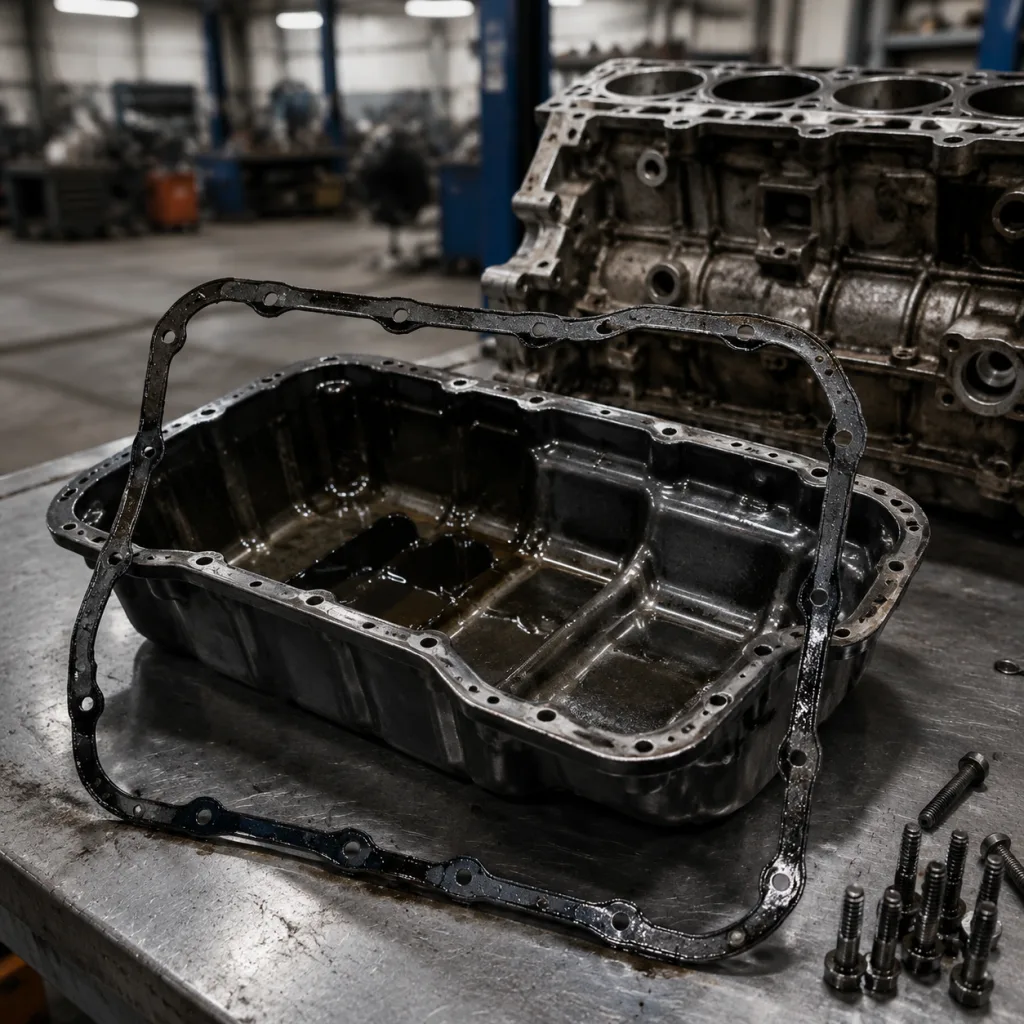
In that scenario, replacement is only part of the fix. Inspect the pan rail, confirm bolt length and thread condition, and check whether the pan has been reshaped by prior service. A gasket will not seal a distorted flange for long.
On stamped-steel pans, even a small rail offset can create a repeat leak. On some cast or formed designs, corner sealing and RTV transitions matter more than the gasket itself. The right part number still fails if the interface is wrong.
How Driventus Supports Sourcing and Validation
Driventus supplies oil pan gaskets and related engine sealing parts to aftermarket distributors, OEM / Tier-1 suppliers, and multi-location repair groups. Buyers can review our catalog, compare sealing families in our quality system, or discuss custom manufacturing for engine-specific programs.
We focus on controlled fit, material consistency, and traceable production records. For parts that must match an OE form factor, we check:
overall perimeter and bolt-hole geometry
bead profile and compression behavior
temperature and oil resistance
packaging and lot traceability
sampling and inspection records for repeat orders
If the application requires adjacent components, the relevant engine families are listed in engine components. That helps teams bundle sourcing for pan gaskets, seals, and related wear parts under one supplier review.
For buyers planning a program quote, we can structure the order around MOQ, price breaks, and lead time as follows: prototype/sample lots may be available for fitment approval, production MOQ is typically set by material family and tooling complexity, and standard lead times depend on whether the design is off-the-shelf or custom. Simpler molded rubber gaskets usually move faster than multilayer or bonded designs, while custom tooling adds validation time before first shipment.
To reduce sourcing risk, request target annual volume, forecast split by engine code, acceptable substitution rules, packaging requirements, and required inspection documents on every RFQ. That gives procurement a workable basis for comparing unit price against total landed cost, not just list price.
Standards, Compliance, and Buying Notes
Published standards do not define every gasket dimension, but they do frame supplier control, compliance, and material expectations.
IATF 16949:2016 for automotive quality management in serial production
ISO 9001:2015 for documented quality management systems
REACH (EC) No 1907/2006 for chemical compliance in the EU market
SAE J2527 when UV durability matters for exposed elastomeric materials
For cross-border sourcing, ask for material declarations, batch traceability, and validation records. For high-mix programs, inspection criteria matter as much as unit price because they reduce returns and rework.
Driventus is an independent aftermarket manufacturer; brand names are referenced for fitment only.
A strong supply package should include target hardness range, media resistance data, shelf-life expectation, carton quantity, and carton-to-pallet configuration. A gasket with a 70-80 Shore A target, 12-month shelf-life minimum, and barcode-labeled lot traceability is easier to control in distribution than an unlabelled bulk pack. If your operation relies on just-in-time replenishment, align reorder point with actual consumption plus a 1-2 week buffer rather than assuming every engine family turns the same way.
Frequently asked questions
Check the highest wet point. Oil pan leaks start low at the sump flange. Head gasket leaks often show coolant loss, milky oil, or combustion gas in the cooling system.
Yes. Oil can travel down the block and collect at the lowest point. Clean the engine first, then inspect the cylinder head seam before replacing the pan gasket.
Confirm engine code, flange geometry, bolt-hole pattern, material type, and any RTV requirements. A dimensional match matters more than a visual match.
If you need a verified fitment cross-reference or a programme quote, please contact our team via /contact.html.