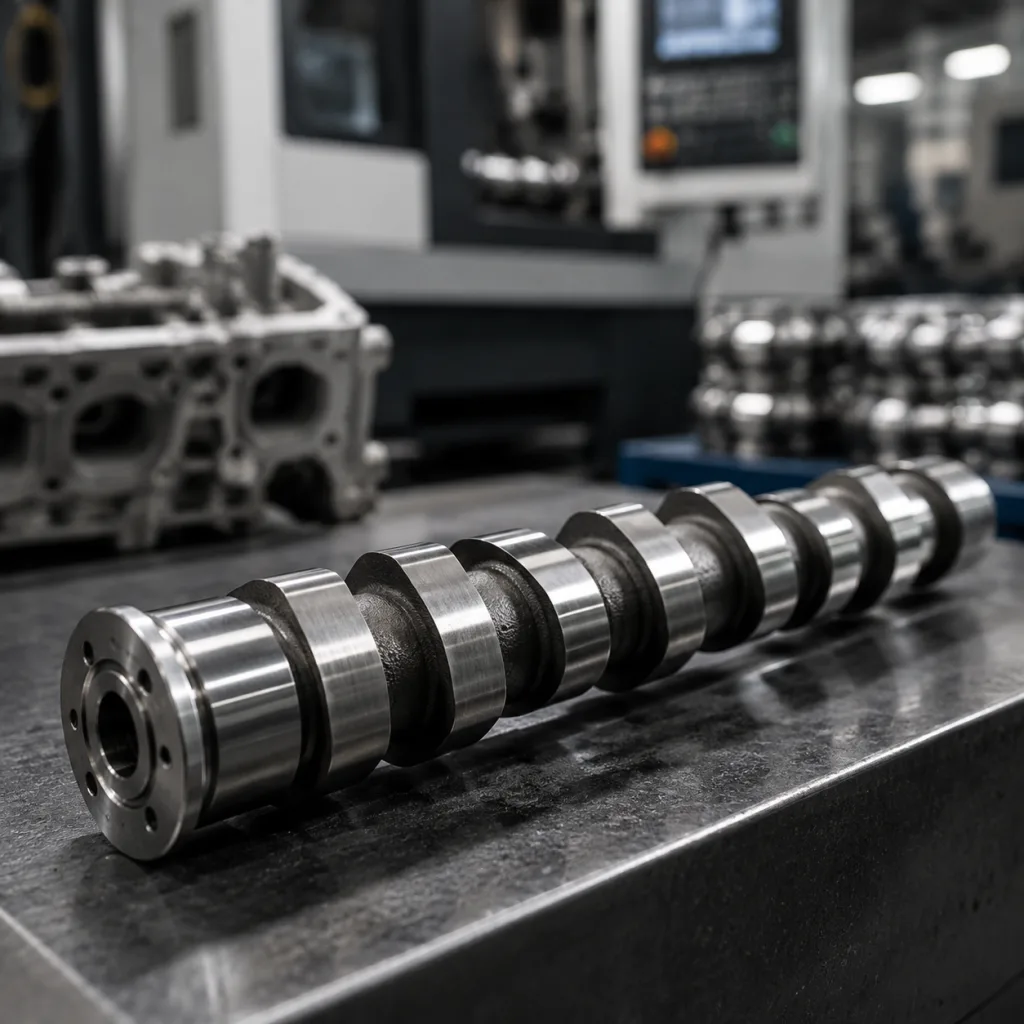
Camshaft Dodge Aftermarket Replacement: OE Match Criteria
A camshaft Dodge aftermarket replacement is only acceptable when it matches the OE profile, lobe timing, journal dimensions, and material specification. For procurement teams, the risk is not just fitment; a part that fits the housing can still shift valve events, idle quality, emissions behaviour, or durability. Treat the camshaft as a controlled engineering item, not a generic service part.
Driventus is an independent aftermarket manufacturer; brand names are referenced for fitment only. We supply engine and powertrain components under IATF 16949:2016 and ISO 9001:2015 controls, with dimensional verification and traceability for B2B sourcing in the EU, UK, US, Canada, Australia, and Brazil. This article focuses on how to decide whether a replacement is worth approving, where failures usually occur, and what to request before release.
How to decide if a replacement is truly equivalent
For a camshaft replacement, the first question is not “does it fit?” It is “does it behave like the OE part in the engine?” A Dodge application can change by engine family, cylinder head design, emissions package, and model year. Two parts can share the same bearing count and still fail the application if base circle, lift, duration, lobe separation angle, or sensor trigger geometry differ.
Start with the identifiers that actually narrow the field:
- OE part reference and engine code
- VIN decode and engine family confirmation
- Journal diameter, overall length, and thrust control features
- Lobe lift, duration at checked lift, and phasing
- Drive type: chain, gear, or mixed timing set
- Sensor and trigger wheel geometry
- Surface finish and core hardness
- Packaging orientation and preservation oil for transit
Typical RFQ tolerances to agree up front:
- Journal diameter: ±0.01 mm on critical fits, or match OE print requirement
- Overall length: ±0.20 mm unless the head package needs tighter control
- Runout: ≤0.03 mm TIR on production parts unless the OE spec is stricter
- Surface roughness: Ra 0.2–0.4 μm on journals, profile-specific on lobes
- Hardness: within the approved range for the chosen material and heat-treat route
If the request includes an OE number such as `OE 06A107065`, use it only as a starting point. Confirm the application by VIN, engine code, and measured sample where possible. For fleet or remanufacture programmes, ask for at least one physical sample and a dimensional report before volume release.
Where aftermarket camshafts fail in the field
Most sourcing problems show up after the part has already cleared catalog matching. That is why a camshaft Dodge aftermarket replacement needs a failure-mode review, not just a cross-reference check. The common misses are predictable.
| Failure mode | What causes it | Typical result |
|---|---|---|
| Wrong lobe profile | Lift or duration does not match OE | Rough idle, torque shift, or misfire behavior |
| Incorrect trigger geometry | Sensor windows or reluctor teeth differ | Timing errors and ECU instability |
| Base circle mismatch | Follower geometry changes | Lash issues or valvetrain interference |
| Thrust control drift | Axial location is not held | Noise, wear, and timing set damage |
| Material or heat-treat variance | Core or lobe hardness is off | Early wear, scuffing, or fatigue failure |
| Surface finish problems | Journals or lobes are too rough | Oil-film breakdown and accelerated wear |
| Check item | Procurement question | Why it matters |
|---|---|---|
| Journal size | Does the cam run in the same bearing set? | Controls oil film, wear, and housing fit |
| Lobe profile | Is lift and duration OE-matched? | Affects torque curve and idle quality |
| End play / thrust | Is axial control unchanged? | Prevents timing noise and wear |
| Trigger features | Are sensor windows or reluctor teeth identical? | Protects ECU timing accuracy |
| Material and heat treat | Is the blank cast, forged, or billet, and how is hardness controlled? | Affects fatigue life and scuff resistance |
| Surface treatment | Is the lobe treated for wear reduction? | Improves boundary lubrication performance |
| Timing phasing | Is the installed centerline preserved? | Protects calibration and emissions behavior |
| Base circle | Is valve lash or follower geometry unchanged? | Prevents valvetrain interference |