connecting rod · 2026-06-16

Connecting Rod Nissan Supplier: Sourcing Guide

If you are shortlisting a connecting rod Nissan supplier, the real decision is not who sounds strongest in a quote email. It is who can prove fitment, metallurgy, dimensional control, and repeatable output at commercial volume. Driventus manufactures engine and powertrain components in Taizhou, Zhejiang, and exports to more than 60 countries. We support aftermarket distributors, OEM and Tier-1 supply chains, and multi-location repair groups that need stable lead times and documented quality control. Driventus is an independent aftermarket manufacturer; brand names are referenced for fitment only. For Nissan applications, buyers usually compare OE cross-references, big-end bore, centre-to-centre length, beam thickness, and bolt specification before placing a trial order. The supplier also needs traceability, inspection records, and export packaging that protects parts in ocean freight. This guide focuses on the checks that prevent bad fitment, rejected lots, and avoidable warranty claims.

Start with fitment, not price

When evaluating a connecting rod Nissan supplier, the first question is whether the part matches the engine, not whether it is the cheapest option. Nissan engine families differ by bore, stroke, pin size, rod length, and fastener design, so the supplier has to confirm the engine code and OE reference before sampling.

Ask for these fitment details up front:

  • OE cross-reference format, for example `OE 12100-xxxx` when provided by the buyer
  • Centre-to-centre length and small-end bore
  • Big-end bore after torque and resizing
  • Beam width, weight window, and cap alignment
  • Rod bolt grade and tightening specification
  • Surface finish, crack detection, and batch traceability

A serious supplier will not accept vague fitment requests. It should ask for the engine code, OE number, or a sample part before quoting. That discipline is inconvenient for impulse buying, but it prevents mixed-lot inventory and avoids the most expensive kind of mistake: a part that looks right and fails on the bench.

Forged steel or powder metal: what changes the outcome

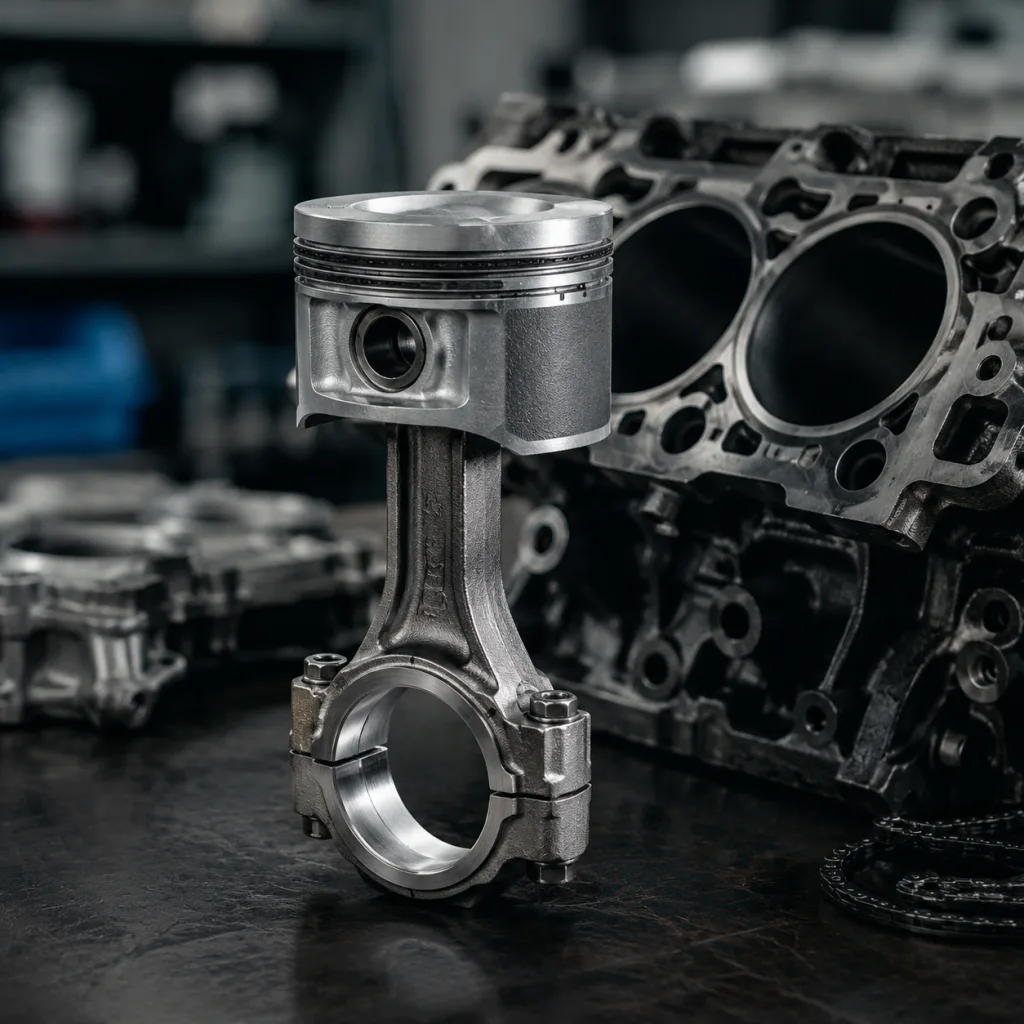
Connecting rods are commonly supplied in forged steel or powder-metal construction, and the choice affects fatigue behavior, machining, and cost. For aftermarket and remanufacturing supply, forged alloy steel remains the common route because it gives buyers robust fatigue performance and predictable machining.

Typical production controls include:

  • Forging followed by heat treatment
  • CNC machining of both bores and mating faces
  • Shot peening where specified
  • Magnetic particle inspection or equivalent crack detection
  • 100% dimensional checks on critical features

A competent supplier should state the material grade, hardness range, and process route in the quotation. Buyers often also ask for target tolerances on centre distance, big-end bore, and small-end bore before approving a pilot run. If you need a custom programme, Driventus can align rod geometry, hole sizing, surface treatment, and packaging to your target application through custom manufacturing. That matters for private label distributors, regional rebuilders, and OEM-aligned projects that need a controlled variant instead of a catalog item.

A practical procurement sequence

The cleanest sourcing process is usually: sample, verify, then scale. Price per piece matters, but it does not decide landed cost on its own. Lead time, MOQ, inspection scope, and packaging specification often matter more once a programme starts moving.

</tr></thead><tbody> </tbody></table>Many buyers structure a first order in three steps: a sample lot of 1-4 pcs for engineering verification, a pilot batch of 20-100 pcs for fitment and packaging validation, then a production order once the tolerance window and label format are approved. MOQ should be negotiated around that path rather than treated as a fixed number, because a custom rod, a standard catalog rod, and a mixed-SKU export carton all have different economics. Lead time should also be separated into sample time, tooling or process preparation time, and repeat-order production time; otherwise quotes are hard to compare fairly.

Distributors and importers should also check whether the supplier can supply mixed-SKU cartons or consolidated export pallets. That matters for regional warehouses that service multiple Nissan engine lines. If your programme includes adjacent parts, review our catalog and the broader engine components range to consolidate purchasing across rods, pistons, gaskets, and pumps.

Documents that stand up in audit review

Procurement teams increasingly ask for proof before they place repeat business. The minimum document set usually includes material certificates, inspection records, packing lists, and a process summary tied to the order.

Driventus operates under `IATF 16949:2016` and `ISO 9001:2015` quality management systems. Buyers may request supporting evidence aligned with their own vendor approval process, including control plans, gauge calibration status, and nonconformance handling.

A practical audit checklist:

  • Confirm incoming material traceability
  • Review in-process dimensional control points
  • Check final inspection sampling method
  • Verify packing and corrosion prevention steps
  • Confirm complaint response and containment procedure

For export markets, buyers may also require material compliance support for `REACH (EC) No 1907/2006` where applicable in the supply chain. The best supplier answer is a clear document pack, not verbal assurance. For this reason, many buyers route supplier qualification through the quality system page before requesting pricing.

Where fitment mistakes usually happen

Cross-referencing helps only when the part data is complete. A Nissan connecting rod request should include the engine code, model year range, and, if available, the OE part number. The supplier should then compare the rod length, big-end journal diameter, small-end bush configuration, cap style, bolt pattern, and weight balance.

If the buyer provides an OE reference such as `OE 12100-xxxx`, the supplier should confirm whether the part is a direct replacement, a supersession, or a variant for a different engine revision. That distinction matters because visually similar rods can still differ in clamp load, bore geometry, or mass balance.

A sensible acceptance plan looks like this: 1. Check the first article against the drawing. 2. Confirm the small lot with go/no-go gauges. 3. Verify paired bore measurement after cap torque. 4. Run trial assembly before releasing the full lot.

For export distributors, the real goal is not a single acceptable sample. It is consistent fitment across lots, so the same part behaves the same way in every market and every reorder cycle.

What Driventus can take on

Driventus supports buyers who need stable supply, documented inspection, and responsive quotation cycles. We work with private-label distribution, OEM-aligned programmes, and repair-chain replenishment using controlled production and export packing.

Typical buyer requirements we can cover:

  • Sample development against drawing or sample part
  • Repeat batches with agreed dimensional tolerance
  • Branded or neutral packaging for channel separation
  • Consolidated purchasing across engine component families
  • Export documentation for customs and inbound receiving teams

If you are comparing a connecting rod Nissan supplier, the fastest way to get a useful answer is to send the engine code, OE reference, annual volume, and target market. Add your target tolerances, preferred pack count, and whether you need a trial order or a stocked programme, because those details change both price and lead time. From there, our team can advise on feasibility, MOQ, and lead time. For programme discussions, request a quote and include your technical specification so we can return a precise offer.

Frequently asked questions

Send the engine code, OE reference if available, annual demand, target market, and any drawing or sample part. Add the required centre-to-centre length, big-end bore, small-end bore, and target quantity so a supplier can confirm fitment, tolerance, MOQ, and lead time before pricing.

Yes. Custom geometry, surface treatment, packaging, and batch marking can be aligned to a programme. Driventus is an independent aftermarket manufacturer; brand names are referenced for fitment only. Buyers can also specify pilot-batch size, carton count, and label format for channel control.

Buyers can typically request material traceability, dimensional inspection records, packing details, and quality system evidence aligned with `IATF 16949:2016` and `ISO 9001:2015`. For controlled launches, a supplier may also provide first-article measurements, hardness data, and crack-detection records.

If you are qualifying a new supply source, send your engine data and volume target to our team and we will review fitment, MOQ, and lead time with you. Start here: /contact.html

Request a Quote
Item What to confirm Why it matters
MOQTrial order and mass-production quantitySupports validation before scale-up
Lead timeSample, pilot, and repeat order timingProtects service level and stock cover
PackagingOil protection, cavity separation, carton strengthReduces transit damage and corrosion risk
TraceabilityBatch code, heat number, inspection reportSupports warranty and recall control
IncotermsEXW, FOB, or other agreed termClarifies logistics responsibility