A harmonic balancer program rarely fails because the unit price was off by a few cents. It fails when the bore fit changes between batches, the pulley plane is slightly wrong, the rubber hardens too quickly, or a merged application crosses a trigger-pattern boundary that the catalogue did not show. For importers, distributors, service networks and OEM service suppliers, the useful question is not “Can you supply this part?” It is “Which harmonic balancer specifications prove this part will install, run and ship consistently?”
That means locking down hub geometry, inertia-ring mass, elastomer behavior, runout, balance, coating, packaging, MOQ logic, tooling ownership and lead-time assumptions before samples become orders. This article sets out the specification checks Driventus uses when reviewing aftermarket and custom crankshaft damper programs. Driventus is an independent aftermarket manufacturer; brand names are referenced for fitment only.
Start With the Failure You Cannot Afford
A harmonic balancer is not just another machined pulley. It is a rotating, bonded assembly that sits on the crankshaft nose and influences torsional vibration, belt alignment, accessory drive stability and service timing. Small errors become expensive because they often appear after installation, heat cycling or high-speed operation rather than at receiving inspection.
The failure modes worth designing out are specific:
Coating thickness, salt-spray target, packaging moisture control
Shelf-life claims, distributor rework
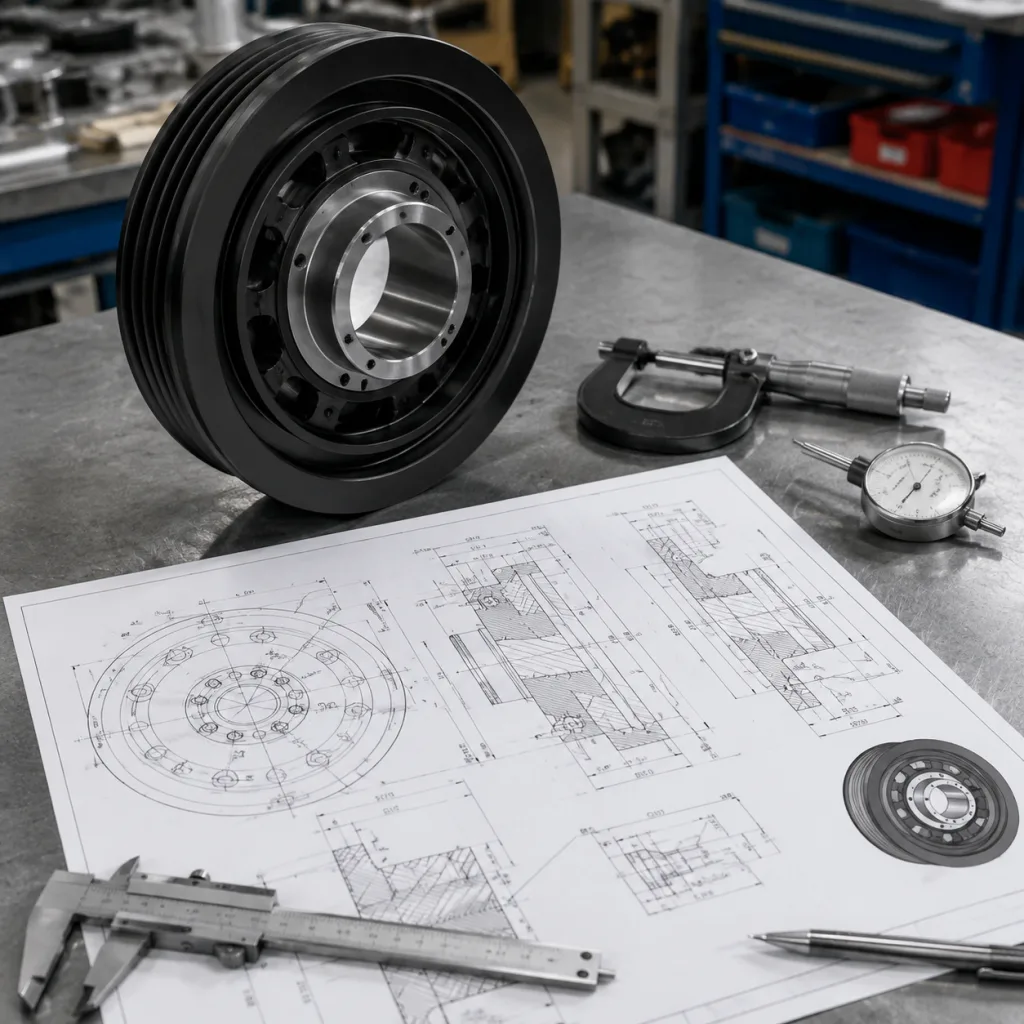
</tr></thead><tbody> </tbody></table>For a sourcing file, the first decision is the data source. Is the supplier quoting from a controlled buyer drawing, an OE sample, a reverse-engineered aftermarket reference or an existing factory SKU? Each route carries different risk. If no drawing exists, agree the datum scheme before tooling: crank bore as the primary datum, mounting face as the secondary datum, and keyway, timing mark or trigger feature as the angular datum.
A 0.3–0.5 mm pulley offset error can be enough to create visible belt wander. An oversized bore may pass a visual check but fail after thermal cycling. A shallow keyway can look harmless until installation torque and crank engagement are reviewed. Driventus normally checks OE sample parts, 2D drawings, 3D scans and application data from our catalog. For private-label or low-volume programs, custom manufacturing can include reverse engineering, material selection, prototype review and controlled drawing release.
Material Choices That Change Field Risk
The metal grade, rubber compound and bonding process decide whether a harmonic balancer behaves like the OE concept or merely resembles it. Most dampers combine a steel or cast-iron hub, an inertia ring and an elastomer layer. The hub transfers torque. The ring supplies damping mass. The elastomer creates phase lag between the two metal components.
Material substitutions should never be treated as purchasing details. They change damping response, corrosion behavior, crack resistance, groove wear and separation risk.
Key choices to specify:
Hub and ring material: grey cast iron such as HT200/HT250, ductile iron such as QT450, forged steel or machined steel, selected according to OE design, engine torque, pulley geometry and expected service load.
Elastomer type: natural rubber, EPDM or an equivalent heat-resistant compound matched to -40°C to 120°C service exposure, short-term peaks around 150°C, oil mist, ozone and ageing risk.
Rubber hardness: usually stated as a Shore A window, often 55–75 Shore A with a ±5 Shore A production tolerance unless the drawing requires tighter control.
Bonding system: shot blasting or phosphating, degreasing, primer/adhesive application, mould temperature, cure time and separation resistance between metal and rubber.
Corrosion protection: phosphate, electrophoretic coating, zinc-based coating or paint, selected for market, warehouse time and packaging method; common coating thickness targets are 8–25 µm depending on process.
Timing features: reluctor wheels, timing marks and reference notches controlled by angular position relative to the crank datum, commonly within ±1° unless the application requires tighter control.
Ask for process evidence, not only material names. How is the rubber mixed? Is every compound batch supported by hardness and rheometer records? How are metal surfaces cleaned before bonding? Is curing controlled by time, temperature and pressure, or by operator judgement?
IATF 16949:2016 and ISO 9001:2015 do not define the damper dimension. They define the discipline behind the dimension: drawing control, traceability, supplier management, calibration, nonconforming product control and corrective action. Driventus operates under IATF 16949:2016 and ISO 9001:2015, and our quality system supports batch traceability for export programs.
A Working Tolerance Map for RFQ Review
Final tolerances must follow the OE drawing, buyer drawing or approved reverse-engineered specification. When the buyer has no drawing, the supplier should propose tolerances, datum references, gauge methods and inspection frequency before tooling approval. Do not leave those items to the first mass-production dispute.
Use the table below as an RFQ review map for harmonic balancer specifications, not as a substitute for an application-specific engineering drawing.
Parameter
Common sourcing target
Why it matters
Crank bore diameter
±0.01–0.03 mm, fitment-specific
Prevents loose fit, hard installation or crank damage
Keyway width/depth
±0.03–0.05 mm, with angular datum controlled
Protects crank engagement and timing reference
Pulley face runout
≤0.15–0.30 mm on rotating fixture
Reduces belt wander and accessory noise
Radial runout at pulley OD
≤0.20–0.35 mm, application-specific
Supports high-speed stability
Axial pulley offset
±0.15–0.30 mm from approved datum
Maintains belt-plane alignment
Groove profile
Gauge or CMM against belt type
Prevents belt mismatch, squeal and accelerated wear
Static or dynamic balance
Residual unbalance target agreed by mass and RPM
Reduces engine-speed vibration
Timing mark angular accuracy
±0.5–1.0° by fixture or CMM
Supports service timing accuracy
Coating thickness
8–25 µm typical; salt-spray target agreed
Protects storage life and corrosion resistance
Rubber hardness
55–75 Shore A, commonly ±5 Shore A
Influences damping response and durability
</tr></thead><tbody> </tbody></table>Inspection frequency is both a quality and cost decision. A new SKU may need 100% checking of bore, keyway and visible defects during pilot production, then AQL sampling or control-plan frequency after three stable batches. A practical routine plan might inspect 5 pieces per 500 pieces for standard dimensions, 1 piece per cavity or fixture setting for critical features, and 100% visual checks for rubber separation, coating holidays, bruised pulley grooves and incorrect timing marks.
The real question for category managers is not whether one sample fits. It is whether the tolerance stack repeats across batches. Incoming quality teams should request first-article inspection reports, mass-production control plans and acceptance criteria for cosmetic defects, coating defects, rubber flash, handling marks and carton damage.
Validation: What to Test Once, What to Repeat
Prototype validation and production conformity are different controls. A prototype that survives overspeed testing does not prove that every shipment is using the same compound, adhesive, cure window, coating process or balance correction method. The purchase agreement should say which tests are performed for initial approval, which checks repeat by batch, and which tests repeat after a material, mould, adhesive, coating or sub-supplier change.
A credible validation package usually includes:
Dimensional first-article inspection against the approved drawing, typically 3–5 pieces from pilot tooling.
Rubber hardness and compound verification for each compound batch, with retained samples where required.
Adhesion or separation-resistance testing between rubber and metal, including cut or peel checks after moulding and ageing.
High-speed rotation or overspeed testing on a guarded fixture, commonly 1.2–1.5 times rated engine speed for a defined time.
Static or dynamic balance verification, with balance grade, correction method and residual unbalance limit recorded.
Heat-ageing checks such as 70–120 hours at 100–125°C, followed by hardness, cracking and bond review.
Ozone-resistance checks for elastomer durability, commonly 40°C exposure under defined ozone concentration and strain.
Salt-spray, coating-thickness or coating-adhesion checks, often 48–240 hours depending on coating and market.
Packaging vibration, compression or drop review for export shipments, including bore protection and pulley-edge impact review.
For repeat production, narrow the focus to the controls that catch drift: bore, keyway, runout, balance, coating, hardness, bond appearance, timing features and visual defects. Annual or change-triggered testing can cover ageing, ozone, salt spray and overspeed.
Material regulations such as REACH (EC) No 1907/2006 may be relevant for EU market declarations. Vehicle emissions rules are different. ECE R-83 is often referenced at vehicle level, but it does not approve an individual aftermarket damper. Challenge claims that imply vehicle manufacturer approval, OE endorsement or regulatory approval unless formal evidence is supplied. Driventus is an independent aftermarket manufacturer; brand names are referenced for fitment only.
When Cross-References Mislead the Buyer
Fitment management creates many harmonic balancer claims because catalogue logic and engineering logic are not the same. The same engine family may use different pulley offsets, trigger patterns, belt grooves, crank bolt arrangements or timing marks depending on model year, accessory layout and regional emissions package.
A useful sourcing file separates interchange data from production-control data.
Catalogue data can include:
OE-style reference format where available, for example OE 06A… or OE 11251…, without claiming brand approval.
Engine code, displacement, fuel type, power rating and production year range.
Vehicle platform, model-year coverage and regional market notes.
Product weight, net/gross carton weight, carton dimensions and pallet configuration.
Country-specific compliance requirements, labelling language, barcode format and private-label artwork rules.
Engineering control data must go deeper:
Pulley groove count, belt profile, pulley OD and groove pitch.
Crank bore, keyway, crank engagement length, bolt pattern, bolt grade and tightening data where available.
Timing mark, reluctor wheel or trigger orientation, including angular datum and tooth count if applicable.
Pulley offset, runout target, balance requirement and coating specification.
A cross-reference can help build a catalogue, but it cannot approve production. Do not release a new SKU because the sample “looks the same” or shares an interchange number. Confirm pulley offset, groove count, bore fit, crank engagement length, trigger geometry, timing reference and belt plane against a sample, drawing or verified 3D scan.
When a distributor wants to merge several references into one SKU, Driventus reviews whether belt alignment, trigger geometry, crank engagement and service timing references remain inside the acceptable range. Sometimes consolidation works. Sometimes it creates a part that fits many listings badly.
The Buyer’s Checklist Before Nomination
Before awarding a harmonic balancer program, run the sourcing file as if a claim has already happened. Can the batch be identified? Can the drawing revision be proven? Can the bore, keyway, offset, runout, balance and rubber compound be traced to records? Can packaging damage be separated from production nonconformity?
Use this checklist before nomination:
Confirm drawing revision, sample status, golden sample location and approval record.
Define inspection frequency for bore, pulley offset, runout, balance, coating and rubber hardness.
Require material, coating and restricted-substance declarations where applicable.
Confirm rubber compound, hardness range, adhesive system and ageing validation.
Specify neutral, private-label or branded carton requirements, including barcode, QR code and country-of-origin text.
Confirm carton drop protection for machined pulley edges, with inner bag, bore plug, divider or foam as needed.
Require batch code marking on the part, carton or pallet label, linked to production date, compound batch and inspection record.
Agree claim process, photo evidence rules, quarantine timing, credit note rules and replacement handling.
Review MOQ, unit price ladder, tooling cost, lead time, safety stock, forecast flexibility and emergency order surcharge.
Packaging deserves attention because these parts combine machined datums, coated surfaces and bonded rubber. Damage to the bore, keyway, timing feature or pulley grooves can turn a conforming part into a return before installation. For long-distance shipments to the EU, UK, North America, Australia or Brazil, packaging should be validated for carton strength, pallet stability, moisture exposure and edge protection.
MOQ and price logic should be transparent before nomination. Existing-tool aftermarket SKUs may be quoted at 100–300 pieces per reference for mixed-container orders. New-tool or low-volume references often require 500–1,000 pieces to absorb setup, rubber mixing, machining fixture and balance setup costs. Prototype tooling and fixture charges should be separated from unit price, with ownership, maintenance and revision responsibility stated in the purchase order.
Typical lead time is 25–45 days for repeat orders after deposit and packaging approval. New reverse-engineered programs may require 45–75 days for drawing confirmation, tooling, pilot samples, validation and carton artwork approval. Driventus can align inspection records, packaging format and shipment documentation to the buyer’s receiving process.
Frequently asked questions
A quotation is faster with OE-style references, samples or drawings, engine application, annual volume, MOQ target, packaging requirements and destination market. Critical dimensions include bore, pulley offset, groove profile, bolt pattern, product weight, timing feature, coating requirement and required validation evidence.
Sometimes, but only after engineering review. Pulley offset, belt groove count, crank engagement, trigger geometry, timing marks, bore fit and bolt pattern must be checked. Catalogue cross-reference alone is not enough for approval.
IATF 16949:2016 and ISO 9001:2015 are relevant for manufacturing quality management. REACH (EC) No 1907/2006 may apply to material compliance for EU supply. Application drawings, buyer specifications, approved inspection plans and validation reports define the part-level requirements.
For drawings, samples, application lists, MOQ targets or export packaging requirements, contact Driventus to [request a quote](/contact.html).