Harmonic Balancer Packaging Requirements for Export
When a harmonic balancer ships by sea or air, packaging failures often appear before any machining issue does: flash rust on the bore, dented reluctor or trigger features, damaged keyways, abrasion on belt grooves, or outer-ring displacement caused by weak support or poor stacking. For procurement teams, export packaging is part of the technical specification, not a warehouse afterthought. The pack must protect machined ferrous surfaces, preserve the elastomer bond, maintain lot traceability, and comply with destination-country import and packaging-material rules.
This article provides a practical checklist for harmonic balancer packaging requirements for export, covering unit protection, pallet rules, labels, and validation tests. The focus is B2B supply: repeatable packaging instructions that can be written into the PO, audited at the factory, and checked again during incoming inspection.
In the best export programs, packaging is not left to general guidance. It is documented around the part’s geometry, weight, route severity, and customer compliance needs. That means defining exactly how each balancer is cleaned, preserved, oriented, cushioned, labeled, cartonized, palletized, and released. It also means avoiding generic packing instructions that may work for light stamped parts but not for dense machined assemblies with bonded elastomer, timing marks, or sensor targets. The sections below break down the key controls buyers should specify when evaluating harmonic balancer packaging requirements for export.
What the packaging must protect
Unlike a simple pulley, a harmonic balancer combines a machined hub, an inertia ring, and an elastomer damping element. Export packaging has to control four common failure modes:
Corrosion on the bore, pilot diameter, keyway, pulley grooves, or timing reference surfaces
Radial impact that chips reluctor teeth, trigger features, or dents belt grooves
Axial compression that transfers load through the outer ring and stresses the bonded elastomer
Traceability loss when unit labels, carton labels, and pallet labels do not match
For sea freight, condensation and chloride-bearing humidity are usually the biggest risks. For parcel, air, or domestic road freight, drop shock and vibration tend to be more common. As a working rule, if unit mass is above about 4 kg, the pack should support the part by the hub or by a designed inner-diameter fixture, not by the outer inertia ring. On heavier balancers above roughly 8-10 kg, hub-based support becomes even more important because drop energy rises quickly with mass and can overload the elastomer or distort thin trigger features if the ring takes the load.
One useful way to write the specification is to map each product feature to a transport hazard, then tie that hazard to a packaging control. For example, the machined bore may need a specified rust preventive plus sealed bagging; trigger wheels may need a radial no-contact zone of at least 10-15 mm to any carton wall or insert edge; painted outer diameters may require non-abrasive separation; and keyways may need controlled orientation so they cannot strike carton corners during handling. This approach makes the requirement measurable instead of subjective.
Procurement teams should also separate cosmetic damage from functional damage. Minor rub marks on a non-critical painted face may be acceptable if the appearance standard allows them, but rust on the pilot bore, deformation of timing features, or any evidence of ring movement is not. Because harmonic balancers are compact, high-mass parts, even a short drop can create high local impact loads if the unit can move inside the pack. A sound export design therefore has to control both moisture exposure and internal movement.
When documenting harmonic balancer packaging requirements for export, include at least these product-specific points:
Which surfaces are corrosion-critical and must remain oil-free, rust-free, or unmarred
Whether the part includes an encoder, reluctor, trigger wheel, or sensor target requiring extra radial clearance
Maximum allowed contact points in the inner pack
Approved support zone, typically hub-based rather than ring-based
Maximum storage and transit temperature, especially where elastomer properties are sensitive to heat aging
For bonded elastomer components, many buyers set a storage and transit temperature limit such as -20°C to +60°C, with short excursions only if validated by the supplier’s material specification. If the destination includes long inland transit after port arrival, the packaging should be designed for the full logistics chain, not only the ocean leg. Many claims arise after discharge, when pallets are handled several more times in domestic warehouses with weaker humidity control and more manual touch points.
Define a repeatable unit pack
A repeatable unit pack is far easier to audit than a vague instruction such as *pack carefully*. A typical export specification is below.
Package element
Typical export requirement
Why it matters
Rust preventive
Neutral corrosion preventive oil, or dry-film inhibitor, on bare ferrous surfaces only
Prevents flash rust on bore, keyway, and grooves without contaminating labels or elastomer
Primary bag
Heat-sealable VCI or PE bag, typically 80-120 µm thick
Reduces moisture ingress, handling abrasion, and contamination
Barrier option
Foil-laminate moisture barrier bag for high-humidity or long sea routes
Gives lower water-vapor transmission than standard PE or VCI film
Desiccant
Typically 10-30 g silica gel or equivalent per unit for small bags; size by bag volume and route length
Controls condensation inside sealed packaging
Inner support
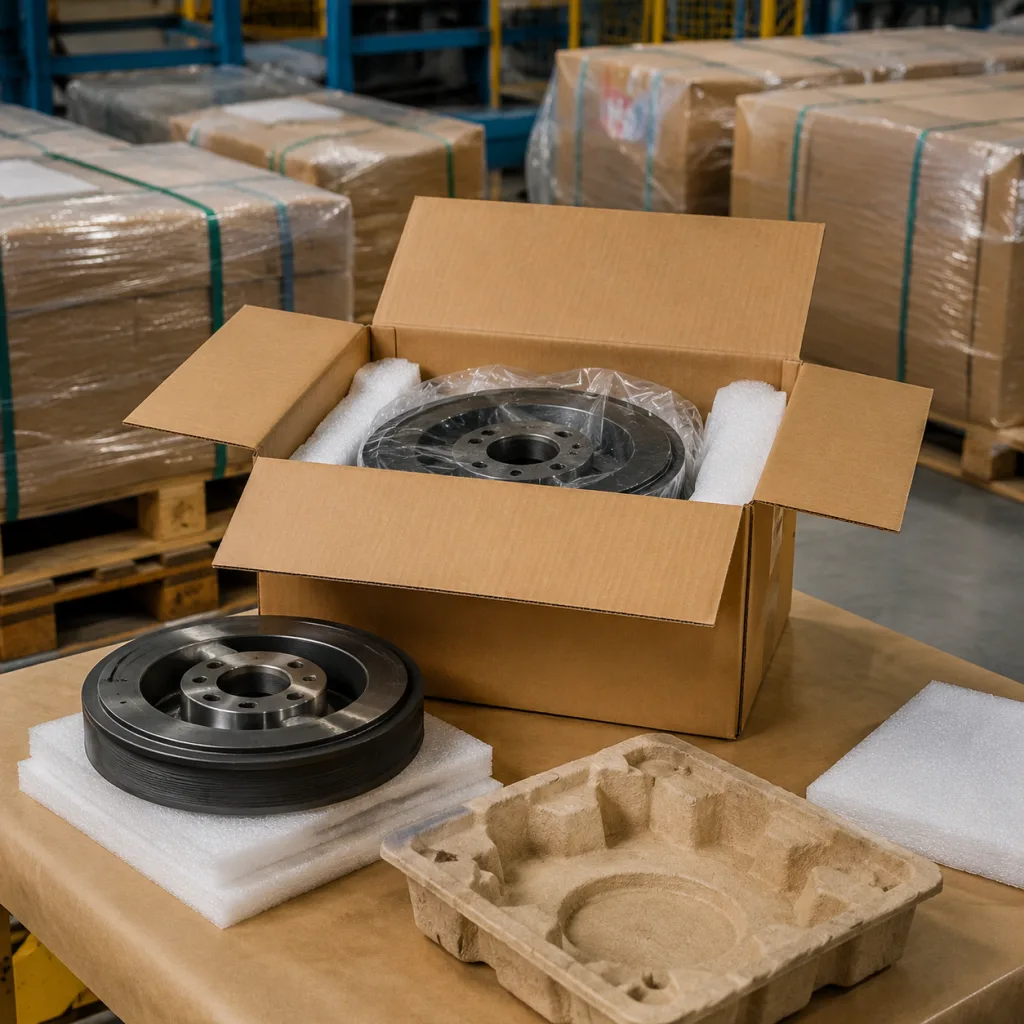
Die-cut EPE/EVA foam, thermoformed tray, or molded pulp supporting hub area
Avoids direct load on the outer ring and limits movement
Carton
Double-wall corrugated board, typically 44 ECT or higher
Improves compression strength in export stacking
Weight limit
Master carton gross weight usually kept below 15-18 kg for manual handling
Reduces drop damage and manual handling risk
</tr></thead><tbody> </tbody></table>These are starting points, not fixed values. Heavier dampers, units with sensor wheels, or mixed-finish parts may need a foil barrier bag, returnable plastic tray, bore cap, or dedicated protector ring. If salt-air exposure or long port dwell time is expected, ask the supplier to state the corrosion protection duration in writing, for example 60, 90, or 180 days under defined storage conditions.
To make the unit pack reproducible, the work instruction should define the sequence, not just the materials. For example:
1. Clean and dry the part after final inspection. 2. Verify no free water, coolant residue, or abrasive dust remains on the part. 3. Apply approved rust preventive only to specified bare metal areas at the defined coverage level. 4. Fit any bore cap, edge ring, or trigger-wheel protector if required. 5. Place the part into the bag with desiccant inserted in a defined position away from the label face. 6. Heat-seal the bag to the approved seal width and seal integrity standard. 7. Place the bagged part into the insert with the hub on the designed support zone. 8. Close and label the carton with lot-matched identification.
That level of detail matters. The same material set can perform very differently depending on how the pack is built. A VCI bag left partly open, foam placed under the wrong face, or excess oil migrating onto labels can turn an acceptable design into a field problem.
For heavier harmonic balancers, one unit per carton is often safer than a multi-pack carton unless the insert positively isolates each part. Dense metal parts generate high shock loads when dropped, and part-to-part contact inside a master carton often damages grooves, timing marks, or painted surfaces. If multi-pack is necessary for freight efficiency, specify separators with defined crush resistance and fixed cavities so parts cannot shift into one another.
Other points that should be written into harmonic balancer packaging requirements for export include:
Approved bag material and thickness range
Minimum desiccant capacity by transit time or container mode
Acceptable foam density or insert compression strength
Orientation of the part inside the carton
Whether cartons may be taped only, glued only, or both
Maximum carton dimensions to control handling and pallet fit
If customer plants use automated receiving or barcode scanning, outer carton geometry and label placement should also be standardized. A highly protective pack that cannot be scanned, stacked, or opened safely at receiving still creates downstream cost even if the part arrives undamaged.
Control pallets and container loading
Once the unit pack is stable, most export damage comes from pallet handling and load movement. Common controls are:
No pallet overhang; cartons should sit fully inside the pallet footprint
ISPM 15-compliant wood pallets, or plastic pallets where the customer requires them
Corner boards plus full-load stretch film; 23-30 µm film is common for export lanes
Slip sheet or top cap to reduce strap abrasion and splash or dust ingress
Pallet height and gross weight limits written on the pack sheet and matched to forklift access at destination
Interlocked carton stacking only if carton compression data supports it
For container loading, keep the heaviest SKUs on the lowest layer and block empty spaces with dunnage so the load cannot migrate. Handling marks should follow ISO 780:2015 where used. If the route includes LCL shipments, assume more touch points and specify stronger outer cartons than for full-container loads.
Pallet design should reflect both product mass and warehouse reality. Harmonic balancers are compact but heavy, so a pallet can exceed safe weight before it looks full. Buyers should therefore specify both maximum pallet height and maximum gross pallet weight. For many manual or mixed-handling destinations, a practical cap is often 700-1000 kg gross per pallet, but the correct limit depends on pallet footprint, carton compression strength, and customer receiving conditions.
A practical pallet specification usually includes:
Pallet footprint, such as 1100 × 1100 mm or 1200 × 1000 mm
Maximum pallet gross weight
Maximum stack height, including pallet base
Number of cartons per layer and number of layers
Layer pad or slip sheet requirement between levels
Stretch-wrap pattern, minimum wraps, and top-sheet requirement
Strap type and strap position if straps are used
Container loading method should also be stated where loads are floor-loaded rather than palletized. Dense automotive parts can shift significantly in transit if voids are left open. Dunnage bags, corrugated fillers, honeycomb board, or timber blocking can be used to immobilize the load. For humid export routes, avoid loading directly against sweating container walls; maintain clearance where possible and use liner or barrier methods if needed.
For sea shipments, ask whether the supplier uses dry containers only and how they inspect them before loading. Even a sound packaging design can fail if it is loaded into a container with floor moisture, roof leaks, broken door seals, or contamination from prior cargo. A basic pre-load container check should confirm:
No visible holes, leaks, or wet flooring
No active odor or chemical residue
Intact locking bars and door seals
Clean interior suitable for packaged metal parts
Acceptable dryness condition before loading
If shipment will move as LCL, cross-dock, or courier freight, increase the assumed handling severity. Those lanes usually involve more transfers, mixed-cargo stacking, and a higher risk of carton puncture. In those cases, stronger board grade, tighter inner fit, and better edge protection are typically justified within harmonic balancer packaging requirements for export.
Specify labels, traceability, and compliance records
Procurement teams often discover packaging problems through paperwork first. Each unit, carton, and pallet label should match the packing list and ERP or ASN data. At minimum, specify:
Supplier part number and revision level
Batch or lot number
Quantity
Country of origin
Gross and net weight
PO number or customer code
Barcode symbology if mandated by the customer
Under IATF 16949:2016 and ISO 9001:2015 controls, the packaging work instruction should be a controlled document linked to the production lot. For EU programs, buyers often request a materials statement covering packaging substances and article-related obligations under REACH (EC) No 1907/2006. If wood packaging is used, the ISPM 15 mark must be visible and legible. If a cross-reference is printed on the label or packing list, it should match the approved customer master data exactly.
A strong labeling standard covers three levels: unit, carton, and pallet. The unit label preserves identity if outer packaging is opened during incoming inspection. The carton label supports receiving and storage. The pallet label enables fast warehouse handling and shipment verification. If any of those levels is missing or inconsistent, traceability breaks quickly, especially when multiple lots or revisions ship together.
For export projects, define label format and placement alongside content. Typical requirements include:
Exact label size and material
Adhesive performance suitable for humid or lightly oily environments
Human-readable font size for key fields
Barcode type, such as Code 128, QR, or customer-specific format
Label position on carton side, not top only, for pallet scanning
Number of labels per carton or pallet face
Where customer systems require EDI or ASN alignment, the physical label data must match the electronic shipment record exactly. Mismatched quantities, lot codes, or part descriptions can create receiving holds even when the product itself is acceptable. That delay is especially costly for service-parts and line-supply programs.
Compliance records should be assembled before first shipment, not requested after goods are already in transit. Depending on destination and customer program, a packaging file may include:
Packaging specification or pack drawing
Carton and pallet dimensions
Carton board grade certificate or supplier data sheet
VCI, barrier bag, or desiccant material specifications
ISPM 15 evidence for wood packaging
REACH, RoHS, or packaging substance declarations where applicable
Label sample and barcode verification result
Packing list template and country-of-origin declaration
This documentation gives buyers a clearer way to audit harmonic balancer packaging requirements for export. It also helps incoming inspection teams verify that the shipped configuration matches the approved one instead of relying only on photos or informal email confirmation.
Use a release checklist before first shipment
Before first shipment, run a short validation gate instead of approving packaging by photo alone:
1. Check fit: confirm the part cannot rotate freely, strike the carton wall, or rest on the outer ring. 2. Check preservation: verify inhibitor coverage, bag seal quality, and desiccant size for the declared transit time. 3. Check load strength: review carton compression data or a transit test such as ASTM D4169 or ISTA 3A. 4. Check identification: scan the label, match it to the packing list, and verify batch traceability back to final inspection. 5. Check reproducibility: confirm the same pack can be built on every shift with the same materials and the same documented work instruction.
If the programme needs a unique inner tray, mixed-SKU pallet, or customer barcode, route it through custom manufacturing rather than handling it as a manual exception. Buyers can review our catalog, including relevant engine components, and our quality system before they request a quote. Driventus is an independent aftermarket manufacturer; brand names are referenced for fitment only.
A useful release process combines document review, physical sample approval, and basic transit validation. For a new SKU, ask the supplier to provide a packaged sample or pilot shipment configuration for inspection. Look beyond whether the product simply fits. Check whether operators can build the pack consistently without forcing parts into inserts, improvising tape positions, or skipping preservation steps.
For validation, the right test level depends on route severity and commercial risk. Common checks include:
Carton compression test to confirm warehouse stacking resistance
Drop testing for parcel or manual-handling environments
Vibration testing to check part migration and insert wear
Humidity exposure or corrosion hold testing for sea-freight programs
Pallet stability review after stretch-wrapping and fork handling
It is also good practice to define acceptance criteria before testing begins. A test report is only useful if everyone agrees on what counts as failure. For harmonic balancers, failure criteria may include visible rust on critical machined surfaces, torn bag seals, direct contact between ring and carton wall, cracked insert material, unreadable labels, or any sign that the outer ring has carried structural load.
Where a formal distribution test is required, buyers should clarify the assurance level and schedule under ASTM D4169, or the exact ISTA protocol to be used. For dense metal parts, drop heights may be lower than for light cartons, but shock severity can still be damaging because of the part mass. That is why fit, restraint, and support geometry often matter more than simply adding more loose cushioning.
After first-shipment approval, the packaging should be locked under change control. Seemingly small substitutions such as thinner bags, lower foam density, lower board grade, or reduced desiccant weight can materially change performance. Buyers should require notification and reapproval for packaging changes that affect protection, dimensions, labeling, palletization, or regulatory compliance.
In short, harmonic balancer packaging requirements for export should end with release discipline: approve the design, document the materials, validate the load, train the operators, and control later changes. That approach reduces claims, receiving delays, and line-side sorting far more effectively than reacting after the first damaged shipment arrives.
Frequently asked questions
No. The preferred rule is to support the balancer at the hub, pilot, or a designed inner fixture. If the outer inertia ring carries carton or pallet load, transport shock can stress the elastomer bond, mark the ring surface, or shift the ring position. That is a packaging defect even if the part passed balance and runout inspection before packing.
A moisture-barrier bag is usually the safer choice when sea transit is around 30 days or longer, when port dwell time is uncertain, or when the route has high humidity and condensation risk. A standard VCI bag can be adequate for shorter and drier lanes, but the choice should be based on transit time, corrosion target, desiccant design, and validation results rather than assumption alone.
Ask for the pack drawing, unit and pallet photos, carton specification, label sample, pallet dimensions, ISPM 15 confirmation where relevant, and a compression-test or transit-test report. For EU supply, request the packaging materials declaration and REACH statement as part of the first-article, PPAP, or supplier-approval file.
If you need a part-specific pack sheet, pallet pattern, or label template for export shipments, Driventus can prepare it with production and logistics data. For project details, [request a quote](/contact.html)