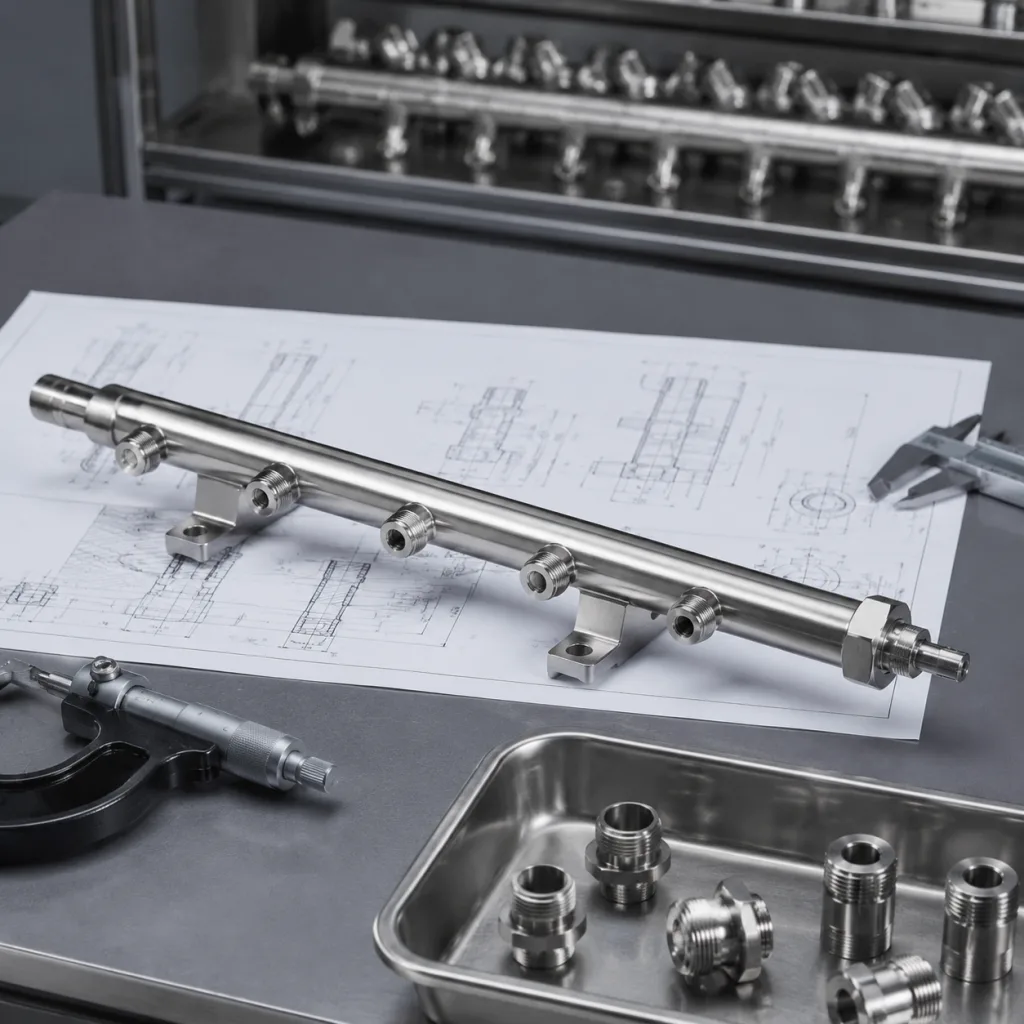
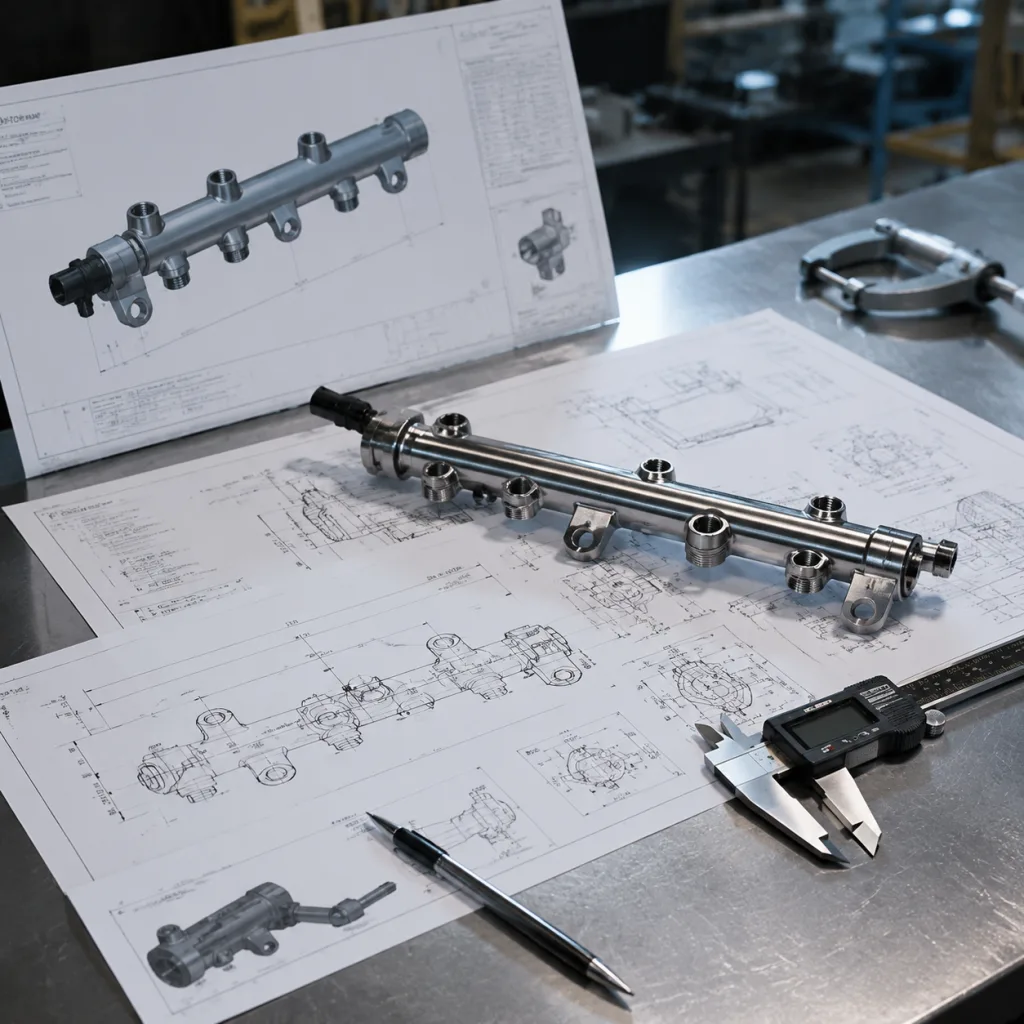
Fuel rail specifications define the interface between the fuel pump, injectors, and engine control system. For procurement teams, the useful detail is not only the rail shape, but the material grade, bore size, mounting pattern, injector port geometry, pressure rating, coating, and test method behind it. A rail that looks similar can still fail on fitment, leak control, or pressure stability if these points differ. Driventus is an independent aftermarket manufacturer; brand names are referenced for fitment only. We build fuel system components in Taizhou, Zhejiang for aftermarket distributors, OEM and Tier-1 customers, and repair networks. Our catalogue, quality system, and custom manufacturing options are available for buyers who need documented parts data, repeatable production, and validation support across multiple vehicle platforms.
What buyers should verify first
For a sourcing review, begin with the interface data that determines fit, sealing, and flow stability.
Item
Typical procurement check
Practical buyer target
Rail material
Aluminium alloy or steel grade
Material certificate and heat/lot traceability
Bore diameter
Match injector and fuel flow design
Nominal ID stated on drawing, with tolerance band
Mounting centres
Hole pitch and bracket offset
Hole position controlled to the assembly datum
Port type
O-ring, quick-connect, or threaded
Seal standard, thread class, and finish defined
Pressure rating
Static and dynamic test limits
Working pressure, proof pressure, and burst margin listed
Surface finish
Coating or passivation
Coating thickness, salt-spray target, and masked seal areas
</tr></thead><tbody> </tbody></table>A complete specification should also define the fuel type, operating pressure, temperature range, and whether the rail includes a sensor port, damper, or other integrated features. In aftermarket programmes, OE references should be treated as fitment cross-references only, not as a statement of approval or performance equivalence. For launch planning, buyers should also ask for MOQ, sample lead time, production lead time, and a price ladder by annual volume so the commercial offer can be compared on the same basis.
Core dimensional requirements
The most important fuel rail specifications are the ones that control interchangeability and seal performance. In practice, buyers should confirm overall length, injector spacing, centreline height, inlet and outlet position, and bracket location.
Common checks include:
Overall length within the packaging envelope for the intake manifold
Injector port spacing to match the engine cylinder count and layout
Port depth and chamfer to control O-ring compression
Mounting-hole position relative to the engine datum
Clearance to throttle body, wiring, and vacuum hardware
For programmes with OE 06A107065 style cross-references, the critical issue is dimensional match and seal geometry. A supplier should provide a 2D drawing with key dimensions, tolerance callouts, and a sample inspection report before mass production begins. As a buyer rule, request explicit tolerances for the critical features: injector center distance typically held to ±0.10 mm to ±0.20 mm, mounting-hole location to ±0.10 mm to ±0.15 mm, and overall length to ±0.30 mm unless the application calls for tighter control. If the rail includes machined injector bores, ask for bore size, concentricity, and O-ring groove dimensions, plus the inspection method used to verify them.
Materials and surface treatment
Material selection depends on pressure requirement, fuel compatibility, mass target, and corrosion exposure. Aluminium is common where low weight and corrosion resistance are priorities. Steel remains useful where higher stiffness or heavier mounting loads are expected.
Typical specification items:
Base material: aluminium alloy or carbon steel
Weld condition: continuous seam or machined body with joined ends
Coating: anodising, zinc plating, or equivalent corrosion protection
Seal areas: protected from heavy coating build-up to preserve O-ring performance
Cleanliness: controlled after machining and before assembly
For export supply, the material and finishing process should be documented under IATF 16949:2016 and ISO 9001:2015 process control. Buyers in regulated markets should also review REACH (EC) No 1907/2006 restrictions where they apply to coatings, lubricants, or residue control. A practical procurement file should ask for alloy designation or steel grade, incoming material certificate, coating thickness target, adhesion standard, and a cleanliness limit for particulate residue after final washing. If the rail is aluminium, common commercial practice is to specify a corrosion-protection finish in the 8 to 15 μm range where anodising is used, while zinc-based coatings are more often specified with a salt-spray target such as 72 to 240 hours depending on market position and cost target.
Pressure, leakage, and durability criteria
A fuel rail is a pressure-containing component, so test data is essential. At minimum, a procurement specification should define static pressure, leak limit, and durability cycle requirements.
A practical test set often includes:
Hydrostatic or pneumatic pressure test at the specified operating pressure
Leak check at room temperature and elevated temperature
Burst margin above normal service pressure
Thermal cycling to confirm seal stability
Vibration exposure for bracket and port retention
For petrol applications, buyers may ask for validation aligned with ECE R-83 where regional requirements apply. For corrosion or durability work, SAE J2527 is often used as a published reference for environmental exposure testing. The exact test plan should match the customer’s duty cycle and fuel formulation, including ethanol blends where relevant. In procurement terms, specify the working pressure in bar or psi, proof pressure at 1.5x working pressure, and burst target at 3.0x working pressure unless the application data requires otherwise. Typical acceptance criteria include zero visible leakage during the hold period, no permanent deformation after proof testing, and no cracking or seal loss after thermal cycling and vibration. Ask the supplier to state the test medium, hold time, temperature, and sample size so the data can be compared across quotations.
What a supplier drawing package should include
A complete drawing and quality pack reduces rejection risk during incoming inspection and helps engineering teams approve the part faster. Ask for:
1. General arrangement drawing with revision control 2. Critical-to-quality dimensions and tolerance bands 3. Material declaration and batch traceability format 4. Pressure and leak test method 5. Surface treatment specification 6. Packaging and contamination-control requirements
Driventus can support this through our catalog, quality system, and custom manufacturing for projects that need platform-specific adaptation. If the rail is part of a broader engine system, buyers may also review engine components to align gaskets, pumps, and related interfaces in one sourcing cycle. For a release-ready pack, request the dimensional drawing in PDF plus STEP or IGES data, a first-article report, material certificate, pressure test record, and packaging standard. If the rail is customised, add tooling ownership, revision freeze date, and engineering change control so repeat orders stay consistent.
How procurement teams should compare offers
A lower unit price does not help if the rail needs rework, slows assembly, or fails leak testing. Compare offers on documented capability rather than appearance alone.
Comparison point
Minimum acceptable
Stronger supplier position
Drawing control
Revision-stamped PDF
CAD + 2D + inspection plan
Sampling
Basic fit sample
PPAP-style submission package
Traceability
Batch code
Full lot and process traceability
Validation
Pressure test only
Pressure, leak, thermal, and corrosion data
Lead time
Quoted ship date
Stable production schedule and MOQ clarity
</tr></thead><tbody> </tbody></table>For volume programmes, ask the factory to confirm tooling ownership, sample lead time, and repeat-order consistency. If the part must cross-reference multiple OE families, request clear dimensional deltas so engineering can approve substitution without ambiguity. Buyers should also request commercial terms in writing: sample MOQ, production MOQ, price breaks at 1,000 / 5,000 / 10,000 pieces or the supplier’s actual tier points, and standard lead times for samples, pilot runs, and mass production. A well-structured offer usually states sample lead time of 7 to 15 days for stocked or simple machined rails, pilot lead time of 15 to 25 days after drawing approval, and regular production lead time of 25 to 45 days depending on coating, test scope, and order size. If the quote does not separate tooling, unit price, packaging, and freight basis, buyers should request a revised commercial sheet before comparing suppliers.
Frequently asked questions
Injector port spacing is usually the first check, because it affects fitment, sealing, and cylinder alignment. Mounting-hole centres and overall length are close behind. Buyers should also confirm port depth, groove geometry, and centreline height when the rail uses O-ring injection ports.
IATF 16949:2016 and ISO 9001:2015 are the main quality references. Depending on market and test scope, REACH (EC) No 1907/2006, ECE R-83, and SAE J2527 may also apply. For purchase orders, the most useful addition is a supplier-specific control plan covering drawing revision, inspection frequency, and lot traceability.
No. OE references help identify fitment, but the buyer still needs drawings, tolerances, material data, and test results to confirm interchangeability and release the part. For a safe release, request the exact port dimensions, pressure rating, coating spec, and first-article inspection data before approving production.
If you need documented dimensions, test data, or a project-specific drawing pack, please request a quote here: /contact.html