connecting rod · 2026-06-20

Connecting Rod for Land Rover Defender Replacement: What Buyers Verify

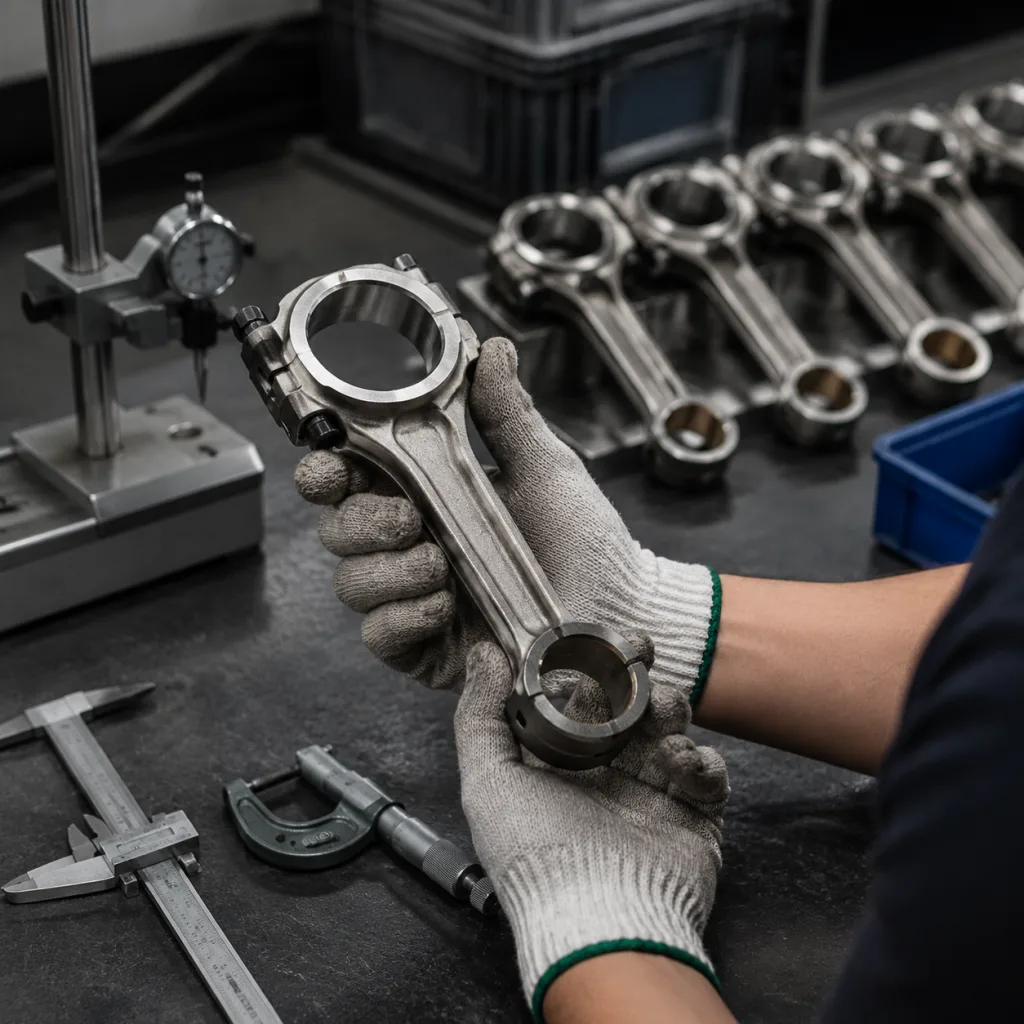
Sourcing a connecting rod for Land Rover Defender replacement is less about buying a generic engine part and more about proving it will survive a rebuild. Buyers need the exact engine application, the right dimensional envelope, and traceable manufacturing data before release to stock or assembly. The rod must match centre distance, big-end bore, small-end geometry, weight class, and heat-treatment expectations. If any one of those drifts, bearing life and rebuild consistency can suffer. Driventus is an independent aftermarket manufacturer; brand names are referenced for fitment only. This article walks through the decision points buyers actually use, where replacement programs fail, and what evidence should sit in the supplier file before purchase.

Start with the fitment decision, not the badge

For a connecting rod for Land Rover Defender replacement, the badge matters less than the engine code. Defender platforms span multiple engines, so the first sourcing step is to verify the exact application, OE reference, and model-year context before comparing parts.

Buyer checks that prevent wrong-order mistakes:

  • Engine code and variant
  • OE part number cross-reference
  • Centre-to-centre length
  • Big-end bore and width
  • Small-end bore or bushing spec
  • Rod bolt size and tightening method
  • Weight class and balance target

If the internal catalog record only says “Defender rod,” the file is not ready. The replacement must be tied to a specific engine family and supported by measurement data, not assumptions.

Where replacement programs usually fail

Most sourcing problems show up after purchase, not before. The usual failure modes are predictable: a part that fits visually but misses bore tolerance, a rod that matches length but not cap alignment, or a supplier sample that passes inspection while the production lot drifts.

Common failure modes:

  • Vehicle-level fitment used instead of engine-level fitment
  • No weight grouping, which complicates balancing
  • Bore mismatch that changes bearing crush
  • Heat treatment not documented by batch
  • Cap face finish or joint alignment outside rebuild expectations
  • Packaging damage that leaves burrs or edge nicks

These issues are expensive because they appear during assembly, when labor is already committed. Buyers should treat dimensional confirmation and batch traceability as release criteria, not optional paperwork.

Spec checklist for OE-equivalent replacement

A compliant replacement rod is defined by more than the drawing dimensions. It needs the right material, the right machining quality, and repeatable process control across the lot.

</tr></thead><tbody> </tbody></table>Published quality systems such as IATF 16949:2016 and ISO 9001:2015 support repeatable control, while REACH (EC) No 1907/2006 may matter for supply-chain compliance in regulated markets. Driventus maintains a documented quality system and can align production to project-specific requirements through custom manufacturing.

Spec checklist for OE-equivalent replacement

How to compare suppliers without getting lost in price

The lowest quote is rarely the lowest-risk option. A better comparison starts with evidence: dimensional reports, material statements, lot control, and packaging quality.

Compare suppliers on these points:

  • OE cross-reference attached to the item record
  • Sample inspection results, not just catalog claims
  • Heat-treatment and material declaration
  • Lot traceability from forging to packing
  • Export-ready packaging and label control
  • Clear response path for nonconforming parts
  • Lead time that holds under repeat orders

For distributors and rebuilders, the real question is whether the supplier can repeat the same part six months later. Stable process control is worth more than a one-time discount. Buyers can also review the wider engine components range or the broader catalog when comparing adjacent applications.

What to verify before stock release

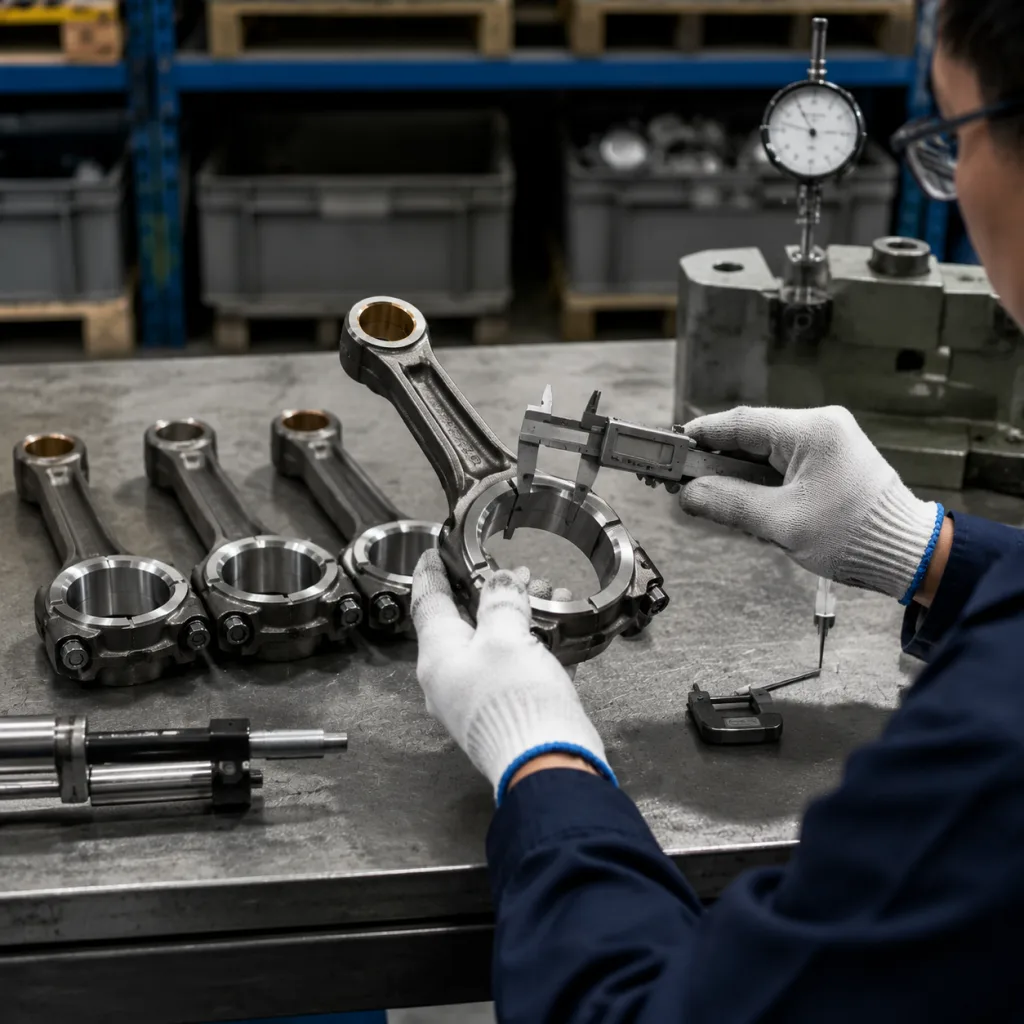
Do not release a rod to inventory on fitment data alone. Validate the part the way a rebuild shop will experience it: through measurement, assembly, and inspection.

Practical release steps: 1. Check bore diameters and centre distance against the approved drawing. 2. Confirm cap alignment and fastener fit. 3. Sample hardness on incoming lots. 4. Inspect for flash, tool marks, corrosion, or edge damage. 5. Trial-assemble with the intended bearing shells and fasteners. 6. Record the lot code against the approved OE reference.

This step-by-step review reduces returns and avoids line stoppages. If the program includes mixed-fitment export, keep the part record locked to the approved drawing revision so future reorders do not drift.

What to verify before stock release

Q&A for buyers and rebuilders

How do I confirm the correct rod for a Defender engine? Match the engine code, OE reference, length, bore sizes, and bolt specification. Vehicle badge alone is not enough.

Is an aftermarket rod acceptable for rebuild work? Yes, if it is dimensionally matched to OE, backed by lot traceability, and supported by inspection data.

What documents should a buyer request? Ask for dimensional inspection data, material declaration, heat-treatment details, lot traceability, and packing records. Add market-specific compliance checks where required.

When is custom supply worth it? When the project needs a nonstandard finish, special packaging, or a controlled dimensional revision for a specific rebuild program.

Driventus is an independent aftermarket manufacturer; brand names are referenced for fitment only. If you are sourcing a replacement connecting rod for a Land Rover Defender programme, send the OE reference, engine code, and annual volume target via request a quote.

Frequently asked questions

Match the engine code, OE reference, centre distance, bore sizes, and bolt specification. Vehicle badge alone is not enough because Defender applications vary by engine family and model year.

Yes, if it is dimensionally matched to OE, traceable by batch, and supported by inspection data. Fitment and validation matter more than branding for replacement supply.

Ask for dimensional inspection data, material declaration, heat-treatment details, lot traceability, and packing records. For regulated markets, also confirm REACH-related supply-chain compliance where applicable.

If you are sourcing a replacement rod for a Defender programme, send the OE reference, engine code, and volume target, and we will review the fitment and supply options. Start here: /contact.html

Request a Quote
Specification area What to confirm
GeometryCentre distance, bore sizes, cap alignment
MaterialDeclared forging grade and material route
Heat treatmentHardness range and process consistency
FinishNo burrs, cracks, or tool marks
MassWeight class or pairing method
TraceabilityHeat number, lot code, inspection record