Fuel pump replacement price is often discussed as a retail repair question, but B2B buyers need a broader cost model. For distributors, repair chains, fleet service networks and importers, the relevant figure includes the pump, application coverage, warranty exposure, installation time, stocking risk, packaging, compliance documentation and field-return handling. A low unit price can become expensive if unstable pressure, poor connector fit, excessive noise or weak strainer quality causes repeat repairs. This article explains the commercial and technical variables that shape replacement cost for electric in-tank pumps and module-style fuel pump assemblies. It is written for B2B teams comparing aftermarket supply options across the EU, UK, US, Canada, Australia and Brazil. Driventus is an independent aftermarket manufacturer; brand names are referenced for fitment only.
What the replacement price usually includes
For B2B buyers, installed cost has more layers than the ex-works pump price. A distributor may invoice only the component, while a repair chain must manage technician time, vehicle downtime and possible comeback claims. Importers also add freight, duty, warehousing, labelling and local warranty handling.
The table below separates common cost elements. Figures vary by vehicle platform and market, so buyers should use this as a costing framework rather than a fixed quotation.
Cost element
Typical driver
Procurement relevance
Pump or module unit price
Motor type, regulator, sender, plastic housing, strainer
Direct landed cost and margin planning
Labour time
Tank access, module location, corrosion, fuel line clips
Repair chain scheduling and warranty exposure
Ancillary parts
Seal ring, strainer, hose, clamps, electrical pigtail
Determines whether a kit reduces repeat work
Diagnostics
Pressure test, current draw test, fault-code scan
Helps prevent pump replacement when wiring, relay or fuel-filter issues are the root cause
Logistics
MOQ, carton size, air or sea freight, local stock
Affects landed cost and replenishment speed
Returns handling
Failure analysis, replacement policy, paperwork
Impacts true cost per successful repair
</tr></thead><tbody> </tbody></table>A fuel pump replacement price comparison should therefore answer two questions: what is the component cost, and what is the cost of installing the wrong specification? The second cost is often larger for repair chains and distributors with national warranty obligations.
Technical variables that move unit cost
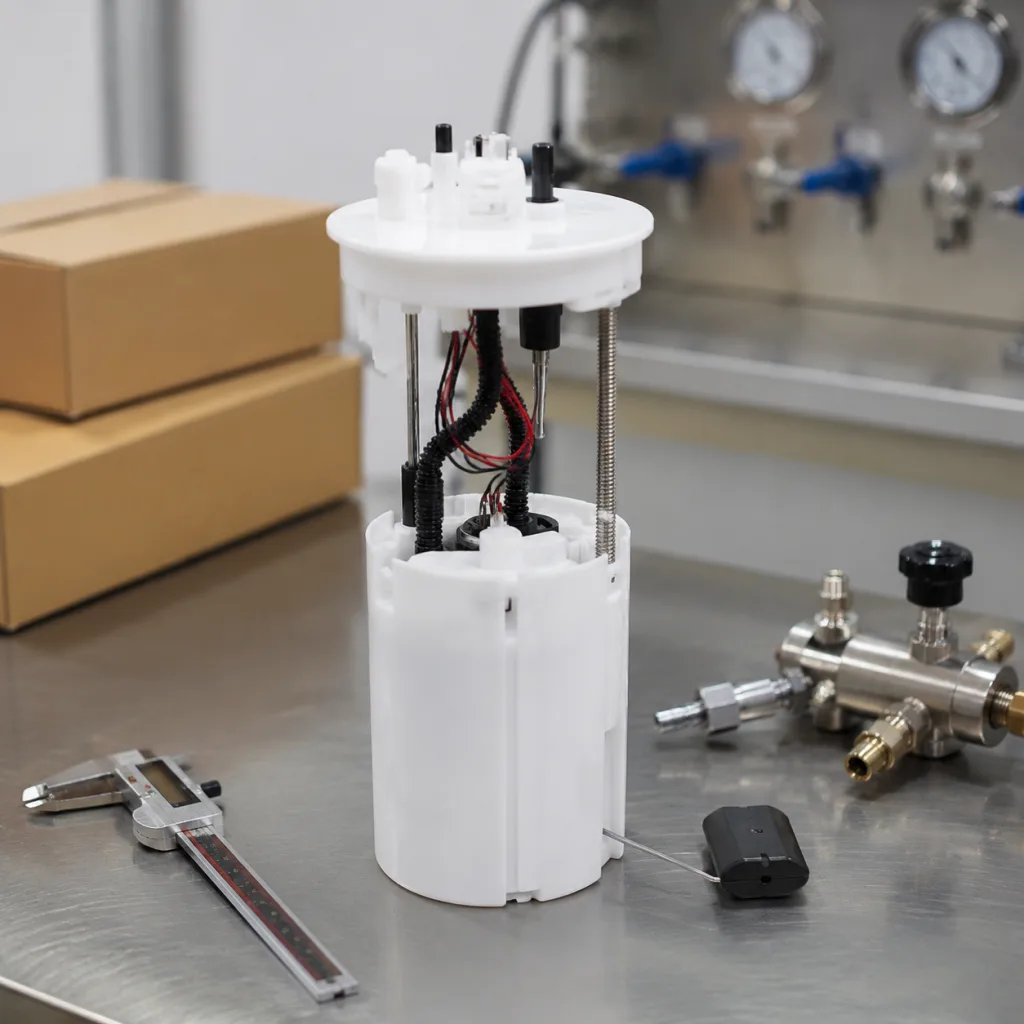
Electric fuel pumps can look similar in catalogue images, but their internal build and supplied hardware may differ significantly. The main cost variables are motor construction, impeller design, pressure control, sender accuracy, housing material and module completeness. A bare pump insert is usually cheaper than a full module, but it requires more installation work and increases the chance of reusing aged seals, hoses or wiring.
Common specification points to confirm before sourcing include:
System type: in-tank electric pump insert, full module assembly, external inline pump or low-pressure feed pump supporting a direct-injection system.
Nominal operating pressure: matched to the vehicle fuel system and regulator arrangement.
Flow rate: verified at specified voltage and pressure, not only at free-flow conditions.
Connector and terminal layout: dimensional match to the original harness to avoid field modification.
Fuel level sender range: resistance sweep must suit the instrument-cluster logic.
Materials: ethanol-compatible plastics, rubber and seals for markets using E10, E15 or higher ethanol blends.
Noise and vibration: motor balancing and module isolation affect perceived quality after installation.
Kit content: tank seal, strainer, retaining clips and instruction sheet where required.
A pump priced lower because it omits a seal, uses a different sender or lacks a required fitting may create higher downstream cost. For B2B programmes, request drawings, test conditions and sample inspection reports before comparing prices.
Installed cost by supply format
A practical way to evaluate replacement cost is to compare the supply format. The lowest component price is not always the lowest installed cost, especially when labour reimbursement, warranty claims and service-bay availability are part of the calculation.
Supply format
Component cost
Labour exposure
Typical B2B use case
Main risk to control
Pump insert only
Low
Medium to high
Price-sensitive aftermarket lines
Reuse of old module parts, hose or wiring
Pump insert kit
Low to medium
Medium
Distributor coverage with basic service parts
Kit completeness and instruction clarity
Complete module
Medium to high
Low to medium
Repair chains and high-turnover applications
Application accuracy and carton volume
Custom private-label module
Depends on tooling and MOQ
Low to medium
Importer or programme buyer
Validation scope, label control and forecast accuracy
</tr></thead><tbody> </tbody></table>For multi-location repair chains, a complete module can reduce bay time and comeback risk, especially where a platform has known issues with fuel sender wear, brittle plastic fittings or difficult tank access. For wholesalers, pump insert kits may provide broader coverage with lower inventory value, but catalogue accuracy and technician guidance need to be tight.
Driventus supports fuel pump sourcing through our catalog and application-specific development through custom manufacturing. Buyers should share target applications, annual volume, preferred packaging and required market documentation at the start of the enquiry.
Quality controls that protect replacement economics
The true cost of a fuel pump programme is strongly affected by validation and process control. An early failure can generate two-way freight, credit notes, labour reimbursement, account disputes and lost customer confidence. Any unit saving disappears quickly when a single market return becomes a repeated claim pattern.
Driventus manufactures under IATF 16949:2016 and ISO 9001:2015 management systems. These standards do not replace part-level validation, but they provide a framework for process control, traceability, corrective action and supplier management. For regulated chemical and material obligations in export markets, buyers may also request documentation aligned with REACH (EC) No 1907/2006 where applicable.
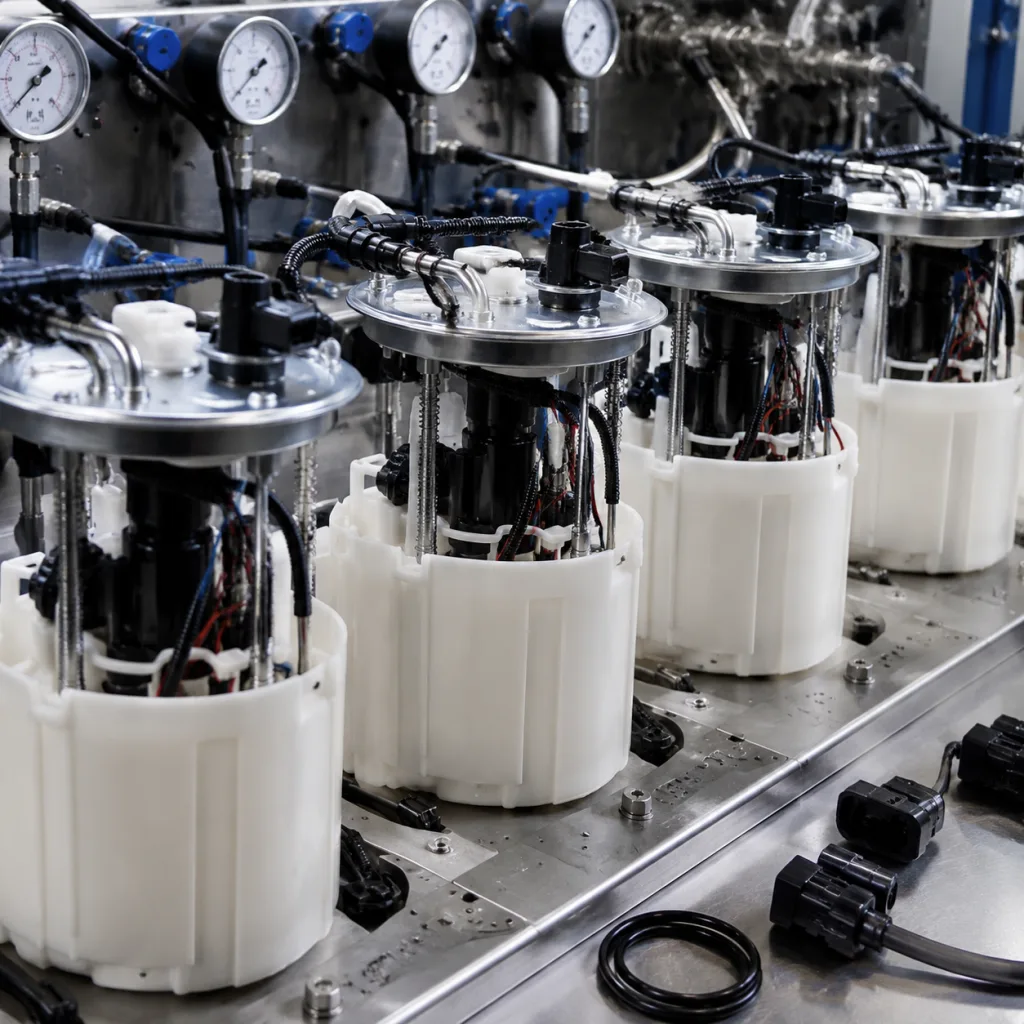
Fuel pump validation typically focuses on:
Flow and pressure output at defined voltage and load.
Current draw and motor temperature rise.
Leak testing of module housings and outlet fittings.
Sender resistance sweep and float travel.
Start-up performance after heat soak.
Noise screening during operation.
Ethanol fuel compatibility for seals, plastics and hoses.
Connector retention and terminal contact stability.
Procurement teams should ask whether test data is recorded by batch, by sample plan or through 100% end-of-line inspection. They should also confirm how traceability is marked on the pump, module, carton and shipment documents. A clear quality system reduces dispute time when a returned part must be analysed.
Why catalogue accuracy changes cost
Many replacement price disputes begin with fitment errors rather than pump manufacturing defects. Similar modules can differ in flange angle, outlet direction, sender resistance, tank depth, connector keying, hose routing or pressure regulation. These differences may not be visible in a small online image, yet they can stop installation or cause inaccurate fuel-level readings.
For procurement teams, catalogue control should include OE part-number cross-references only where verified from reliable data. Use a generic format such as OE 06A… only when a platform record supports it; do not create brand-owned numbers for marketing pages or price lists. Driventus is an independent aftermarket manufacturer; brand names are referenced for fitment only.
Recommended data fields for a fuel pump line include:
Vehicle make, model, engine, production year and market region.
Fuel type and emissions configuration where relevant.
Pump format: insert, module, sender-only or external pump.
Electrical connector image and pin count.
Operating pressure and flow test condition.
Tank seal and strainer inclusion.
Cross-reference source and revision date.
Packaging dimensions and gross weight.
For distributors selling across multiple regions, the same model name may have different fuel systems. This is common where vehicles were produced in different plants or adapted for local fuel quality, emissions rules and market-specific parts supply. Catalogue review is therefore a cost-control activity, not only a sales activity.
How buyers can reduce total replacement cost
A lower fuel pump replacement price is useful only if the programme remains stable after launch. Buyers can reduce total cost by standardising specifications, improving forecast accuracy, selecting the right supply format and aligning validation with the risk level of each application.
Practical sourcing steps include:
1. Segment the range by turnover. Use complete modules for high-volume or high-labour applications; use insert kits where field installation risk is manageable. 2. Define the acceptance standard. Agree pressure, flow, noise, sender sweep and leakage requirements before mass production. 3. Audit sample fitment. Check connector, flange, seal and outlet orientation on actual vehicle tanks or verified fixtures. 4. Control packaging. Fuel pump modules are easily damaged by flange distortion or float-arm bending during transport. 5. Set return analysis rules. Require pressure readings, voltage data and installation notes with warranty claims. 6. Consolidate shipments. Group SKUs by carton efficiency and production schedule to reduce landed cost.
Repair chains should also train technicians to test voltage supply and ground integrity before replacement. A weak relay, corroded connector, blocked strainer or restricted fuel filter can mimic pump failure. Distributors should include clear installation notes to reduce avoidable returns and protect account relationships.
If your team is building a range review, Driventus can quote by pump insert, module assembly, packaging type and forecast volume. Share your target applications and commercial assumptions to request a quote.
Frequently asked questions
The largest drivers are pump format, labour time, application accuracy and warranty risk. A complete module usually costs more than a pump insert, but it may reduce installation time and repeat repairs. For B2B buyers, landed cost, packaging, MOQ, documentation and return handling should be included in the calculation.
Not always. Pump inserts reduce inventory value and can cover many applications, but they rely on reusing module parts. If old hoses, seals, sender units or connectors fail after installation, the distributor may face higher returns. High-turnover or difficult-access applications often justify a complete module.
Request drawings or key dimensions, application data, pressure and flow test conditions, material declarations where applicable, packaging specifications and quality-system certificates such as IATF 16949:2016 and ISO 9001:2015. For repeat programmes, also agree traceability and warranty analysis procedures.
For fuel pump programme pricing by SKU, kit content and shipment volume, contact Driventus with your target applications and forecast. Start a sourcing discussion at /contact.html