Fuel pump replacement is both a procurement decision and a service-quality decision. For distributors, repair chains, fleet operators, and import managers, the real cost risk is rarely the pump alone. It is the mismatch that creates returns: incorrect flow, wrong connector format, unstable pressure control, poor module depth, noisy operation, or seal material that does not suit the local fuel blend. A correct replacement must fit the OE envelope, connect to the existing harness, deliver the required pressure and volume, and support the vehicle’s fuel system without modification.
Driventus is an independent aftermarket manufacturer; brand names are referenced for fitment identification only. For buyers, the useful questions are straightforward: will the part install cleanly, hold pressure under load, restart after heat soak, and pass durability, leak, and cleanliness checks at the required standard? This guide explains the replacement criteria, dimensional checks, validation steps, and RFQ details that help buyers compare options before volume purchase. You can also review our catalog, quality system, custom manufacturing, or request a quote.
What buyers should verify first
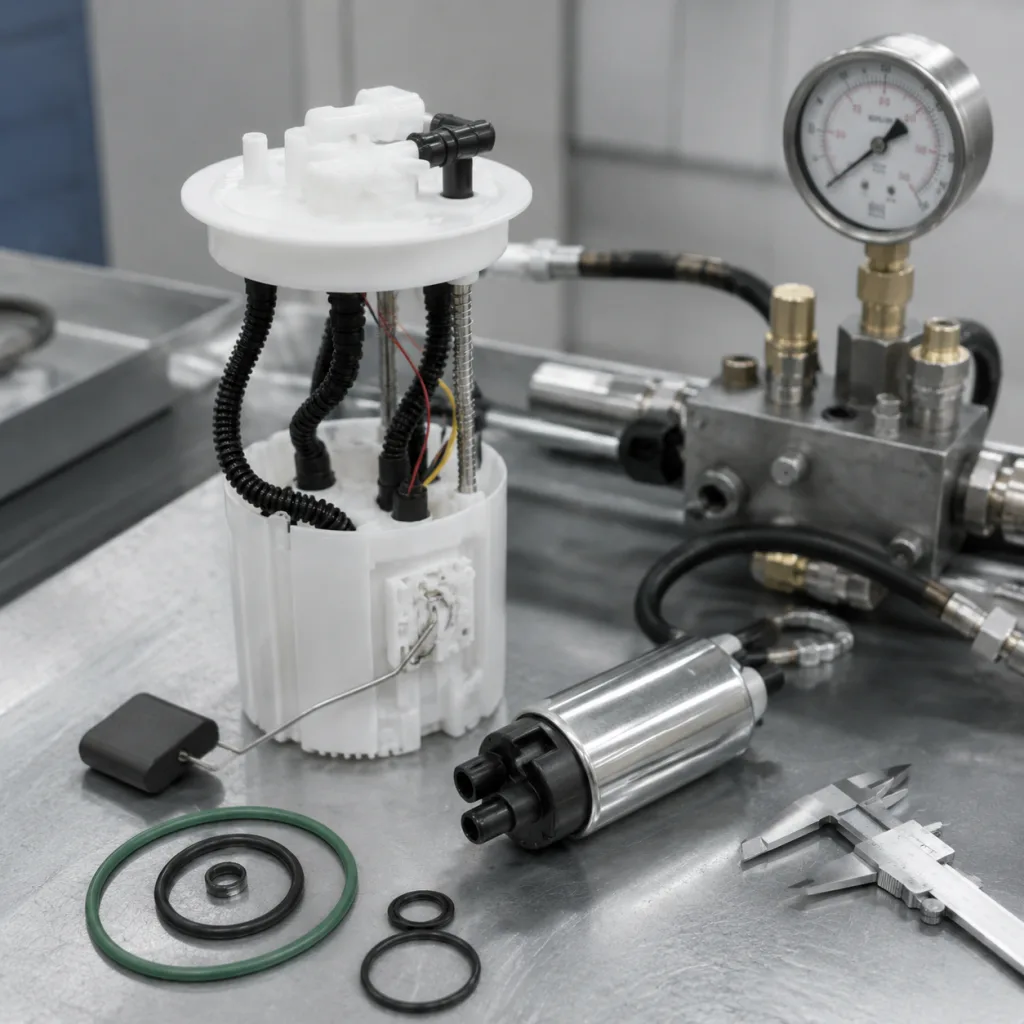
A fuel pump replacement should be specified as an OE-equivalent component, not treated as a visual match. The first review should confirm part type, fuel system design, pressure range, flow requirement, connector style, inlet and outlet geometry, mounting depth, and seal material. For in-tank pump modules, sender height, float arm travel, flange shape, strainer position, and tank pickup location can be as important as the pump motor.
Practical verification list
Confirm application by VIN, engine code, production year, and fuel system type
Match operating pressure and flow to the OE specification or verified cross-reference
Check connector pin count, polarity, terminal design, and locking mechanism
Confirm body length, diameter, flange pattern, outlet angle, and socket depth
Verify strainer position, sender module height, and float movement for in-tank assemblies
Check seal compatibility with E10, E15, or other ethanol-blend exposure where relevant
Review packaging, traceability, batch coding, and inspection records before release
These checks protect both installation quality and aftersales performance. Driventus supplies parts under IATF 16949:2016 and ISO 9001:2015 controlled processes, which supports repeatability, documented inspection, and lot traceability across distributor networks and multi-location service operations.
Dimensional and functional comparison
The comparison below highlights the control points buyers normally use when evaluating replacement options. Exact values change by vehicle application, but the same logic applies across passenger cars and light-duty commercial vehicles: the part must fit the tank or housing, connect without modification, and maintain the fuel delivery window the engine management system expects.
Check point
OE-equivalent target
Why it matters
Pump pressure
Match OE range
Prevents lean running, hard start, or regulator overload
Flow rate
Within application spec
Supports cold start, acceleration, and sustained load
Connector
Same pin format and lock
Avoids harness repair, loose contact, or wrong polarity
Mounting depth
Match OE envelope
Keeps pickup position correct inside the tank
Strainer position
Same orientation and clearance
Reduces fuel starvation on low tank level or slope
Seals and grommets
Fuel-resistant elastomer
Limits leaks, swelling, vapor odor, and premature failure
Noise signature
Comparable to OE
Reduces post-installation complaints and warranty claims
Cleanliness
Controlled particulate residue
Protects injectors, regulators, and pressure sensors
</tr></thead><tbody> </tbody></table>For programmes that require a direct OE part-number cross-reference, use the vehicle data sheet and confirm the application line by line before purchase. Visual similarity is not a reliable interchange method because small changes in outlet angle, connector keying, sender curve, or module height can create installation failure even when the pump appears correct.
Validation testing that reduces returns
Replacement parts create warranty exposure when suppliers rely only on appearance checks. A reliable programme includes bench, functional, and endurance validation before release. For fuel pump replacement sourcing, the most useful data covers electrical load, pressure stability, current draw, flow output, noise, thermal cycling, leak resistance, and fuel compatibility.
Typical validation scope
1. Bench test at nominal voltage and low-voltage operating conditions 2. Pressure and flow measurement across the defined duty range 3. Current draw check to identify excessive load or motor instability 4. Endurance run to confirm stable output and wear pattern 5. Thermal soak and hot-restart testing 6. Seal, plastic, and rubber compatibility exposure with relevant fuel blends 7. Leak inspection after vibration, pressure hold, or temperature cycling 8. Cleanliness inspection to control particles that may damage injectors or regulators
Commonly referenced frameworks in this category include IATF 16949:2016 for automotive quality management, ISO 9001:2015 for process control, and REACH (EC) No 1907/2006 for restricted-substance compliance. Where local emissions, evaporative-control, or market-specific fuel requirements apply, confirm the vehicle programme specification instead of assuming one universal regulatory fit.
Table: replacement parts versus generic sourcing
The commercial decision is usually a balance between lower unit price and lower lifecycle risk. A generic pump may look attractive at purchase, but the cost of returns, technician time, customer dissatisfaction, and distributor stock correction can outweigh the initial saving. For B2B buyers, the stronger comparison is total landed and warranty cost, not only invoice price.
Sourcing route
Strength
Main risk
OE-equivalent replacement
Predictable installation, documented fit, and stable performance
Higher documentation and verification requirement
Generic low-cost part
Lower purchase price and broad availability
Higher return rate, fitment gaps, and inconsistent validation
Custom programme
Exact control over connector, housing, pressure profile, and packaging
Longer development, sampling, and approval cycle
</tr></thead><tbody> </tbody></table>Driventus supports customers through custom manufacturing when a standard catalogue item does not meet the required connector, housing, sender, or pressure profile. For distributors, fleet suppliers, and multi-site repair networks, that application control can reduce assortment complexity, improve fill rate, and make replacement performance more consistent across markets.
How to specify the part for purchase
A complete purchase specification should read like a technical record rather than a short product label. Include the vehicle platform, engine code, production range, OE reference if confirmed, system pressure target, flow requirement, connector type, module dimensions, seal material, and packaging requirements. If the pump is supplied as part of a sender assembly, include the sender resistance curve, tank depth, float travel, and strainer orientation.
Use the following fields in the RFQ:
Vehicle application, market, model year range, and engine code
Confirmed OE cross-reference or sample part reference
Electrical voltage, connector style, pin count, and terminal type
Pressure range, flow target, and test conditions
Module height, body diameter, flange pattern, outlet angle, and mounting depth
Housing material, seal compound, and fuel-blend requirement
Required certifications, inspection reports, and validation documents
Label format, barcode, carton quantity, pallet requirement, and traceability coding
For buyers comparing several suppliers, request sample validation before volume release. This is especially important when consolidating SKUs, entering a new market, or replacing an existing supplier after return issues. A structured sample approval step helps catch dimensional mismatch at warehouse intake, fitment gaps during installation, and performance drift before the product reaches the field.
Where Driventus fits in the sourcing process
Driventus manufactures engine and powertrain components in Taizhou, Zhejiang, and exports to more than 60 countries. For fuel system programmes, the practical value is controlled production, repeatable dimensions, batch traceability, and technical documentation that supports distributor and OEM-style procurement. The aim is not only to supply a pump that fits, but to support a repeatable fuel pump replacement programme across orders, markets, and service locations.
If you need to review adjacent parts, start with our catalog or the broader engine components range. If you are auditing a supply base, the quality system page outlines the certification framework and production controls used on manufacturing lots.
Driventus is an independent aftermarket manufacturer; brand names are referenced for fitment identification only. For a new sourcing project, the fastest next step is to send the application data, target annual volume, required OE reference, and any packaging or documentation needs through request a quote.
Frequently asked questions
Match the vehicle application, engine code, OE reference if available, connector type, mounting depth, sender details, and required pressure and flow. Visual similarity alone is not enough for a safe sourcing decision.
Yes. Ask for pressure, flow, current draw, noise, leak, endurance, thermal-cycle, and cleanliness data. These records reduce return risk and help confirm the part is suitable for your market.
Yes. If a catalogue item does not match the required envelope, connector, sender design, or pressure profile, Driventus can support custom manufacturing and application-specific development.
If you are sourcing a fuel pump replacement programme or need an OE-equivalent specification check, send your application details and target volume through /contact.html.