Engine Motor Mount Replacement for B2B Buyers
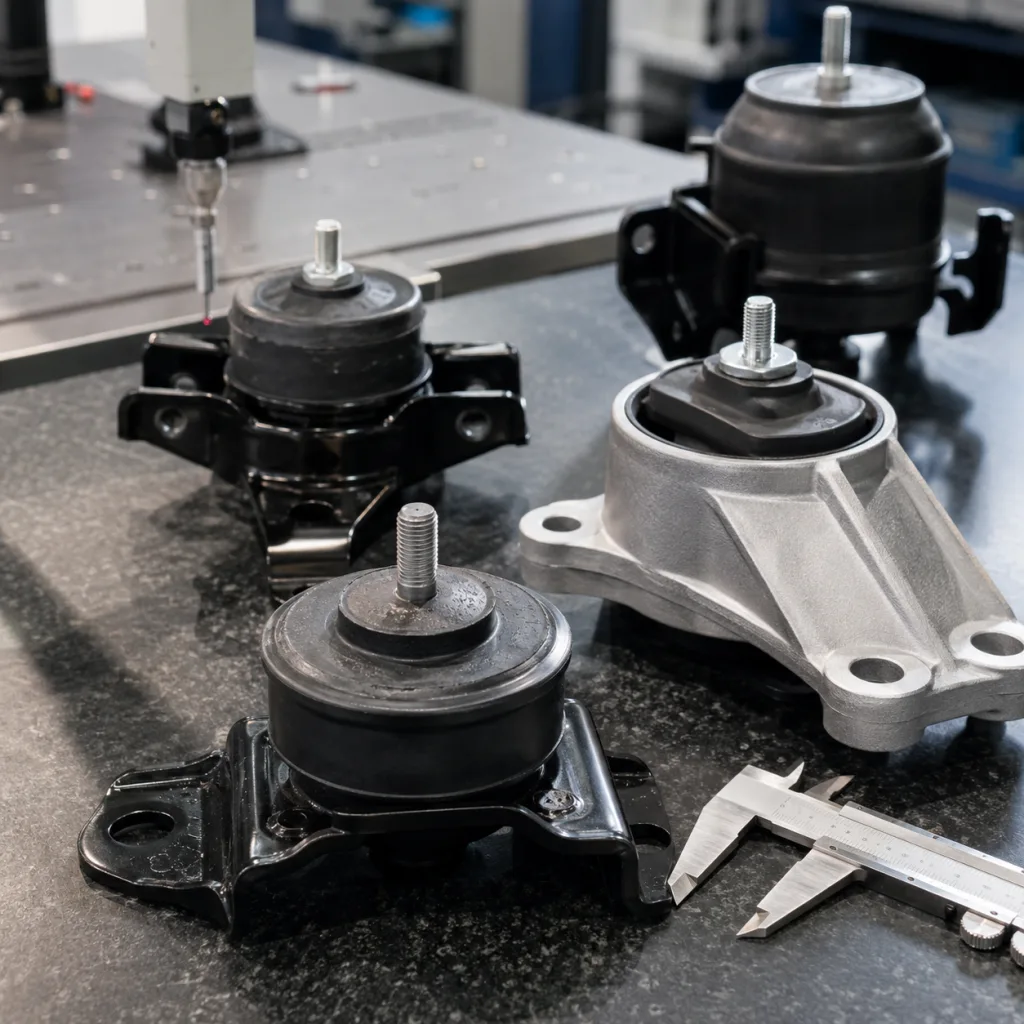
Engine motor mount replacement is a routine service event, but for distributors, repair chains, fleet operators, and OEM service programmes it is also a quality-risk category. A mount that appears to fit can still transmit excessive vibration, settle after heat ageing, leak hydraulic fluid, or move the powertrain outside acceptable driveline angles. For procurement teams, the buying decision therefore needs to go beyond unit price and catalogue interchange. It should confirm OE-equivalent geometry, controlled rubber characteristics, reliable rubber-to-metal bonding, corrosion-resistant brackets, packaging durability, and lot-level traceability. Driventus manufactures engine and powertrain components in Taizhou, Zhejiang, with export supply to more than 60 countries. For engine mounts and adjacent engine parts, sourcing decisions should be based on measured fit, material validation, process control, and documentation under IATF 16949:2016 and ISO 9001:2015 systems. This guide explains what to check before approval, how to compare standard and custom supply routes, and which evidence to request before placing volume orders.
What Replacement Buyers Need to Control
For an engine motor mount replacement programme, buyer risk is broader than whether the part can be bolted into place. The mount must locate the engine, isolate vibration, limit powertrain movement, and help maintain driveline alignment while exposed to heat, oil mist, road salt, engine torque, and repeated start-stop loading.
A complete sourcing file should define:
- Vehicle application range and engine family coverage
- OE part-number cross-reference format where applicable, such as OE 06A… or OE 11251…
- Bracket interface dimensions and hole-position tolerance
- Rubber compound hardness and ageing performance
- Metal insert coating or corrosion-protection requirement
- Static and dynamic load expectations
- Packaging method for long-distance sea freight
- Labelling, barcode, and batch traceability requirements
For aftermarket distributors, the commercial risk is return rate and customer confidence. For repair chains, it is repeat labour and bay-time loss. For OEM and Tier-1 service channels, it is documented conformity and change control. A low-cost mount that fails noise, vibration, and harshness expectations can create warranty costs far above the part value.
Driventus is an independent aftermarket manufacturer; brand names and OE references are used only to identify fitment.
OE-Equivalent Fit: Dimensions, Interfaces, and Cross-References
Engine mounts are application-specific components. A 1 mm deviation at a bracket slot can increase installation time or force the mount into position, while an incorrect rubber void shape can alter stiffness and vibration isolation. Buyers should not approve replacement parts based only on visual similarity, catalogue claims, or broad interchange lists.
Sample approval should compare the proposed part against an original reference part, validated drawing, or buyer-approved master sample. Critical-to-fit dimensions normally include bracket thickness, mounting-hole diameter, centre-to-centre distance, stud height, thread specification, locating-pin position, and installed height under defined load. For hydraulic mounts, chamber geometry, fluid sealing, and leak resistance also need verification.
| Control point | Typical buyer check | Procurement relevance | |
|---|---|---|---|
| Mounting hole location | Coordinate measurement against reference | Prevents installation force and misalignment | |
| Installed height | Measured unloaded and under defined compression | Maintains driveline angle and exhaust clearance | |
| Rubber hardness | Shore A reading by lot | Controls vibration isolation consistency | |
| Thread form | Gauge verification | Reduces workshop installation failures | |
| Bonded area | Cut-section or peel validation | Supports durability under torque movement | |
| Coating thickness | Salt-spray and visual inspection | Reduces corrosion claims in winter markets |
| Sourcing route | Best fit | Main advantages | Points to confirm |
|---|---|---|---|
| Existing aftermarket reference | Distributor range expansion | Faster sampling, lower tooling cost, established packaging | Application accuracy, sample validation, cross-reference list |
| Buyer-controlled drawing | Repair chain or fleet programme | Clear dimensional control, stable repeat purchasing | Drawing revision control and test responsibility |
| Reverse-engineered sample | Obsolete or low-data applications | Useful where drawings are unavailable | Master sample condition and measurement method |
| Custom bracket or compound | OEM service or Tier-1 project | Tuned stiffness, packaging, and branding requirements | Tooling cost, PPAP scope, lead time |
| RFQ field | Why it matters |
|---|---|
| Vehicle application and engine code | Confirms fitment and load environment |
| Reference part or drawing | Defines geometry and interface points |
| Annual volume and order pattern | Determines tooling, MOQ, and pricing basis |
| Market destination | Influences compliance documents and packaging |
| Required tests | Aligns sample approval with warranty expectations |
| Branding and label format | Supports distributor and repair-chain operations |
| Documentation package | Prevents late-stage audit delays |
| Target launch date | Sets sampling and production planning |