Motor Mount Replacement: OE-Equivalent Sourcing Guide
Motor mount replacement demand remains steady across passenger car, light commercial and fleet repair channels because powertrain mounts work in harsh conditions: heat, oil mist, road salt, vibration and repeated engine torque. For procurement teams, the commercial risk extends well beyond unit price. A mount with incorrect rubber hardness, bracket geometry, installed height or hydraulic damping can trigger vibration complaints, longer workshop fitting time, premature failure and branch-wide returns. This guide explains how to assess aftermarket engine and transmission mounts for OE-equivalent fit, function and durability. It is written for distributors, importers and repair-chain category managers sourcing replacement parts at scale. Driventus manufactures aftermarket powertrain components in Taizhou, Zhejiang, under IATF 16949:2016 and ISO 9001:2015 process controls. Driventus is an independent aftermarket manufacturer; brand names are referenced for fitment only.
Replacement demand and procurement risk
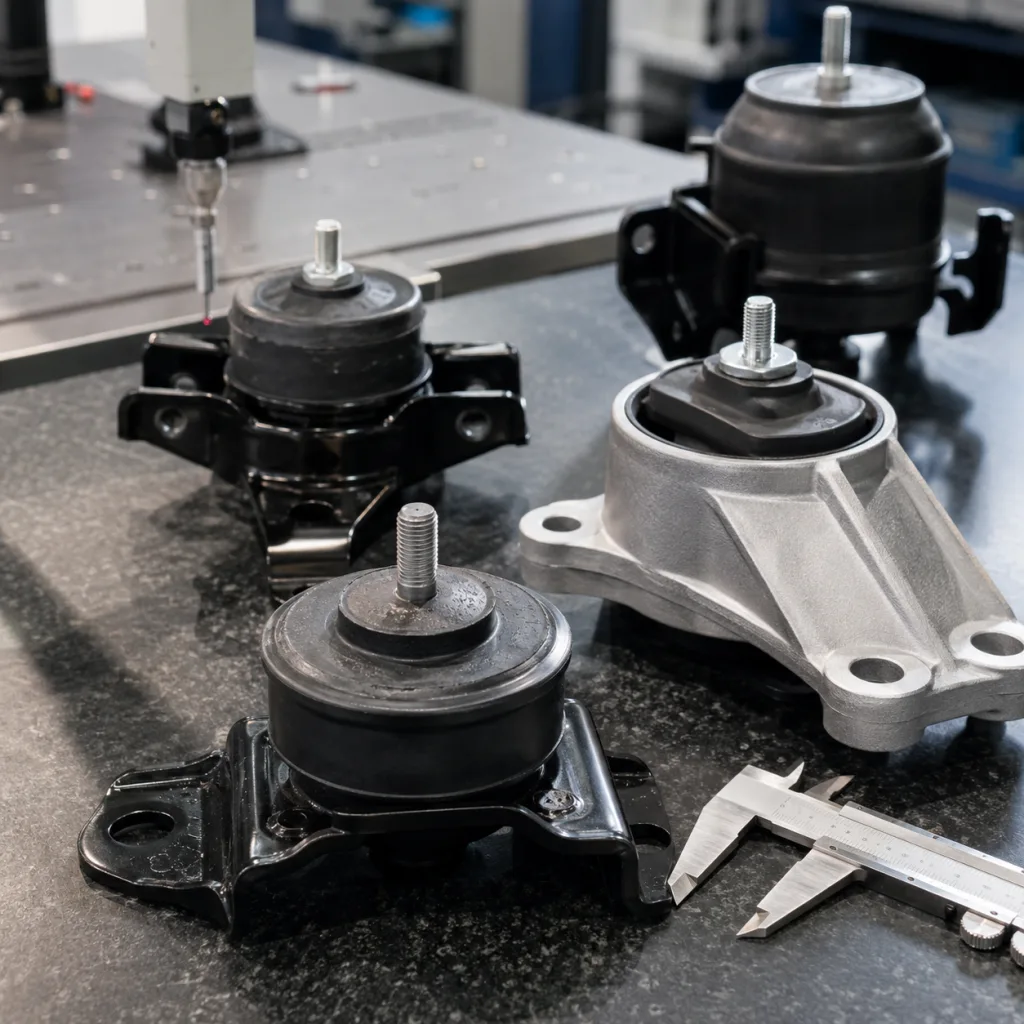
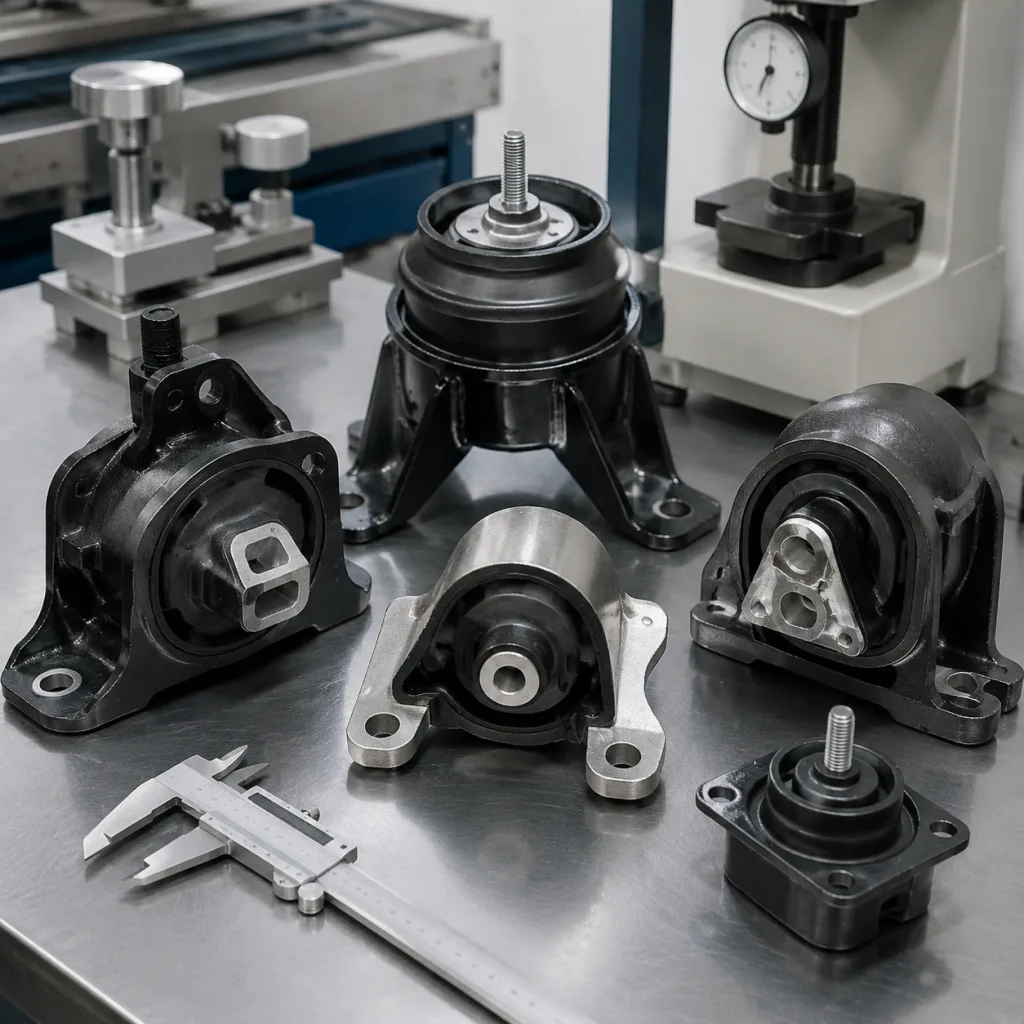
Engine mounts and transmission mounts support static powertrain weight while controlling movement during acceleration, braking, cornering and gear changes. Rubber-to-metal designs isolate vibration from the body structure, while hydraulic mounts add fluid chambers, membranes or tuned orifices to manage defined frequency ranges.
For B2B buyers, the main sourcing issue is repeatability. A mount may look correct in catalogue photos, but small deviations in hole position, bracket angle, rubber compound, installed height or bonding quality can affect installation time, NVH performance and warranty exposure.
Common purchasing risks include:
- Bracket holes outside fixture tolerance, causing workshop fitment delays.
- Rubber hardness too high, increasing NVH complaints after installation.
- Rubber hardness too low, allowing excessive engine roll and hose strain.
- Weak rubber-to-metal bonding, leading to separation under torque cycling.
- Incorrect hydraulic mount fluid volume, changing damping behaviour.
- Poor corrosion protection on stamped or cast brackets in winter markets.
- Incomplete fitment data, increasing misapplication across similar vehicle variants.
A controlled replacement programme should treat the mount as a powertrain support component with measurable fit and performance requirements, not as a simple rubber part. Buyers can review Driventus engine and powertrain coverage through our catalog, including related aftermarket replacement parts.
OE-equivalence criteria for aftermarket mounts
OE-equivalence does not mean vehicle manufacturer approval. It means the replacement part is engineered to match the original application’s installation envelope, load path and functional behaviour within validated aftermarket specifications.
Driventus is an independent aftermarket manufacturer; brand names are referenced for fitment only.
A sourcing specification should combine dimensional checks, material controls and performance targets. The following table shows typical qualification points for replacement engine and transmission mount families.
| Evaluation point | What to verify | Procurement relevance | |
|---|---|---|---|
| Bracket geometry | Hole centres, datum surfaces, bushing axis and installed height | Controls direct fitment and labour time | |
| Static load capacity | Vertical load under engine mass and accessory load | Reduces sagging and misalignment risk | |
| Rubber hardness | Shore A range defined by application | Balances isolation and movement control | |
| Bonding strength | Rubber-to-metal adhesion after ageing | Reduces separation claims | |
| Hydraulic function | Damping curve, leak resistance and fill consistency | Controls vibration on idle and launch | |
| Corrosion protection | Coating thickness and salt-spray performance | Supports EU, UK, Canada and northern US demand | |
| Traceability | Batch, compound, mould and inspection records | Supports warranty analysis and containment |
| Supply option | Advantages | Risks to control | Best use case |
|---|---|---|---|
| Catalogue aftermarket SKU | Faster launch and lower development cost | Confirm fitment coverage and batch consistency | Distributor range expansion |
| Sample-to-sample replacement | Useful for obsolete or regional parts | Risk of copying visible geometry but missing internal performance | Low-volume service parts |
| Drawing-controlled production | Stronger dimensional and material control | Requires engineering input and approval time | Repair-chain or programme business |
| Custom tooling | Optimised for target market and packaging | Tooling cost and validation lead time | High-volume or exclusive range |