A failed injector is rarely just a failed injector. It may be the visible end of dirty fuel, water ingress, pump debris, wrong calibration, damaged wiring, poor installation, or an unsuitable replacement part. If the root cause is missed, the same vehicle may return, or the same complaint may appear across a fleet, distributor network, or repair-chain programme.
This article takes a practical B2B view of fuel injector failure causes and fixes across gasoline port injection, gasoline direct injection, and light-duty diesel common-rail systems. The aim is to separate symptoms from evidence: what to measure, what not to assume, when cleaning is defensible, when replacement is mandatory, and what sourcing teams should verify before approving an injector range.
Driventus supplies engine and powertrain components for aftermarket and OEM service channels, with production controls aligned to IATF 16949:2016 and ISO 9001:2015. Typical B2B projects are reviewed by application list, annual volume, test standard, label format, and export market requirements before quotation. Driventus is an independent aftermarket manufacturer; vehicle brand names are referenced only for fitment identification.
Start with the complaint, not the injector
Injector faults imitate many other faults. A restricted nozzle can look like weak ignition. A leaking injector can look like a purge fault. A diesel injector with excessive return flow may be blamed when the real issue is rail pressure control. The first decision is therefore not “clean or replace?” It is “does the evidence point to the injector, the cylinder, or the fuel system?”
Complaint in the workshop
Injector-related possibility
Evidence to collect before authorising replacement
Review misfire counters, swap injector position where practical, verify ignition and compression. A compression spread above about 10–15% between cylinders should be resolved before blaming injectors.
Hard start after hot soak
Injector leakage, rail pressure bleed-down, fuel vaporisation in some applications
Run a fuel pressure decay test for 5–20 minutes, inspect spark plugs for wet fouling, and check purge and rail pressure data. Any visible nozzle wetting after a static leak test is a replacement trigger.
Check fuel trims, exhaust gas readings, injector balance, part number, and coding. Long-term fuel trim outside roughly ±10% on a warmed engine needs system diagnosis.
Diesel knock or smoke
Nozzle wear, excessive return leakage, poor pilot injection control
Perform leak-off testing, rail pressure logging, injector correction review, and particulate filter status checks. One injector returning 2x the lowest cylinder in the same test window is a strong fault indicator.
Test fuel pressure under load, filter condition, tank contamination, and pump delivery volume. Pressure drop during a wide-open-load log should be compared with OE limits before ordering injectors.
Emission test failure
Incomplete combustion from flow imbalance or leakage
Review lambda correction, catalyst status, and OBD readiness under ECE R-83 where applicable. Confirm monitors have completed after repair rather than relying on a cleared MIL.
</tr></thead><tbody> </tbody></table>For multi-location repair chains, the format of the claim matters as much as the claim itself. Record the symptom, mileage, fuel type, ethanol or biodiesel content, DTCs, rail pressure data, adaptation values, ambient temperature, and removed-part findings. Add photos of the injector tip and seal. If contamination is suspected, retain a fuel sample. If a bench test is performed, the printout should show pressure, pulse width, temperature, flow, leakage result, and operator ID.
This turns a complaint into evidence. It also helps separate one random field failure from a pattern caused by water, sediment, incorrect fuel, or a workshop process problem.
Five failure modes and the fix that actually matches each one
Most injector returns fall into five groups. Each group has a different fix. Replacing every suspect injector without naming the failure mode creates repeat repairs and weak warranty files.
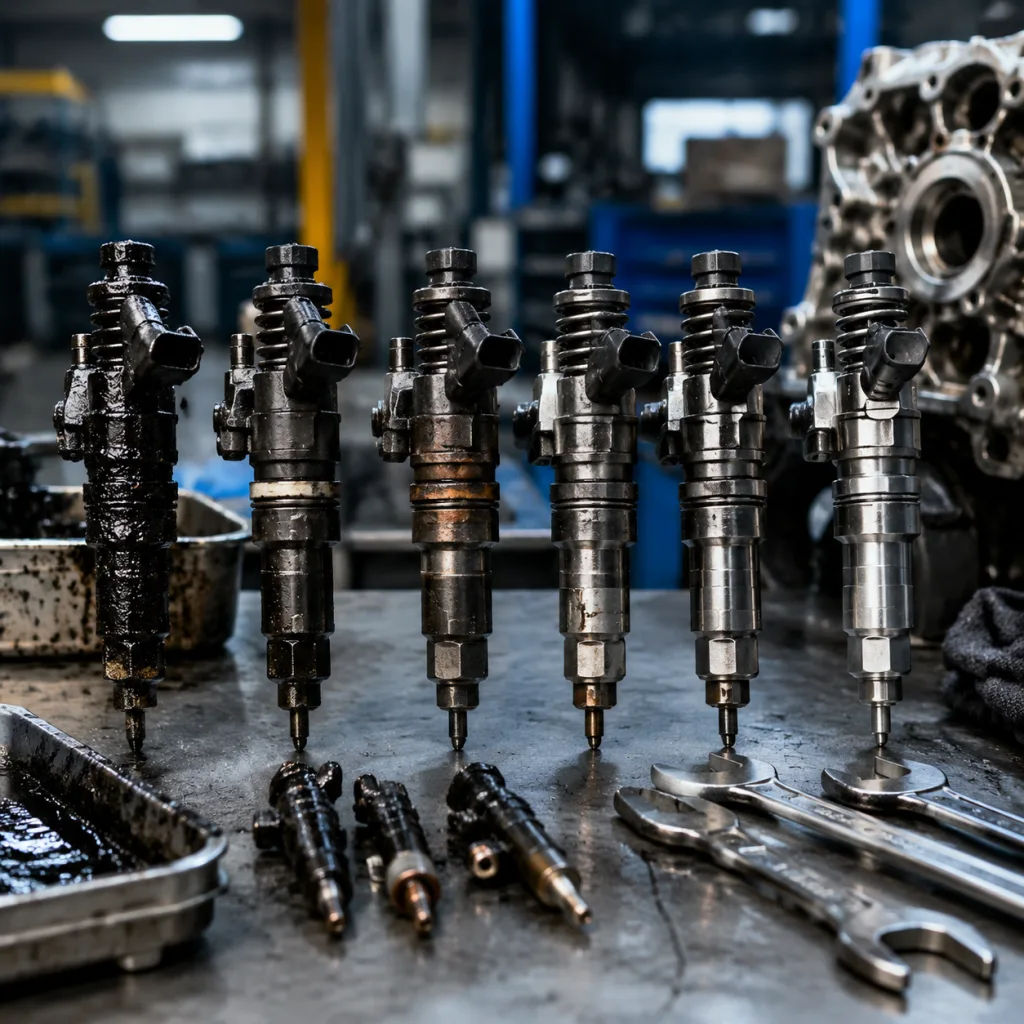
Particulate contamination. Rust, tank debris, deteriorated hose particles, pump wear material, or poor filtration can block micro-orifices and distort spray shape. Gasoline direct-injection and diesel nozzles may use very small spray holes, so particles far below visible size can still affect flow. The fix is system-level: replace the fuel filter, flush the rail where required, clean the tank if contamination is visible, and replace any injector that fails flow, leakage, or spray testing. If metal debris is present, inspect the low-pressure pump, high-pressure pump, rail, and return circuit before fitting new injectors.
Varnish and carbon deposits. Heat soak, short-trip operation, poor fuel stability, and combustion blow-by near the nozzle can form gum or carbon. Port injectors are more exposed to fuel-side varnish. Gasoline direct-injection and diesel injectors face high-temperature nozzle deposits. Cleaning is acceptable only when recovery is measurable under the same pressure, pulse width, and test-fluid temperature. Heavy carbon damage, distorted spray, or persistent leakage normally means replacement.
Electrical failure. Open coils, short circuits, high resistance, poor connector tension, and harness damage can cause intermittent misfire or unstable fueling. The fix is not guesswork. Check harness voltage drop, terminal condition, coil resistance at normal and elevated temperature where possible, and ECU driver signal. Many saturated gasoline injectors are in the approximate 12–16 Ω range, while low-impedance and piezo systems are different. Use service data for the part family.
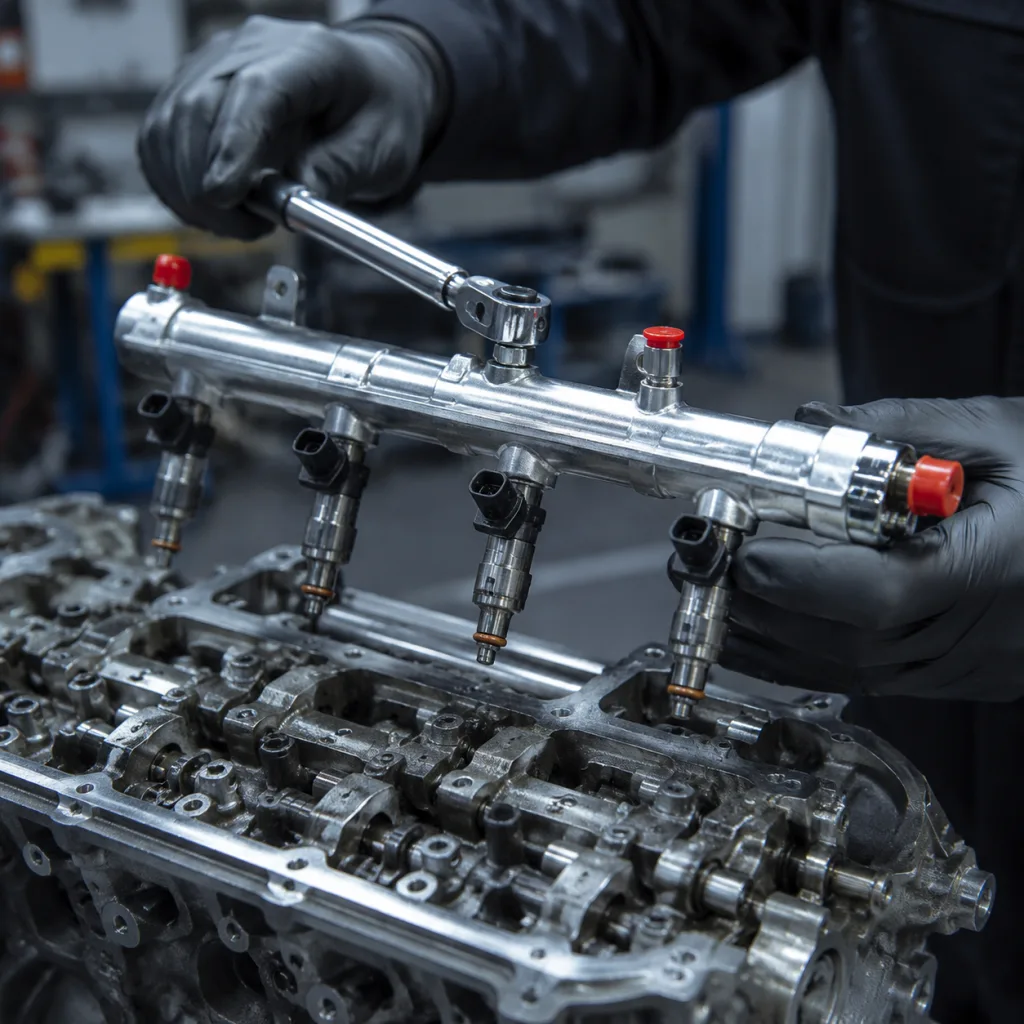
Seal and O-ring damage. Incorrect installation, dry assembly, wrong seal material, combustion seal failure, or rail misalignment can cause air ingress, fuel smell, external leakage, or compression gas leakage on direct-injection applications. Use the correct seal kit, clean seating surfaces, seal sizing tools where specified, and torque-controlled rail or clamp installation. Do not reuse PTFE combustion seals on gasoline direct injectors unless the service procedure explicitly permits it.
Wrong injector specification. A new injector can still be wrong. Incorrect flow rate, spray angle, connector keying, nozzle type, body length, or calibration code can create drivability and emissions problems. Cross-check fitment data, flow class, fuel compatibility, seal arrangement, pressure range, and any required ECU coding or adaptation procedure. A visually similar injector can mis-target the spray cone toward a wall instead of the valve or piston bowl.
The strongest warranty files name the mode and the fix: contamination plus filter and rail action; leakage plus replacement; wrong flow class plus catalogue correction. For buying teams, group claims by engine code, OE reference, production lot, mileage-to-failure, and workshop location. A cluster under 30 days after installation deserves a different investigation from scattered failures after 80,000–120,000 km.
A diagnostic sequence that prevents false returns
A repeatable workflow protects both sides of a B2B transaction. Repair networks avoid unnecessary parts replacement. Distributors and sourcing engineers receive field data that can be compared across applications, markets, and batches.
1. Confirm the complaint. Record DTCs, freeze-frame data, short- and long-term fuel trims, misfire counters, commanded and actual rail pressure, injector correction values where available, coolant temperature, intake air temperature, and battery voltage. Low cranking voltage can distort injector operation; a cranking voltage below about 9.6 V on a 12 V system should be corrected before fine diagnosis. 2. Eliminate non-injector causes. Verify compression, ignition condition, intake leaks, exhaust restrictions, and supply fuel pressure. A smoke test for intake leaks and a fuel pressure test under load often prevent unnecessary injector replacement. 3. Inspect the fuel from the right location. Look for water, sediment, unusual odour, incorrect fuel type, excessive ethanol content where relevant, or microbial contamination in diesel systems. Use a clear sample jar from the rail or filter drain, not only from the filler neck, and allow separation time if water is suspected. 4. Test the electrical side. Measure coil resistance against specification, check connector pin tension, inspect for corrosion or oil intrusion, and use an oscilloscope or noid light where appropriate. A useful scope capture shows supply voltage, driver pull-down, inductive kick on solenoid injectors, and consistent pulse command between cylinders. On electronically controlled diesel injectors, follow the vehicle maker’s limits for resistance, insulation, capacitance, and driver checks. 5. Compare cylinders. Use power balance, injector balance, cylinder contribution, or smooth-running tests. One outlier usually points to a local injector or cylinder issue. All cylinders affected points toward fuel supply pressure, ECU strategy, air measurement, or fuel quality. On gasoline balance testing, compare pressure drop per injector at equal pulse width rather than judging only the absolute number. 6. Bench-test when evidence is still incomplete. Test flow rate, static leakage, spray pattern, response time, and, for diesel, return flow on calibrated equipment using approved test fluid. Do not judge an injector only by appearance unless there is obvious physical damage. A useful bench report states test pressure, pulse width, number of pulses, fluid temperature, measured flow per channel, leak result, and pass/fail limit.
Procurement teams can convert this same workflow into supplier-quality feedback. Field return forms should include vehicle application, operating conditions, fuel type, installation date, mileage in service, diagnostic readings, and whether the injector was cleaned, resealed, coded, or replaced. For higher-volume claims, retain at least 5–10 samples from different workshops before concluding there is a batch issue. A single sample is useful for screening, but weak for statistical decisions.
Clean, reseal, code, or replace? A practical decision table
Cleaning is a repair only when deposits are the confirmed restriction and the injector remains mechanically and electrically sound. It is not a cure for cracked housings, damaged connectors, failed coils, internal leakage, excessive diesel return flow, severe corrosion, or incorrect specification. Aggressive or unapproved cleaning can also damage precision components, coatings, seals, or nozzle geometry.
Decision point
Cleaning or service may be acceptable
Replace injector
Coil resistance
Within specified range and stable at room temperature and after heat soak
Open, shorted, heat-sensitive, or unstable; resistance shifts that appear only when hot are still failures
External condition
No cracks, corrosion, distorted connector, or impact marks
Fuel seepage, impact damage, broken connector lock, severe corrosion, or nozzle cap damage
Leakage
Passes static leakage test after cleaning at the specified rail pressure and hold time
Drips, pressure decay, wet nozzle, or internal leakage remains after cleaning
Flow recovery
Balanced within service specification after cleaning and test; many service benches use a practical cylinder-to-cylinder spread of about ±3–5% for gasoline injectors where OE data is unavailable
Persistent low flow, high flow, or unacceptable cylinder imbalance
Spray pattern
Even atomisation after cleaning, correct cone or fan shape, no wall-targeting
Split stream, dribble, distorted cone, poor targeting, or delayed shut-off
Seal damage
O-rings, spacers, filters, caps, or combustion seals are serviceable separately with correct tools
Seat erosion, injector body damage, damaged sealing land, or missing non-serviceable calibration parts
Coding and calibration
Correct code or flow class can be entered and verified by scan tool
Incorrect specification, missing calibration data, or ECU will not accept the code for the application
</tr></thead><tbody> </tbody></table>When replacement is required, fitment accuracy is as important as manufacturing quality. Buyers should verify body length, nozzle geometry, electrical connector, flow rating, fuel compatibility, seal arrangement, pressure range, and any calibration code requirement. They should also ask whether the part is supplied with pre-installed seals, protective caps, a QR or alphanumeric calibration code, and installation notes.
For aftermarket range planning, review our catalog and application coverage before committing to stocking quantities. A sensible stocking decision compares claim frequency, vehicle parc, competitive price level, and lead time. Fast movers may justify carton or pallet inventory. Slow movers should usually be ordered against confirmed demand unless minimum order economics support stocking.
Supplier qualification: what separates price risk from controlled production
Injector warranty can originate from the part, the installation, the catalogue data, or the upstream fuel system. Supplier qualification should therefore go beyond unit price. The buyer needs evidence that the process is controlled and that the part supplied is the part specified.
Relevant procurement checks include:
Manufacturing under an audited IATF 16949:2016 and ISO 9001:2015quality system, with current certificates, scope, issuing body, and expiry date checked before supplier approval.
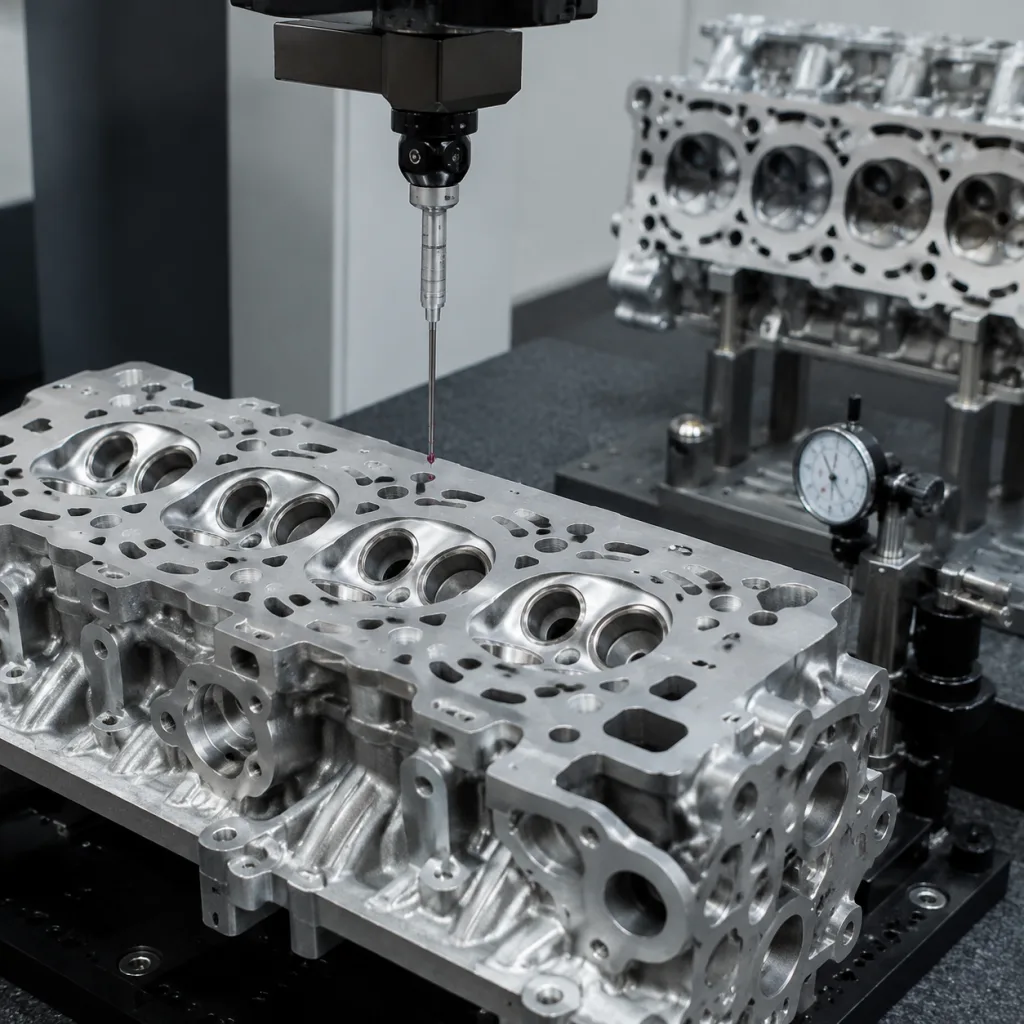
Incoming inspection for machined body dimensions, nozzle and seat geometry, spring characteristics, coil resistance, insulation, filter screen condition, and seal material conformity. Critical dimensions should be controlled with calibrated gauges rather than only visual inspection.
Functional testing for flow rate, leakage, spray pattern, response time, and pressure behaviour on calibrated benches. Buyers should request the test plan: 100% end-of-line test for critical function, sample size for audit testing, calibration interval, test fluid specification, temperature control, and pass/fail tolerance.
Batch traceability by production date, line, material lot, operator or station record, and test result. A practical traceability mark should connect the carton, label, and product batch to retained production records for at least the warranty period.
Packaging that protects nozzle tips, O-rings, caps, and connectors from impact, dust, moisture, and contamination during export shipment. Specify inner bags or caps, anti-rust protection where needed, drop-test expectations, barcode label fields, carton quantity, and pallet height limits.
Material and substance control aligned with REACH (EC) No 1907/2006 for EU-market supply, plus market-specific declarations if required by the buyer.
Fitment data management that avoids implying vehicle manufacturer approval and uses vehicle brand references for application identification only. Cross-reference data should be revision-controlled so supersessions do not create incorrect interchange.
Clear handling instructions for service networks, especially where seals, caps, calibration codes, cleanliness requirements, or one-time-use high-pressure pipes are critical.
Driventus manufactures engine and powertrain components in Taizhou, Zhejiang, and supports aftermarket distributors, OEM/Tier-1 programmes, and repair-chain sourcing teams. Commercial review normally depends on annual forecast, SKU count, drawing or sample status, inspection standard, packaging design, and logistics terms.
MOQ and unit price are not fixed across all injector-related items. A catalogue part with existing tooling may support lower trial quantities. A custom body, connector, calibration, or private-label pack usually requires higher MOQ to absorb tooling, test setup, packaging artwork, and production changeover. Lead time should be separated into sample build, validation, packaging approval, mass production, and sea or air freight rather than quoted as one vague delivery date. Where a customer requires a specific injector-related component, seal kit, test protocol, label format, or packaging configuration, custom manufacturing can be reviewed against drawing, sample, or application data.
If injectors fail again after repair, look upstream
A second injector complaint after 500 to 5,000 km is a signal. The likely cause is not bad luck. It is often unresolved contamination, incorrect installation, unsuitable fuel, wrong coding, or a system-level fault that survived the first repair.
Use these service-network controls to prevent repeat failures:
Replace fuel filters at the same time when contamination is suspected, and cut open the old filter if the finding may support a warranty decision. Photograph metal particles, rust, algae-like diesel contamination, or water marks before disposal.
Use clean caps and plugs during rail removal so workshop debris cannot enter open fuel lines or injector ports. For common-rail diesel work, treat uncapped ports as contamination events, not minor housekeeping issues.
Lubricate seals only with approved clean lubricant; do not install O-rings dry or with incompatible grease. Fuel-resistant elastomers can swell or crack if exposed to the wrong lubricant.
Follow the specified torque sequence for the fuel rail, clamp, or hold-down bracket to avoid side-loading the injector. Uneven clamping can cause external leakage, combustion blow-by, or cracked plastic bodies.
Clean injector bores and sealing seats with the correct tools, especially on direct-injection and diesel applications with combustion seals. Remove old copper washers, carbon rings, and debris from the bore before fitting the new seal.
For diesel systems, replace high-pressure pipes if the service procedure requires it, keep all ports capped, and observe cleanliness rules for common-rail components. Do not use compressed shop air that may carry water or oil unless the process is filtered and approved.
Confirm ECU coding, adaptation reset, injector classification entry, or learning procedure where the vehicle procedure requires it. Save a scan-tool screenshot showing accepted codes when this is relevant to warranty.
After repair, road test with fuel trim, rail pressure, injector correction, and misfire data logged under load conditions similar to the original complaint. A short idle-only check is not enough for load-related lean codes or diesel smoke complaints.
Feed confirmed root-cause information back to purchasing, technical support, and supplier quality teams so repeated claims can be analysed by application, batch, fuel source, installation location, and mileage band.
Handled this way, fuel injector failure causes and fixes become a controlled diagnostic and service process rather than a parts-changing exercise. For B2B buyers, the result is fewer unnecessary returns, stronger technical evidence, and more productive warranty discussions. A useful network KPI is warranty rate by 1,000 units sold, split into no-fault-found, contamination, installation damage, electrical failure, leakage, and confirmed manufacturing defect. That structure makes price, MOQ, and lead-time decisions more defensible.
Frequently asked questions
Yes, if the fault is deposit-related and the injector passes leakage, coil resistance, flow balance, and spray-pattern checks after cleaning. Cleaning is not suitable for cracked bodies, failed coils, severe corrosion, internal leakage, excessive diesel return flow, damaged connectors, or injectors that remain outside flow tolerance after a controlled bench test.
Multiple failures usually point to a system issue such as contaminated fuel, water, tank debris, poor filtration, incorrect fuel type, microbial growth in diesel, or a high-pressure pump problem. Inspect the fuel supply, filter, rail, tank, and pump debris before fitting new injectors.
Request fitment data, material and seal specifications, flow and leakage test controls, traceability, packaging details, handling instructions, MOQ and lead-time assumptions, and evidence of IATF 16949:2016 and ISO 9001:2015 quality management.
If your team is reviewing injector-related sourcing, diagnostic feedback, MOQ planning, test protocols, or export packaging requirements, Driventus can provide technical discussion without implying any vehicle manufacturer endorsement. To share application data or [request a quote](/contact.html), visit /contact.html