Front Crank Seal Leak: Diagnosing the Front Crankshaft Seal
A front crank seal leak is usually seen first as oil at the lower timing cover, crank pulley, or belts. On transverse engines, it may spread onto the accessory drive and undertray before a technician can confirm the source. The front crankshaft seal sits between the crankshaft and the timing cover or housing, so a leak can come from seal wear, shaft wear, pressure issues, or installation damage. The practical question is not only whether the seal is wet, but why it failed and whether the replacement will hold under real operating conditions. Driventus is an independent aftermarket manufacturer; brand names are referenced for fitment only. For buyers and workshops, the right approach is symptom review, careful inspection, and a dimensional match to the engine application rather than a visual-only substitution.
What a front crank seal leak looks like
The most common signs are consistent across petrol and diesel engines:
Oil film around the crank pulley or harmonic balancer
Oil running down the front cover and onto the sump flange
Belt contamination, squeal, or glazing
Oil mist inside the timing cover area
Repeated loss of oil without an external upper-engine source
A front crankshaft seal leak may appear small at idle and become more visible after highway running, long idling, or high crankcase pressure. If the leak reaches the auxiliary belt, the symptom may look like belt slip or pulley misalignment even when the seal is the root cause.
For procurement teams, the first decision is whether the failure is isolated to the seal lip or whether the shaft and housing also need review. A replacement seal will not correct groove wear, blocked crankcase ventilation, or distortion in the cover bore.
Main causes of seal failure
Seal failure is usually mechanical, thermal, or pressure-related rather than random. The most common causes are:
Cause
What to inspect
Typical result
Shaft wear
Polished groove, corrosion, eccentric runout
Lip cannot maintain stable contact
Crankcase pressure
PCV system, breather blockage, blow-by
Oil forced past the lip
Installation damage
Cut lip, cocked seal, damaged bore
Immediate or early leak
Heat exposure
Hardened elastomer, brittle dust lip
Loss of elasticity
Contamination
Dirt, sealant residue, abrasive particles
Accelerated wear
</tr></thead><tbody> </tbody></table>A damaged crank nose or pulley hub is a common missed cause. If the sealing surface is grooved, a standard replacement may leak again even when the seal itself is correct. That is why a proper inspection should include the shaft finish, radial runout, and the condition of the timing cover bore before any replacement order is placed.
How to confirm the leak source
Use a controlled inspection rather than replacing the first wet component you see.
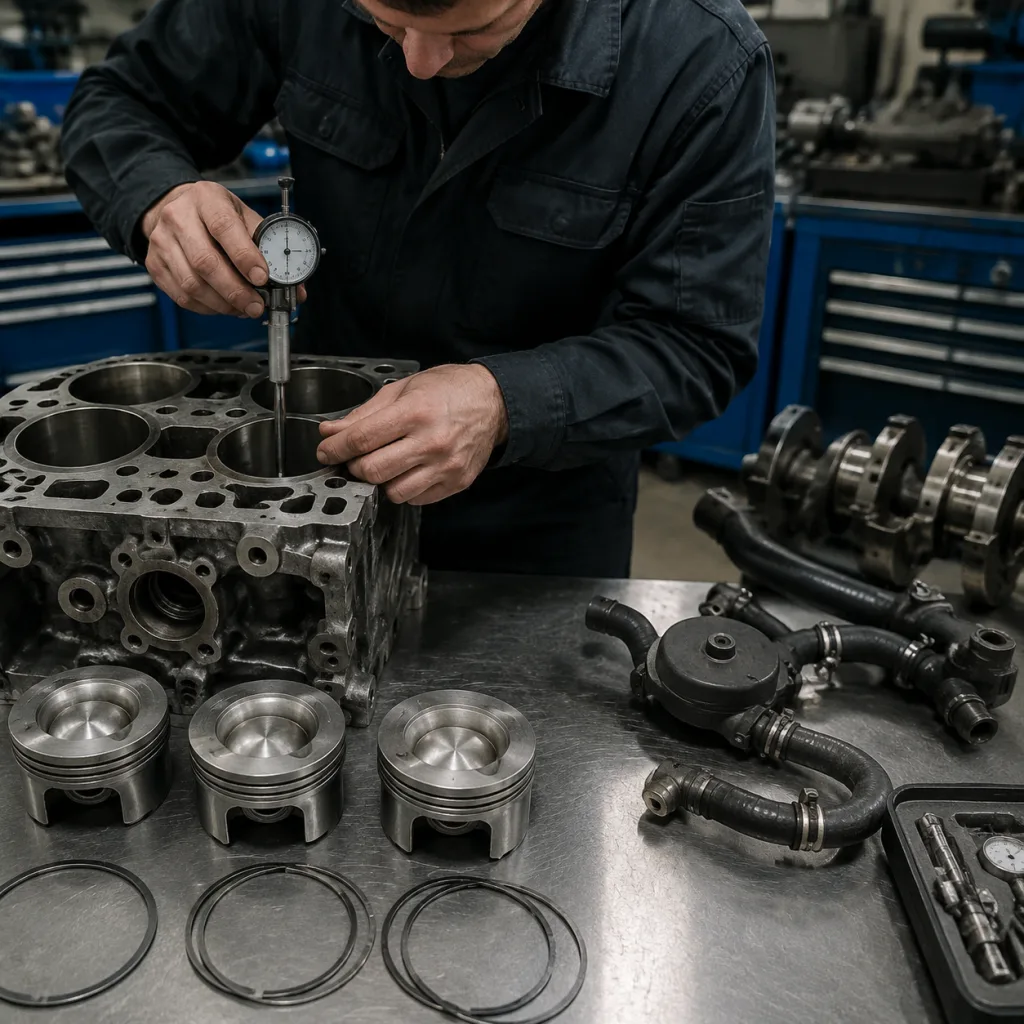
1. Clean the front engine area thoroughly. 2. Run the engine and inspect with a lamp and mirror. 3. Trace oil from the highest wet point downward. 4. Check whether oil appears from behind the crank pulley or from above the cover. 5. Verify crankcase ventilation before removing the seal. 6. Measure the shaft where the lip rides.
If the leak source is uncertain, UV dye can help separate a front seal leak from a cam cover, oil pan, or oil filter housing leak. On some engines, oil thrown by the crank pulley spreads across nearby parts and gives a false impression of seal failure. If the area is contaminated, clean and recheck before authorising replacement stock.
A front crank seal leak should be confirmed with evidence, not assumption, because the same external pattern can come from several nearby sealing points.
Replacement checks that matter
For replacement, the key requirements are dimensional match, material compatibility, and stable lip loading. Buyers should verify:
Inner diameter, outer diameter, and width against the engine application
Lip design for rotation direction and shaft speed
Elastomer material for oil and temperature resistance
Dust lip or auxiliary lip where specified
Housing fit and interference level
Surface finish of the crankshaft sealing track
Common elastomer choices include NBR for standard mineral-oil applications and FKM for higher temperature or chemical resistance. Selection should reflect the duty cycle, oil temperature, and exposure to additives. For export markets, material declarations may also need to align with REACH (EC) No 1907/2006.
Validation should follow the customer’s requirements and relevant published standards where applicable, including IATF 16949:2016 and ISO 9001:2015 for quality control discipline, plus application-level endurance references such as SAE J2527 or ECE R-83 when they are used in the broader test plan.
What purchasers should ask suppliers
For engine programs, the seal is a low-cost part with high failure cost. The sourcing questions should be direct:
Is the seal built to the correct dimensional drawing for the application?
What material compound is used, and what is its temperature range?
Has the lip profile been validated on the intended shaft finish?
What are the packaging and storage controls to prevent lip deformation?
Can the supplier support batch traceability and PPAP-style documentation where required?
Driventus supplies crankshaft sealing components through our catalog and supports buyer review through our quality system. For platform-specific programmes, custom manufacturing is available when the application needs a tailored profile, compound, or packaging specification. The same discipline applies whether the order is for aftermarket distribution, workshop supply, or OE-linked replacement programmes.
If your team also sources adjacent engine parts, the broader engine components range can help consolidate procurement across related wear items.
When replacement is the right decision
Replacement is justified when the lip is hardened, the shaft surface is worn beyond reuse, the bore is damaged, or the seal has been contaminated during prior service. It is also the correct decision when a vehicle returns with repeated leakage after a short interval, because repeat failure usually indicates an unresolved root cause.
A responsible replacement plan should include:
Measuring the shaft and bore before ordering
Confirming the ventilation system is clear
Checking pulley balance and runout
Using the correct installer to avoid cocking the seal
Verifying the engine oil meets the required specification
A front crankshaft seal is not a universal part. The correct part is the one that matches the engine design, the service environment, and the quality expectations of the buyer. That is the level of control Driventus applies across its sealing and engine-part supply chain.
Frequently asked questions
Only sometimes, and usually only for a short period. Conditioner may reduce minor lip hardening, but it will not fix shaft wear, bore damage, or high crankcase pressure. If the leak is visible at the pulley or timing cover, replacement is the reliable fix.
The usual causes are shaft groove wear, incorrect installation depth, damaged lip during fitting, or unresolved crankcase pressure. Repeated leakage means the source problem was not corrected, not that the seal material is automatically wrong.
Confirm dimensions, material, temperature range, shaft finish requirements, traceability, and packaging controls. For export supply, also check documentation against IATF 16949:2016, ISO 9001:2015, and REACH (EC) No 1907/2006 where applicable.
If you need a front crankshaft seal matched to an engine programme or aftermarket line, send the application details and target volume through our contact form at /contact.html.