Flex Plate Symptoms of Failure: B2B Diagnostic Guide
A flex plate does two jobs that are easy to underestimate: it transfers crankshaft torque to the torque converter, and it gives the starter a precise ring-gear interface. When either function drifts out of control, the complaint is often filed under the wrong label: bad starter, torque converter noise, rear main seal leak, engine knock, or driveline vibration.
For distributors, repair chains, and sourcing teams, the cost is not just one vehicle down. Poor diagnosis creates unnecessary replacements. Poor specification creates repeat warranty claims across branches and batches. This article focuses on flex plate symptoms of failure, how to separate them from neighboring powertrain faults, and what to lock down before buying replacements at scale.
Driventus manufactures engine and powertrain components in Taizhou, Zhejiang, under IATF 16949:2016 and ISO 9001:2015 controls. Driventus is an independent aftermarket manufacturer; brand names are referenced for fitment only.
Symptom triage: what the complaint is really telling you
Start with the pattern, not the part. A flex plate fault can be noisy, intermittent, or load-sensitive, and the same vehicle may still start and drive. That is why symptom capture before removal matters for workshop networks and warranty teams.
Symptom observed
What it points to on the flex plate
Similar faults to rule out
First check
Metallic rattle at idle, loudest near bellhousing
Crack around crankshaft bolt circle, converter pads, or formed section
Rotate crankshaft and inspect the full gear circumference
Rear main seal area appears oily after noise starts
Bolt loosening, crack propagation, or movement at crank flange
Rear main seal leak, transmission pump leak
Remove inspection cover and inspect the bolt pattern area
</tr></thead><tbody> </tbody></table>A useful diagnostic note includes: when the noise occurs, whether it changes in gear, starter behavior, location of maximum sound, and any visible fretting dust or metal flakes. Without that evidence, a returned part review quickly becomes guesswork.
Failure modes buyers should not treat as random breakage
Flex plates are thin because they must absorb small axial and torsional movements between the crankshaft and torque converter. That design also makes them unforgiving when geometry, torque, concentricity, or material consistency is off.
The common failure modes are predictable:
Fatigue cracking. Repeated bending concentrates stress around crankshaft holes, converter pads, lightening windows, and formed transitions.
Fretting at bolt locations. Under-torque or poor seating allows microscopic movement. Red-brown dust around holes is a warning sign.
Distortion from installation or manufacture. Excessive runout can create vibration, starter engagement issues, and secondary cracking.
Ring gear tooth damage. Incorrect starter engagement, inconsistent tooth hardness, poor tooth profile, or impact damage during handling can chip or wear teeth.
Converter misalignment. Debris, pilot fit issues, incorrect spacers, or uneven converter pads create cyclic bending every revolution.
Imbalance. Poor balance control adds load into the crankshaft-converter interface and may show up as rpm-specific vibration.
For procurement teams, the lesson is simple: do not buy a flex plate as if it were only a stamped disc with teeth. Request evidence of material grade, ring gear joining method, dimensional control, hardness range, runout limits, and balance verification where applicable. These controls should be part of the sourcing file for multi-SKU aftermarket programs listed in our catalog.
A workshop sequence that prevents false warranty claims
The fastest inspection is not always the cheapest. Replacing a plate without documenting the fault can hide an installation issue, starter fault, or adjacent driveline problem. Use a repeatable sequence across branches.
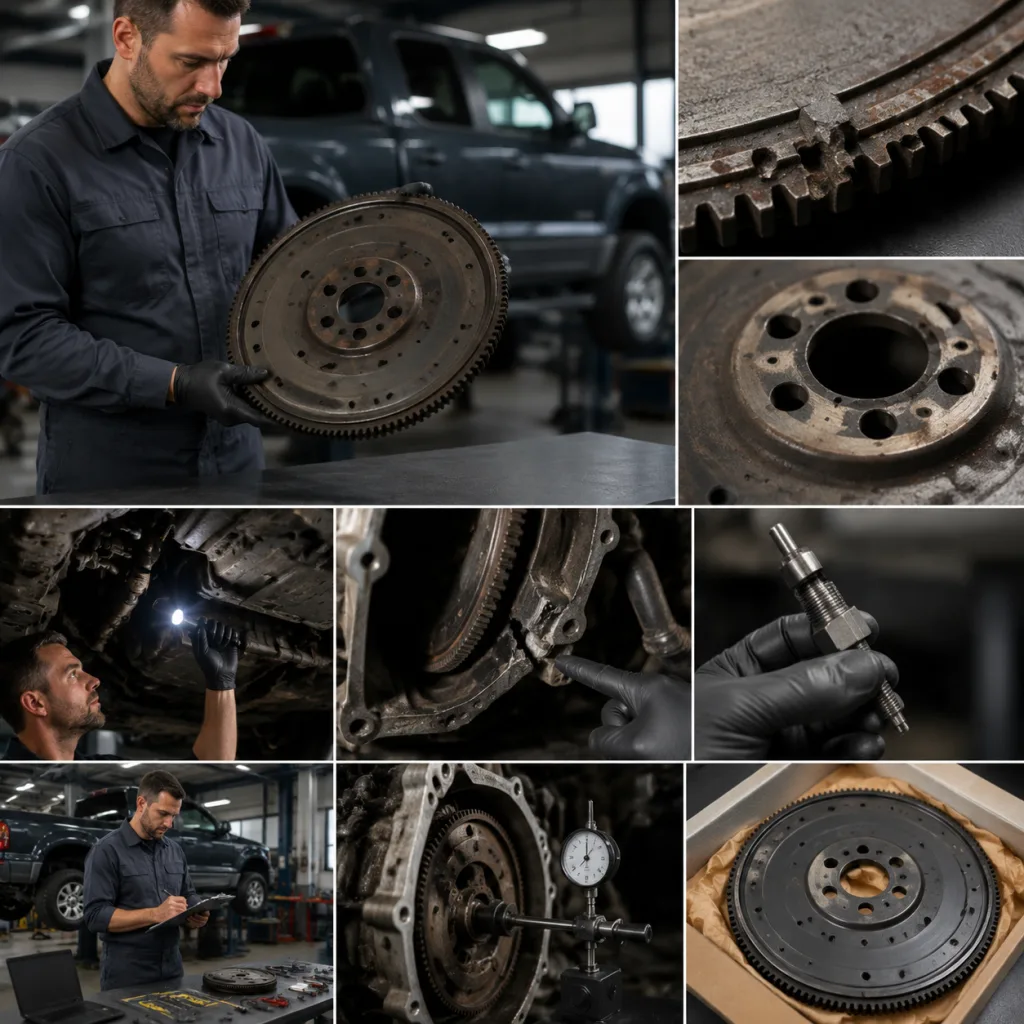
1. Locate the sound. Use chassis ears or a stethoscope around the bellhousing, starter area, and oil pan rail. Flex plate cracks are usually most audible at the bellhousing. 2. Record starter behavior. Note grinding, free-spinning, delayed engagement, or normal engagement. Low voltage and wiring resistance can mimic ring gear trouble. 3. Remove the inspection cover. Look for fretting dust, elongated converter holes, missing teeth, cracks, metal flakes, or witness marks. 4. Rotate the crankshaft by hand. Inspect the whole ring gear, not only the section visible when the cover comes off. 5. Check converter bolt torque. Loose bolts can create impact noise that sounds like a cracked plate. 6. Measure runout where accessible. Wobble points to distortion, poor seating, converter alignment error, or an incorrect part. 7. Inspect mating surfaces after removal. Check crank flange, converter pads, pilot, spacers, dowels, and any debris trapped between faces.
Reject the plate if these signs appear
Do not reuse a flex plate with visible crack initiation, even if the vehicle still starts. Replacement is also justified when ring gear teeth are chipped in multiple positions, converter holes are elongated, bolt areas show fretting, or runout remains outside the vehicle maker’s service limit after cleaning and reseating.
Specification deep-dive: small geometry errors that cause big returns
A replacement flex plate must match three interfaces at once: crankshaft, torque converter, and starter. A part can look correct on the shelf and still fail in the vehicle if offset, tooth geometry, or hole position is wrong.
Build the purchasing check around these points:
Tooth count and ring gear outside diameter.
Crankshaft bolt pattern, hole diameter, and pitch circle diameter.
Torque converter bolt pattern, pad position, and formed offset.
Plate thickness and formed geometry.
Pilot bore diameter and concentricity.
Ring gear hardness and tooth profile consistency.
Runout and dynamic balance requirement, where applicable.
Corrosion protection for ocean shipment and warehouse storage.
Packaging that prevents tooth impact, bending, and edge damage.
Purchase orders should state the inspection evidence expected with shipment or sample approval. Typical documents include dimensional reports, material certificates, hardness records, and production control plans. Driventus aligns production control with IATF 16949:2016 and ISO 9001:2015 through APQP-style feasibility review, incoming material inspection, in-process checks, and final sampling. The same quality system supports flex plate programs, pistons, crankshafts, gaskets, water pumps, and turbochargers.
If an OE part-number cross-reference is needed, use the customer’s verified reference format in the bill of materials. Driventus does not claim approval or endorsement by any vehicle manufacturer.
Manufacturing control map: where repeat failures are stopped
Repeat flex plate failures are rarely solved by a final visual check alone. The controls have to sit at the points where the part can lose geometry, hardness, or concentricity.
Control point
Failure it helps prevent
Typical verification method
Steel grade and thickness
Low fatigue strength, incorrect formed offset
Mill certificate and incoming thickness check
Stamping and forming
Hole position error, flatness loss, offset variation
Fixture measurement and go/no-go gauges
Ring gear joining
Gear movement under starter load
Visual inspection, dimensional check, process monitoring
</tr></thead><tbody> </tbody></table>For OEM, Tier-1, and private-label buyers, Driventus can support drawing-based review, sample development, PPAP-style documentation where requested, and packaging specifications through custom manufacturing. Compliance discussions can also include REACH (EC) No 1907/2006 for applicable materials and substances in exported components.
Escalation scenario: one cracked plate or a sourcing problem?
A single cracked flex plate may come from age, a previous installation error, converter misalignment, or a starter issue. A cluster is different. When the same SKU, engine family, repair branch, or batch starts producing similar complaints, move from diagnosis to sourcing review.
Escalate when any of these patterns appear:
Cracks repeat at the same bolt-hole location.
Ring gear wear appears before normal service mileage.
Starter complaints rise after a supplier change.
Converter bolt holes show repeated elongation.
Returned parts show inconsistent thickness, offset, hardness, or runout.
Packaging damage is found near ring gear teeth before installation.
A strong corrective-action file includes vehicle application, mileage, installation date, torque procedure, starter condition, photos before removal, crack location, ring gear condition, and batch code. Compare that file against inspection records and supplier traceability. The goal is to determine whether the root cause is fitment, installation, adjacent component condition, logistics damage, or production variation.
That evidence gives procurement teams a defensible basis for supplier qualification, revised drawings, packaging changes, or tighter incoming inspection.
Frequently asked questions
Yes. A crack near the crankshaft bolt circle can create a metallic knock or rattle that seems to come from the rear of the engine. The sound may change between idle, load, and start-up. Inspect through the bellhousing cover before condemning internal engine parts.
Not always. Replace or service the starter only if the drive gear, solenoid action, mounting alignment, or electrical performance is faulty. If ring gear teeth are damaged, inspect the starter carefully because poor engagement can damage the new plate.
Provide application details, drawings or samples, tooth count, bolt patterns, plate offset, thickness, expected annual volume, packaging requirements, and any validation documents required. Fitment cross-references should be supplied by the customer when needed.
If your team is reviewing flex plate failures or qualifying a replacement program, Driventus can assess drawings, samples, and batch requirements. To discuss specifications or request a quote, contact us at /contact.html