Exhaust Manifold vs MAHLE Alternative: Buyer Comparison
A manifold sourcing decision should not start with the logo on the box. It should start with the failure you cannot afford: a warped flange, a leaking gasket face, a cracked collector, the wrong oxygen-sensor angle, or a batch with no traceable inspection evidence.
For buyers comparing exhaust manifold vs MAHLE alternative options, the real question is whether an independent aftermarket part can match the application requirement, hold up under heat and vibration, and support the commercial model behind the programme. That may mean a controlled second source, a private-label range, or a lower-cost replacement line with warranty risk kept inside agreed limits.
This article reviews the decision as a procurement and engineering exercise: fitment, material, machining, emissions-related interfaces, validation, documentation, MOQ, lead time and landed cost. Driventus manufactures engine and powertrain components in Taizhou, Zhejiang, and exports to distributors, wholesalers, OEM/Tier-1 suppliers and repair-chain procurement teams in more than 60 countries. Driventus is an independent aftermarket manufacturer; brand names are referenced for fitment identification only.
Decision Framework: What Must Match Before Price Matters
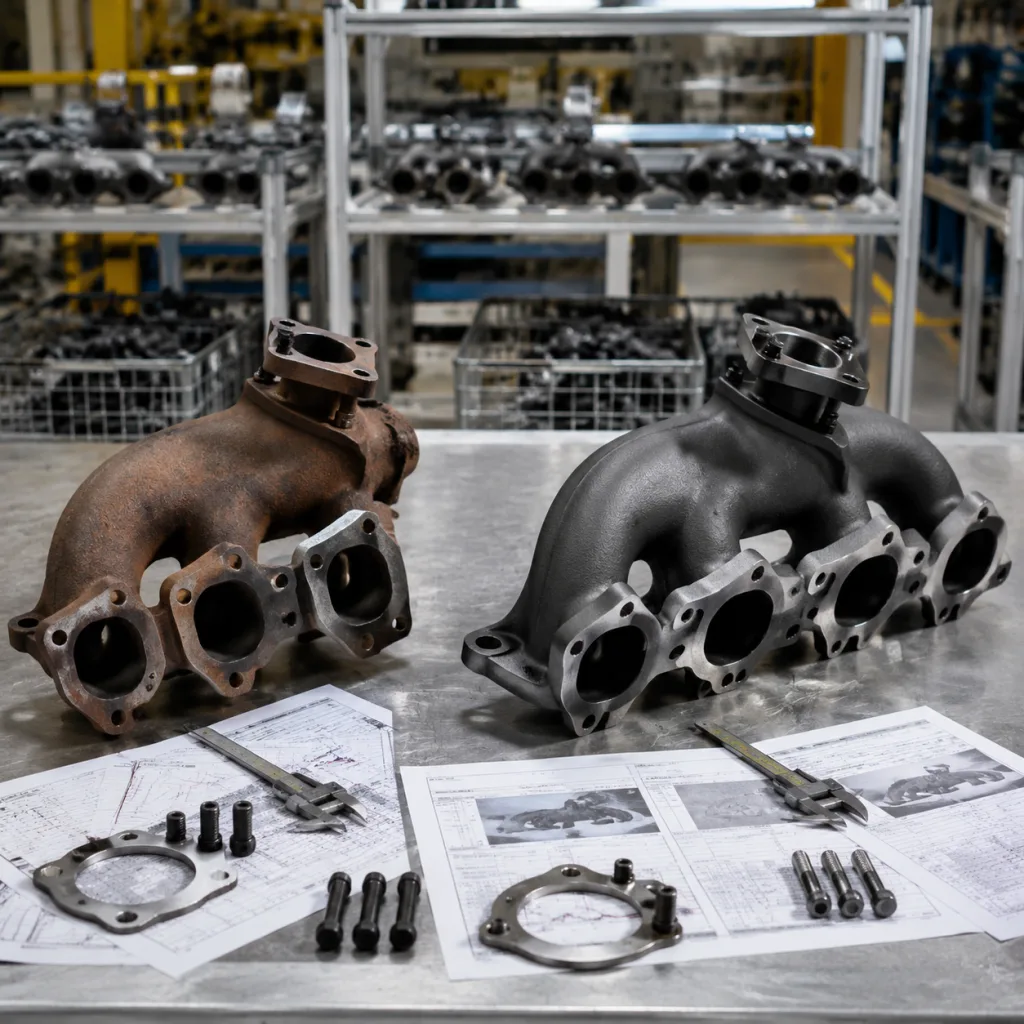
Treat the branded part as a fitment and performance reference, not as a shortcut around inspection. A useful comparison separates what the manifold must do from how the buyer prefers to source it.
Evaluation area
Branded reference part
Independent aftermarket alternative
Buyer verification point
Fitment reference
Established application data
Built to OE dimensional targets and cross-reference data
Confirm vehicle, engine code, year range, port count, turbo/non-turbo layout and OE-style reference before order
Material
Application-dependent cast iron or stainless assembly
GG20/GG25 grey iron, QT450/QT500 ductile iron or stainless steel by programme
Review material grade, hardness, wall thickness, heat resistance and substitution limits
Flange geometry
Controlled by original tooling intent
CNC-machined gasket and cylinder-head interfaces
Check flatness target, hole position, port alignment and sealing width on sample and pre-shipment lots
Emissions-related interfaces
Sensor and EGR positions by application
Matched bosses, threads and sealing faces where specified
Verify M18 x 1.5 oxygen-sensor threads, EGR flange angle, catalyst connection and blanking-plug fit
Validation
Brand-specific internal procedures
Supplier test plan agreed during sourcing
Request heat-cycle, leak and dimensional inspection records with sample size and acceptance criteria
Documentation
Standard aftermarket packaging and cataloguing
PPAP-style files, inspection reports or private-label documentation by agreement
Define document scope, language, file format, approval timing and retention period in the RFQ
Supply model
Distributor channel availability
Factory-direct or programme-based supply
Compare MOQ, lead time, forecast flexibility, mixed-SKU loading and batch traceability
</tr></thead><tbody> </tbody></table>Price enters the discussion after those gates are clear. If the part number, engine code, port pattern, gasket interface and sensor layout are still uncertain, the cheapest quotation is just an unpriced warranty claim.
For a multi-supplier range, define each SKU by application, drawing data where available, critical dimensions and test acceptance criteria. The RFQ should also state annual demand, target order quantity, landed-cost window, packaging type, document requirements and launch date. That keeps the comparison grounded in evidence rather than assumptions about brand equivalence.
Failure Modes: Where Manifold Alternatives Usually Go Wrong
Most manifold problems are not dramatic on day one. The part may bolt on. The risk appears after installation, heat cycles and customer use.
Common failure points include:
Casting material mismatch: GG20/GG25 grey iron suits many passenger-vehicle manifolds, while QT450/QT500 ductile iron or stainless assemblies may be needed near turbochargers, high-temperature packaging or severe thermal-fatigue conditions. Approve substitutions before sampling, not after a low price has been negotiated.
Flange distortion: Gasket faces should be machined and measured across the full sealing area. Buyers often specify 0.10-0.30 mm flatness for the cylinder-head flange, with tighter limits near 0.10-0.15 mm for short rigid flanges and wider limits for long multi-port castings where the gasket design can compensate.
Port misalignment: Exhaust ports are commonly held within about ±0.5-1.0 mm against a drawing or approved sample, depending on port size and gasket overlap. The sealing land must remain continuous around each port to reduce gasket burn-through, local hot spots and installation complaints.
Poor boss machining: Oxygen sensor and EGR threads should be gauged, protected and free of sand, burrs and machining debris. M18 x 1.5 oxygen-sensor threads are common, but thread form, depth, boss height and sensor clearance still need application-level confirmation.
Uncontrolled wall thickness: Critical runner bends, collector transitions and turbo or catalyst mounting areas need local wall-thickness control. Thin sections raise crack risk; heavy variation can indicate core shift, mould instability or weak casting-process control.
Wrong surface treatment: Anti-corrosion coating, shot blasting or passivation must suit the material, environment and packaging. Approval should define appearance limit samples, salt-spray target if required, masking areas and thread protection.
Kit definition is another frequent source of disputes. A bare manifold, a manifold with studs, and a full kit with gaskets, nuts, heat shields, blanking plugs or sensor plugs are not the same commercial offer. For kit programmes, specify fastener grade, gasket material, plug material, bagging method and whether small hardware is packed loose, in the same carton, or in a sealed inner bag.
Evidence Package: Documents That Separate Sample Luck from Process Control
When buyers evaluate a MAHLE alternative, documentation should be judged as part of the product. A lower unit price has limited value if incoming inspection, warranty analysis, customer audits or first-article approval cannot be supported.
Driventus operates under IATF 16949:2016 and ISO 9001:2015. These standards do not replace part-level testing, but they support controlled purchasing, process discipline, traceability, corrective-action handling and repeatable production. Depending on the programme, the file may include dimensional reports, material certificates, process flow, control plan, packaging specification, inspection records and batch traceability data.
Regional compliance should be handled carefully. REACH (EC) No 1907/2006 matters for EU chemical-substance obligations. ECE R-83 relates to vehicle emissions type approval at vehicle level, but an aftermarket exhaust manifold is not normally certified in isolation under that regulation. Do not treat a component comparison as proof of vehicle-level emissions compliance.
For higher-volume programmes, ask suppliers to define:
Heat-cycle test temperature range, dwell time and cycle count, for example 650-800°C peak exposure with controlled cooling where thermal-fatigue screening is required
Leak-test method, pressure level and acceptance criteria, such as air-under-water or pressure-decay testing with a defined zero-visible-bubble or maximum pressure-loss limit
Dimensional checkpoints before and after thermal exposure, including flange flatness, bolt-hole pitch, port position, collector flange angle and boss orientation
Thread gauge standards, gauge condition and sampling frequency, including go/no-go checks for sensor, EGR and mounting threads
Coating thickness, adhesion or corrosion-resistance requirements where applicable, with masking rules for gasket faces, threads and sensor seats
Packaging drop-test or vibration-test method for export shipment, including carton compression strength, inner protection and pallet stacking height
A practical approval route is to inspect 100% of critical threads and sealing faces on samples, then move to AQL-based inspection after stable production. For first release, buyers can require dimensional reports for 3-5 pieces per SKU plus pre-shipment inspection from each batch. These records make supplier comparison more reliable than catalogue screenshots or price lists alone. Buyers can review Driventus process controls through the <a href="/quality.html">quality system</a> page.
Brand Stock or Factory Programme: Which Buying Model Fits the Risk?
The best supply route depends on how the buyer earns margin and manages claims. A regional wholesaler may need immediate stock, brand recognition and wide catalogue coverage. A repair chain may care more about kit consistency, low return rate and stable pricing over 12-24 months. An OEM or Tier-1 buyer may need drawing-based development, PPAP-style documentation, capacity planning and change-control discipline.
Factory-direct sourcing can improve margin and private-label control, but it is less forgiving. Before quotations are compared, define the application list, annual volume, SKU forecast, packaging requirements, inspection criteria and approval timeline.
A practical RFQ should state:
Target applications and any OE-style references, using reference numbers only where the programme already relies on that convention
Required material grade and whether any substitution is allowed
Supplied kit content, including gasket, studs, nuts, heat shield, blanking plugs or sensor plugs
Label format, barcode standard, carton strength, palletisation requirements and private-label artwork ownership
MOQ per SKU, mixed-SKU container options, safety-stock expectations and forecast flexibility
Required documents for sample approval, first production release and recurring shipment inspection
Warranty return process, evidence required for claim review, credit rules and response timing
MOQ only makes sense beside tooling, setup time and demand certainty. For many cast or machined manifold programmes, discussions often start with 5-20 sample pieces, 100-300 pieces per SKU for trial orders, and production MOQs around 300-1,000 pieces depending on tooling status, machining setup, kit complexity and packaging. Existing-tooling SKUs usually quote faster and carry lower MOQ risk. New-tooling or low-velocity SKUs may need tooling amortisation, a larger first order or a multi-SKU annual commitment.
Lead time also has layers. Existing references may take about 2-4 weeks for quotation and sample preparation after data confirmation, 1-2 weeks for buyer inspection, and 30-60 days for first production depending on material, machining, coating, hardware and packaging. Repeat orders should run against rolling forecasts. Sea freight may add roughly 25-45 days depending on destination port and routing.
Compare ex-works price, FOB price, duty, freight, inspection cost, warranty reserve and inventory carrying cost before calling one option cheaper. Driventus supports catalogue supply through <a href="/products.html">our catalog</a> and drawing-based <a href="/oem-services.html">custom manufacturing</a> for buyers that need controlled second sourcing. For broader engine-part planning, buyers can also review <a href="/products/engine-components.html">engine components</a> alongside manifold sourcing.
Scenario Test: When the Independent Route Wins, and When It Does Not
An independent aftermarket manifold makes sense when the buyer can verify fitment and quality before volume release. Risk is lowest when the application list is stable, sample parts or drawings are available, approval responsibility is clear, and batch traceability can continue after launch.
The factory alternative is usually a strong candidate when:
The buyer needs a second source for continuity, margin improvement or price negotiation
The application has mature demand and predictable annual volume, ideally with repeat orders rather than one-time emergency replenishment
Private-label packaging or regional branding is required, including agreed label fields, barcodes, carton dimensions and warranty insert language
The buyer can perform incoming inspection, sample validation or first-article approval against written tolerances
Documentation is required beyond standard distributor invoices, including material certificates, inspection reports and batch traceability
Lead time can be planned through forecasts rather than emergency purchasing, with agreed reorder points and safety stock
The branded distributor route may still be better for low-volume, urgent or highly fragmented SKUs. It can also be safer where the buyer lacks technical resources for approval, or where a single warranty event would erase the purchase-price saving. A slow mover selling fewer than 50 pieces per year may not justify tooling review, sample freight, private-label packaging and incoming inspection. A mature SKU selling several hundred pieces per year may.
For buyers comparing exhaust manifold vs MAHLE alternative options, the strongest launch method is controlled and staged: approve samples, place a pilot order, release the first batch to selected branches or customers, monitor installation feedback for 60-90 days, then widen distribution if returns, noise complaints, leak reports and fitment issues stay within the agreed threshold. That gives category managers a defensible supplier-approval file instead of a decision based only on catalogue overlap.
Approval Walkthrough: From Sample Bench to Purchase Order
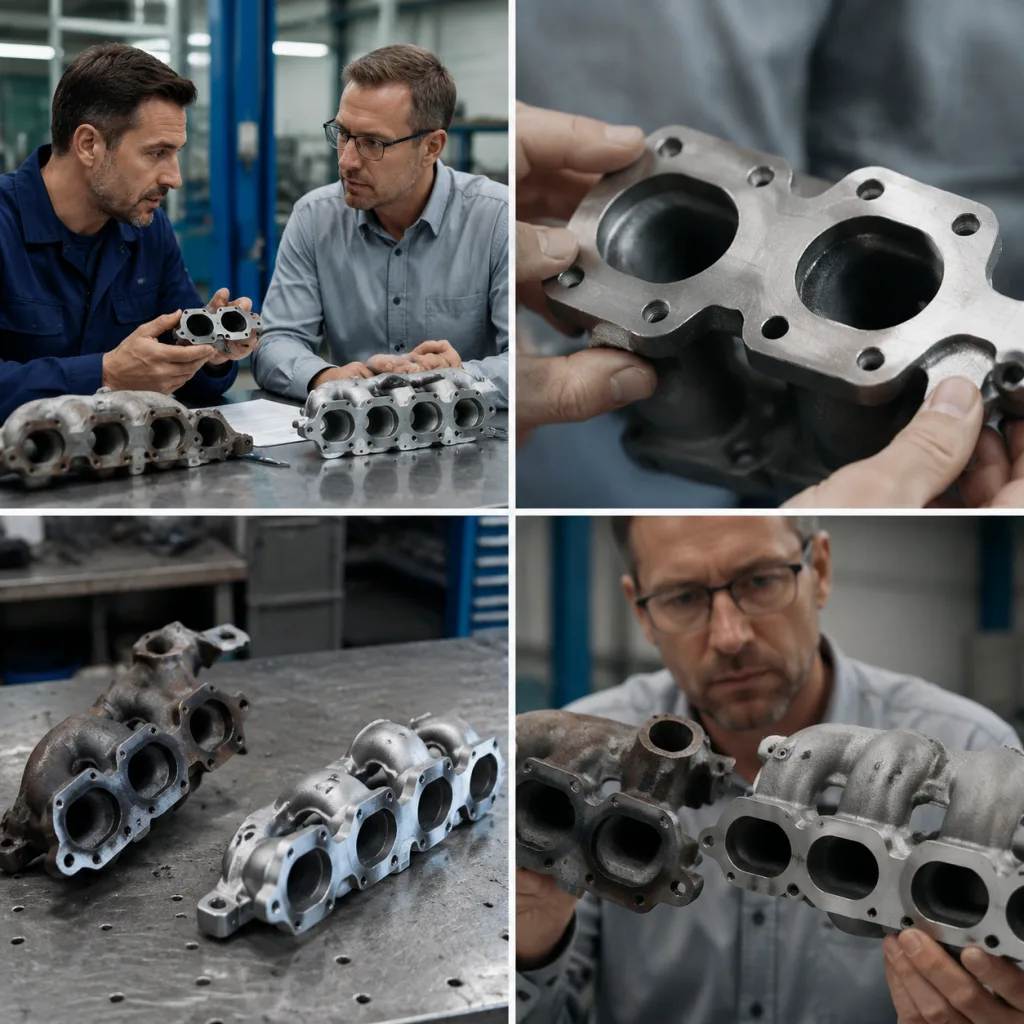
Before a sample becomes a purchase order, procurement and engineering need one shared acceptance file. Without it, warehouses, regional teams and customer accounts may inspect the same part differently.
Recommended approval sequence:
Confirm vehicle applications, engine codes, year ranges, turbo/non-turbo status, catalyst layout and relevant cross-reference data
Inspect cylinder-head flange flatness, port geometry, sealing width, bolt-hole location and collector flange angle against drawing or approved sample
Gauge threaded bosses for oxygen sensors, EGR fittings and mounting hardware, including thread pitch, thread depth and perpendicularity where critical
Review material certificate, hardness data, casting identification, heat/batch number and traceability method
Check supplied gasket, studs, nuts, plugs and heat-shield quality if sold as a kit, including fastener grade and gasket material
Review heat-cycle, leak-test and post-test dimensional records with sample size, test conditions and acceptance limits
Confirm carton labelling, barcode format, palletisation, inner protection, country-of-origin marking and export carton strength
Agree MOQ, sample cost, tooling cost if any, lead time, payment terms, Incoterms, batch identification and warranty claim process
For EU, UK, US, Canada, Australia and Brazil buyers, import documentation should be checked early. Requirements may include commercial invoice accuracy, HS code consistency, material declarations, restricted-substance statements and customer-specific packaging rules. REACH (EC) No 1907/2006 should be considered for EU market placement, especially where coatings, packaging inks, labels or auxiliary materials are involved.
The final approval file should record the approved sample date, drawing or reference revision, tolerance list, packaging revision, inspection level, agreed deviation process and named contacts for technical and warranty escalation. That file is what turns a one-time acceptable sample into a repeatable supply programme.
Frequently asked questions
No. Driventus is an independent aftermarket manufacturer; brand names are referenced for fitment identification only. We do not claim approval, endorsement or authorisation by any vehicle or component brand.
Depending on the programme, buyers can request dimensional reports, material certificates, control plans, inspection records, packaging specifications and batch traceability information. The required scope should be stated in the RFQ before sample approval, including sample size, tolerance list and report format.
Yes, for suitable volumes and validated applications. Packaging, label format, kit content, barcode requirements, MOQ, lead time and documentation can be agreed during quotation and sample approval.
If you are comparing exhaust manifold vs MAHLE alternative sourcing for a distributor, repair-chain or OEM supply programme, share your application list, target volumes, MOQ expectations and documentation needs. You can request a quote at /contact.html