Engine Valve Specifications for Sourcing and Validation
Engine valve specifications are not just catalogue data. For procurement, the useful question is whether the valve will fit the engine geometry, survive the thermal load, and remain consistent across repeated production lots. That means checking head diameter, stem diameter, overall length, seat angle, groove geometry, hardness, and surface finish against the drawing, not against a generic description. Material choice matters as well, because intake and exhaust valves see different temperatures and corrosion loads. A good supplier should also provide dimensional inspection data, heat treatment records, and lot traceability. Driventus is an independent aftermarket manufacturer; brand names are referenced for fitment only. If you are comparing an OE cross-reference with an aftermarket replacement, the safest approach is to request the dimensional report, the material declaration, and the validation method before you place volume.
What a valve specification sheet should include
A usable specification sheet should answer three sourcing questions: does the part fit, does it survive, and can it be repeated at volume?
Include these items on every enquiry or drawing review:
Valve type: intake or exhaust
Head diameter and margin thickness
Stem diameter, stem length, and tip geometry
Face angle and seat width
Groove layout, keeper style, and installed height
Straightness, concentricity, and runout limits
Material grade and heat treatment condition
Stem finish, coating, or nitriding, if used
Hardness range and inspection method
Traceability level, lot code, and packaging standard
If any of these fields are missing, the buyer is forced to assume compatibility from appearance alone. That is where fitment mistakes usually start. A sound specification also states whether the part is made to print, made to sample, or matched to an OE benchmark. For volume programs, ask for our catalog and the related engine components family so the valve can be checked against adjacent parts such as guides, springs, and seals.
Core dimensions buyers check first
The table below shows the main dimensions buyers verify before approving a valve for production use. The actual numbers vary by engine family, but the control points are the same.
Parameter
What to confirm
Why it matters
Head diameter
Matches chamber and seat geometry
Affects flow area and sealing width
Stem diameter
Matches guide clearance and oil control
Too small increases lash and wear; too large risks seizure
Overall length
Matches installed height and valvetrain geometry
Changes lash, spring load, and rocker contact
Face angle
Matches the seat design, often 45 degrees
Incorrect angle reduces sealing contact
Margin thickness
Adequate for heat load and burn resistance
Thin margins fail faster on exhaust duty
Runout and straightness
Measured against the drawing limit
Excess runout raises wear and leakage risk
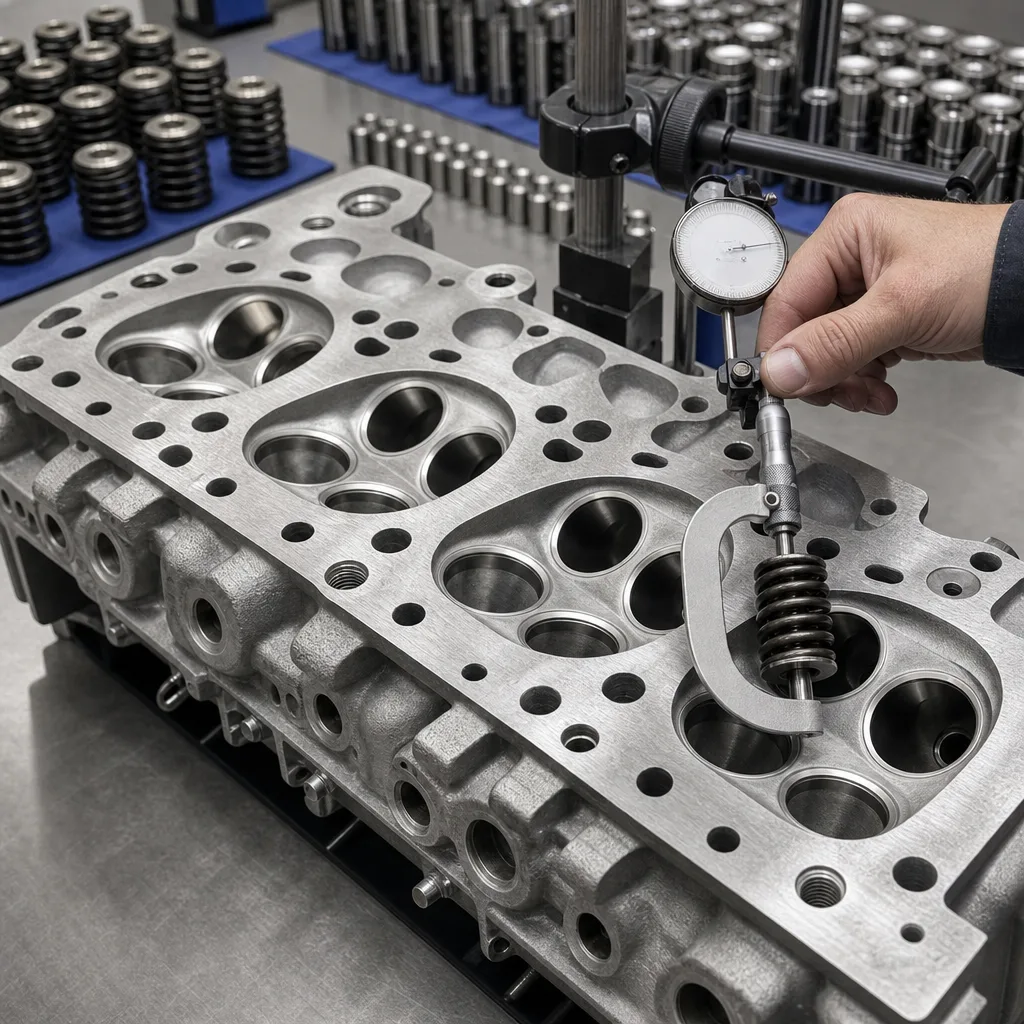
</tr></thead><tbody> </tbody></table>A 0.02 mm deviation in stem diameter can matter when the guide clearance window is already tight. For the same reason, the buyer should not accept a part that is dimensionally close but undocumented. The drawing limit, not the visual match, defines interchangeability. In high-volume sourcing, ask for a first-article report and a sampling plan before you approve mass production.
Materials, heat treatment, and surface finish
Material selection depends on temperature, corrosion exposure, and duty cycle. Intake valves are often made from austenitic stainless steel because they need stable dimensions and good oxidation resistance. Exhaust valves usually need higher heat resistance, so suppliers may use martensitic or other heat-resistant alloys, sometimes with a hardfaced seat area.
Common control points include:
Alloy identification by heat or melt lot
Hardness after heat treatment
Stem surface finish for guide wear control
Tip hardness for rocker or lash adjuster contact
Coating thickness, if a nitrided or coated stem is specified
Face integrity after grinding and lapping
A rough stem finish can shorten guide life, while excessive coating thickness can change clearance. Buyers should ask for the finish requirement in Ra, the coating type if applicable, and the acceptance method used at inspection. For EU-bound supply, REACH (EC) No 1907/2006 is relevant when coatings, cleaning residues, or surface treatments involve restricted substances. Material control should also be aligned with IATF 16949:2016 and ISO 9001:2015 traceability expectations.
Testing, standards, and quality control
Standards do not define every valve dimension, but they do shape the evidence a supplier should provide. A credible production file normally includes chemical analysis, hardness testing, dimensional inspection, and traceability back to the heat lot. For program-level validation, buyers should expect documented control of the following:
Chemical composition and incoming material verification
Rockwell or equivalent hardness records
Concentricity, runout, and straightness checks
Seat angle and margin inspection
Metallographic review when required
Thermal cycling, fatigue, and corrosion testing where the application demands it
A supplier with a documented quality system should be able to show how nonconforming parts are contained, how gauges are calibrated, and how records are retained. For some OEM-facing programmes, validation work may reference ECE R-83 for emissions-related durability context, while coating durability requests may cite SAE J2527 when a customer specifies it. Those references do not replace the drawing, but they do define how the part is proven before shipment.
How to match OE and aftermarket requirements
For replacement supply, the technical goal is dimensional equivalence with controlled manufacturing variation, not a loose visual match. Start with the OE cross-reference, then compare the actual valve drawing, the sample dimensions, and the installed geometry in the cylinder head.
Use this workflow:
1. Confirm engine code, valve type, and application year. 2. Measure stem diameter, overall length, head diameter, and keeper groove location. 3. Verify seat angle, margin thickness, and tip height against the sample. 4. Check guide clearance, spring seat load, and installed height in the assembled head. 5. Request material, hardness, and inspection records before volume approval.
If the part needs a custom seat profile, tip treatment, or coating, custom manufacturing is the right route. Driventus is an independent aftermarket manufacturer; brand names are referenced for fitment only. That disclosure matters in procurement because the commercial decision should be based on specification control, not on any implied endorsement. When the drawing is incomplete, a measured sample and an agreed inspection plan are the minimum safe starting point.
Frequently asked questions
Provide the engine code, valve type, dimensions, material preference, target annual volume, and any OE cross-reference you are using. If you have a drawing or sample, include that as well. The more complete the pack, the faster the first-article review.
It can match the specified drawing and functional envelope, provided the manufacturer controls material, heat treatment, grinding, and inspection tightly. Exact interchangeability still depends on guide clearance, seat geometry, and installed height in the cylinder head.
Ask for material certificates, hardness records, dimensional inspection reports, and traceability to the heat or lot number. For regulated markets, also ask how REACH, IATF 16949:2016, and ISO 9001:2015 requirements are handled in the production file.
If you need a catalogue match or a drawing-based program, send your dimensions, target volume, and application details. Request a quote at /contact.html.