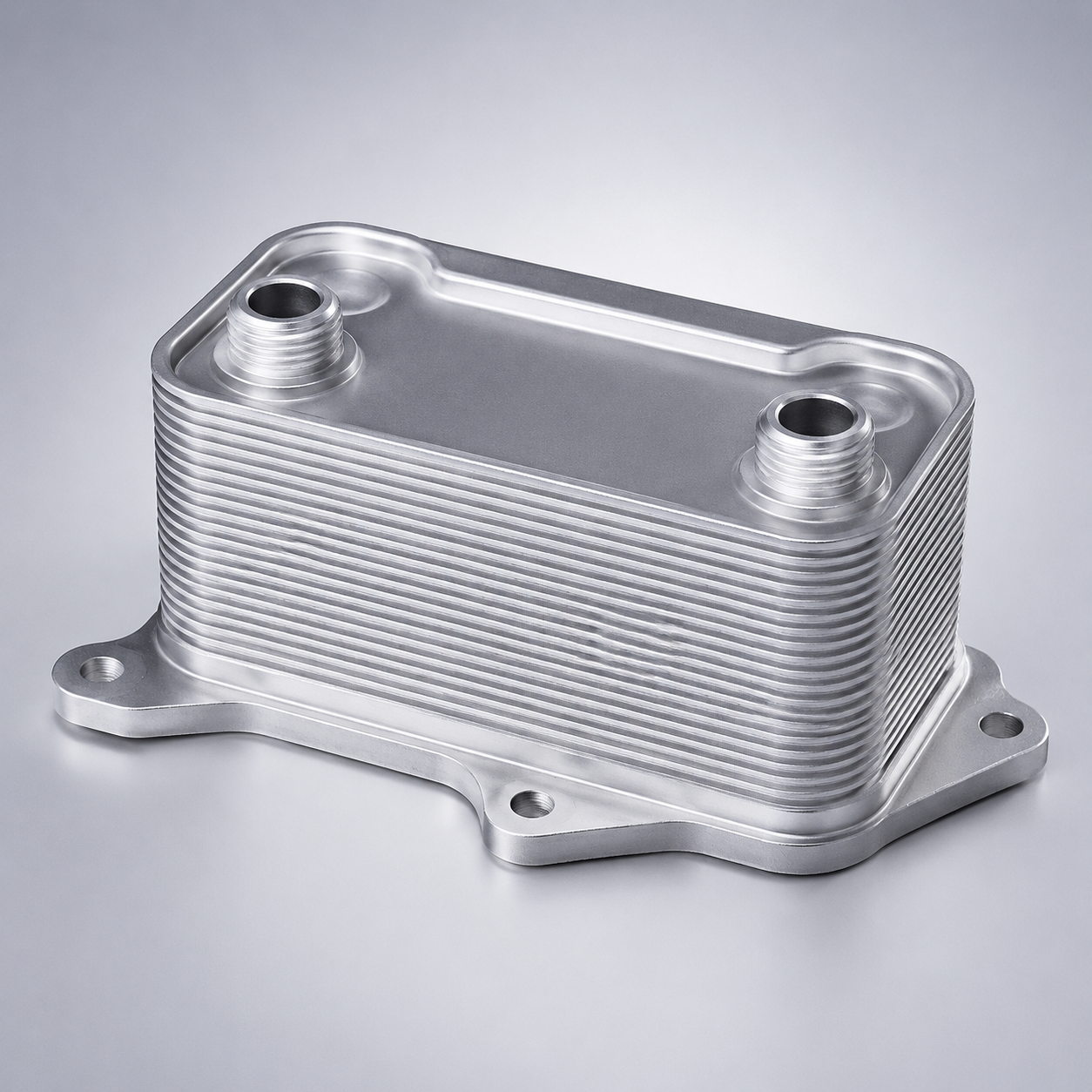
EGR Cooler Alfa Romeo Supplier: Sourcing Criteria
Choosing an egr cooler alfa romeo supplier is a control decision before it is a price decision. The part has to fit, seal, survive thermal cycling, and arrive with documentation that can stand up to customs, quality review, and warranty analysis. Buyers in aftermarket distribution, repair networks, and private-label programs also need repeatable traceability, stable change control, and lead times that reflect actual capacity.
EGR coolers run hot, cold, pressurized, and vibrating. Weak joints, poor cleanliness, off-spec brackets, or inconsistent materials can turn into coolant loss, restricted flow, install problems, and early field failure. So the useful question is not only who is cheapest, but which supplier can hold process capability across lots. This article focuses on what to verify when qualifying an egr cooler alfa romeo supplier: audit points, validation evidence, commercial terms, documentation, and the practical signals that separate a dependable source from a risky one.
Driventus is an independent aftermarket manufacturer; brand names are referenced for fitment only.
What to verify before price
Before comparing quotes, check whether the supplier can actually control the part. For Alfa Romeo EGR cooler sourcing, the first screen should cover fitment discipline, manufacturing consistency, and export readiness. A serious supplier should be able to explain how each cooler is built, tested, packed, labeled, and traced by batch from line to shipment.
Ask these questions in the RFQ and approval stage:
- Application coverage: which engines, model years, and vehicle variants are included, and how fitment is validated against drawings or physical samples
- Cross-reference discipline: whether the supplier maps buyer references to its own part numbers without making unsupported interchange claims
- Materials: exhaust-side metal grade, core construction where relevant, and gasket or seal compatibility with temperature and fluid exposure
- Leak testing: method, pressure, hold time, medium, and acceptance criteria for coolant-side integrity
- Thermal durability: whether the supplier has cyclic or bench testing that reflects exhaust heat and coolant load
- Traceability: batch code, date code, line trace, and retained inspection records tied to the shipment
- Compliance documentation: REACH (EC) No 1907/2006 declarations and other market-specific substance records where needed
- Quality management: IATF 16949:2016 and ISO 9001:2015, or a documented system built on the same control logic
A useful RFQ also asks for the sample basis, the allowable tolerance band for mounting points, and the target leak rate. Many buyers specify mounting-hole position within 0.5 mm, port-angle variance within 1 to 2 degrees, and zero visible leakage at the agreed test pressure. If a supplier cannot answer those numbers clearly, delays usually show up later in sample approval, incoming inspection, or claims handling.
Early precision reduces back-and-forth later.
Where factories fail on EGR coolers
A polished sample does not tell you much. The real failure modes are usually buried in the process: joining quality, internal cleanliness, fixture repeatability, and dimensional stack-up across lots.
Common production weak points
- Core forming and tube alignment: poor fixture control can distort the assembly before joining
- Brazing or welding parameters: temperature, shielding, filler lots, and operator settings should be recorded, not assumed
- Pressure and leak testing: 100% end-of-line testing matters more than a sample-only check
- Cleaning and debris control: contamination can restrict coolant flow and create downstream service issues
- Fixture verification: gauges and inspection jigs need periodic calibration records
- Change management: material, process, drawing, or sub-supplier changes should have formal approval and revision control
Records buyers should ask for
- Quality manual or process overview linked to the quality system
- Dimensional inspection report for critical characteristics, with nominal, tolerance, measured values, and sample size
- Material certificates for pressure-bearing parts where applicable, with heat or lot linkage where available
- Leak-test work instruction and sample records showing pressure, hold time, medium, and result
- Packaging specification for export shipment, including carton count, carton size, gross weight limit, and pallet pattern
- Non-conformance and corrective-action workflow with response timing and root-cause format
It helps to ask for process capability instead of general assurance. A stable line may track critical dimensions to Cpk 1.33 or higher, perform 100% leak testing at a defined pressure, and retain samples through the warranty window. Those details show control. Vague answers usually mean the opposite.
When comparing factories, make each one describe the same production route at the same level of detail. The weakest source is often exposed by evasive answers on leak limits, cleaning control, tooling maintenance, or revision history.
MOQ, lead time, and packaging by channel
Commercial terms depend on design complexity, tooling status, packaging, and whether the part is already in routine production. Standard catalogue supply, neutral-box aftermarket orders, and custom programs do not behave the same way.
| Sourcing item | Typical expectation | What to confirm |
|---|---|---|
| MOQ for stocked design | 100-300 pcs | Whether mixed references per shipment are allowed |
| MOQ for private label | 300-1,000 pcs | Box artwork, label format, barcode standard |
| MOQ for custom development | Case by case | Tooling ownership, sample timing, drawing approval |
| Sample lead time | 2-6 weeks | Whether samples come from production tooling |
| Mass production lead time | 30-60 days | Raw material stocking and peak-season capacity |
| Warranty support | Agreed by contract | Claim window, evidence required, chargeback process |