engine mount · 2026-06-13

Engine Mount Repair Cost: B2B Sourcing Guide

Engine mount repair cost is often framed as a workshop invoice, but procurement teams need to look beyond the counter price. The real cost includes the mount, labour time, diagnostic accuracy, warranty exposure, logistics, claim handling, and vehicle downtime. For distributors, fleets, and multi-location repair chains, a low unit price can become expensive if rubber hardness, bonding strength, hydraulic damping, bracket geometry, or packaging consistency vary from lot to lot. This guide breaks down the cost components that matter when sourcing engine mounts for aftermarket programmes, fleet maintenance, and service networks. It covers repair variables, quality checks, validation points, stocking decisions, and supplier questions that help reduce returns and rework. Driventus manufactures engine and powertrain components in Taizhou, Zhejiang, under IATF 16949:2016 and ISO 9001:2015 systems. Driventus is an independent aftermarket manufacturer; brand names are referenced for fitment only.

What Drives Engine Mount Repair Cost

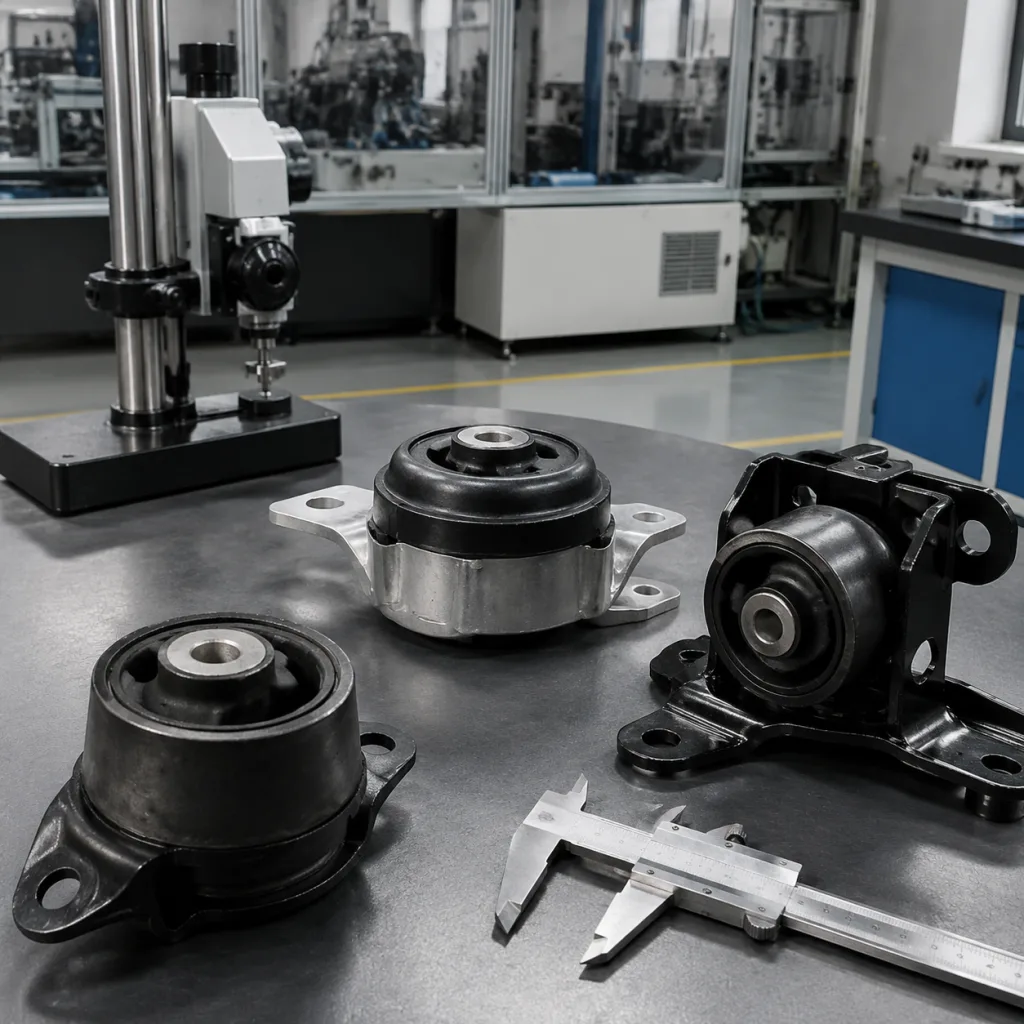
For a repair chain or fleet workshop, the invoice combines the mount, labour, diagnosis, and related hardware. The component may be a conventional rubber-metal mount, a hydraulic mount, or an electronically controlled active mount. Each design has a different material cost, validation requirement, access challenge, and failure mode.

Common cost drivers include:

  • Mount type: rubber-metal mounts are usually less expensive than hydraulic or active mounts.
  • Vehicle packaging: transverse engine layouts often require less access time than tightly packaged longitudinal platforms.
  • Labour rate: workshop rates vary widely across the US, EU, UK, Canada, Australia, Brazil, and other major repair markets.
  • Replacement quantity: one failed mount can overload the remaining engine and transmission mounts.
  • Fasteners and brackets: torque-to-yield bolts, corroded brackets, seized hardware, and subframe access can increase the job time.
  • Diagnostic time: vibration, clunking, and driveline movement can overlap with axle, exhaust, suspension, or misfire symptoms.

For B2B procurement, the important question is not only the repair price paid by the end customer. It is whether installed performance is repeatable across thousands of repairs. A mount that bolts in correctly but transmits excess idle vibration can trigger labour claims, customer complaints, catalogue distrust, and technician resistance to the product line.

Typical Cost Structure for Repair Networks

Actual prices depend on local labour rates, vehicle mix, and workshop process, but the cost structure is consistent. Procurement teams should separate component cost from total installed cost before comparing suppliers.

</tr></thead><tbody> </tbody></table>A low purchase price can be offset quickly if a technician has to remove and reinstall the mount. For example, a part that saves a few dollars on the buying side but causes one rework event per 100 repairs can materially change category profitability. Buyers should model warranty labour as a cost line, not as an after-sales issue disconnected from sourcing.

A practical internal cost model should include unit price, inbound freight, duty, packaging, inspection cost, fill rate, warranty allowance, and technician rework time. For imported components, lead-time stability also belongs in the calculation. Stockouts can force emergency buying, split shipments, or substitution with slower-moving brands that reduce margin and service consistency.

Part Quality Factors That Affect Installed Cost

Engine mounts appear simple, yet small changes in material, geometry, and process control directly affect NVH performance and service life. A supplier evaluation should cover rubber compound control, metal surface preparation, adhesive process discipline, fixture accuracy, and final inspection.

Cost element Low-complexity rubber mount Hydraulic mount Active or electronically controlled mount
Relative part costLowMediumHigh
Labour sensitivityMediumMedium to highHigh
Common added itemsBolts, bracket bushingsBolts, fluid leak checksElectrical checks, scan time
Return risk if quality is poorNoise and vibrationCollapse, leakage, vibrationFault codes, vibration, poor damping
Procurement focusDimensional fit, rubber hardness, bondingDamping curve, leak resistance, bondingElectrical interface, damping, calibration match

</tr></thead><tbody> </tbody></table>For conventional rubber-metal mounts, buyers often request Shore A hardness windows such as ±5 points around the engineering target. Bonding quality should be supported by documented surface cleaning, primer application, adhesive cure time, moulding temperature, and lot-level inspection. For hydraulic mounts, leak testing and damping consistency are critical because fluid loss may not be visible during incoming checks.

Relevant management systems include IATF 16949:2016 and ISO 9001:2015. Material compliance may require REACH (EC) No 1907/2006 declarations for EU supply chains. These standards do not replace part validation, but they provide a framework for traceability, corrective action, supplier control, and process discipline.

When Replacement Scope Changes the Budget

A single visible failure does not always define the correct repair scope. Engine mounts work as a system with transmission mounts, torque struts, brackets, and fasteners. When one mount collapses, the driveline can rotate farther than intended and accelerate wear in adjacent mounts.

Repair networks should give technicians clear inspection rules:

  • Check engine movement under light load and reverse engagement.
  • Inspect rubber cracking, separation, fluid leakage, and metal bracket deformation.
  • Verify exhaust clearance, axle angle, hose tension, and fan shroud clearance.
  • Confirm fastener condition and follow the vehicle service torque sequence.
  • Recheck idle vibration and shift engagement after installation.

For category managers, stocking strategy should reflect real repair patterns. If a common application frequently requires the engine mount and torque strut together, kit planning can reduce bay time and improve first-time completion. Distributors can also lower avoidable returns by publishing precise fitment notes, supersession guidance, and cross-reference data.

Where OE part-number cross-references are used, they should be treated as fitment identifiers, not approval claims. For example, a catalogue may reference a generic format such as OE 11251… only when applicable fitment data supports it. Driventus is an independent aftermarket manufacturer; brand names are referenced for fitment only.

Sourcing Checks Before Comparing Unit Prices

Before negotiating price, buyers should define the required technical and commercial baseline. Driventus supports aftermarket distributors, OEM/Tier-1 suppliers, and repair chains with engine mount sourcing programmes linked to our catalog, documented quality system, and custom manufacturing capability.

A supplier RFQ should request:

  • Application list, fitment notes, and OE cross-reference data.
  • Drawing or controlled sample confirmation for critical dimensions.
  • Rubber compound specification, hardness target, and allowable tolerance.
  • Bonding process controls and inspection frequency.
  • Hydraulic or active mount test method, where applicable.
  • Production capacity, MOQ, lead time, and export packaging specification.
  • PPAP-style documents where required by the customer programme.
  • Warranty data, corrective action process, and traceability method.

For repair chains, a controlled pilot launch is often more useful than a large first purchase. Select high-volume applications, then track installation time, NVH complaints, returns, and technician notes for 60 to 90 days. For distributors, compare landed cost and claim rate by SKU family rather than judging a supplier on one item. A strong manufacturer should be able to explain price differences in terms of material, process, test scope, tooling condition, order volume, and documentation requirements.

How Driventus Supports Cost Control

Driventus manufactures engine and powertrain components in Taizhou, Zhejiang, with export supply to more than 60 countries. For engine mount programmes, cost control starts with consistent tooling, compound management, bonding discipline, and fitment verification. The commercial objective is stable installed performance, not simply a lower purchase price.

For buyers managing engine mount repair cost across a network, Driventus can support SKU rationalisation, private label packaging, application expansion, and controlled production planning. Programmes may include dimensional inspection reports, material declarations, lot traceability, carton labelling, and shipment planning aligned to distributor replenishment cycles.

The most useful procurement comparison is total category cost:

Quality factor Why it matters Procurement check
Rubber hardnessControls isolation and movement under loadShore A specification with batch records
Bond strengthPrevents rubber-to-metal separationPeel or tensile test records from production lots
Hydraulic fluid sealingPrevents collapse and leakagePressure or leak testing for hydraulic designs
Bracket geometryEnsures bolt alignment and correct engine positionCMM or gauge inspection reports
Corrosion protectionAffects shelf life and field durabilityCoating type and salt spray validation where specified
PackagingPrevents deformation and coating damageExport carton specification and drop-test method

</tr></thead><tbody> </tbody></table>Buyers can share samples, drawings, target applications, or market references for feasibility review. For new programmes, Driventus can evaluate tooling requirements, MOQ, test scope, validation plan, and packaging before quotation.

Frequently asked questions

Labour time is often the largest variable after mount type. A simple rubber mount may be quick to replace, while a hydraulic or active mount in a tight engine bay can require extra removal steps, scan checks, electrical diagnosis, or fastener replacement.

Not always. The decision should follow inspection results, mileage, vehicle use, and mount layout. However, one collapsed mount can overload adjacent mounts, so technicians should inspect the full engine and transmission mounting system before quoting.

Request fitment data, critical dimension checks, rubber hardness records, bonding or leak test evidence, material compliance declarations where required, warranty process details, traceability information, and certification evidence such as IATF 16949:2016 and ISO 9001:2015.

If you are reviewing engine mount sourcing options for a distributor, fleet, or repair chain, share your target SKUs, annual volume, and documentation requirements to [request a quote](/contact.html).

Request a Quote
Procurement metric Why it matters for cost control
First-pass fit rateReduces technician time and installation disputes
Claim rate by SKUIdentifies weak applications before they scale
Lead-time stabilityReduces emergency purchasing and lost sales
Packaging damage rateProtects brackets, coatings, and rubber geometry
Documentation completenessSupports import, audit, and customer approval processes