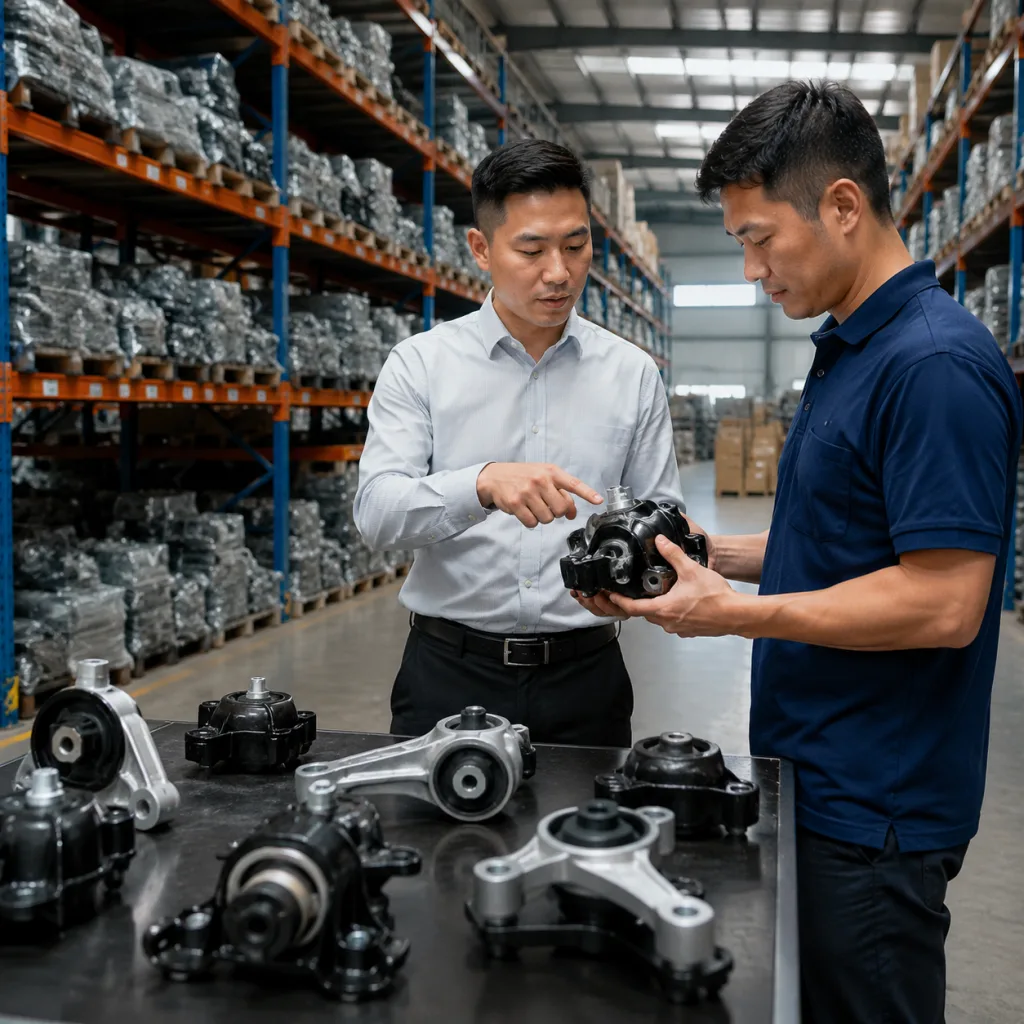
Buying engine mounts for Isuzu applications at wholesale scale is not a catalogue-copy exercise. A mount that looks correct can still put the engine 2 mm too high, preload the rubber in the wrong direction, or move the bracket just enough to create vibration, exhaust contact, or repeat returns. The real cost often appears after arrival: mixed fitment claims, weak cartons, missing batch records, delayed slow-moving SKUs, or warranty files with no usable evidence.
This guide treats an engine mount Isuzu wholesale programme as a sourcing decision, not a generic parts purchase. It covers fitment triage, common supplier failure modes, MOQ and lead-time planning, validation checks, commercial documents, and the way Driventus supports aftermarket importers and distributors. Use it to compare suppliers on the same facts: dimensions, rubber hardness, bonding control, inspection records, packaging, Incoterms, and claim handling.
Driventus manufactures engine and powertrain components in Taizhou, Zhejiang, and exports to 60+ countries for aftermarket distributors, OEM/Tier-1 supply chains, and multi-location repair networks. Driventus is an independent aftermarket manufacturer; brand names are referenced for fitment only.
Start with the fitment decision: which SKUs deserve attention first?
Isuzu applications span N-Series light trucks, D-Max pickups, MU-X SUVs, buses, and industrial diesel platforms. That range creates a trap for wholesale buyers: too many similar-looking mounts, not enough verified application data. The right starting point is not “quote everything.” It is to decide which references justify validation first.
Build the first review around these sorting questions:
Which 20–50 SKUs drive most annual sales or service demand?
Which references have the highest return rate or most fitment complaints?
Which applications differ by market region, chassis, engine, or gearbox?
Which parts are safety- or downtime-sensitive for fleets and repair chains?
Which SKUs can be supplied from existing tooling, and which need development?
Engine position, bracket offset, rubber hardness, bolt size, hole centre distance, and installed height must match the intended application. A 2–3 mm installed-height error or a 1.5–2.0° bracket-angle difference can be enough to cause installation stress, higher idle vibration, driveline interference, or exhaust contact.
For catalogue planning, group engine mounts by:
Vehicle platform and model year range
Engine family and displacement, such as 2.5 L, 3.0 L, 4.3 L, or 5.2 L diesel applications
Left, right, front, rear, or transmission mount position
Rubber-only, rubber-metal bonded, or hydraulic mount construction
Manual or automatic transmission compatibility where relevant
Bolt thread and grade, commonly M10, M12, or M14 depending on application
Market region, because chassis and engine combinations can differ
A usable fitment file should include part number, buyer cross-reference, vehicle application, engine code, mount position, main dimensions, thread size, bracket thickness, and photos from at least six angles. Ask for measurement points such as hole centre distance, stud projection, installed height, rubber body width, bracket offset, and mounting-face flatness. Common control targets are ±0.5 mm for critical hole centres, ±1.0 mm for general bracket dimensions, and ±2–3 Shore A for rubber hardness, unless the buyer drawing states otherwise.
If you have a failed field sample, document the VIN range, engine code, gearbox type, installation position, and mileage at failure. Without that information, the supplier is guessing.
Driventus can support range building from buyer samples, technical drawings, and OE part-number cross-references where supplied by the customer, such as OE 11251… formats. These references are used only to identify fitment targets; we do not claim approval or endorsement by any vehicle manufacturer. Buyers can review related powertrain product groups in our catalog, including engine component programmes where relevant.
A simple A/B/C demand split prevents waste. A-items may justify 300–1,000 pieces per order. B-items may run at 100–300 pieces. C-items may need mixed-shipment consolidation or later development after tooling, packaging, and sales demand are clearer.
Where engine mount suppliers fail: controls to audit before the PO
Most engine mount problems are not mysterious. They usually come from one weak process: unstable rubber compound, poor metal preparation, uncontrolled adhesive application, inaccurate bracket forming, inconsistent cure time, or missing traceability. A nice sample does not prove batch capability.
Engine mounts combine metal forming, welding or stamping, surface treatment, rubber compounding, rubber-to-metal bonding, curing, trimming, inspection, and export packing. Buyers should verify how every lot is controlled, not only how quotation samples are made.
Failure mode to prevent
What to verify
Practical target to discuss
Why it matters
Harsh vibration or soft collapse
Rubber compound, Shore A hardness, tensile strength, elongation, ageing resistance
Hardness commonly 45–75 Shore A depending on position; tensile and elongation per agreed compound sheet
Degreasing, blasting/phosphating, primer/top adhesive, controlled drying and cure time
Reduces early bond failure risk
Mixed geometry within one batch
Dimensional inspection process
First-piece, patrol, and final checks; gauges for repeated SKUs
Supports consistent fitment
Unusable warranty investigation
Batch number, inspection record, production date
Lot code on carton and/or product label linked to compound and cure batch
Enables root-cause analysis
Transit damage or picking errors
Carton strength, pallet loading, label accuracy
Export carton 5-ply where needed; agreed pallet height and weight
Protects parts and warehouse efficiency
</tr></thead><tbody> </tbody></table>For bonded mounts, the normal process should cover cutting or stamping, deburring, welding where required, surface cleaning, shot blasting or phosphating, adhesive application, drying, rubber loading, mould curing, trimming, coating inspection, and final packing. Ask whether the supplier records rubber mixing batch, adhesive batch, curing temperature, curing time, and mould number. If those records are missing, a future field issue becomes opinion rather than analysis.
Driventus operates under IATF 16949:2016 and ISO 9001:2015 management frameworks. For export markets, documentation may also need to consider REACH (EC) No 1907/2006 requirements for chemical substances in articles. Confirm required declarations, test summaries, or material statements before mass production starts.
A useful audit is evidence-based. Review incoming material inspection, rubber mixing records, mould maintenance, bonding-line controls, calibration, storage conditions, and nonconforming product handling. Ask for inspection forms, batch records, calibration certificates, curing parameters, retained samples, and corrective action examples. Check calibration validity for calipers, height gauges, hardness testers, torque tools, and any pull or compression fixtures.
MOQ and lead time: a planning sequence that avoids dead stock
MOQ is not a number the supplier invents at random. It is shaped by tooling status, rubber compound, bracket stamping, surface treatment, packaging, label control, and production setup. The mistake is treating all references alike.
Use this sequence before committing an engine mount Isuzu wholesale order:
1. Share the SKU list, target market, annual forecast, samples or drawings, and packaging requirements. 2. Ask the supplier to mark each SKU as stock, existing-tooling production, sample-confirmation needed, or new development. 3. Separate fast movers from slow references. 4. Request tier pricing by SKU, not only one total order value. 5. Approve samples, dimensions, hardness, packaging, and labels before mass production. 6. Lock the rule for delayed SKUs: partial shipment, revised schedule, approved substitute, or full consolidation.
As a planning guide, mature existing-tooling SKUs may start from 100–300 pieces per reference. Slower references may need consolidation to reach a shipment MOQ. New-tooling items may require 300–1,000 pieces or a tooling contribution, depending on bracket complexity and mould cavities. Private-label cartons, special barcodes, inner boxes, pallet labels, or custom packing layouts can raise MOQ because printing, label control, and packing-line setup must be planned together.
Lead time should be discussed by SKU group:
Confirmed stock: often 3–10 working days if packaging and documents are standard
Existing-tooling production: commonly 25–45 days after deposit and artwork approval
New development: typically 45–90 days for drawing confirmation, mould construction, trial production, dimensional review, rubber checks, and sample validation
Sample timing needs the same clarity. If tooling exists, samples may take 7–15 working days after technical confirmation. If a private mould or bracket fixture is needed, first samples may take 30–60 days. Define the number of samples per SKU: usually 2–5 pieces for dimensional and packaging review, with more if vehicle fitment, destructive adhesion testing, or heat-age testing is required. Put sample cost, freight, refund policy, and approval validity in the quotation.
A small order with many low-volume references can take longer than a larger order concentrated on mature SKUs. Each reference still requires setup, inspection, labelling, and packing control. Buyers sourcing for tenders, fleet maintenance, seasonal demand, or distributor launches should reserve capacity early and confirm inspection points before production starts.
Price logic should be transparent. Unit price can move with rubber grade, bracket weight, coating, order quantity, carton type, inspection level, and Incoterms. Ask for tier pricing at 100, 300, 500, and 1,000 pieces where relevant, plus separate tooling, packaging, and test costs. A neutral bulk-packed mount is not the same commercial product as a private-label item with inner box, barcode, colour carton, pallet label, and 100% label scan.
Acceptance testing: the minimum proof before a wholesale release
You do not need a full vehicle manufacturer validation programme for every aftermarket mount. You do need a written approval plan. It should name the SKU, revision level, sample quantity, reference drawing or sample, and exact acceptance criteria.
For an engine mount Isuzu wholesale programme, the first-release checklist should include:
Visual inspection for cracks, flash, exposed metal, coating defects, and incomplete bonding
Dimensional check against drawing, approved sample, or buyer-provided reference part
Shore A hardness check at defined rubber locations, commonly nominal ±3 Shore A unless otherwise specified
Static load or compression check for selected critical references, using agreed load, displacement, and recovery criteria
Rubber-metal adhesion verification by agreed method, including required failure mode where relevant
Heat ageing comparison before and after defined exposure, such as 70°C for 72 hours or another buyer-approved condition
Salt spray or coating review where corrosion resistance matters, such as 48–96 hours for routine export checks or longer by agreement
Packaging drop or compression review for long-distance container shipment
Record the method name, sample quantity, acceptance criteria, and retention sample process. Do the same for dimensional reports: tolerances, measurement points, tools used, and inspection frequency should be clear. For high-volume SKUs, buyers often request first-piece inspection, patrol inspection every defined quantity or time interval, and final random inspection to AQL or buyer-specific rules.
Defect classification avoids arguments at the end of production. Critical defects may include wrong mount position, wrong bracket geometry, separated rubber-metal bond, missing stud, or unsafe weld. Major defects may include out-of-tolerance hole centres, wrong hardness, coating gaps, wrong label, or damaged packaging. Minor defects may include small cosmetic marks that do not affect fitment or function.
Retention samples are valuable because engine mount disputes often depend on physical comparison. Keep at least one approved sample for important SKUs. The supplier should keep a matching sample from the same approval lot where feasible. Define whether approval applies to one order, one batch, or continuing production under controlled conditions. If rubber hardness, bracket thickness, adhesive, coating, mould, or packaging changes, the buyer should be notified before shipment.
ISO 9001:2015 supports documented process control and record retention. IATF 16949:2016 adds automotive-specific expectations for risk management, traceability, change control, and defect prevention.
Driventus can support dimensional reports, material confirmation, batch inspection summaries, and retained sample comparison. For projects requiring bracket changes, rubber hardness adjustment, or private moulds, buyers can discuss custom manufacturing before order confirmation.
Commercial Q&A for importers comparing engine mount quotes
Why is one quotation cheaper than another? Maybe the supplier is efficient. Or maybe the quote assumes thinner brackets, a different rubber compound, weaker coating, bulk packaging, reduced inspection, or no private-label control. Price comparison only works when the basis is identical.
A reliable comparison sheet should show unit price, MOQ per SKU, shipment MOQ, tooling cost, sample cost, carton type, estimated gross weight, lead time, payment terms, Incoterms, inspection level, and included documents. Common shipping terms include EXW, FOB Ningbo/Shanghai, CIF, or DAP where available.
What should be confirmed before supplier approval?
SKU list includes fitment notes and buyer-supplied cross-reference data
MOQ is stated by SKU and by shipment
Sample policy defines charge, freight, timing, and approval validity
Lead time is split between sample, production, inspection, and shipment readiness
Quality documents are agreed before production, not requested after dispatch
Warranty process defines photos, batch code, installation notes, and return handling
Supplier confirms independent aftermarket status for brand reference use
Do different sales channels need different documents? Yes. EU, UK, US, Canada, Australia, and Brazil buyers often have different documentation and packaging expectations. Distributors may need mixed-SKU consolidation. Repair chains may prefer scheduled replenishment. Fleet maintenance suppliers usually prioritise stable repeat references. OEM/Tier-1 channels may request PPAP-style documents or additional audits. Driventus can align quotation format and inspection documents with the purchasing channel through its quality system.
What export details should not be left until shipment week? Confirm carton markings, country-of-origin requirements, HS code review responsibility, pallet treatment requirements where applicable, and document timing for customs clearance. The basic document set may include commercial invoice, packing list, bill of lading or airway bill, certificate of origin where required, and agreed quality records.
Packaging should be measurable: pieces per inner box, pieces per master carton, carton dimensions, maximum carton weight, pallet size, pallet height, stretch film, corner protection, and label position. Heavy mounts should usually stay within a practical manual-handling master-carton weight, often 15–25 kg, to reduce warehouse damage and labour complaints.
How should warranty claims be handled? Engine mounts can fail or appear to fail because of installation method, engine condition, accident damage, oil contamination, or related chassis wear. A fair claim process needs photos, batch codes, application details, installation notes, mileage, purchase invoice, and sample return rules where required. Agree whether credit, replacement, repair analysis, or joint inspection applies after a claim is accepted. The claim window should match the sales channel and local legal requirements, but evidence requirements should be fixed before the first shipment.
A Driventus programme scenario: from SKU list to repeat order
A practical Driventus project usually begins with a messy file: buyer part numbers, a few OE-style references, mixed vehicle notes, packaging requests, and a target price. The first task is to turn that file into a controlled sourcing plan.
Driventus manufactures engine and powertrain components in Taizhou, Zhejiang, with export experience across more than 60 countries. For engine mounts, our role is to support wholesale buyers with controlled production, clear documentation, and practical range development rather than broad claims.
A typical programme moves through four stages:
1. List review. The buyer sends SKU list, annual forecast, target market, packaging requirement, sample status, required certificates, and critical dimensions or warranty concerns. 2. SKU classification. Driventus separates the list into available items, items requiring sample confirmation, items needing new tooling, and items better held for later development. 3. Technical and commercial alignment. Available references are reviewed for MOQ, lead time, carton configuration, and inspection records. Development references are reviewed for sample quantity, drawing confirmation, tooling ownership, target hardness, bracket material, coating, validation plan, and expected first-order quantity. 4. Release and repeat baseline. Once samples, labels, documents, and packaging are approved, the order has a defined baseline for future repeat production.
Support can include:
Existing aftermarket engine mount supply where tooling is available
Development from buyer sample, drawing, or approved reference part
Rubber hardness and bracket dimensional checks for agreed references
Batch traceability and inspection records
Neutral or buyer-specific packaging, subject to MOQ and artwork approval
Mixed-container planning with other engine and powertrain components
Export documentation aligned with destination market requirements
For an engine mount Isuzu wholesale programme, the most efficient enquiries include application notes, annual forecast, target market, packaging style, required documents, and buyer-supplied references or samples. If a target price is included, pair it with target quantity and specification. Otherwise, it is impossible to know whether the price assumes a different compound, coating, packaging, or inspection level.
Driventus is an independent aftermarket manufacturer; brand names are referenced for fitment only. We do not state or imply vehicle manufacturer approval, endorsement, or sponsorship. Procurement teams comparing suppliers can request a quote with a structured SKU list, forecast, target market, and packaging requirements.
Frequently asked questions
Send the part list, vehicle applications, mount position, annual forecast, required packaging, destination country, and any buyer samples or drawings. Include quantity targets by SKU, preferred Incoterms, sample needs, and required documents. If you use OE-style cross-references such as OE 11251…, include them as buyer-supplied fitment references only.
Yes. Driventus can review buyer samples, drawings, or approved references for custom manufacturing. Feasibility depends on bracket complexity, rubber specification, tooling needs, MOQ, and validation requirements agreed before development starts. Existing-tooling samples may be faster, while new tooling commonly requires drawing confirmation, mould build, trial samples, and buyer approval.
No. Driventus is an independent aftermarket manufacturer; brand names are referenced for fitment only. We do not claim approval, endorsement, or sponsorship by any vehicle manufacturer.
For a structured quotation, share your SKU list, forecast, sample status, target MOQ, Incoterms, quality documents, and packaging requirements with the Driventus team. Start a procurement review at /contact.html