Camshaft for Citroen C3 OE Equivalent Sourcing Guide
A camshaft for Citroen C3 OE equivalent program fails or succeeds on small details: journal clearance, lobe profile, timing reference angle, oil-feed alignment, surface hardness, and shipment protection. Model name is not enough. Citroen C3 applications span different engine families, market emissions setups, petrol and diesel variants, and sensor layouts, so buyers need an engineering-led approval path before releasing a part to distributors or repair-chain tenders. A 0.03 mm journal error can disturb oil film. A 0.5° timing-feature shift can trigger cam/crank correlation issues. A rough lobe finish can shorten follower life after cold starts. This guide turns those risks into sourcing checks for importers in the EU, UK, North America, Australia, Brazil, and other aftermarket markets. Driventus manufactures engine and powertrain components in Taizhou, Zhejiang, under IATF 16949:2016 and ISO 9001:2015 controls. Driventus is an independent aftermarket manufacturer; brand names are referenced for fitment only.
Start with the decision: can this camshaft really replace the OE function?
OE-equivalent does not mean vehicle-maker approval or endorsement. It means the replacement camshaft can perform the same mechanical function in the target engine family without changing mating parts, calibration assumptions, or service procedures.
Use this decision sequence before listing a camshaft for Citroen C3 OE equivalent programs:
1. Identify the exact engine family. Confirm engine code, production year, valve train layout, timing drive, emissions configuration, and camshaft position sensor design. 2. Match the physical architecture. Check overall length, journal count, journal spacing, thrust arrangement, oil-feed layout, timing slot or dowel position, and sensor reference features. 3. Measure the working geometry. Compare base circle, nose height, calculated lift, ramp form, lobe phasing, and runout against a drawing or approved master sample. 4. Confirm the surface system. Validate material route, heat treatment or chilling process, lobe hardness, journal finish, thrust-face finish, and oil-passage cleanliness. 5. Lock the application data. Release catalog information only after the part is tied to verified engine-code and interchange logic, not just to the Citroen C3 model name.
Critical fitment points deserve hard limits, not visual judgement:
Overall length and journal spacing: Match the cylinder-head bearing positions; overall length is commonly controlled within ±0.20 mm, and journal spacing within ±0.05 mm where the drawing requires it.
Journal diameter and roundness: Measure every bearing journal. Typical aftermarket control targets are ±0.010–0.015 mm on diameter and ≤0.005 mm roundness, with final clearance agreed against the mating head or bearing specification.
Lobe lift and base circle: Compare base circle, nose height, and calculated lift. Common approval limits are ±0.03 mm on lift and ±0.02 mm on base circle when the OE sample is stable.
Timing slot, dowel, or sensor reference feature: Verify angular position with a dedicated fixture. ±0.5° cam angle is a practical target, but buyer drawings override generic limits.
Thrust face width and finish: Define end-float and surface finish with the mating thrust arrangement, rather than accepting a polished appearance.
Oil-feed hole location: Confirm position, chamfer, burr removal, and passage cleanliness during final inspection.
The common sourcing mistake is approving from a vehicle model and a photo. Citroen C3 has multiple engine variants and regional configurations. Cross-referencing should use verified application data, sample measurement, VIN or engine-code logic where available, and OE-style reference formats only when they belong to the buyer’s own interchange database. Driventus can support application review through our catalog and engine component range at /products/engine-components.html.
Spec deep-dive: dimensions, material route, and approval gates
The first approval gate is dimensional. The second is process control. A camshaft can match the drawing on one trial sample and still fail in production if the material, hardening, straightening, grinding, or washing process is unstable.
Define the inspection plan before the first shipment. A practical approval file for a camshaft for Citroen C3 OE equivalent project normally includes a marked drawing, master-sample report, critical-to-function dimensions, material specification, hardness data, surface finish records, runout results, and packaging specification.
Check item
Practical target to define before approval
Why it matters
Journal diameter
Drawing or sample nominal, commonly ±0.010–0.015 mm
Controls oil clearance and bearing load
Journal roundness/cylindricity
Typically ≤0.005–0.008 mm where measurable
Prevents local oil-film collapse
Lobe height and lift
Lift commonly held within ±0.03 mm vs approved master
Maintains valve timing and engine output
Base circle
Commonly ±0.02 mm vs master sample
Controls lifter preload and noise
Runout
Usually ≤0.03 mm total indicator reading on supported journals
Reduces vibration, noise, and uneven wear
Surface roughness
Journals often Ra 0.2–0.4 µm; lobes often Ra 0.3–0.8 µm
Supports oil film retention and wear resistance
Hardness
Chilled or hardened lobe surface commonly 50–60 HRC equivalent, by route
Prevents early lobe scuffing
Timing feature position
Dedicated angular fixture, commonly within ±0.5° cam angle
Avoids timing error and fault codes
Oil hole location and burrs
Position checked; burrs removed; passage blown clean
Prevents lubrication restriction
</tr></thead><tbody> </tbody></table>Material route must follow the original design intent and load case. Common camshaft constructions include chilled cast iron, ductile iron, forged or machined steel, and assembled steel. The nominal alloy is only part of the answer. Buyers should also ask how the working surface is created and controlled: chilling depth, induction hardening, heat-treatment batch, straightening method, final grinding, deburring, washing, and anti-rust protection.
A clean approval path is:
1. Receive OE or buyer master sample. 2. Create a measurement report and application review. 3. Freeze critical characteristics and inspection gauges. 4. Cut first articles. 5. Inspect 3–5 pieces from the trial lot. 6. Approve a pilot batch before volume orders.
For serial shipments, use AQL sampling plus 100% visual checks on risk items: oil-hole burrs, slot damage, thread damage, corrosion, impact marks, and packaging condition. For import programs, confirm substance compliance early. REACH (EC) No 1907/2006 may apply to EU supply-chain declarations, while packaging can require market-specific marking or recycling documentation. Material test reports should trace to casting lot or steel heat number, heat-treatment batch, and final grinding lot.
Failure modes that dimensional inspection alone will miss
A camshaft that fits the head can still create a warranty problem. The highest-risk failures often appear after heat, load, oil contamination, poor installation lubrication, or repeated cold starts.
Typical failure modes include:
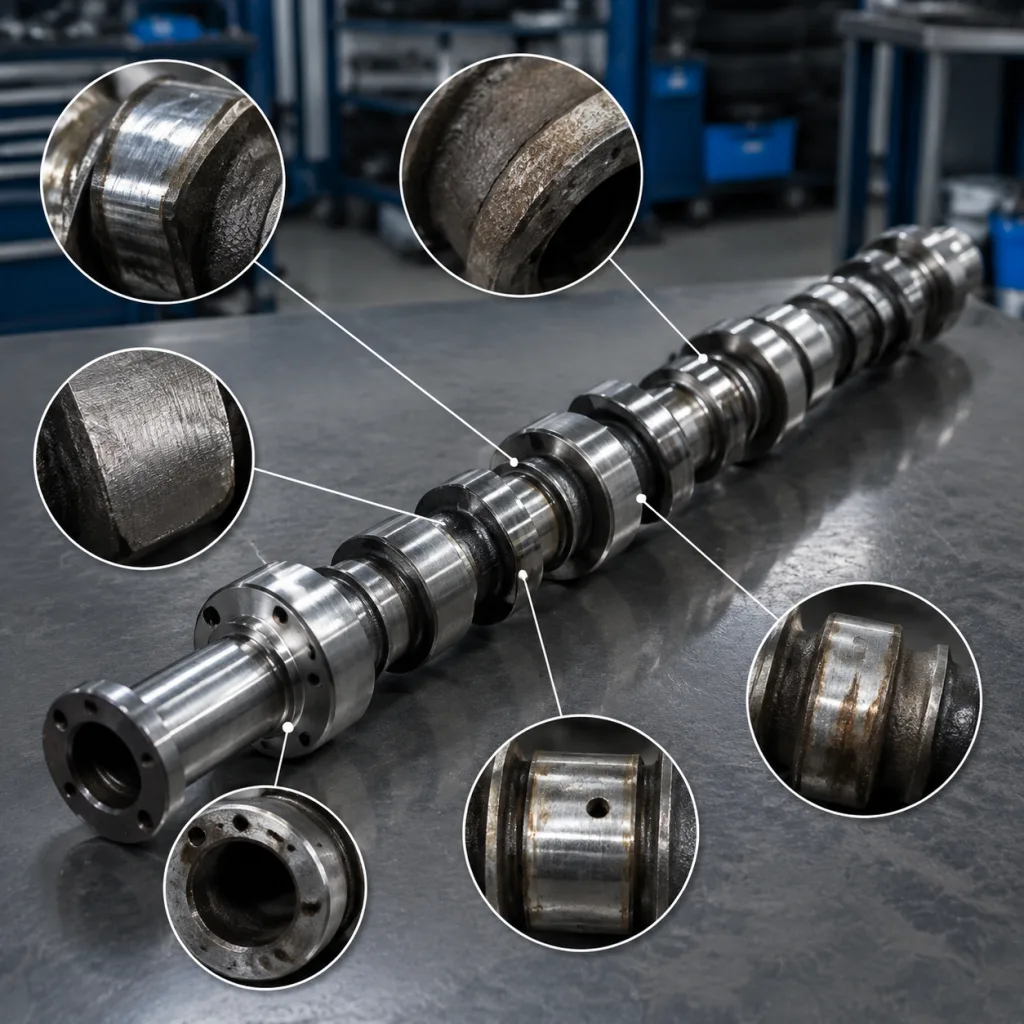
Early lobe scuffing: Usually linked to poor surface hardness, unsuitable surface finish, inadequate lubrication at installation, or mismatch with lifters or followers.
Bearing journal distress: Can come from diameter drift, roundness error, runout, poor oil-feed alignment, contamination, or insufficient washing after machining.
Timing correlation faults: A small angular error in the trigger, slot, dowel, or sensor feature can produce fault codes even when the shaft physically installs.
Valve-train noise: Base-circle deviation, lift variation, ramp mismatch, or excessive runout can change hydraulic lifter preload and operating noise.
Cracking after service load: Casting defects, heat-treatment stress, aggressive straightening, or inadequate crack detection can leave a part vulnerable.
Repeat repair after installation: The camshaft may be blamed when related parts were not replaced, oil passages were dirty, or timing components were incorrectly installed.
Driventus builds validation plans around the application risk and buyer requirements. The plan can include:
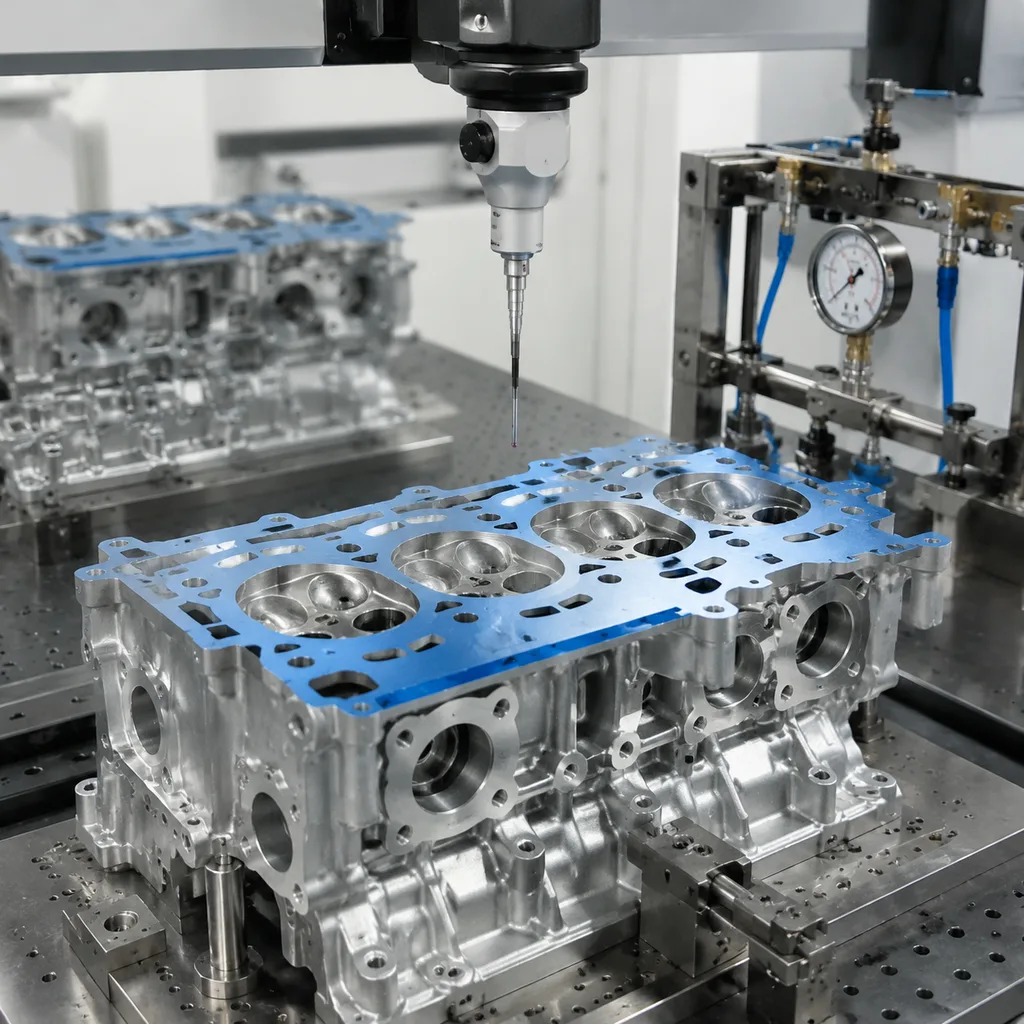
First-article dimensional reporting with calibrated CMM, height gauge, micrometer, roundness tester, cam profile equipment, or dedicated go/no-go fixtures.
Metallographic inspection of the lobe and journal surface layer, including chilled depth or hardened layer confirmation where the process requires it.
Hardness testing on lobes, journals, and thrust faces using HRC, HV, or converted values defined by the material route and drawing.
Magnetic particle inspection or other crack detection after casting, heat treatment, or straightening where applicable.
Cam profile measurement against a master cam or approved drawing, covering base circle, opening ramp, nose radius, and angular location.
Dynamic runout and straightness checks after machining and heat treatment, with re-check after final grinding if straightening is used.
Bench fitment inspection with mating timing components, seals, thrust parts, and sensor trigger parts where supplied.
Oil-passage cleanliness checks, including borescope review or compressed-air verification for cross-drilled holes.
Endurance or application-based testing when required, such as 100–300 hour rig or engine durability cycles for higher-risk launches.
Where valve timing can affect emissions-related engine behaviour, control the replacement part carefully. ECE R-83 is often referenced in the context of vehicle emissions type approval in UNECE markets; a camshaft supplier should not claim vehicle approval unless formally granted through the appropriate approval route. The procurement file should instead show that the replacement camshaft maintains the intended mechanical timing relationship and does not introduce avoidable deviations.
For repair-chain tenders, Driventus can provide inspection summaries, batch traceability, sample review support, and a control plan showing which characteristics are checked by operator, final inspection, and laboratory. A sensible launch rule is simple: hold the first 1–2 shipments under tightened inspection, review installation feedback, then move to normal sampling only after no repeat defect pattern appears.
Documentation checklist: what importers should ask for before rollout
Treat camshafts as critical engine components, even when the unit price looks modest. One defect can create labour claims, repeat repair, engine damage, and private-label warranty exposure. The supplier’s quality system should be verified before commercial rollout.
Driventus operates under IATF 16949:2016 and ISO 9001:2015. These standards support structured process control, risk management, corrective action, calibration, traceability, and continual improvement. Buyers can review our quality system before starting a sourcing project.
Ask for a documentation pack that proves both part conformity and process repeatability:
Company certificates for IATF 16949:2016 and ISO 9001:2015.
Process flow chart covering casting or blank sourcing, heat treatment, straightening, machining, grinding, washing, oiling, inspection, and packing.
Control plan with critical characteristics, gauge type, inspection frequency, reaction plan, and record-retention period.
Critical dimension inspection report, normally 3–5 first-article pieces and agreed AQL sampling for production shipments.
Material certificate or chemical composition report tied to casting lot or steel heat number.
Hardness and microstructure test report, including lobe surface and depth where applicable.
Surface finish, roundness, straightness, and runout data for sampled parts.
Calibration list for micrometers, CMM, hardness tester, roughness tester, profile tester, and angular fixtures.
Packaging drop, vibration, or transport protection review where requested for export cartons.
Batch identification and traceability procedure linking carton label to production and inspection records.
Corrective action format for nonconformity handling, preferably 8D or buyer-approved equivalent.
Distributors should define acceptable quality levels, sampling rules, and warranty-data feedback channels before the first order. For high-volume aftermarket programs, the supplier must be able to isolate batches quickly and review casting lot, heat-treatment batch, straightening record, grinding wheel change, washing line record, anti-rust oil batch, and final inspection record.
Driventus is an independent aftermarket manufacturer; brand names are referenced for fitment only.
Scenario planning: pilot order, replenishment, or custom development?
Commercial sourcing should match the buying scenario. A distributor adding one proven reference does not need the same launch structure as a repair chain converting several regional references into a private-label program.
Scenario 1: existing reference, low launch risk Use a sample approval, confirm application data, place a pilot order of 50–150 pieces, monitor claims for 60–120 days, then move to pallet or container replenishment.
Scenario 2: mixed engine variants Group demand by engine code and shaft design, not by vehicle model. Confirm whether MOQ applies per engine variant, per shaft type, or per shipment. Existing tooling often supports practical MOQs around 100–300 pieces per reference; new development or low-volume variants may need 300–800 pieces to absorb setup, fixture, and inspection cost.
Scenario 3: custom or rationalised program When a buyer wants to consolidate several regional references, use samples, drawings, and target specifications to create one controlled technical baseline. Driventus can review these projects through custom manufacturing.
Key commercial points to lock before purchase order release:
Price logic: Separate blank cost, machining time, heat treatment, inspection level, packaging, and tooling or fixture amortisation. A hardened steel or assembled camshaft may cost more than chilled cast iron because the process is different, not because the part is heavier.
Lead time: Separate tooling or sample lead time from repeat production lead time. First samples are often 30–60 days after sample or drawing confirmation; repeat production is often 35–55 days, plus sea freight, customs, and local receiving time.
Private-label packaging: Confirm label format, EAN/UPC or buyer barcode, carton strength, anti-rust method, inner separators, language requirements, and installation notes.
Application data: Confirm vehicle, engine code, power output, year range, market, timing system, sensor feature, and interchange logic before listing.
Warranty handling: Define claim evidence, including installation photos, oil condition, fault codes, mileage, service date, and whether lifters, followers, and timing components were replaced.
Forecast flexibility: Use a rolling 3-month forecast to reserve material and heat-treatment capacity instead of relying on emergency orders.
Price breaks should follow real production economics, such as 100, 300, 500, and 1,000 pieces. Setup and inspection cost per unit changes sharply at low quantities. Driventus supplies aftermarket distributors, OEM/Tier-1 projects, and multi-location repair chains in more than 60 countries. The strongest sourcing result usually comes from a phased release: sample approval, pilot order, warranty monitoring, then volume purchase.
Export packaging and traceability: the last quality gate
A camshaft can leave the grinding line in specification and arrive unusable. Rust on a journal, a dented lobe, a bent shaft, or debris in an oil passage can turn a correct part into a warranty claim before installation starts.
Write the packaging specification as a quality requirement, not a shipping afterthought:
Anti-rust oil or approved vapour corrosion inhibitor, with protection period defined; export programs commonly specify 6–12 months of indoor storage protection.
Protective sleeves, foam, VCI paper, or separators at journals and lobes so ground surfaces do not touch carton walls or other parts.
Rigid inner support to prevent shaft bending or edge impact; long shafts should be supported at multiple points rather than suspended at the ends.
Moisture-resistant outer cartons, commonly double-wall for export, with gross weight kept within the buyer’s warehouse handling limit.
Individual polybag or VCI wrap where required, plus desiccant for humid routes if packaging trials show condensation risk.
Clear batch code, part number, quantity, production date or lot code, and country-of-origin marking.
Palletisation plan with corner protection, stretch wrap, pallet height limit, and no overhang to avoid carton crushing.
Traceability should connect each shipped carton to the inspection batch. At minimum, retain production date, line or process route, material lot, heat-treatment batch, straightening record, grinding batch, final inspection record, and packing operator or packing date. Many importers require 3–5 years of record retention for warranty and recall support.
This protects both sides. Distributors can contain suspect stock quickly. Repair chains can separate installation-related, lubrication-related, timing-kit-related, and part-related failures. Buyers should also keep catalog wording clean: fitment references identify application compatibility, but listings should not imply vehicle manufacturer endorsement.
Frequently asked questions
Confirm the engine code, production year, valve train type, timing system, camshaft position sensor feature, and any market-specific emissions configuration. Do not rely only on the vehicle model name. A sample, drawing, or verified interchange record should be used before approval, with journal, lobe, timing-feature, and oil-hole measurements checked against the target part.
Request IATF 16949:2016 and ISO 9001:2015 certificates, a process flow chart, control plan, dimensional report, material or chemical composition report, hardness and microstructure data, surface finish and runout checks, packaging specification, and batch traceability records. For EU import, REACH (EC) No 1907/2006 substance declarations may also be required.
Yes. Driventus can review samples, drawings, application data, and buyer specifications for aftermarket or custom production. Validation scope depends on the engine family, target volume, risk level, inspection requirements, and whether the project uses existing tooling or needs new fixtures and process development.
If you are evaluating a camshaft for Citroen C3 OE equivalent supply program, Driventus can review fitment data, samples, target tolerances, MOQ, lead-time requirements, and quality documentation. To discuss availability or development, [request a quote](/contact.html).