Buying Audi-fit connecting rods is not a catalogue-box exercise. The risk sits in microns, cap pairing, bolt clamp load, heat-treatment history, and whether the second shipment matches the first. For distributors, repair chains, and rebuild programmes, a connecting rod Audi aftermarket replacement must hold centre-to-centre length, big-end housing geometry, small-end bore finish, mass balance, and material traceability across repeat lots. This guide gives B2B buyers a tighter way to evaluate independent aftermarket supply: what to define, what can fail, what evidence to request, and how to connect MOQ, lead time, price, inspection, and packaging to real process controls. Driventus manufactures engine and powertrain components in Taizhou, Zhejiang, and exports to 60+ countries under IATF 16949:2016 and ISO 9001:2015 systems. Driventus is an independent aftermarket manufacturer; brand names are referenced for fitment only.
Decision point: what counts as an Audi-fit replacement?
Start with the word “replacement.” For an Audi-fit rod programme, it should mean functional equivalence proven by measurements, not a broad claim of OE approval or vehicle-maker endorsement.
A buyer should define equivalence around the conditions that matter inside the engine:
Centre-to-centre length held to the approved drawing, commonly within ±0.02 mm when deck-height control is tight.
Big-end bore size, roundness, taper, and surface finish after the cap is assembled and bolts are tightened to the inspection torque.
Small-end bore diameter, bushing wall condition, and oil-feed alignment where a bronze or steel-backed bushing is used.
Big-end width and thrust-face finish so side clearance remains compatible with the crankshaft journal stack.
Weight class or controlled mass spread across the set, managed by total weight and small-end/big-end balance rather than total weight alone.
Location features, chamfers, oil holes, cap marks, and orientation marks that help installers avoid assembly errors.
That definition protects both sides. The supplier knows what to make and inspect. The importer knows what evidence to file. The catalogue team can use OE-style references for fitment without implying approval, supply status, or endorsement by the vehicle manufacturer.
Build the sourcing file around application data, internal drawings, OE-style cross references, sample reports, and inspection plans. If a programme uses a generic reference such as OE 06A…, keep it in the fitment file as cross-reference information only. Before accepting samples for a connecting rod Audi aftermarket replacement, approve the drawing revision, inspection torque, matched-set packing rule, and cap-pairing control in writing.
Failure modes hidden in small measurements
Connecting rods rarely fail procurement review because they look wrong. They fail because one controlled feature drifts just enough to affect bearing crush, piston position, oil-film stability, or rotating balance. That is why the specification sheet matters before sample approval.
Specification item
Practical target or control point
Typical control method
What can go wrong if missed
Material grade
40Cr, 42CrMo, C70S6, powder metal, or drawing-specified equivalent
Mill certificate and incoming PMI or chemical analysis
Wrong chemistry can undermine heat-treatment response and fatigue life
Centre-to-centre length
Drawing value, often ±0.02–0.03 mm for machined rods
CMM or dedicated rod gauge
Deck height and compression balance can shift between cylinders
Big-end bore geometry
Bore size to drawing; roundness/taper commonly ≤0.005–0.010 mm where specified
Air gauge, bore gauge, roundness check
Bearing crush, clearance, and oil-film stability can become inconsistent
Small-end bore finish
Diameter to drawing; roughness often Ra 0.2–0.8 µm depending on pin/bushing design
Bore gauge and roughness tester
Wrist-pin fit, lubrication, and noise control can suffer
Rod weight and end-to-end balance
Set spread commonly controlled within 1–3 g, tighter if specified
Strength, ductility, and fatigue resistance may sit outside the intended window
Surface cleanliness
No cracks, folds, burrs, bearing-face nicks, or abrasive residue
Visual inspection, magnetic particle inspection where specified
Cracks can initiate early; debris can contaminate assembly
</tr></thead><tbody> </tbody></table>For a first shipment, use tightened incoming checks: 100% visual inspection, batch dimensional sampling, and full dimensional reporting on 5–10 pieces per lot. Many buyers apply ISO 2859-1 Level II with AQL 1.0 for major defects and AQL 2.5 for minor defects, then reduce to normal inspection only after stable Cpk data, clean nonconformity history, and acceptable warranty returns.
IATF 16949:2016 and ISO 9001:2015 do not set connecting rod dimensions. They show whether the supplier has a system for process control, records, corrective action, nonconforming output, and change management. That system becomes critical when a honing stone wears, a fixture shifts, a bolt torque setting changes, or a cap is mixed with the wrong rod body.
Spec deep-dive: material route, cap control, and machining sequence
The right material is not simply the “strongest” option on a quote sheet. Forged steel, powder metal, and high-strength steel alloys can all be correct, depending on the engine family, bearing design, cap style, bolt system, and original load case. The question is whether the chosen route reproduces the required geometry and fatigue performance consistently.
A robust process should lock down the following controls:
Steel heat number, billet diameter, and incoming chemical analysis before forging or sintering.
Forging temperature, die wear, flash trimming, and grain flow orientation through the beam and big-end transition.
Normalising, quenching, tempering, or other specified heat-treatment steps with furnace charts retained by lot.
Cap separation method, including cracked-cap or machined-cap design where applicable.
Big-end machining after cap installation and bolt tightening, because the bore must be measured in its assembled condition.
Bolt-hole perpendicularity, thread depth, thread cleanliness, and washer-seat flatness.
Bushing press-fit, oil-hole indexing, and final honing for bushed small ends.
Shot peening intensity, coverage, and media control where the drawing calls for fatigue-life enhancement.
Deburring and washing controls so abrasive particles do not remain in oil holes, bolt holes, or bearing faces.
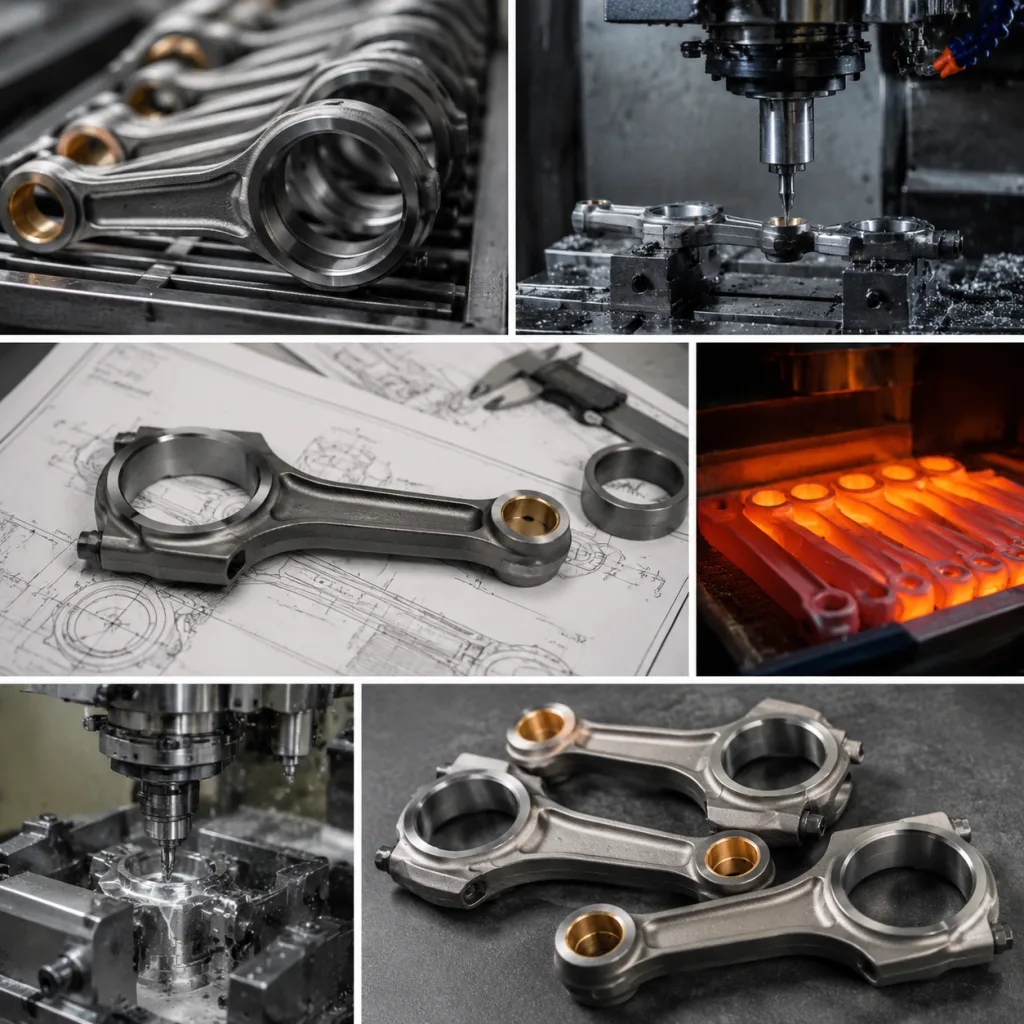
A typical route runs raw material approval → forging or powder forming → heat treatment → shot blasting or surface preparation → rough machining → cap split or cap machining → bolt installation → big-end finish boring/honing → small-end bushing and honing → deburring and washing → hardness and dimensional inspection → anti-rust treatment → matched-set packing. Ask which steps are subcontracted. Heat treatment, surface treatment, and coating are often outsourced, but they still need lot traceability.
Cap control deserves special attention in connecting rod Audi aftermarket replacement programmes. A cap and rod body are a machined pair. If they separate during WIP handling, final packing, or mixed-SKU production, big-end roundness and bearing crush can change even when both pieces look acceptable. Permanent orientation marks, QR or laser lot codes, fixture poka-yoke, and in-process scanning reduce this risk.
Do not release a bulk order because the sample looks clean or the box label lists the right application. Approve the programme in stages, and make each stage produce evidence.
A practical approval path looks like this:
1. Confirm the engine code, application range, OE-style cross references, drawing revision, and inspection torque. 2. Measure 5–10 prototype samples against every critical drawing dimension and record actual values, not pass/fail marks only. 3. Review material certificates showing heat number, chemistry, mechanical properties, and heat-treatment lot. 4. Check hardness by lot on approved test areas that do not damage functional machined surfaces. 5. Verify big-end bore diameter, roundness, taper, and bearing-face width after bolts are tightened to the agreed inspection torque. 6. Verify small-end bore diameter, surface finish, cylindricity, bushing press-fit, and oil-hole position. 7. Weigh each rod and record end-to-end balance for matched sets. 8. Review bolt torque-angle, torque-yield, proof-load, or clamp-load validation where applicable. 9. Request magnetic particle inspection, dye penetrant, or other crack-detection evidence when the application or buyer specification requires it. 10. Run a 20–50 piece pilot lot to check process capability, packing protection, labels, and warehouse handling. 11. Release a controlled first mass-production lot and keep retained samples at both buyer and supplier sites.
Once enough production data exists, request Cpk or Ppk for centre-to-centre length, big-end bore diameter, big-end roundness, and small-end bore diameter. A common rule is to avoid normal replenishment status until critical dimensions show stable capability, for example Cpk ≥1.33 where the tolerance and measurement system support that calculation.
The connecting rod itself is not normally certified under emissions rules such as ECE R-83, which concerns vehicle emissions type approval. Still, rod geometry can influence combustion balance, oil consumption, noise, vibration, and durability. Buyers serving regulated markets should keep traceability records that support conformity reviews and warranty investigation.
Import compliance may also touch the programme. If coatings, preservatives, corrosion inhibitors, VCI materials, or packaging components are used, EU importers should consider REACH (EC) No 1907/2006 declarations and supplier documentation where relevant.
Audit scenario: one bad rod in the warehouse
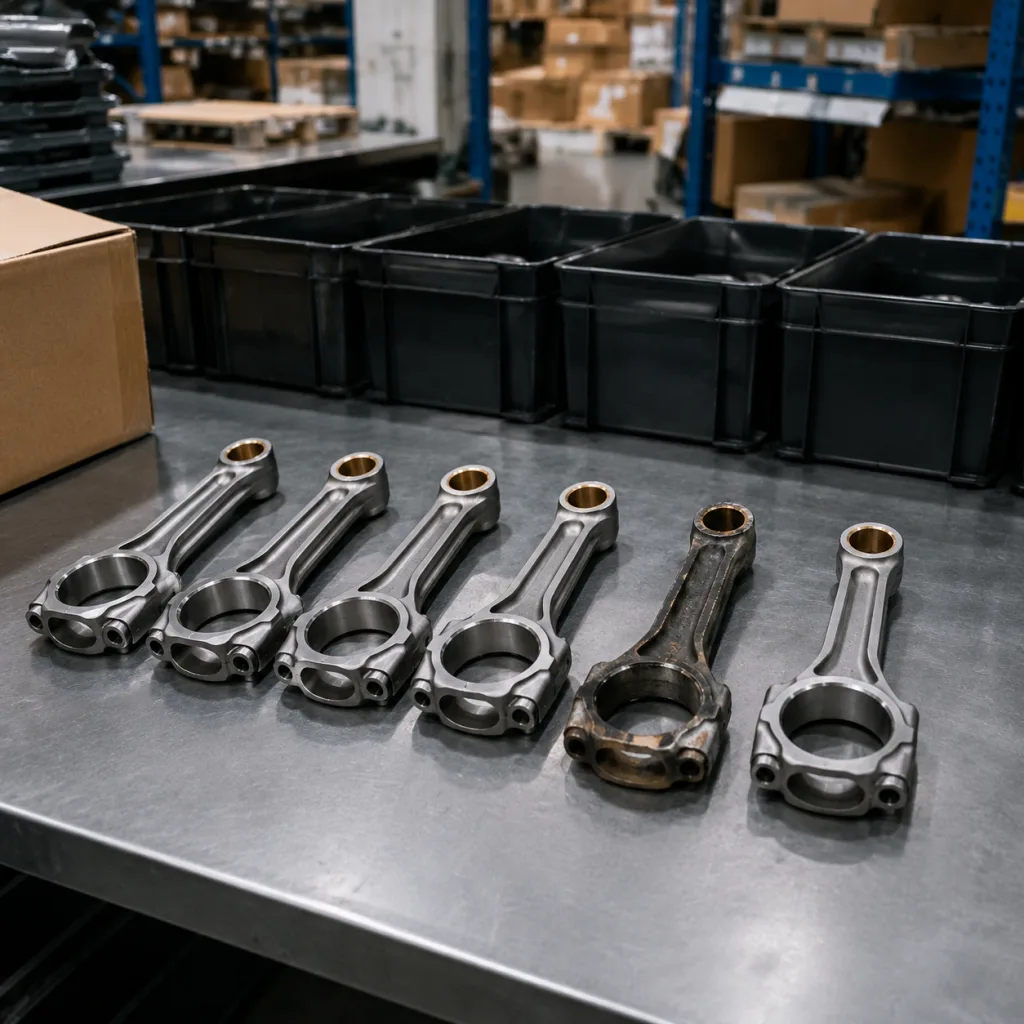
Imagine a distributor finds one rod with an out-of-round big end during incoming inspection. The commercial question is not only whether the supplier will credit the part. The real question is whether the supplier can contain the lot.
A strong supplier should be able to identify:
Steel heat, forging batch, heat-treatment batch, and machining date.
Bolt lot, bushing lot, coating or anti-rust batch, and final inspection record.
Operator station, fixture, measuring device, calibration status, and inspection torque used for the affected dimension.
Other cartons, pallets, SKUs, or customers connected to the same production lot.
Whether any material, tooling, heat-treatment, machining, bolt, bushing, coating, packaging, or inspection change occurred since approval.
Put these controls in the supply agreement, not only in the purchase order. Include approved drawing revision, master sample status, written change-notification rules, lot-level traceability, AQL definitions for critical/major/minor defects, and clear rules for sets, single rods, bolts, bushings, installation notes, and replacement-bolt policy.
Packaging and warehousing need the same discipline. Define rust prevention method, oil or VCI type, expected shelf life, label language, barcode symbology, carton labels, pallet labels, and mixed-SKU pallet rules. A reasonable export-protection target is often 12 months when packaging remains sealed and dry, but humid markets and long sea freight may require stronger protection.
Driventus operates under a documented quality system aligned with IATF 16949:2016 and ISO 9001:2015. For importers, that framework supports APQP-style review, control plans, corrective actions, change control, and production part traceability.
Repair chains should add field feedback. Track failures by engine code, mileage after installation, installer location, oil condition, bolt reuse status, and bearing condition. This separates product issues from assembly errors and gives the supplier enough evidence for 8D corrective action instead of a simple credit note.
Buyer Q&A before issuing the purchase order
What application data should be locked first? Confirm engine application, fuel type, engine code, displacement, power output, and production-year range. Treat OE-style references as fitment information, not approval evidence.
Which technical items belong in the PO pack? Approved drawings, tolerances, inspection torque, measurement method, inspection frequency, matched-set rules, mass variation limits, cap-pairing control, and retained-sample requirements.
Are bolts included? Confirm whether bolts are supplied, whether they are single-use by design, and whether installation torque data is available for professional use. Bolt assumptions can change both price and field risk.
What packaging prevents damage? Specify VCI bag, oil paper, sealed PE bag, divider protection, carton drop resistance, and protection for big-end faces, bolt threads, and machined side faces. Connecting rods are dense precision parts; carton damage can become surface damage.
How should MOQ be discussed? For catalogue rods using existing tooling, buyers often negotiate by SKU, engine set, or consolidated order value. A practical planning range is 100–300 pieces per SKU or 25–75 four-cylinder sets, depending on material, packaging, and production schedule. New or modified designs may require tooling, gauges, fixtures, and higher MOQ because setup costs must be spread across the lot.
What drives price? Steel grade, forging or powder-metal route, bolt specification, bushing type, shot peening, inspection level, matched-set balancing, packaging, and order quantity. Ask the supplier to separate sample cost, tooling or gauge cost, volume-break unit price, packaging cost, inspection surcharge, Incoterms, and quote validity.
What lead time is realistic? Existing catalogue SKUs may be sampled in about 7–15 days if stock or semi-finished parts are available. First mass production often needs 30–60 days. New drawings or special tolerances can extend to 60–90 days because fixtures, gauges, pilot production, and validation reports must be completed before release.
What should the final sourcing file contain? For a connecting rod Audi aftermarket replacement project, combine fitment data, dimensional inspection, metallurgical records, process controls, MOQ logic, packaging rules, and replenishment planning. Buyers can review available references in our catalog and request a quote with engine code, annual volume, target market, inspection requirements, target price range, Incoterms, and packaging format.
Frequently asked questions
Verify centre-to-centre length, big-end bore size and roundness, small-end bore size, rod width, bolt specification, and set weight balance. These dimensions affect bearing crush, piston position, and rotating assembly balance. Fitment references should always be supported by inspection data and the agreed drawing tolerance.
Yes. For repair chains and engine rebuilders, matched-set packing is recommended. The supplier should control total rod weight and end-to-end balance, keep caps paired with their original rod bodies, mark each rod in the set, and provide inspection records by lot.
No. IATF 16949:2016 certifies the quality management system, not a specific connecting rod design. Buyers still need drawing approval, material evidence, dimensional reports, process controls, and validation records for the selected application.
For application matching, sample review, or bulk supply planning, share the engine details, annual demand, target market, target price range, Incoterms, packaging format, and inspection requirements with Driventus. Our team can review the sourcing file and respond through /contact.html.