Engine Mount GMC Supplier: Sourcing Guide for B2B Buyers
If you source engine mounts for GMC applications, the main risk is not finding a part — it is finding one that stays consistent across batches, fitments, and delivery cycles. A dependable supplier should control dimensions, support OE cross-references, and provide the documents procurement and quality teams expect. In aftermarket, wholesale, and repair-chain supply, catalogue fit is only the starting point. Buyers also need clarity on material grade, bond construction, bracket finish, packaging, and how the part performs against real failure patterns. Driventus is an independent aftermarket manufacturer; brand names are referenced for fitment only. For related parts, see [our catalog](/products.html) and [our quality system](/quality.html).
Start with the fitment decision
Before you compare prices, lock down the fitment scope. For an engine mount programme, the first questions are vehicle year, engine code, drivetrain, and mounting geometry. If any of those are loose, sourcing errors tend to show up later as returns, noise complaints, or installation delays.
Minimum buyer checklist
OE cross-reference: for example, `OE 15220655` where applicable
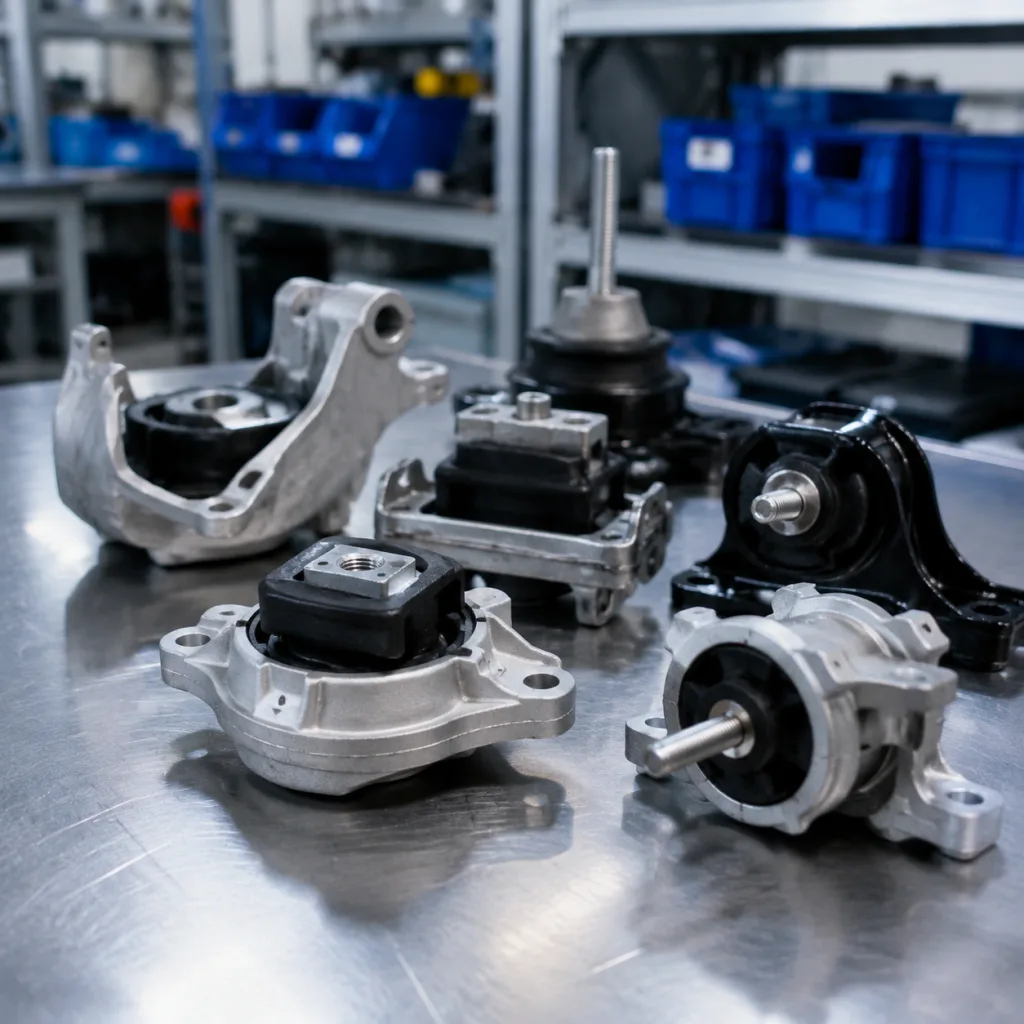
Mount type: hydraulic, elastomer, or torque mount
Bracket finish: zinc-plated, e-coated, or painted steel
Rubber hardness: typically specified by Shore A range
Insert and bond details: steel-to-rubber adhesion method
Packaging standard: bulk, labelled carton, or barcode pack
If the same reference spans several platforms, ask for an application matrix instead of a single line item. It is the fastest way to avoid substitution mistakes.
Compare suppliers by risk, not promises
A strong engine mount supplier should reduce operational risk, not just quote quickly. The useful comparison is less about brochure language and more about whether the factory can repeat the same result under ongoing order pressure.
Procurement item
What to confirm
Certification
`IATF 16949:2016` and `ISO 9001:2015`
Material traceability
Rubber compound batch, steel lot, and cure record
Tolerance control
Hole spacing, stud position, and bracket alignment
Compliance file
`REACH (EC) No 1907/2006` declaration where required
Validation data
Static load, vibration, and durability test records
Supply terms
MOQ, lead time, and packing specification
</tr></thead><tbody> </tbody></table>When you are shortlisting, ask for recent audit evidence and a corrective-action summary. The quote is easy; the repeatability is what protects landed cost.
What failure modes should the buyer watch for?
Engine mounts usually fail in predictable ways, and that is exactly why sourcing teams should ask about them early. Common issues include rubber separation, bracket distortion, excessive softness, poor bonding, and corrosion at exposed metal surfaces.
These problems are not cosmetic. They can create vibration complaints, steering shake, or premature replacement claims. In some cases, the part fits but still performs badly because the compound, cure profile, or steel interface was not controlled tightly enough.
Failure-mode checks to request
Rubber adhesion inspection after cure
Dimensional control on stud position and bracket alignment
Static load and deflection review
Corrosion resistance review for coated metal parts
Visual control for flash, voids, and distortion
Batch traceability for compound and steel inputs
If a supplier cannot explain how it handles drift, do not assume the sample result will hold in mass production.
Where Driventus fits in the programme
Driventus supports aftermarket and private-label engine mount supply from a vertically integrated manufacturing base in Taizhou, Zhejiang. That matters because compound selection, metal processing, bonding, and final inspection stay aligned inside one production chain.
Our programmes are designed for:
Aftermarket distributors and wholesalers
OEM / Tier-1 supply chains
Multi-location repair networks
If a project needs a new fitment or a regional part consolidation, custom manufacturing can align dimensions, label format, and carton requirements. For related engine and powertrain parts, you can also review products.
Validate the part before you release volume
Buyers should ask how the mount was validated before order release. For vehicle-mounted components, acceptance usually depends on dimensional inspection plus mechanical durability, not catalogue appearance alone.
Typical verification points include:
Dimensional check against drawing or sample master
Static load and deflection review
Vibration and fatigue screening
Rubber adhesion inspection
Corrosion resistance review for coated metal parts
Visual control for flash, voids, and bracket distortion
Where programme requirements call for road-weather durability, align the test plan with published methods such as `SAE J2527` for accelerated exposure, and document any customer-specific limits separately. The part itself is not governed by `ECE R-83`, but that reference is sometimes used in adjacent compliance discussions; keep those scopes separate in the supply file.
Use commercial terms to filter weak suppliers
MOQ and lead time should be discussed alongside the technical file, not after it. A low unit price can become expensive if the supplier cannot hold a stable production slot or if packaging causes transit damage.
Practical commercial questions
What is the standard MOQ for stocked and non-stocked references?
What lead time applies after sample approval?
Can the supplier support mixed-line packing for catalogue consolidation?
Is there a re-test trigger after compound or tooling changes?
What is the escalation path for dimensional drift or early field return?
If your team needs a new private-label range, keep the brief clear on target markets, annual volume, and label language. That shortens approval cycles and lowers the chance of packaging rework.
Frequently asked questions
No. We supply engine mount programmes across multiple vehicle applications, with GMC fitments covered through OE cross-reference and application matching. Driventus is an independent aftermarket manufacturer; brand names are referenced for fitment only.
Typical documents include material declarations, dimensional reports, PPAP-style records when required, and certification evidence for `IATF 16949:2016` and `ISO 9001:2015`. Buyers can also request REACH-related declarations.
Yes. We support private-label and custom manufacturing projects for distributors and repair networks. Use the required packing, barcode, and carton specifications at the start of the enquiry.
If you are building a GMC engine mount programme, send your fitment list, target volume, and packaging needs. Use [request a quote](/contact.html) to start the review.