Camshaft for Hyundai i30 OE Equivalent: Sourcing Guide
For B2B buyers, a camshaft for Hyundai i30 OE equivalent is not a generic replacement. It has to match the engine code, cam position, timing geometry, journal dimensions, trigger features, and surface treatment closely enough to perform like the original part in service. Driventus supplies engine components for buyers who need dimensional control, material traceability, and repeatable packaging for distribution or workshop supply. Driventus is an independent aftermarket manufacturer; brand names are referenced for fitment only. Before placing repeat orders, confirm the OE cross-reference, valve-train layout, and market variant. The same discipline applies whether the order is for resale, repair-chain demand, or export stocking. This guide breaks down the decision points buyers should use to qualify an OE-equivalent camshaft, compare suppliers, and reduce avoidable returns.
Which spec details decide OE equivalence?
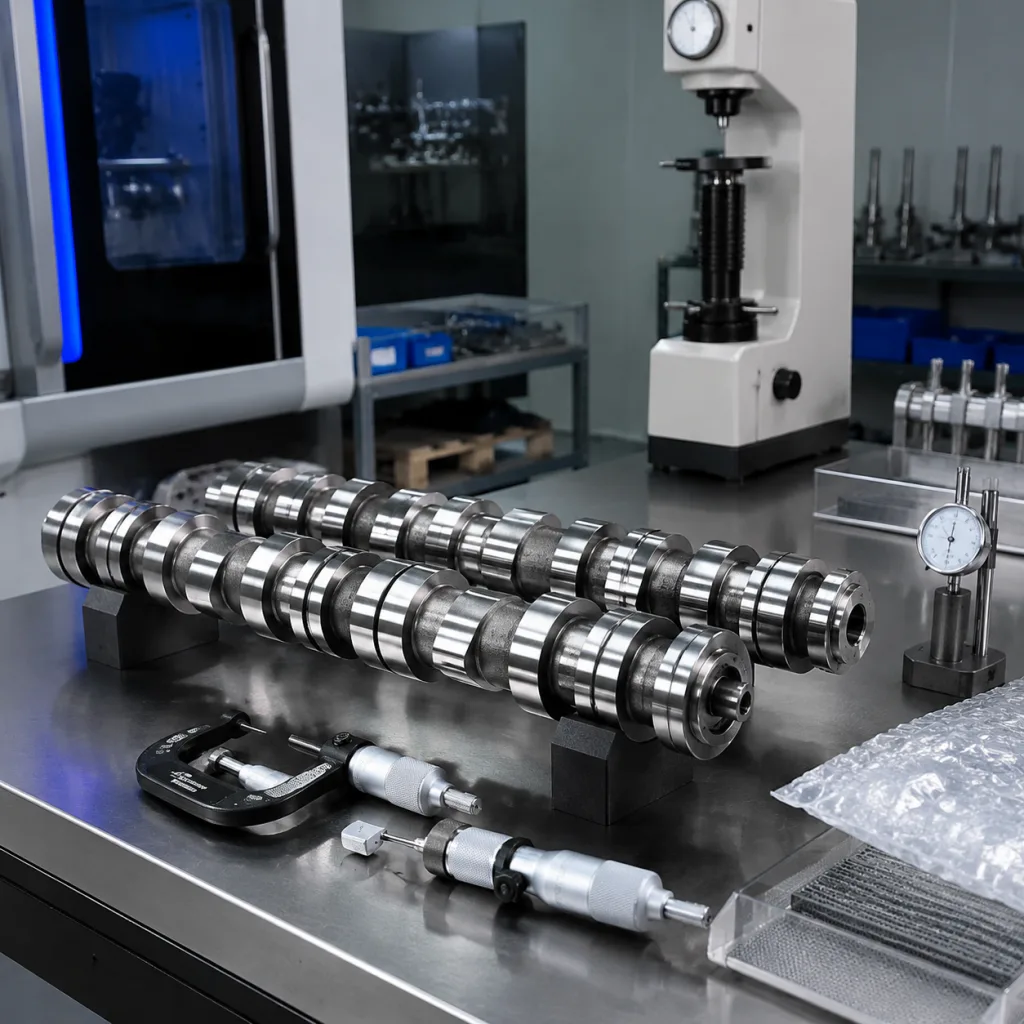
A camshaft for Hyundai i30 OE equivalent only works if the underlying specification matches the original application, not just the visible shape. The critical items are lobe timing, lift, base-circle geometry, journal sizing, thrust control, and any sensor or trigger interfaces used by the engine management system. If one of those differs, the part may still fit physically and still fail in service.
For procurement teams, the first question is whether the part is being matched to the correct engine family. Hyundai i30 programmes can vary by gasoline or diesel engine, intake or exhaust position, emissions package, and model year. A supplier should identify the engine code and OE reference before quoting. The sourcing record should also capture journal diameters, shaft length, lobe lift, centerline, sprocket offset, and end-treatment details.
A useful rule: do not accept “OE-equivalent” as a marketing claim without drawing control, measured tolerances, and repeatable production records. For many aftermarket programs, critical journal tolerances may sit around ±0.01 to ±0.03 mm, but the buyer should always follow the controlled drawing for that exact part. If you need adjacent engine components for the same build, our catalog helps align related valvetrain and sealing parts.
Common fitment traps on Hyundai i30 applications
Most sourcing mistakes happen when buyers assume the Hyundai i30 name alone is enough to confirm interchangeability. It is not. The correct camshaft can change with engine code, cam position, transmission or emissions variant, and the presence of variable valve timing or other valvetrain features.
Before approving supply, compare the removed part, the OE number, and the vehicle build data. Verify the bearing-journal count, overall length, end-treatment, sprocket interface, trigger wheel or reluctor features, and any sensor phasing requirements. Also confirm whether the drive interface is keyed, doweled, or press-fit. That detail is easy to miss and can stop assembly even when the shaft dimensions look correct.
Incoming inspection should not be limited to a visual check. A practical minimum includes bore and journal measurement, total indicated runout, end play, lobe height, and inspection of oil passages and surface finish. For higher-risk programs, ask for first-article verification on all critical dimensions, then lot sampling on repeat orders. If idle stability or NVH matters, request the acceptance method and gauge resolution before release. For buyers comparing adjacent parts, our engine-components page helps keep the camshaft aligned with other replacement items.
What makes a camshaft durable in service?
The base material and machining route determine whether an OE-equivalent camshaft can survive the real duty cycle. The blank may be forged, cast, or chilled-cast, but it needs a grade that fits the load path and wear target. Lobe surfaces often require induction hardening, nitriding, or another controlled finish to hold profile stability over the service interval. Journals, lobe contours, and end faces should be machined for concentricity and surface roughness that stay stable under load.
Buyers should ask for the material grade, heat-treatment route, and hardness target. On many programs, a hardened lobe surface in the 50–60 HRC range is a useful benchmark, but only when it matches the drawing. Validation should include dimensional inspection data and hardness or case-depth evidence where applicable. Runout, lobe lift, and profile consistency matter most on modern engines with tighter emissions and performance windows.
Packaging is part of durability in the field, because damage often starts after the part leaves production. Anti-corrosion protection, clear part-number labels, and traceable lot coding reduce warehouse mix-ups and installation errors. A shipment file should show the lot number, production date, quantity per carton, and barcode format. If a project needs a non-standard lobe profile or coating, Driventus can support custom manufacturing for programmed applications and private-label supply.
How to compare suppliers without getting fooled by price
Price matters, but it rarely tells the whole story. A credible supplier should be able to show process discipline, inspection records, traceability, and a clear path for nonconformities. Certifications such as IATF 16949:2016 and ISO 9001:2015 help, yet they matter most when backed by actual sampling plans, corrective-action procedures, and lot-level traceability.
Compare batch consistency, not just samples. Small changes in lobe geometry or journal finish can create noise, wear, or timing issues even when the part looks correct on arrival. That makes supplier qualification important for importers, wholesalers, and workshop chains that need stable replenishment. Ask for drawings, inspection reports, and a clear statement of the exact reference being quoted.
Commercially, split the quotation into piece price, tooling or validation charges if any, packaging cost, and freight terms. Compare landed cost, not only unit price. Many B2B programs use staged MOQ logic: a trial run may start at 20–50 units, then move to 100–200 units for replenishment, with better pricing at 500 units and above depending on finish and packaging. Lead time should also be broken into sample time, production time, and shipping time. If the supplier cannot say whether inspection, corrosion protection, and carton labeling are included, the quote is incomplete. Buyers reviewing compliance controls can also review our quality system before issuing a trial order.
What to send in an RFQ so quoting is accurate
The fastest way to reduce errors is to send complete application data, not a partial description. At minimum, include the vehicle model, engine code, OE part number if available, camshaft position, quantity target, market or region, and photos or measurements from the removed part. If the request is for long-term supply, add packaging expectations, label format, and annual forecast volume.
A stronger RFQ also states the tolerance basis if known, target hardness if the drawing calls for it, and the inspection documents needed for approval. Tell the supplier whether the order needs bulk cartons, retail packaging, or private-label printed boxes. For price comparison, ask for both ex-works and delivered pricing where possible, and request the MOQ by SKU. It also helps to confirm whether sample sets are chargeable, whether mixed-color cartons are allowed, and whether the requirement is standard OE-equivalent supply, a matched replacement for a specific engine code, or a custom private-label build.
For cross-border orders, specify whether the shipment is for workshop bulk supply, retail packaging, or export consolidation, because those choices affect carton configuration and pallet planning. If you are ready to move from sample review to production supply, use request a quote and attach your technical references.
Frequently asked questions
No. OE-equivalent means the part matches the functional and dimensional requirements of the original application. It does not mean vehicle-maker approval or endorsement.
Send the engine code, OE number if available, intake or exhaust position, order quantity, and any photos or dimensions from the removed part. That reduces fitment risk.
Yes. Driventus supports custom manufacturing for defined specifications, subject to drawing review, volume discussion, and validation requirements.
If you need an OE-equivalent camshaft supply for Hyundai i30 applications, send your part details and target volume through /contact.html.
Request a Quote