engine mount · 2026-05-27

Engine Mount Chevrolet Manufacturer China: Sourcing Guide

For buyers searching for an engine mount Chevrolet manufacturer China, the real screening criteria are fitment accuracy, rubber compound stability, bracket weld quality, and repeatable compression set performance. Driventus supplies engine mounts for aftermarket and OEM-aligned programmes from Taizhou, Zhejiang, with production controls built around IATF 16949:2016 and ISO 9001:2015. Driventus is an independent aftermarket manufacturer; brand names are referenced for fitment only. That matters for procurement teams that need supplier documentation, not consumer-grade claims. A mount that looks correct on paper can still fail in service if the hardness is off, the void geometry is wrong, or the steel insert shifts during moulding. This article explains what to verify before placing a purchase order, how to compare suppliers on objective criteria, and which quality records should be requested when sourcing parts for distributors, repair chains, or OE-adjacent programmes.

What buyers should verify first

An engine mount is a structural and vibration-control component. For Chevrolet applications, the first question is not price; it is whether the part matches the vehicle platform, engine code, transmission layout, and mounting direction.

A sourcing file should confirm:

  • Bracket geometry and hole centre distances against the approved drawing
  • Rubber hardness, usually specified in Shore A, with a defined tolerance band
  • Metal substrate thickness and coating type for corrosion resistance
  • Bond line quality between rubber and steel
  • Static load and dynamic deflection targets under heat and oil exposure

If the application is for aftermarket distribution, ask for fitment notes, vehicle coverage, and photo evidence from dimensional inspection. If it is for a repair chain, ask whether the part can be supplied as a complete left/right kit or as a single position unit. These details prevent catalogue mismatches and reduce returns.

Materials and build details that affect service life

Engine mounts are typically built from a steel bracket, an elastomer element, and in some cases a hydraulic or fluid-filled chamber. The material mix determines idle vibration isolation, durability, and resistance to oil contamination.

Typical specification points

</tr></thead><tbody> </tbody></table>For buyers comparing suppliers, this table is more useful than a generic product description. A lower quoted price is often the result of looser compound control, thinner steel, or weaker corrosion protection. Those trade-offs usually appear later as noise, vibration, and premature separation.

Quality records and validation tests

A procurement review should ask for evidence, not assurances. For programmes with higher risk or higher volume, request a PPAP-style submission pack or a defined document set that includes dimensional reports, incoming material records, and process control records.

Relevant standards and references may include:

  • IATF 16949:2016 for automotive quality management
  • ISO 9001:2015 for documented quality processes
  • REACH (EC) No 1907/2006 for chemical compliance in the EU
  • SAE J2527 for weathering methods used on adjacent elastomer validation plans when specified by the buyer
  • ECE R-83 where a customer programme also requires broader vehicle-level documentation

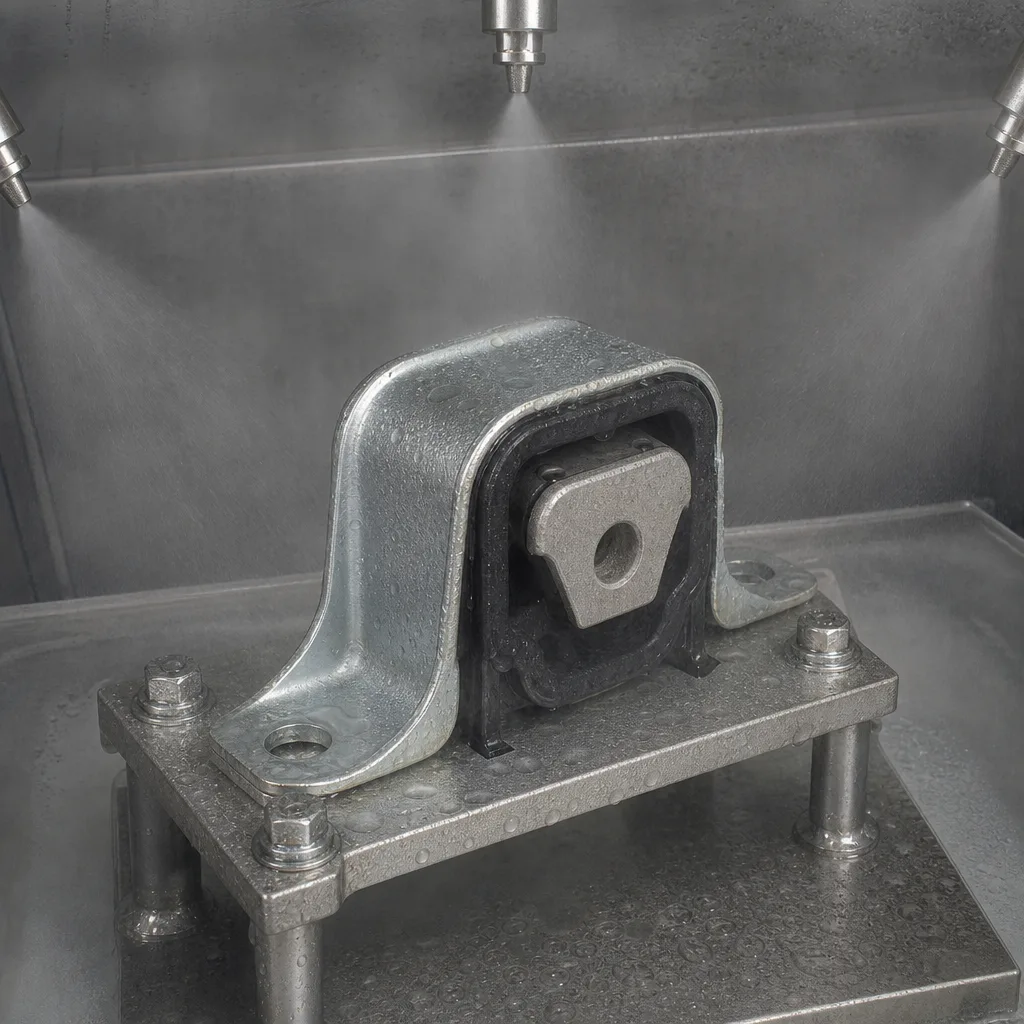
Test evidence should cover heat ageing, compression set, static load, fatigue cycling, and, where relevant, oil splash resistance. For mounts with hydraulic features, buyers should also request leakage and cavity integrity checks. If a supplier cannot define test conditions, sample size, or acceptance criteria, the validation is not procurement-ready.

Commercial terms that matter in sourcing

When evaluating an engine mount Chevrolet manufacturer China, the commercial discussion should be as structured as the technical review. Ask for MOQ by part number, lead time by tooling status, and the packaging standard used for export cartons or palletisation.

Common sourcing questions include:

  • What is the MOQ for a new part and for a repeat order?
  • Can the factory support mixed-line exports across multiple Chevrolet applications?
  • Is tool ownership transferred or shared under contract?
  • What is the normal production lead time after sample approval?
  • What inspection report is supplied with each batch?

For buyers who need broader programme support, review our catalog, the quality system, and custom manufacturing. If your sourcing scope extends beyond mounts into adjacent engine parts, the broader engine components range can reduce vendor count and simplify consolidation. For pricing and schedule discussion, request a quote.

How to shortlist a supplier

A disciplined shortlist should separate manufacturers from traders and then compare manufacturers on the same basis. The goal is not to find the cheapest quote; it is to find the supplier that can hold tolerances at volume.

Use this sequence:

1. Confirm the supplier is the actual manufacturer, with in-house moulding, pressing, bonding, and inspection capability. 2. Review inspection records for at least one current engine mount programme. 3. Check whether the supplier can support revision-controlled drawings and sample approval. 4. Verify export experience for your target market, including EU, UK, US, Canada, Australia, or Brazil documentation needs. 5. Compare packaging durability, labelling accuracy, and carton traceability.

For a Chevrolet programme, the best supplier is usually the one that can show stable dimensions across production lots, not the one that only offers a low initial sample price. That is particularly important for fleets and repair networks, where noise complaints and warranty returns carry direct cost.

Frequently asked questions

Yes. We support private label and customer-specific packaging, subject to agreed artwork, carton rules, and market compliance requirements.

Typical documents include dimensional reports, material declarations, inspection records, sample approval data, and compliance statements aligned with the target market.

Yes. Our OEM and aftermarket engineering teams can support custom manufacturing when the drawing, target load, and vehicle fitment requirements are defined.

If you are comparing suppliers or building a new sourcing file, share your part drawings, annual volume, and target market requirements. Start here: /contact.html

Request a Quote
Item What to request Why it matters
Rubber compoundEPDM, NR, or compound declarationControls heat, ozone, and oil resistance
HardnessShore A target with toleranceAffects engine movement and cabin vibration
Metal partSteel grade and coatingInfluences corrosion and weld integrity
BondingAdhesive system and cure processPrevents rubber-metal separation
Dimensional controlCritical dimensions with inspection methodEnsures OE-equivalent fitment