Engine Mount BMW Supplier Sourcing Guide
Choosing an engine mount BMW supplier is not a catalog exercise. It is a risk-control decision covering fitment, rubber chemistry, bonding, export packing, traceability, and reorder stability. A mount that looks correct on a bench can still fail through bracket drift, hardness variation, poor heat-ageing performance, hydraulic leakage, weak rubber-to-metal adhesion, or carton damage during sea freight. Driventus manufactures engine and powertrain components in Taizhou, Zhejiang, and supplies B2B customers in more than 60 countries. BMW-fitment engine mounts can be sourced from existing aftermarket coverage or developed from customer drawings, physical samples, 3D data, or OE cross-reference requirements. Driventus is an independent aftermarket manufacturer; brand names are referenced for fitment only. Use this guide to define the part, challenge supplier claims, compare quotations, and lock the documentation before issuing a production order.
Start With the Buying Decision, Not the Part Number
A BMW-fitment engine mount RFQ should begin with the commercial and technical decision you need to make: buy an existing aftermarket item, adapt an available mould, or develop a new part. That choice controls cost, MOQ, validation time, and launch risk.
The specification still needs application data, but a vehicle model list is not enough. Engine mounts combine elastomer behaviour, metal forming accuracy, coating, adhesive control, curing discipline, and final assembly. The buyer should define what must be controlled and what can follow the supplier’s existing standard.
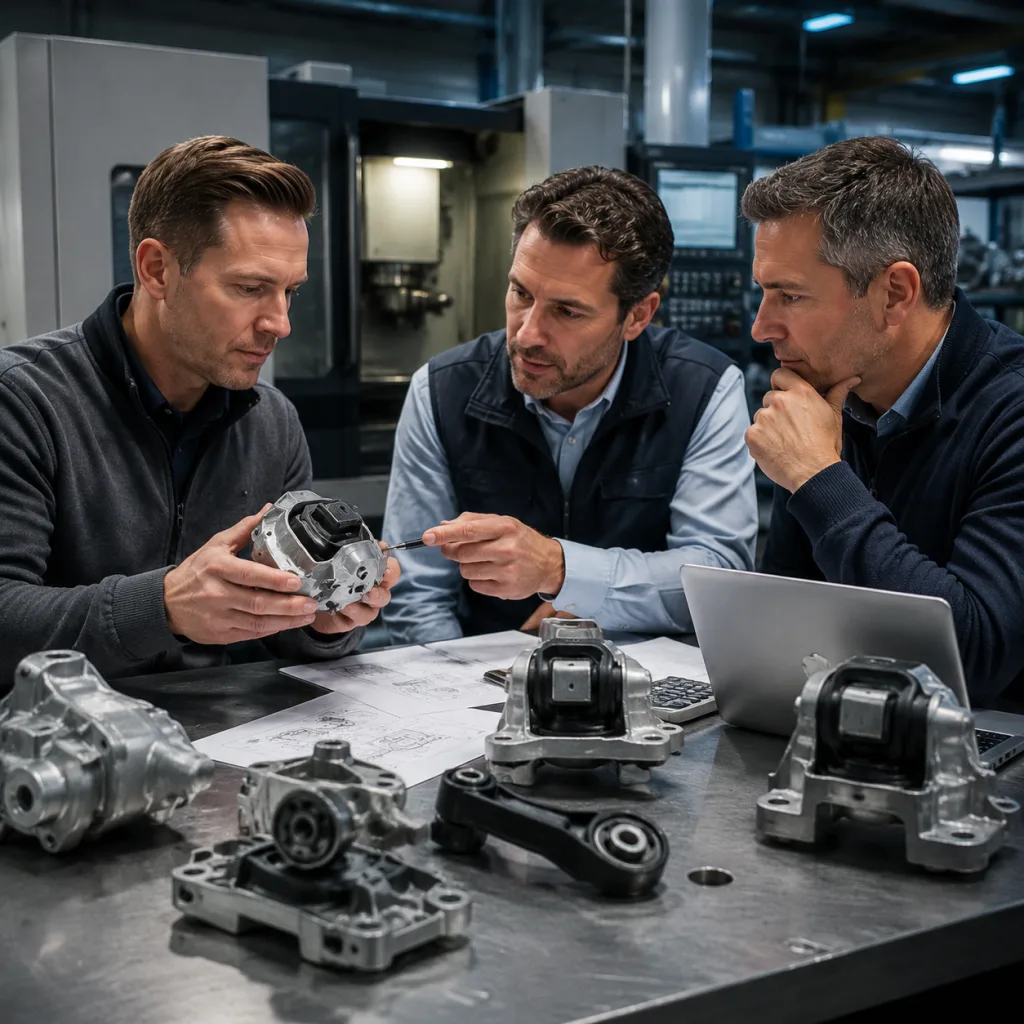
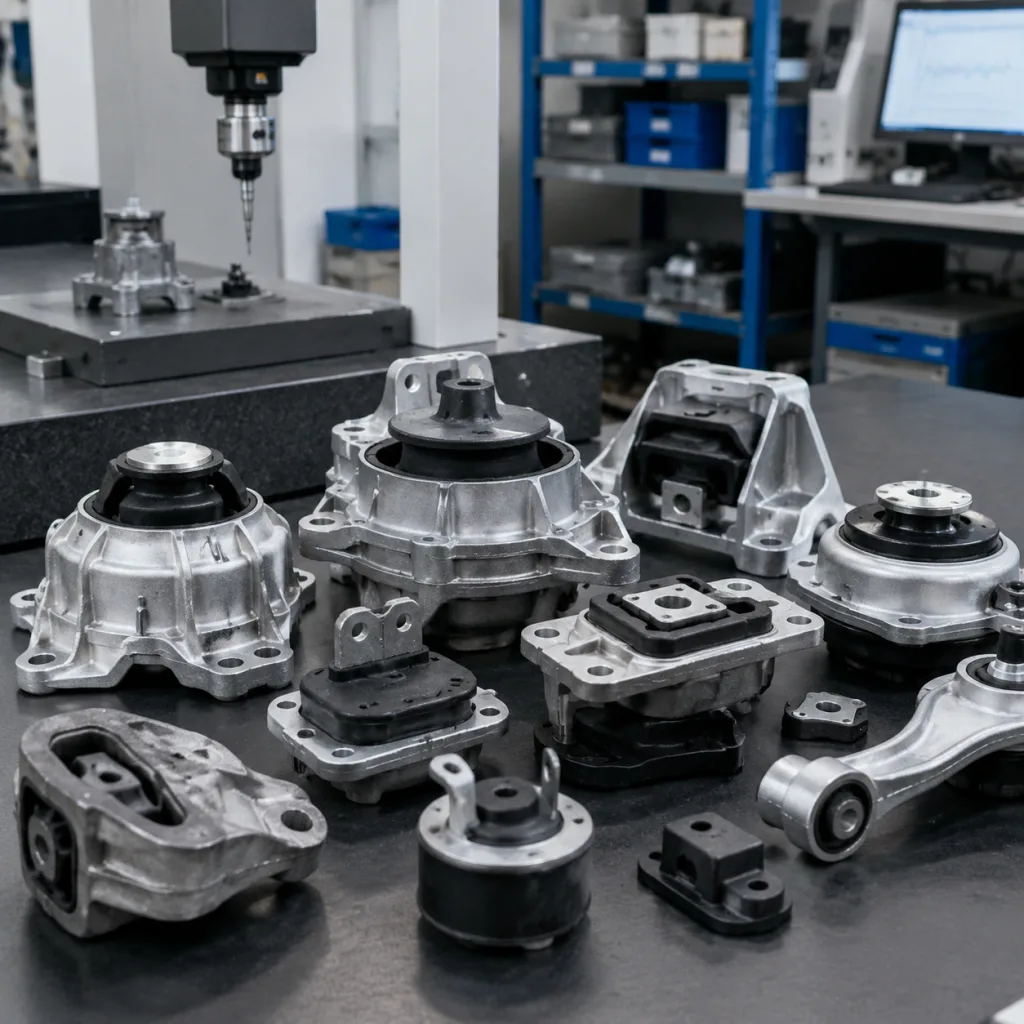
For BMW-fitment programmes, common categories include hydraulic mounts, conventional rubber-metal mounts, transmission mounts, and torque strut mounts. Hydraulic mounts raise the validation burden because leakage, fill volume, damping, and crimping consistency matter. Solid rubber-metal mounts depend more heavily on compound stability, cure control, geometry, and bond strength.
Build the RFQ around these decisions:
- Fitment boundary: Target application range, engine code, chassis code, left/right position, transmission type, and OE part-number cross-references where available.
- Data source: Sample, drawing, 3D scan, or bracket datum scheme covering stud position, sleeve location, installation height, and inspection references.
- Critical dimensions: Stud centre distance, sleeve ID/OD, bracket flatness, installed height, thread specification, and functional tolerances rather than visual matching only.
- Rubber target: Shore A hardness range, agreed tolerance such as ±5 Shore A, test standard, sample location, and conditioning time.
- Functional targets: Static load, allowable deflection, compression set, heat-ageing condition, oil resistance, and hydraulic leakage criteria where applicable.
- Metal and coating: Zinc plating, electrophoretic coating, phosphate treatment, or powder coating, including thickness and corrosion targets when required.
- Commercial frame: Annual forecast, first order quantity, repeat-order expectation, launch schedule, target unit-price band, Incoterms, and destination market.
- Packing and labelling: Carton strength, inner protection, pallet specification, barcode rules, and neutral, private-label, or customer-branded packaging.
- Quality documents: Required certificates, inspection reports, material declarations, and compliance files, including IATF 16949:2016 and ISO 9001:2015 certificates where applicable.
Buyers can review our catalog to check existing engine mount coverage before requesting tooling, private-label packaging, or a customer-specific development project.
Where BMW-Fitment Mount Programmes Usually Fail
Most sourcing failures are not caused by one dramatic mistake. They come from weak control at one process step that later appears as vibration, poor fitment, rust, leakage, or a warranty claim. A capable engine mount BMW supplier should be able to trace compound preparation, metal preparation, moulding, bonding, curing, inspection, packing, and lot release.
| Failure point | What to verify | Procurement risk if missed | |
|---|---|---|---|
| Rubber compounding | Batch card, formulation lock, weighing tolerance, Mooney or rheometer data, Shore A checks | NVH variation, early cracking, and inconsistent service life | |
| Metal preparation | Degreasing, shot blasting, surface roughness, coating thickness, corrosion checks | Poor adhesion, rust, and premature separation | |
| Adhesive system | Primer/topcoat batch, viscosity or solids control, spray coverage, flash-off time, oven condition | Rubber-to-metal separation under load | |
| Moulding process | Mould temperature, injection or compression pressure, cure time, demould timing, mould maintenance | Dimensional drift, porosity, and weak rubber strength | |
| Hydraulic filling | Fluid batch, fill volume, crimping condition, vacuum or pressure leak test | Leakage, damping variation, and early customer returns | |
| Inspection | Gauge calibration, go/no-go fixtures, CMM records where needed, load-deflection fixture | Fitment complaints, installation delays, and returns | |
| Traceability | Lot code, operator record, inspection report, material batch link, pallet and carton ID | Slow containment after a field issue |
| Project type | Tooling need | Common MOQ logic | Lead-time considerations |
|---|---|---|---|
| Existing aftermarket item | No new tooling | Trial MOQ often negotiated by SKU or mixed shipment value; repeat price improves when cartons, labels, and inspection are standardised | Sample 7-15 days if stock is available; production commonly 30-45 days after deposit and artwork approval |
| Existing mould with compound or packaging change | Minor setup only | MOQ driven by compound batch, private-label carton run, barcode label roll, and packing labour | Add 7-14 days for label, carton, and sample confirmation before mass packing |
| New mount from sample or drawing | New moulds, gauges, and fixtures | MOQ linked to tooling amortisation, cavity count, metal part MOQ, and validation cost | Tooling and first samples commonly require 45-75 days, with bulk production after approval |
| Private-label range programme | Mixed | MOQ may be set by SKU family, launch phase, shipment value, or container utilisation | Requires phased SKU rollout, master label approval, carton print control, and claims workflow setup |
| Quotation item | Why it matters | What to ask |
|---|---|---|
| Unit price basis | Prevents hidden cost and incorrect landed-cost comparison | FOB, EXW, CIF, DAP, or DDP terms, currency, validity period, and price breaks |
| MOQ by SKU | Affects inventory exposure and range-planning flexibility | Trial order, repeat order, mixed-container quantities, and surcharge below economic batch |
| Tooling ownership | Controls long-term sourcing rights and supplier continuity | Ownership, maintenance, replacement, storage terms, and exclusivity |
| Validation scope | Reduces field complaints and launch risk | Which dimensional, hardness, bond, leakage, corrosion, and load tests are included |
| Packaging | Affects landed damage rate and channel presentation | Neutral, private-label, customer carton, bulk packing, barcode, pallet, and drop-protection options |
| Lead time | Controls launch planning and reorder reliability | Sample, first order, repeat order, artwork approval, holiday, and peak-season timing |
| Payment and cash flow | Determines true working-capital cost | Deposit ratio, balance timing, tooling payment, sample credit, and credit terms |
| Claim handling | Protects distributor margin and customer confidence | Evidence process, response time, credit terms, replacement policy, and disposal rules |