A Volkswagen-compatible engine block programme can fail long before the first container leaves China. The usual cause is not the casting price; it is an unclear specification, weak fitment control, missing dimensional proof, or a supplier that cannot repeat the approved sample. Buyers evaluating an engine block Volkswagen manufacturer China partner should therefore treat sourcing as a release process, not a catalogue purchase. Driventus is an independent aftermarket manufacturer; Volkswagen and related brand names are used only to identify vehicle fitment and application references. For buyers in the EU, UK, US, Canada, Australia, Brazil, and other export markets, the central test is simple: can the supplier hold bore geometry, maintain lot traceability, control changes, pack the part for export, and prove conformity before shipment? This guide reframes the sourcing work into five practical views: supplier-scope decisions, technical failure modes, quality evidence, commercial risk, and an RFQ pack that lets procurement compare offers on the same basis.
Start with the supply decision: casting, semi-finished, or fully machined block?
The first decision is not price. It is scope. A supplier may offer a raw casting, a semi-finished block with datum faces and rough bores prepared, or a fully machined unit with plugs, dowels, washing, testing, and export packing. Each option moves risk to a different point in the supply chain.
For aftermarket distributors, the strongest option is often a fully machined, export-packed component with stable part numbering and controlled cross-references. It reduces local processing work and limits warehouse confusion. For remanufacturers or engineering-led buyers, a semi-finished block may be more useful if final machining, honing, or assembly checks are done locally. Bare castings make sense only when the buyer has machining capacity, fixtures, datum strategy, and inspection capability.
See our catalog for the broader range of engine and powertrain parts, or review engine components if you are building a mixed programme.
Use this decision frame before requesting a quotation:
Bare casting: lower initial component scope, but the buyer must control machining allowance, datums, heat treatment or stress relief where required, and final dimensional release.
Semi-finished block: useful when the supplier controls major casting risk and rough machining, while the buyer keeps final bores, decks, and critical faces under local control.
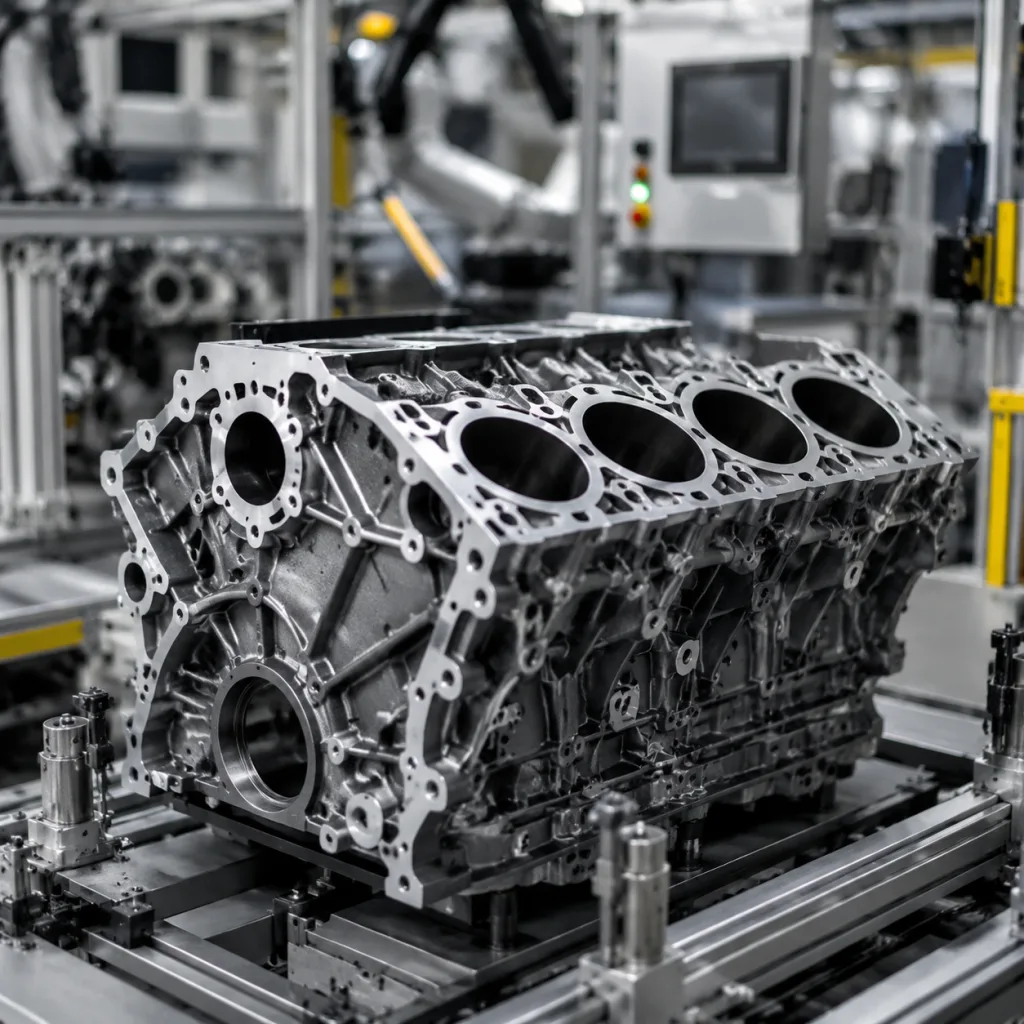
Fully machined block: best for distribution and service-part programmes if the supplier can provide inspection records, washing, pressure testing where required, rust prevention, and export packaging.
Tested finished part: needed when the purchasing organisation wants leak-test data, critical measurement results, certificates, and packing evidence before shipment.
Whether liners, main caps, plugs, dowels, oil-gallery machining, washing, pressure testing, and surface finishing are included
Which inspection data is released with samples and production lots, such as CMM reports, bore measurements, leak-test records, and material certificates
How tooling ownership, pattern maintenance, fixture control, packaging, and rolling forecasts are handled
Which export documents, markings, pallet sizes, carton labels, and packing standards can be supported
Fitment discipline is the safeguard. Volkswagen-compatible catalogue references can be misread if they are not tied to the correct engine code, displacement, model year, transmission combination, and regional application. Work from OE reference numbers, buyer drawings, sample comparison, or an agreed cross-reference file. Then freeze the released specification with revision level and date. Product descriptions should be built from measurable application data, not broad claims.
Where engine blocks go wrong: material, machining, and measurement failure modes
Engine block defects are expensive because many are found late: during assembly, pressure testing, installation, or field use. A useful technical review therefore starts with failure modes, not a generic material list. Ask what can move, leak, wear, crack, distort, or fail to seal.
Block family
Typical material
Common application
Main technical risks to control
Cast iron block
Grey cast iron such as HT250/HT300 or equivalent
Higher-load petrol and diesel programmes
Bore wear, casting cracks, porosity, mass variation, machining distortion
Aluminium block with liners
Aluminium alloy such as ADC12/A356 equivalent with cast-in or fitted iron liners
</tr></thead><tbody> </tbody></table>### Critical control points
Cylinder bore diameter, taper, roundness, straightness, and surface finish; buyer-controlled features may require micron-level gauging when the drawing specifies it
Main bearing tunnel alignment, housing bore size, cap register fit, and line-bore consistency
Deck flatness, roughness, and gasket sealing condition; these should be measured against limits, not judged by eye
Coolant jacket and oil-gallery pressure integrity, commonly checked with air-under-water or dry leak equipment according to the drawing or buyer test plan
Thread quality for head bolts, brackets, mounts, sensors, and ancillary fixings, including go/no-go thread gauge records
Position accuracy of dowels, sensors, oil passages, and mounting faces, verified from the agreed datums
Cleanliness after machining, including swarf, casting sand, burrs, and residual oil control before export packing
A pass/fail note is not enough. The released drawing or agreed specification should define tolerances, and the inspection report should show actual measured values. Expect CMM checks for datum holes and critical locations, air or dial bore gauging for cylinder geometry, surface roughness readings where sealing is critical, and leak or pressure testing when the design requires it.
For machined aluminium blocks with liners, ask how liner position, protrusion or flushness, interference, and retention are verified after machining and thermal exposure. For iron or CGI blocks, focus on casting soundness, stress relief where required, machining distortion, and tool-wear effects over longer runs. A real control plan identifies inspection frequency, gauge ID, calibration due date, reaction plan, and the authority responsible for releasing parts after an out-of-tolerance finding.
Evidence beats certification: what quality files should prove
IATF and ISO certification are useful, but they do not prove that a specific lot of engine blocks is acceptable. The quality file does. Driventus operates to IATF 16949:2016 and ISO 9001:2015, supporting process control, documented inspection, corrective action, and continual improvement within the production flow. Buyer-side validation still matters, especially when a part will remain active in a catalogue for years.
Review the full quality system before you approve a new source.
Relevant standards and compliance points may include:
IATF 16949:2016 for automotive quality management, process control, risk review, and corrective action
ISO 9001:2015 for general quality management requirements and document control
REACH (EC) No 1907/2006 for EU chemical compliance where substances in the supply chain are relevant
EN 10204 3.1 material certificates when material traceability is required
Customer-specific inspection plans, ISIR, or PPAP-style submissions when requested by the buying organisation
The production file should answer four questions. What material was used? Which casting and machining lots were involved? What was measured? What happened when something was outside tolerance?
A strong file normally includes lot traceability from melt or casting batch to machining batch, incoming material control, hardness or chemistry checks where specified, gauge calibration status, first-article approval, in-process inspection records, final inspection data, leak-test records, and non-conformance handling. It should also show how engineering changes are reviewed, approved, and communicated before production continues. That includes pattern repairs, material substitutions, fixture changes, revised machining programs, and packaging changes.
If your programme uses sampling plans, define acceptance rules in the RFQ. State whether every block needs leak testing, whether critical bores require 100% measurement, and whether cosmetic casting defects are judged by a visual standard or by maximum size and location. If PPAP-style documentation is required, specify the submission level, sample quantity, dimensional layout expectations, material test reports, capability studies, and retained master sample requirements at the quoting stage. Do not leave documentation scope until samples are ready; it affects cost, timing, and internal release.
Commercial risk map: MOQ, lead-time, tooling, and audit checks
The cheapest quotation often hides the most risk. MOQ, lead-time, tooling status, included parts, and inspection scope shape the real landed cost. Sourcing from China works best when the demand plan is realistic and the technical scope is fixed early.
MOQ depends on the casting family, material, mould or pattern availability, machining fixture reuse, and whether the part is already in series production. For existing Volkswagen-compatible service parts, a trial order may be practical at 20–50 pieces for fully machined blocks. Stable production pricing often starts around 100–300 pieces, depending on weight, machining hours, and packing density. New casting or new machining variants usually require higher commitment because pattern work, fixtures, trial casting, machining validation, sample approval, and dimensional confirmation must be amortised.
Ask these questions before comparing prices:
Is this a repeat build, a revived service part, or a new development programme?
Are we buying from existing tooling or investing in new tooling, and who owns the pattern, core box, and machining fixtures?
What is the expected annual volume, order frequency, and call-off pattern?
Can the supplier support safety stock, scheduled releases, or container consolidation?
Which lead-time applies to samples, pilot lots, and regular production?
What is the transit plan for sea freight, air freight, or consolidated shipment?
Request lead-time logic in writing. Existing-tooling samples may take 25–45 days if casting inventory or fixture capacity is available. New-tooling samples commonly require 60–90 days, sometimes longer if the first casting trial exposes porosity, core shift, or machining allowance problems. After approval, repeat production is often planned at 35–60 days, plus sea freight of about 25–40 days to many EU, UK, US, or Australian ports.
Price is usually driven by casting weight, alloy or iron grade, yield loss, CNC machining cycle time, liner and plug content, 100% testing requirements, documentation level, packaging method, and order quantity. A low unit price that excludes pressure testing, plugs, dowels, certificates, or export crates is not comparable to a complete finished-part quotation.
A factory audit should follow the manufacturing route, not the showroom. Review foundry process, melt control, sand or core control, heat treatment or stress relief where applicable, machining line capacity, fixture condition, gauge management, calibration records, incoming material storage, washing process, rust prevention, and export packing controls. For machined blocks, check how non-conforming castings are segregated before more value is added, and whether rework is authorised, recorded, and re-inspected.
If suppliers are being compared, force the same quote structure: casting only, semi-finished block, fully machined block, tested assembly, or fully packaged finished part. The quote should state whether plugs, liners, caps, dowels, certificates, inspection reports, wooden pallets or cartons, desiccant, VCI protection, and export packaging are included.
For buyer-led development, custom manufacturing is most efficient when drawings, target volumes, application references, and inspection requirements are defined before the first sample run.
Build the RFQ pack: a step-by-step checklist procurement can actually use
A strong RFQ prevents mismatched samples and weak quotations. It also makes internal approval faster because engineering, quality, purchasing, and logistics are reviewing the same assumptions. Use the sequence below when sourcing Volkswagen-compatible applications from a Chinese manufacturer.
1. Define the application. Include engine family, engine code if available, displacement, fuel type, aspiration type, model-year range, and target market or regional application if fitment differs by market. 2. Lock the reference basis. Provide OE reference, sample photos, 3D data, 2D drawing, or an approved cross-reference file. State that brand references are for fitment identification only unless they are part of an agreed cross-reference document. 3. State the manufacturing scope. Specify bare casting, semi-finished block, or fully machined block. Identify whether plugs, liners, caps, dowels, washing, pressure testing, and packing are included. 4. Define material and process requirements. Include material grade, liner specification, hardness range, heat treatment if applicable, and any restricted substances or compliance declarations. 5. List critical dimensions. Call out bore, deck, main tunnel, mounting face, oil passage, dowel, and thread tolerances from the released drawing. 6. Specify inspection and testing. Define CMM points, bore gauge method, roughness readings, thread-gauge checks, and pressure-test method for coolant jackets or oil galleries, including pressure, hold time, and acceptance limit where available. 7. Request traceability and documents. State material certificate format, lot traceability requirement, part marking, carton marking, pallet marking, inspection report format, and any customer-specific requirements. 8. Control sampling. Confirm sample quantity, approval timeline, retained sample requirement, and documentation package required. 9. Set logistics rules. Define packaging standard, rust prevention, pallet height, carton marking, barcode, export labelling, incoterms, and preferred delivery terms. 10. Give the volume picture. Provide forecast volume, MOQ target, annual call-off profile, and expected order frequency.
If one supplier will support multiple engine programmes, ask for a cross-reference matrix linking engine family, application, machining scope, revision level, sample status, PPAP or approval status, and part availability. Also require a documented change-control process. This is critical for distributors, remanufacturers, and multi-location repair chains that need stable availability rather than one-off purchases.
When the technical package is complete, quote comparison becomes more accurate. You are no longer choosing only by unit price. You are comparing material, machining, inspection, testing, documentation, packaging, MOQ, and lead-time on equal terms. That is the practical way to choose an engine block Volkswagen manufacturer China partner for total supply reliability.
Frequently asked questions
Verify the exact engine family or engine code, material grade, machining scope, dimensional tolerances, inspection method, pressure-test requirement, packaging standard, and traceability documents. Confirm whether the quote covers a bare casting, semi-finished block, or fully machined and finished supply, including plugs, liners, dowels, certificates, and export packing.
Yes. Custom manufacturing is suitable when drawings, application references, forecast volume, and inspection requirements are available. With that information, tooling, fixture design, sample approval, dimensional reports, and production documentation can be planned before regular manufacturing starts.
Use the same scope for both quotes: material, machining level, included parts, testing, inspection data, certificates, packaging, delivery terms, MOQ, sample timing, and documentation. A lower unit price may not be the better option if another supplier includes traceability, dimensional reports, export-ready packing, or better change control.
If you need a sourcing review, drawing check, or volume-based quotation, [request a quote](/contact.html).