Engine Block Ram Wholesale: Sourcing Guide for Buyers
Engine block ram wholesale buyers usually need three things at once: consistent dimensional control, predictable lead times, and documentation that stands up to supplier approval. For procurement teams, the issue is not finding a low unit price. It is confirming that the casting or machined block meets the bore, deck, and main-bearing requirements needed for the target application, then proving repeatability across production lots. Driventus supplies engine and powertrain components from Taizhou, Zhejiang, with IATF 16949:2016 and ISO 9001:2015 systems in place. We support aftermarket distributors, OEM and Tier-1 programmes, and repair-chain supply. Driventus is an independent aftermarket manufacturer; brand names are referenced for fitment only. This guide explains what wholesale buyers should verify before placing an order, including material grade, machining capability, inspection records, packaging, and documentation for export to the EU, UK, US, Canada, Australia, and Brazil.
What wholesale buyers should define first
For an engine block programme, the first sourcing step is to define the application envelope. Buyers should confirm engine family, fuel type, cylinder count, bore spacing, deck height, main journal layout, and whether the block is supplied as raw casting, semi-machined, or fully machined.
Minimum data set for RFQ:
OE cross-reference, if available, such as OE 06A107065
Material requirement: grey iron, compacted graphite iron, or aluminium alloy
Bore diameter and allowable finish allowance
Deck flatness target and main bore alignment requirement
Oil gallery and coolant passage specification
Surface treatment, if any
Packing standard and export destination
If the request is for a wholesale supply programme, define the annual volume, forecast split by month, and acceptable MOQ. That allows a factory to plan pattern capacity, machine scheduling, and inspection sampling without later changes. For catalogue browsing, start with our catalog.
Material, machining, and dimensional control
Engine block sourcing depends on more than the casting material. A supplier should state what is controlled at each stage: casting chemistry, heat treatment where applicable, rough machining, finish machining, and final inspection.
Typical control points
Control item
What buyers should verify
Why it matters
Material grade
Chemistry and mechanical properties on certificate
Affects strength, thermal stability, and machinability
Bore geometry
Diameter, taper, and out-of-round
Determines ring sealing and oil consumption risk
Deck flatness
Measured across the full deck surface
Reduces head-gasket failure risk
Main bore alignment
Centreline and spacing
Prevents crankshaft load issues
Surface finish
Ra requirement on machined faces
Supports gasket sealing and wear life
Cleanliness
Residual sand, chips, and oil
Impacts assembly quality and warranty risk
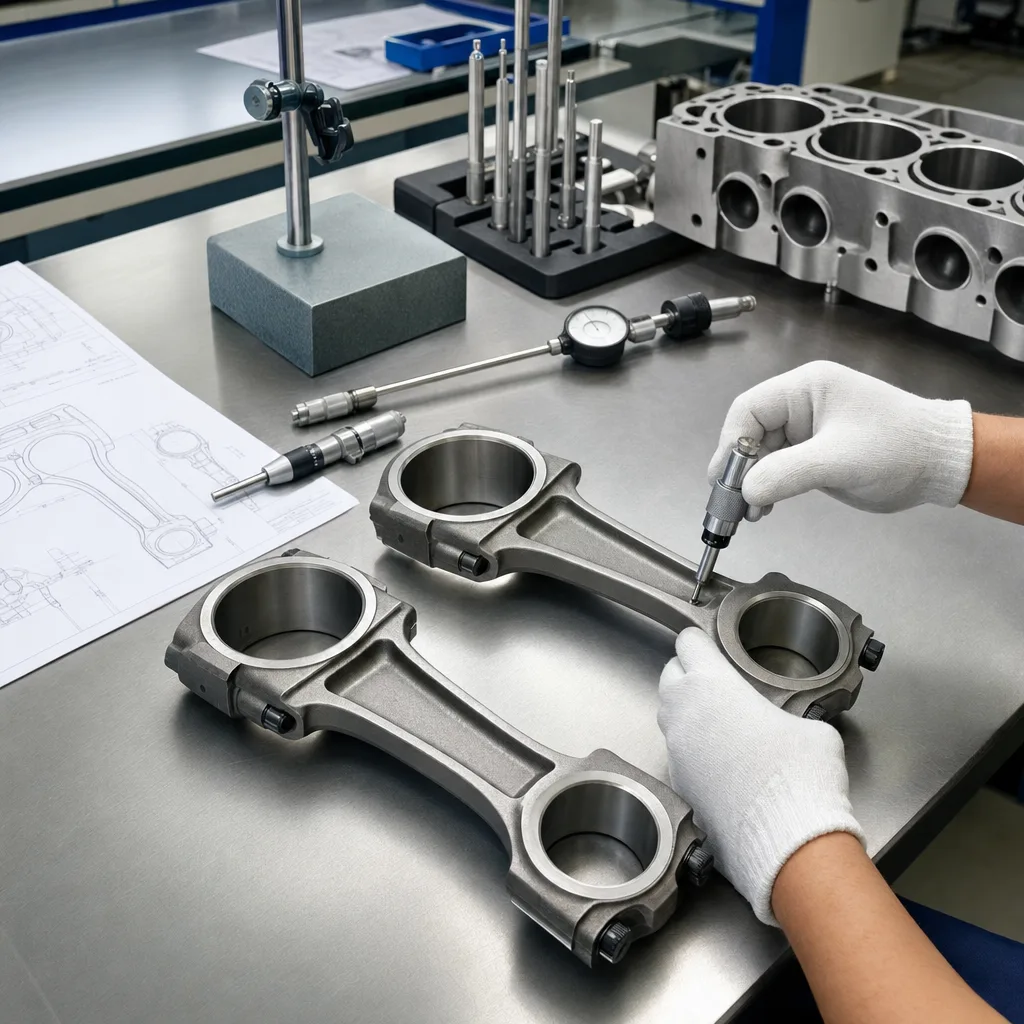
</tr></thead><tbody> </tbody></table>For OEM and Tier-1 supply, dimensional acceptance should be tied to the agreed drawing, PPAP-style submission pack, or customer-specific control plan. A wholesale purchase should not rely on visual inspection alone. Buyers should request first article inspection records, gauge lists, and process capability evidence where available. Our quality system explains the documentation structure used across production.
Certification and export documentation
Procurement teams should ask for evidence that the supplier can support repeat export shipments, not just one-off samples. For engine block programmes, the usual baseline is IATF 16949:2016 and ISO 9001:2015, plus compliant material declarations where required.
Documentation commonly requested by import teams:
Commercial invoice and packing list
Certificate of origin, when applicable
Material test report or chemical analysis report
Dimensional inspection report
Process flow and control plan summary
REACH (EC) No 1907/2006 declaration for EU-bound shipments, when relevant
RoHS or other declaration if the customer specification requires it
A wholesale buyer should also confirm whether the product is supplied for aftermarket distribution, remanufacture, or OEM programme use, because the documentation set may differ. If your purchasing team needs a supplier with both standard products and development support, see custom manufacturing.
MOQ, lead time, and supplier audit expectations
Price per unit is only one variable in a wholesale engine block purchase. MOQ and lead time often determine whether the programme is viable.
Typical commercial questions include:
What is the MOQ by part number or family?
Is tooling already available, or does a new pattern need to be built?
What is the standard lead time for repeat orders?
How is capacity reserved during peak seasons?
What is the corrective action process if an inspection issue is found?
For audit preparation, buyers should ask for factory layout, incoming inspection controls, machining traceability, and final inspection procedures. A supplier should be able to explain how lot identity is maintained from raw material to finished goods. That is important for field claims, warranty analysis, and recall containment.
Driventus supports buyer audits with production records, inspection samples, and export packing controls. For a broader view of related parts, see our engine components page.
How to compare suppliers without overpaying
A fair comparison should separate quote price from total landed cost and from risk. Two suppliers can quote similar unit pricing, but one may include better inspection coverage, tighter packaging, or more stable delivery.
Compare these items side by side: 1. Drawing compliance and revision control 2. Material certification completeness 3. Dimensional inspection frequency 4. Sample approval method 5. Packing specification for sea freight 6. Warranty response time 7. Production traceability by lot
If the application is sensitive, insist on measurement against the drawing rather than verbal confirmation. Ask for bore, deck, and main-bore reports on the same batch. If the buyer is replacing an existing application, reference the OE code only for fitment confirmation, not as endorsement. Driventus is an independent aftermarket manufacturer; brand names are referenced for fitment only.
A wholesale programme should also define acceptable cosmetic variation. Cast surfaces may differ from OEM appearance, but functional dimensions must stay within agreed limits.
What Driventus supplies for wholesale buyers
Driventus manufactures engine and powertrain parts in Taizhou, Zhejiang, with export experience in more than 60 countries. For wholesale buyers, the main value is stable supply backed by controlled manufacturing and documented inspection.
Buyer-facing supply features:
IATF 16949:2016 and ISO 9001:2015 certified systems
Support for aftermarket, OEM, and Tier-1 sourcing channels
Engine and powertrain component manufacturing under one supply base
Technical support for drawing review and fitment confirmation
Export packing and lot traceability for international shipments
For engine block programmes, we can support quotation review, specification alignment, and sampling before mass order release. If you are building a long-term sourcing plan, start with a product review, then lock the drawing revision, target tolerance, and inspection method before first production.
Frequently asked questions
Request the drawing, material specification, dimensional report, inspection plan, MOQ, lead time, and export packing details. If available, ask for lot traceability and certification copies.
Yes, but it should be used for fitment confirmation only. Do not treat cross-reference data as manufacturer approval. Always validate dimensions against the drawing or sample.
IATF 16949:2016 and ISO 9001:2015 are the core quality standards. Depending on destination and customer requirements, REACH (EC) No 1907/2006 and other material declarations may also be needed.
If you need a quotation, drawing review, or sample for a wholesale engine block programme, please [request a quote](/contact.html).